
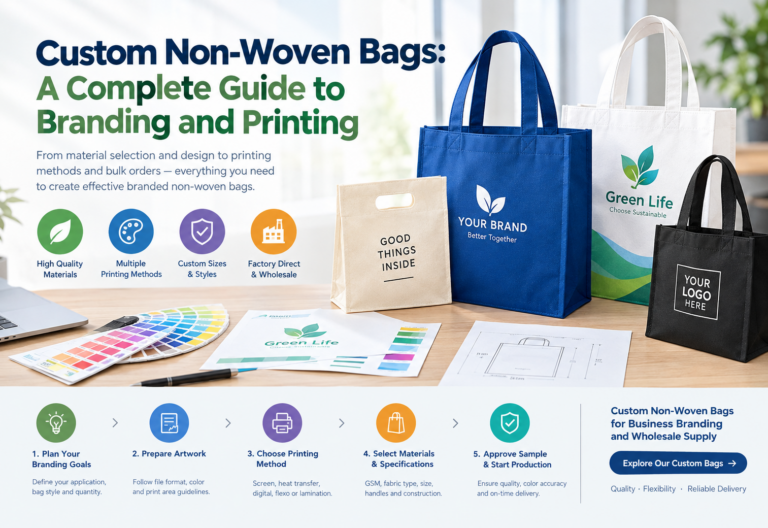

Custom non-woven bags are a practical branding solution for retailers, supermarkets, promotional agencies, trade show organizers, and businesses looking for reusable shopping or promotional bags. With customized logos, brand colors, printed messages, and different bag styles, businesses can turn an everyday carry bag into a mobile brand asset.
However, creating an effective custom non-woven bag involves more than simply printing a logo onto fabric. Material weight, bag construction, printing method, artwork quality, color matching, and order quantity all influence the final result.
For B2B buyers, understanding these factors before placing an order can help control costs, improve brand consistency, and reduce production problems.
This guide explains how to plan, design, print, and source custom non-woven bags for business branding and wholesale projects.
1. What Are Custom Non-Woven Bags?
Custom non-woven bags are bags made from non-woven fabric, commonly polypropylene (PP), that can be customized with a company’s logo, brand colors, promotional message, or other graphic elements.
Unlike woven textiles, non-woven fabric is produced by bonding fibers together rather than weaving yarns into a traditional fabric structure. The result is a versatile material commonly used for shopping bags, promotional totes, retail packaging, and reusable carry bags.
Businesses can customize non-woven bags in several ways:
- Logo printing: Display your company name, logo, or brand symbol.
- Brand colors: Coordinate the bag with your existing visual identity.
- Custom dimensions: Choose a size that suits your products or campaign.
- Bag construction: Select tote bags, box-style bags, gusseted shopping bags, or die-cut handle bags.
- Handle options: Choose suitable handle designs according to appearance, comfort, and intended use.
- Surface finishes: Use standard non-woven fabric or explore laminated options for a smoother appearance.
- Printing coverage: Print on one side, both sides, or larger areas where the construction and production method allow.
These options make custom non-woven bags suitable for both straightforward promotional projects and more developed retail branding programs.
2. Why Use Custom Non-Woven Bags for Business Branding?
The main advantage of a branded bag is that it combines practical use with repeated brand exposure.
Increase brand visibility
A bag featuring a recognizable logo can be carried through shopping districts, offices, exhibitions, campuses, and public spaces. Each use creates another opportunity for people to notice your brand.
For businesses distributing large quantities of bags, a clear and consistent design can help extend the reach of a marketing campaign beyond its original location.
Support retail and promotional campaigns
Custom non-woven bags can serve different business purposes, including:
- Supermarket and grocery shopping
- Retail store packaging
- Trade shows and industry exhibitions
- Corporate events and promotional giveaways
- Product launches and marketing campaigns
- Conferences and employee welcome kits
- Wholesale distribution and branded merchandise
The intended application should guide the bag’s construction, material weight, and print design.
For example, a lightweight event giveaway bag may require a different specification from a structured shopping bag intended for repeated retail use.
Maintain brand consistency
Custom printing allows businesses to apply their visual identity across packaging, promotional materials, and customer-facing accessories.
Using approved logo files, defined brand colors, and consistent artwork placement helps create a recognizable appearance across multiple orders.
For companies with several stores or distribution channels, agreeing on specifications before production can also simplify repeat purchasing.
Balance branding and purchasing costs
Non-woven bags can offer a practical option for bulk promotional and retail programs. The final unit cost depends on factors such as fabric GSM, dimensions, handles, printing method, construction, quantity, and packing requirements.
Rather than choosing the lowest-priced bag automatically, procurement teams should compare the complete specification and determine whether it meets the project’s quality and budget requirements.
3. Choose the Right Non-Woven Bag Style
Before selecting a printing method, decide what type of bag best supports your business application.
Tote bags
Tote-style bags are suitable for retail shopping, promotional campaigns, corporate events, and general brand merchandise. They provide a familiar format with space for a front-facing logo or graphic.
Box-style bags
Box-style bags offer a more structured appearance and can provide useful internal space for products, documents, or promotional materials. They may suit retail stores, gift distribution, and campaigns that require a more defined bag shape.
Gusseted shopping bags
Side or bottom gussets can create additional capacity, depending on the bag’s dimensions and construction. These bags are useful when customers need to carry several products or bulkier items.
Die-cut handle bags
Die-cut handle bags have handles formed directly into the bag panel. They can suit straightforward promotional distribution and shopping applications, subject to the required load capacity and construction.
Foldable promotional bags
Foldable designs can be useful for events, travel-related promotions, and campaigns where compact storage is important.
Buyer tip: Select the bag structure before finalizing your artwork. The usable print area, handle placement, gussets, seams, and folding lines can all affect where the design should appear.
4. Select the Right Material and GSM
GSM means grams per square meter. It describes the weight of the fabric and is one of the factors buyers use when specifying non-woven bags.
A higher GSM generally indicates heavier fabric, but it does not automatically guarantee a stronger finished bag. Dimensions, handle attachment, seams, bottom construction, reinforcement, and manufacturing quality also matter.
Common material-weight ranges used for non-woven bags include:
| Approximate GSM | Potential applications | What buyers should consider |
|---|---|---|
| 60–70 GSM | Lightweight promotional bags and giveaways | Prioritize budget, distribution volume, and intended load |
| 70–80 GSM | General promotional and shopping bags | Balance material use with everyday handling needs |
| 80–100 GSM | More substantial retail and reusable bags | Evaluate bag dimensions, handles, and expected contents |
| 100–120 GSM | Heavier-duty or more structured bag designs | Check construction and actual load requirements |
| Above 120 GSM | Selected projects requiring a heavier material specification | Confirm whether the added material is necessary for the application |
These ranges are general starting points, not universal performance ratings. Actual suitability depends on the fabric, bag design, and manufacturer’s production capabilities.
Standard non-woven versus laminated non-woven
Standard non-woven fabric has a relatively textured surface and a straightforward fabric appearance. It can work well for simple logos and promotional graphics.
Laminated non-woven material has an additional surface layer that can create a smoother finish and support more detailed printed designs, depending on the printing process.
Lamination may also change the bag’s feel, appearance, cost, and end-of-life considerations. If recyclability or a specific environmental claim is important to your brand, request material documentation rather than relying on general marketing descriptions.
5. Which Printing Method Is Best for Custom Non-Woven Bags?
There is no single printing method that works best for every project. The appropriate choice depends on artwork complexity, material surface, color requirements, order quantity, budget, and desired finish.
Screen printing
Screen printing transfers ink through a prepared mesh screen onto the bag surface. Each color generally requires its own screen or setup.
Best suited for:
- Simple company logos
- Bold text and graphics
- One-color or limited-color designs
- Promotional bags and event merchandise
- Projects where cost-effective production is important
Screen printing can be a practical option for many standard non-woven bags. However, extremely fine details, photographic imagery, and smooth gradients may require a different approach.
Heat transfer printing
Heat transfer printing applies a prepared graphic to the bag using heat and pressure.
Best suited for:
- Detailed graphics
- Multicolor artwork
- Designs that need more flexibility than a basic solid-color logo
- Certain short- or medium-run projects
The final appearance and durability depend on the transfer system, material compatibility, application conditions, and quality of production. Buyers should request a sample when the design is complex or the bags will receive frequent use.
Flexographic printing
Flexographic printing transfers ink through flexible printing plates and can be useful for suitable high-volume production workflows.
Best suited for:
- Large production quantities
- Repeated designs
- Projects where setup costs can be spread across many units
- Artwork compatible with the selected printing process
The economics depend on the supplier’s equipment, number of colors, material format, and production quantity. It is worth comparing the total project cost rather than assuming one method is always cheaper.
Digital printing
Digital printing can reproduce complex graphics without the same plate or screen setup associated with some traditional methods. Availability and suitability vary according to the machine, ink system, bag surface, and production workflow.
Best suited for selected projects involving:
- Multicolor graphics
- Detailed artwork
- Designs with gradients
- Lower-volume production where compatible equipment is available
Not every digital process can print directly onto every non-woven material. Confirm the proposed process with the manufacturer.
Printing on laminated non-woven bags
Laminated non-woven bags can support detailed graphics through suitable printing processes, including processes that print on the film before it is laminated to the fabric.
Best suited for:
- More elaborate retail designs
- Broad printed areas
- Detailed illustrations and multicolor branding
- Projects requiring a smoother surface appearance
Lamination and complex printing can increase production cost. Buyers should also consider whether the finished material aligns with their sustainability and disposal requirements.
Quick comparison
| Printing method | Typical design fit | Key consideration |
|---|---|---|
| Screen printing | Simple logos and solid colors | Color count and setup |
| Heat transfer | Detailed or multicolor graphics | Transfer quality and material compatibility |
| Flexographic printing | Suitable large-volume runs | Setup investment and quantity |
| Digital printing | Complex graphics when supported by the equipment | Substrate compatibility and unit cost |
| Printing with lamination | Detailed designs on a smoother surface | Finish, cost, and material composition |
The best choice should be confirmed against the actual bag specification. A supplier should evaluate the artwork and material together before recommending a production method.
6. How to Design an Effective Branded Non-Woven Bag
A technically printable design is not necessarily an effective branding design. The goal is to make the bag recognizable, readable, and consistent with your company’s identity.
Keep the main message clear
Your logo or primary brand identifier should be easy to recognize at a glance.
Avoid overcrowding the front panel with too many slogans, contact details, icons, and decorative elements. A clear visual hierarchy usually makes the design easier to understand.
Use sufficient contrast
The relationship between the bag color and printed artwork affects visibility.
For example, a dark logo on a light bag may be easy to read, while a dark logo on a similarly dark fabric may lose definition. White or other opaque inks may be necessary for certain designs on dark-colored materials, depending on the printing process.
Review the artwork against the actual proposed bag color, not just a white background on a computer screen.
Make small text readable
Non-woven fabric can have a textured surface, which may limit the reproduction of very small text and thin lines.
If the design includes a website, slogan, QR code, or small secondary text, ask the manufacturer to check whether the proposed size is suitable for the selected material and printing method.
Plan the logo placement carefully
Common placement options include:
- Centered on the front panel
- Large artwork covering most of one side
- Smaller logos near the upper front panel
- Different designs on the front and back
- Repeated graphics across a larger print area
Make sure the logo does not conflict with handles, seams, gussets, or areas that may fold during use.
Prepare print-ready artwork
Before sending files to the factory, confirm the following:
- Use an accepted vector format, such as AI, EPS, or vector PDF, when available.
- Supply raster artwork at the required resolution and final print size.
- Convert fonts to outlines when requested by the manufacturer.
- Confirm whether colors should be specified in CMYK, Pantone, or another production color system.
- Check bleed, safe areas, and the permitted print area against the manufacturer’s template.
- Provide separate front and back artwork where necessary.
- Include a clear reference for logo colors and placement.
- Proofread all text and contact information before approval.
Exact requirements vary by factory and printing process. Request the manufacturer’s artwork template before preparing the final files.
7. How to Match Printing Quality With Your Brand Positioning
Different businesses have different expectations for appearance and cost. Your bag design should reflect the role the packaging plays in the customer experience.
For supermarkets and grocery retailers
Prioritize clear brand visibility, suitable carrying capacity, practical construction, and consistency across repeat orders.
Bold logos and straightforward graphics can be effective when bags are distributed in large quantities.
For fashion and lifestyle retailers
Consider a more developed visual identity, carefully selected colors, a balanced logo layout, and a bag style that matches the store’s positioning.
If detailed graphics are central to the design, discuss whether a laminated surface and a compatible printing method would provide the desired finish.
For trade shows and exhibitions
Focus on brand recognition from a distance, readable messaging, and space for brochures or promotional materials.
If the bags are intended for a large event, confirm the quantity and delivery deadline early enough to allow for artwork approval and production.
For corporate gifts and promotional agencies
Confirm the client’s brand guidelines, color specifications, quantity, and distribution plan before approving the design.
For campaigns involving multiple clients or logos, check whether each design requires a separate setup and whether all artwork can be approved before production begins.
8. What Affects the Cost of Custom Printed Non-Woven Bags?
The cost of a custom non-woven bag is determined by the complete specification, not printing alone.
Important factors include:
Material GSM and type: Heavier fabric or laminated material may increase material costs.
Bag size: Larger dimensions generally require more material.
Construction: Gussets, reinforced bottoms, additional stitching, and specialized handles can affect cost.
Printing method: Different processes have different setup requirements, production efficiencies, and artwork limitations.
Number of colors: Additional colors may require more screens, plates, ink, or production steps, depending on the method.
Print coverage: Large printed areas or designs on multiple sides may require more resources.
Order quantity: Larger quantities may reduce the unit cost by spreading setup costs across more bags, although the total purchase cost will be higher.
Packaging and shipping: Carton specifications, packing requirements, delivery terms, and shipping destination should be considered in the total landed cost.
For an accurate quotation, provide the supplier with the bag dimensions, material requirements, printing artwork, quantity, delivery destination, and required delivery date.
9. What Should B2B Buyers Check Before Mass Production?
Approving a design on a computer screen is only one part of the process. A structured approval process can help reduce avoidable problems.
Confirm the complete specification
Record the bag size, GSM, material type, handle style, construction, colors, printing method, and print positions.
Both parties should work from the same approved specification.
Request a digital proof or physical sample
A digital proof can help confirm artwork placement and general appearance. A physical sample can provide a more realistic assessment of material feel, print quality, dimensions, and construction.
For complex designs or large orders, ask the supplier which approval stage is appropriate before mass production.
Check color expectations
Screen displays and printed materials may show colors differently. If exact brand-color consistency is important, agree on the color reference and approval method before production.
Review construction and printing together
Inspect more than the logo. Check handle attachment, seams, bottom construction, print alignment, surface consistency, and the overall appearance of the finished bag.
Confirm the delivery schedule
Allow time for artwork preparation, sample approval where applicable, production, quality checks, packing, and transportation.
Changes made after approval can affect both cost and lead time, so finalize the specification as early as possible.
Establish repeat-order standards
For ongoing procurement, retain approved artwork, specifications, color references, and sample records. These references can help simplify future orders and reduce differences between production batches.
10. How to Order Custom Non-Woven Bags for Your Business
A clear purchasing process makes it easier to compare suppliers and receive a quotation that reflects your actual requirements.
Step 1: Define your application. Explain whether the bags are for retail shopping, exhibitions, corporate gifts, promotional campaigns, or another use.
Step 2: Choose the bag style and size. Specify dimensions, handle style, gussets, and any structural requirements.
Step 3: Confirm the material. Discuss GSM, standard or laminated non-woven fabric, and expected carrying needs.
Step 4: Prepare the artwork. Supply your logo, brand colors, print files, and preferred placement. If you need design assistance, ask the manufacturer what support is available.
Step 5: Select the printing method. Provide the artwork and quantity so the factory can recommend a suitable production process.
Step 6: Request a quotation. Ask for pricing at your target quantity and, where useful, alternative quantities for comparison.
Step 7: Approve the proof or sample. Confirm the appearance and specifications before mass production.
Step 8: Confirm production and delivery. Agree on the order details, quality requirements, packing, shipping arrangements, and schedule.
A well-prepared request for quotation should include enough information for the manufacturer to recommend a suitable combination of material, construction, and printing.
11. Why Work With a Custom Non-Woven Bag Manufacturer?
Working directly with a manufacturer can help B2B buyers discuss material options, printing requirements, construction details, production quantities, and quality expectations in one process.
When evaluating a supplier, consider:
- Experience with your intended bag type and application
- Available printing and finishing capabilities
- Ability to review artwork before production
- Clear communication about minimum order quantities
- Transparent quotations based on defined specifications
- Sample or proof approval procedures
- Production planning and quality-control processes
- Ability to support repeat orders and bulk purchasing
Do not compare quotations on price alone. Two offers may cover different GSM, bag dimensions, handle constructions, printing coverage, or packing requirements. Make sure you are comparing equivalent specifications.
For businesses sourcing custom non-woven bags for retail, wholesale distribution, and promotional branding, review the available options here:
Custom Non-Woven Bags for Business Branding and Wholesale Supply
Share your intended application, target quantity, preferred bag size, logo artwork, and delivery schedule to help the supplier assess your requirements.
Conclusion
Custom non-woven bags can combine practical carrying functions with valuable brand exposure, but successful results depend on making the right decisions before production.
Choose a bag style that fits its intended use, select suitable material and GSM, match the printing method to the artwork, and prepare files according to the manufacturer’s specifications. Before committing to a bulk order, confirm the final design, color expectations, construction, quality requirements, and delivery schedule.
For B2B buyers, the strongest approach is to treat branding, printing, and bag construction as one coordinated project. With a clear specification and an experienced manufacturing partner, you can develop custom non-woven bags that meet your brand requirements and purchasing objectives.