
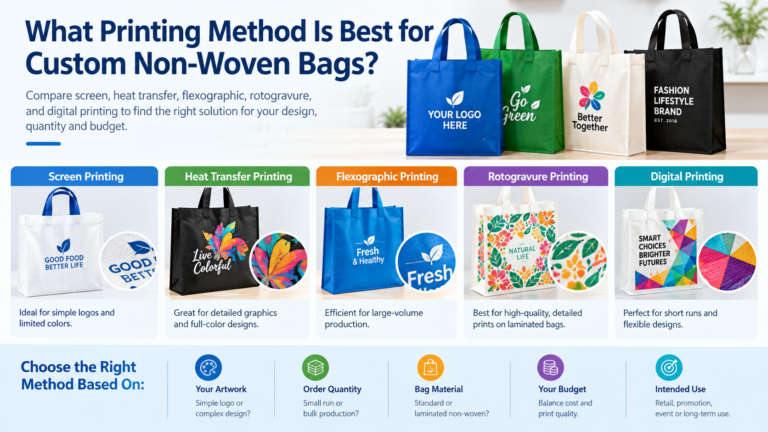

Choosing the right printing method is an important step when ordering custom non-woven bags for your business. The printing process affects how your logo looks, how accurately brand colors are reproduced, how durable the design is, and how much each bag costs.
For example, a supermarket ordering thousands of bags with a simple one-color logo may need a different printing solution from a fashion retailer looking for detailed, full-color graphics.
So, what printing method is best for custom non-woven bags?
The best method depends on your design, order quantity, bag material, budget, and intended use. Screen printing is often a practical choice for simple logos, while heat transfer and other full-color processes may be more suitable for complex artwork. For large-volume production, flexographic or rotogravure printing may offer greater efficiency, depending on the bag construction and manufacturing process.
In this guide, we compare the main printing methods to help business buyers make an informed decision.
Why Does Printing Method Matter for Custom Non-Woven Bags?
Custom non-woven bags are widely used for retail shopping, promotional campaigns, trade shows, supermarkets, exhibitions, and corporate events. Printing transforms a standard bag into a branded product that supports business visibility.
However, non-woven polypropylene (PP) fabric has a different surface from paper, cotton, and smooth plastic film. Its texture, color, and construction can affect how ink adheres and how clearly a design appears.
The printing method you choose can influence:
- Print quality: How clearly logos, text, and graphics appear.
- Color accuracy: How closely printed colors match your brand guidelines.
- Durability: How well the design withstands handling, folding, and everyday use.
- Production cost: The setup expense and printing cost per bag.
- Production efficiency: How quickly the order can be printed at the required quantity.
- Design flexibility: Whether the method can reproduce simple logos, multiple colors, gradients, or detailed images.
Before requesting a quotation, it is worth matching your artwork and order requirements with the appropriate printing process.
1. Screen Printing: Best for Simple Logos and Promotional Bags
Screen printing, also called silk-screen printing, is a common option for custom non-woven bags. Ink is transferred through a prepared mesh screen onto the bag surface. Separate screens are generally needed for different spot colors.
Best applications
Screen printing is particularly suitable for:
- Company logos and brand names
- One-color or limited-color artwork
- Promotional giveaway bags
- Trade show and exhibition bags
- Supermarket and retail shopping bags
- Event merchandise and corporate gifts
Advantages of screen printing
Cost-effective for suitable bulk orders
Once the screens have been prepared, repeated printing can be efficient. For larger orders with straightforward artwork, the initial setup cost can be spread across more bags.
Strong, clear branding
Bold shapes, solid colors, and simple text can produce an eye-catching result when the ink and printing settings are appropriate for the fabric.
Suitable for many standard bag styles
Screen printing can be used on a range of non-woven bag designs, subject to the material, construction, and available printing area.
Limitations
Each additional color can increase setup work and production complexity. Screen printing is generally less convenient for photographic images, complex gradients, and artwork containing many subtle color transitions.
Buyer tip: If your design mainly consists of a logo, company name, and one to three solid colors, ask your supplier to quote screen printing first. Confirm the actual result with an approved sample before mass production.
2. Heat Transfer Printing: Best for Detailed, Full-Color Artwork
Heat transfer printing applies a design to the bag using a printed transfer material and controlled heat and pressure. The exact process depends on the transfer technology and the bag material.
It can be useful when the artwork contains more colors or finer details than a conventional screen-printed design can reproduce efficiently.
Best applications
- Detailed brand illustrations
- Multicolor promotional graphics
- Selected limited-edition designs
- Small or medium production runs
- Designs that require more complex color reproduction
Advantages of heat transfer printing
Greater design flexibility
Depending on the transfer system, this method can reproduce multiple colors, gradients, and detailed artwork without requiring a separate screen for every design color.
Useful for selected smaller orders
Some transfer processes have lower color-related setup requirements, which may make them attractive when ordering smaller quantities or testing a new design.
Potentially detailed visual results
The printed transfer can provide crisp graphics when the film, adhesive, printing settings, and bag surface are compatible.
Limitations
The transfer layer may feel different from the surrounding fabric. Adhesion, folding resistance, and edge durability depend on the materials and application process.
Non-woven polypropylene is also sensitive to excessive heat. Incorrect settings can distort or damage the bag, so the supplier should test the process on the actual material before production.
Buyer tip: Request a sample and inspect the printed area for peeling, cracking, stiffness, and distortion. Pay particular attention to areas that will be folded or handled frequently.
3. Flexographic Printing: Best for Efficient High-Volume Production
Flexographic printing transfers ink from a flexible printing plate to a material surface. It is commonly used in packaging production, particularly when printing is integrated into a continuous material-processing line.
For non-woven bags, its suitability depends on whether the design is printed on the fabric roll or another compatible surface before the bag is converted into its final shape.
Best applications
- Large-volume bag programs
- Repeated designs with consistent artwork
- Standardized promotional or retail bag orders
- Projects where printing and bag conversion can be coordinated in production
Advantages of flexographic printing
Efficient continuous production
When the material and production line are compatible, printing on a roll can support high output and consistent repeat production.
Suitable for repeat orders
Once the artwork, plates, inks, and settings are established, repeat orders may be easier to standardize.
Potential cost advantages at scale
Although setup and tooling can be more involved, larger quantities may help spread those costs across the order.
Limitations
Flexographic printing is not automatically the cheapest choice for every bag order. Setup requirements, the number of colors, artwork, material handling, and production volume all affect its commercial value.
It may also be less practical for very small orders or frequently changing designs.
Buyer tip: If you need tens of thousands of bags or expect to reorder the same design regularly, ask whether roll-to-roll printing or an integrated production process is available. Compare the total setup cost and unit price against other suitable methods.
4. Rotogravure Printing with Lamination: Best for Detailed Graphics on Laminated Bags
Rotogravure printing uses engraved cylinders to transfer ink onto a compatible surface. In non-woven bag manufacturing, it is often associated with printing on a film that is subsequently laminated to non-woven fabric.
This differs from printing directly onto an ordinary, unlaminated non-woven bag.
Best applications
- Laminated non-woven shopping bags
- Full-color promotional bags
- Bags with large printed panels
- Retail packaging that requires detailed graphics
- High-volume orders with established artwork
Advantages
Detailed, consistent artwork
Printing on a suitable film can provide a smoother surface for reproducing complex graphics and multiple colors.
A distinctive laminated appearance
The finished bag can have a matte or glossy surface, depending on the selected material and finish.
Suitable for repeat production at scale
For suitable high-volume projects, the cost of cylinders and setup can be distributed across many units.
Limitations
This process typically involves more preparation and material coordination than simple direct printing. Lamination also changes the appearance, feel, and construction of the finished bag.
It may not be cost-effective for small quantities, and the additional layers should be considered when evaluating the bag’s intended reuse and end-of-life options.
Buyer tip: If your design covers most of the bag with detailed, full-color artwork, ask your supplier to compare laminated construction with direct printing. Evaluate the finished sample rather than judging the print file alone.
5. Digital Printing: Best for Short Runs and Design Flexibility
Digital printing applies artwork using a digital printing system or a digital transfer process. Its capabilities vary considerably by equipment and ink technology.
Not every digital printer can print directly onto every type of non-woven fabric. Material compatibility must be confirmed before choosing this method.
Best applications
- Prototype and design testing
- Short production runs
- Multiple artwork variations
- Detailed graphics and color-rich designs
- Projects that require frequent artwork changes
Advantages
Flexible artwork changes
Digital workflows can reduce the need for traditional color-specific tooling, making design revisions more convenient.
Good potential for detailed graphics
Compatible systems can reproduce complex artwork without separating the design into a small number of spot colors.
Useful for testing new designs
A digital sample may help a buyer evaluate the layout and color direction before committing to a larger production order.
Limitations
The unit cost may be higher than a suitable conventional printing process at large volumes. Print durability and color reproduction also depend on the equipment, ink, surface treatment, and finishing process.
Buyer tip: Ask whether the supplier uses direct digital printing or a transfer process. These are different methods, and their suitability for your bag material should be assessed separately.
Custom Non-Woven Bag Printing Methods Compared
| Printing method | Best suited for | Main advantage | Key consideration |
|---|---|---|---|
| Screen printing | Simple logos and limited colors | Practical branding for many standard orders | More colors can increase setup costs |
| Heat transfer | Detailed, multicolor artwork | Flexible color reproduction | Heat settings and transfer durability |
| Flexographic printing | Compatible high-volume production | Efficient continuous printing | Setup and production-line compatibility |
| Rotogravure with lamination | Detailed designs on laminated bags | Smooth, colorful printed panels | Higher setup and material complexity |
| Digital printing | Short runs and changing artwork | Flexible design changes | Equipment compatibility and unit cost |
There is no universal price or minimum quantity for each method. Actual costs depend on the factory’s equipment, bag specifications, print area, number of colors, order volume, and finishing requirements.
How to Choose the Best Printing Method for Your Business
Instead of selecting a printing process based on its name alone, evaluate your project using the following factors.
1. Consider your logo and artwork
Start with the design itself.
- Simple logo with solid colors: Screen printing is a sensible starting point.
- Detailed graphics or gradients: Compare heat transfer and compatible digital options.
- Large printed panels on laminated bags: Ask about rotogravure printing with lamination.
- Repeated, high-volume designs: Explore screen printing or compatible flexographic production.
These are starting points rather than fixed rules. A supplier should assess your actual artwork before confirming the method.
2. Match the method to your order quantity
Printing costs usually include both setup and production expenses. A process with a higher initial cost may offer a competitive unit price for a large order, while a process with less setup may be more attractive for a smaller run.
For example, a company ordering 1,000 bags with a one-color logo may receive a different recommendation from a retailer ordering 50,000 laminated bags with full-color graphics.
Ask for quotations at your planned quantity and, if relevant, at one larger quantity. This makes it easier to see how the unit price changes with volume.
3. Confirm the bag material and construction
Specify whether you need standard unlaminated PP non-woven fabric or laminated non-woven material.
Also provide the bag dimensions, GSM, color, handle type, gusset, and intended use. These details help the manufacturer determine whether the printing process is technically suitable.
4. Set your budget priorities
The lowest unit price is not always the best overall choice.
Consider the complete cost, including setup, printing, finishing, sample approval, packaging, and delivery. A slightly higher printing cost may be worthwhile if the final result better matches your brand requirements.
5. Approve a sample before mass production
A digital preview cannot fully show how ink will look on a textured fabric or how a transfer will feel on a finished bag.
Before approving bulk production, check:
- Logo size and placement
- Color consistency against the approved reference
- Print sharpness and coverage
- Adhesion and resistance to normal handling
- Bag construction and overall appearance
For repeat orders, retain an approved sample or documented print specifications to help maintain consistency.
Common Printing Mistakes Buyers Should Avoid
Even a suitable printing method can produce disappointing results if the project specifications are incomplete.
Sending low-resolution artwork
Low-quality images may become blurred or pixelated when enlarged. Provide a high-resolution file or vector artwork whenever possible.
Ignoring brand color requirements
Colors can appear different across screens, fabrics, and printing systems. Supply Pantone references or other agreed color specifications when brand consistency matters.
Choosing a process based only on price
A low quotation may not include the same material, print coverage, finish, or quality requirements as another supplier’s offer. Compare equivalent specifications.
Overlooking the bag’s surface
A textured, unlaminated bag and a smooth laminated bag may produce different results even with similar artwork. Request a sample on the intended material.
Failing to allow time for approval
Artwork revisions, sample production, and print testing can affect the project schedule. Confirm the approval process and production lead time before placing an order.
Questions to Ask Your Non-Woven Bag Supplier
Before confirming an order, ask your supplier:
- Which printing method do you recommend for my artwork and quantity?
- Can you print on the specific non-woven material and bag construction I selected?
- What setup costs, printing charges, and minimum order quantities apply?
- Can you provide a physical sample or an approved production sample?
- How will you check print quality and color consistency?
- What is the expected production lead time after artwork approval?
- Will the same printing specifications be used for future repeat orders?
Clear answers help you compare suppliers and reduce the risk of unexpected costs or quality issues.
Order Custom Non-Woven Bags for Your Business
The right printing method can help your custom non-woven bags represent your brand accurately while balancing visual quality, production efficiency, and budget.
For simple logos and limited-color designs, screen printing is often a practical starting point. Heat transfer and compatible digital processes can be useful for detailed artwork, while flexographic or rotogravure printing may suit specific high-volume production requirements.
The most effective choice comes from evaluating the artwork, bag material, order quantity, and intended use together.
If you are sourcing bags for retail, promotional campaigns, exhibitions, supermarkets, or wholesale distribution, explore our custom non-woven bags for business branding and wholesale supply.
Share your bag specifications, logo artwork, estimated quantity, and delivery requirements with your supplier to receive a recommendation and quotation tailored to your project.
Frequently Asked Questions
What is the most common printing method for custom non-woven bags?
Screen printing is a common choice for bags featuring simple logos and a limited number of solid colors. The best option still depends on the artwork, fabric, order quantity, and factory capabilities.
Which printing method is best for full-color designs?
Heat transfer, compatible digital printing, and rotogravure printing with lamination can all be suitable in different circumstances. The right choice depends on whether the design is printed on the finished bag, the fabric, or a laminated film.
Is screen printing suitable for bulk orders?
Yes. Screen printing can be cost-effective for many bulk orders, especially when the design uses a limited number of colors. Setup costs and production efficiency should be compared against other methods for the specific order.
Can non-woven bags be printed with detailed logos?
Yes, provided the artwork, printing process, and bag surface are compatible. Very fine lines and small text may need adjustments to remain clear on textured fabric.
Does printing affect the durability of a non-woven bag?
It can. Durability depends on the ink or transfer system, adhesion, curing or application settings, material construction, and how the bag is used. Ask for a sample and test it under realistic handling conditions.
What artwork file should I send to a manufacturer?
A vector file such as AI, EPS, or print-ready PDF is often preferred for logos and solid-color graphics. If you have a raster image, provide a high-resolution file and confirm the manufacturer’s requirements before production.