
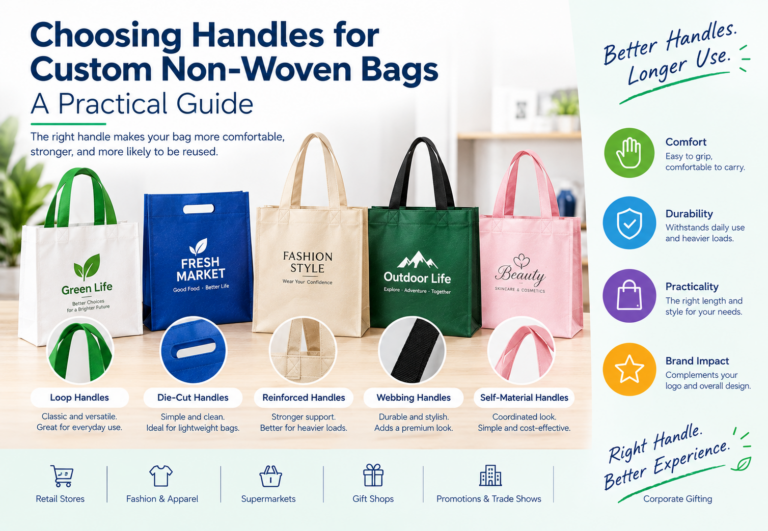

When ordering custom non-woven bags for retail stores, promotional campaigns, trade shows, or corporate gifting, handle design deserves more attention than many buyers expect.
The handle affects how comfortable a bag feels, how easily customers can carry it, how well it supports the intended contents, and how the finished product looks. It can also influence material usage, production complexity, unit cost, and the overall customer experience.
For B2B buyers placing bulk orders, choosing the right handle is not simply a matter of appearance. It is a practical decision that should match the bag’s intended use, construction, budget, and branding requirements.
In this guide, we will explain the most common handle options for custom non-woven bags and show you how to select the right design for your business.
1. Why Handle Design Matters for Custom Non-Woven Bags
A non-woven bag may use suitable fabric and attractive printing, but poor handle design can still make the finished product inconvenient or unreliable.
For example, narrow handles may feel uncomfortable when carrying heavier products. An unsuitable attachment method may cause the handle to pull away from the bag body. Handles that are too short can make larger bags difficult to carry, while excessively long handles may cause the bag to swing or drag.
For businesses ordering hundreds or thousands of bags, these details can influence customer satisfaction and the perceived quality of the brand.
A well-designed handle should provide four benefits:
- Comfort: The handle should be easy to grip during normal use.
- Strength: The handle and its attachment points should suit the intended load.
- Practicality: The length and shape should match how customers will carry the bag.
- Brand presentation: The handle should complement the bag’s color, shape, and overall design.
The best choice balances all four factors rather than focusing on a single feature.
2. Common Handle Types for Custom Non-Woven Bags
Different handle structures suit different products and applications. The following options are commonly considered when customizing non-woven shopping bags.
2.1 Loop Handles
Loop handles are separate strips of material attached to the bag body. Depending on the design, they may be made from the same non-woven fabric as the bag or from another suitable material.
This style is widely used for retail shopping bags, apparel packaging, promotional totes, and reusable shopping bags.
Advantages:
- Familiar and convenient carrying style
- Flexible handle length and width options
- Suitable for a wide range of bag shapes
- Can be designed for hand carrying or shoulder carrying
- Offers opportunities for reinforcement and contrasting colors
Loop handles are particularly useful when a business wants a more traditional shopping-bag appearance.
For example, a fashion retailer may choose a bag with long handles that customers can carry over their shoulders. A supermarket or promotional campaign may prefer shorter handles for straightforward hand carrying.
However, the final performance depends on the handle material, attachment method, bag construction, and intended load. A loop handle is not automatically stronger than every other option.
2.2 Die-Cut Handles
Die-cut handles are created by cutting an opening directly into the upper part of the bag body. This eliminates the need for a separate handle component.
They are often used for lightweight promotional bags, exhibitions, conferences, and certain retail applications.
Advantages:
- Simple and streamlined appearance
- No separate handle strips required
- Convenient for flat storage and distribution
- Can be economical for suitable high-volume orders
- Provides a clean design for lightweight promotional items
The main consideration is the area surrounding the handle opening. When the bag is loaded, stress concentrates around the cut-out, particularly near its edges.
For bags carrying brochures, lightweight samples, or small products, this structure may be appropriate. For heavier merchandise or repeated carrying, buyers should discuss reinforcement and load requirements with the manufacturer.
Do not select a die-cut handle solely because it appears economical. Confirm that the finished structure is appropriate for the intended application.
2.3 Reinforced Handles
Reinforced handles include additional material or construction features around the handle area or attachment points. Reinforcement can be incorporated into suitable loop-handle or die-cut designs.
This option is worth considering for reusable retail bags, larger shopping bags, and promotional bags intended to carry multiple items.
Potential benefits include:
- Improved support around high-stress areas
- Reduced risk of premature damage when properly designed
- Greater suitability for demanding carrying applications
- Better confidence when the bag is used repeatedly
Reinforcement can take different forms depending on the bag structure and manufacturing method. For example, a supplier may recommend additional fabric layers, stronger stitching, or a reinforced handle opening.
It is important to distinguish reinforcement from fabric thickness. A heavier fabric does not automatically compensate for a weak seam or poorly designed attachment point.
Ask the manufacturer to assess the complete bag rather than specifying reinforcement without considering the rest of the construction.
2.4 Webbing Handles
Webbing handles use a separate woven strap attached to the bag body. Depending on the specification, the strap may be made from polypropylene or another suitable material.
Webbing can create a distinctive look and a different hand feel from handles made from non-woven fabric.
Advantages:
- Multiple widths and colors may be available
- Can create a more structured or distinctive appearance
- Suitable for certain reusable shopping and promotional bags
- Offers design flexibility for branded packaging projects
Webbing handles can be useful when a brand wants a visual contrast between the bag body and the handles.
For example, a company might choose a navy bag with white webbing handles to match its corporate identity. A retail brand could select a neutral bag with contrasting straps for a more refined appearance.
Before confirming this option, check material compatibility, attachment details, available colors, and the effect on the total production cost.
2.5 Self-Material Handles
Self-material handles are made from the same non-woven fabric used for the bag body.
This approach creates a consistent appearance and allows the handles to coordinate naturally with the bag’s color and overall design.
Advantages:
- Consistent color and material appearance
- Flexible coordination with custom bag designs
- Suitable for many promotional and retail applications
- Can support a simple, unified brand presentation
Self-material handles can be designed in different widths and lengths. The appropriate specification depends on the bag’s dimensions, expected contents, and intended carrying style.
For heavier applications, ask whether the handle attachment requires extra layers, stronger stitching, or another suitable reinforcement method.
3. How to Choose the Right Handle for Your Business
The most suitable handle depends on how the bag will be used, what it needs to carry, and how customers will interact with it.
The following comparison provides a starting point.
| Handle type | Typical applications | Main consideration |
|---|---|---|
| Loop handles | Retail, apparel, shopping, gifting | Handle length and attachment strength |
| Die-cut handles | Exhibitions, brochures, lightweight promotions | Stress around the cut-out |
| Reinforced handles | Reusable retail bags and demanding applications | Reinforcement design and load testing |
| Webbing handles | Branded retail and distinctive promotional bags | Strap material, color, and attachment |
| Self-material handles | Shopping bags and coordinated promotional packaging | Fabric construction and handle reinforcement |
These are general guidelines rather than fixed performance rankings. The same handle type can perform differently depending on its dimensions, material, attachment method, and the complete bag structure.
Step 1: Identify the Intended Use
Start by identifying where and how the bags will be used.
For example:
- Retail stores: Consider comfortable loop handles and a design that complements the shopping experience.
- Supermarkets: Prioritize practical carrying, suitable capacity, and reliable construction.
- Trade shows: Lightweight handles may be sufficient when bags contain brochures and small samples.
- Corporate gifting: Consider handle comfort, appearance, and coordination with the gift packaging.
- Promotional campaigns: Balance usability, branding, distribution requirements, and target unit cost.
The intended application helps narrow the available options before you compare prices.
Step 2: Estimate the Expected Load
The expected contents are one of the most important factors in handle selection.
A bag carrying a few brochures has different requirements from one carrying clothing, boxed products, or multiple grocery items.
When requesting a quotation, provide the manufacturer with information about:
- The products that will go inside the bag
- The approximate total weight
- Whether the contents have sharp corners
- Whether the bag will be reused frequently
- Whether customers will carry it by hand or over the shoulder
These details help the manufacturer assess the handle width, attachment structure, fabric weight, and bottom construction together.
Avoid relying on GSM alone. GSM measures fabric mass per square meter, but it does not independently establish the carrying capacity of a finished bag.
Step 3: Choose the Appropriate Handle Length
Handle length affects comfort and usability.
Shorter handles are generally suitable for hand carrying, while longer handles may allow customers to carry the bag over their shoulders.
However, longer is not always better. A handle that is too long may cause the bag to hang awkwardly, swing while walking, or sit too low when loaded.
When choosing the length, consider:
- The overall height and width of the bag
- The likely height and carrying preferences of the target customers
- The size and weight of the contents
- Whether shoulder carrying is an important requirement
If you already have a preferred bag style, provide a reference sample or drawing so the supplier can evaluate the proportions before mass production.
Step 4: Consider Handle Width and Comfort
Handle width influences how pressure is distributed across the hand or shoulder.
A very narrow handle may feel uncomfortable when carrying a heavier bag. A wider handle may provide a more comfortable grip, but it should remain proportionate to the bag’s size and design.
For reusable shopping bags, evaluate comfort with the bag loaded rather than judging the handle only when it is empty.
Also consider whether the handle folds neatly for storage, twists during use, or feels bulky when carried over the shoulder.
Step 5: Match the Handle to the Bag Structure
The handle should work with the rest of the bag rather than being designed in isolation.
For example, a box-shaped non-woven bag with side and bottom gussets may need a different handle specification from a flat promotional bag.
Check the relationship between:
- Bag width and height
- Side and bottom gussets
- Fabric weight
- Handle length and width
- Attachment method
- Reinforcement
- Printing and artwork placement
If the bag will carry boxed merchandise or several products at once, make sure the bottom and side construction can accommodate the contents as well.
4. How Handle Construction Affects Durability
Handle performance depends on more than the handle material itself.
The attachment points, stitching or bonding, reinforcement, and surrounding fabric all contribute to the performance of the finished bag.
Stitching and Attachment Quality
For sewn non-woven bags, inspect the stitching around the handle attachment. Poor stitching, insufficient attachment area, or unsuitable thread can compromise the finished product.
For heat-pressed or heat-sealed structures, the quality of the bonded area is especially important. The attachment must be suitable for the material and intended load.
Neither construction method should be assumed to be stronger in every situation. The correct choice depends on the design, materials, production process, and performance requirements.
Reinforcement at High-Stress Areas
The handle attachment is a key area to inspect because lifting a loaded bag transfers force through the handle and into the bag body.
For bags intended for heavier products or repeated use, ask the supplier whether additional reinforcement is appropriate.
The goal is not simply to add more material. It is to distribute stress effectively without creating unnecessary cost or making the bag difficult to fold and store.
Sample Testing Before Bulk Production
Before approving a large order, request a sample made as close as possible to the intended production specification.
Check the following:
- Load the bag with representative products.
- Lift and carry it using the intended method.
- Inspect the handle attachment and surrounding fabric.
- Check the seams, bottom, and gussets.
- Repeat the process according to an agreed testing procedure.
For projects with specific performance requirements, agree on the test load, duration, handling conditions, and acceptance criteria with the manufacturer.
A sample test provides more useful evidence than judging strength from a product photograph or material specification alone.
5. How to Coordinate Handles With Your Brand Design
Handle selection also affects the appearance of a custom non-woven bag.
For businesses ordering branded packaging, the handle should complement the logo, bag color, printing method, and intended market positioning.
Match Handle Colors With Your Brand Identity
A same-color handle creates a coordinated appearance. A contrasting handle can make the bag more distinctive.
For example, a cosmetics brand might choose a cream bag with dark handles, while a sports retailer might prefer a bold combination of contrasting colors.
When color consistency matters, confirm the available material colors and request a physical sample or approved color reference.
Keep the Logo Visible
The handle should not interfere with the main logo or important artwork.
Before production, review the bag layout and confirm that the handle attachment, cut-out opening, and folded areas will not obscure the design.
For die-cut handles, keep important text and logos away from the cutting area. For loop handles, check that the attachment positions do not interfere with the main printed panel.
Choose Materials That Suit the Desired Appearance
Self-material handles can create a uniform look, while webbing handles can introduce contrast and texture.
The right choice depends on the brand’s visual identity, budget, and intended use. A promotional bag distributed in large quantities may prioritize simple construction, while a retail bag designed for repeated use may justify additional attention to handle appearance and comfort.
For more guidance on bag design and branding, visit our custom non-woven bags for business branding and wholesale supply.
6. How Handle Choices Affect Cost and MOQ
Handle design can influence material consumption, labor, production complexity, packing, and the final unit price.
For example, a simple integrated die-cut handle may require fewer separate components than a bag with additional webbing or more complex sewn reinforcement. However, the most economical option depends on the bag structure, manufacturing equipment, quantity, and specifications.
When comparing supplier quotations, make sure the quotes cover the same requirements.
Confirm:
- Handle type, length, and width
- Handle material and color
- Attachment and reinforcement method
- Bag dimensions and gussets
- Fabric type and GSM
- Printing and finishing
- Quantity and packaging requirements
- Sample cost and production lead time
Minimum order quantities also depend on the construction method and the supplier’s production setup. Do not assume that every handle option has the same MOQ.
For example, our indicative starting quantities for certain non-woven bag styles are 500 pieces for sewn bags and 10,000 pieces for heat-pressed bags. Actual MOQ and feasibility should be confirmed for your specific design, dimensions, and order requirements.
If your budget is limited, discuss the trade-offs with your supplier before removing reinforcement or changing the handle design. A lower unit price is not necessarily the best value if the finished bag does not meet your customers’ needs.
7. Common Mistakes to Avoid When Choosing Bag Handles
Even experienced buyers can overlook small details when preparing a bulk packaging order.
Here are several common mistakes worth avoiding.
Choosing handles based on appearance alone. An attractive handle still needs to suit the intended load and carrying method.
Assuming thicker fabric guarantees stronger handles. Handle attachment, seams, reinforcement, and bottom construction also affect performance.
Ignoring handle length. The wrong length can make a bag uncomfortable or awkward to carry.
Finalizing artwork before confirming the structure. Handle openings and attachment points can affect logo placement and usable printing space.
Skipping sample approval. A sample allows buyers to evaluate proportions, materials, construction, and usability before mass production.
Comparing quotations with different specifications. A fair price comparison requires matching handle materials, reinforcement, bag dimensions, printing, and packing requirements.
Avoiding these mistakes can make supplier communication more efficient and reduce the risk of costly changes after production begins.
8. Buyer Checklist Before Ordering Custom Non-Woven Bags
Before approving your next order, use this checklist to confirm the key specifications.
-
Intended application and target users
-
Expected product weight and bag capacity
-
Preferred handle type
-
Handle length and width
-
Handle material and color
-
Attachment and reinforcement requirements
-
Bag dimensions and gussets
-
Fabric type and GSM
-
Logo placement and printing requirements
-
Sample approval and agreed performance tests
-
Order quantity, MOQ, and production lead time
-
Packaging and delivery requirements
If you are unsure which handle is most suitable, share your intended application, approximate bag dimensions, expected load, and order quantity with your manufacturer. These details provide a practical starting point for comparing options.
Conclusion: Choose Handles That Work for Your Customers
Choosing handles for custom non-woven bags requires a balance of comfort, durability, appearance, manufacturing feasibility, and cost.
Loop handles can suit everyday retail use, die-cut handles may work well for lightweight promotional applications, and reinforced or webbing handles can be considered when the project calls for specific structural or visual features.
The right option is not necessarily the most expensive or the thickest. It is the handle design that works with the complete bag structure and meets the requirements of the intended use.
For your next bulk order, evaluate the handle together with the fabric, bag dimensions, seams, gussets, printing, and packaging. Approve a suitable sample before proceeding to mass production.
Need Custom Non-Woven Bags for Your Business?
At CXGIAE, we support custom non-woven bag projects for business branding, retail packaging, and promotional applications.
Share your preferred bag style, handle requirements, artwork, estimated quantity, and target application to discuss a suitable specification and request a quotation.
A well-designed handle helps turn a custom bag into a more comfortable, practical, and brand-ready product.