
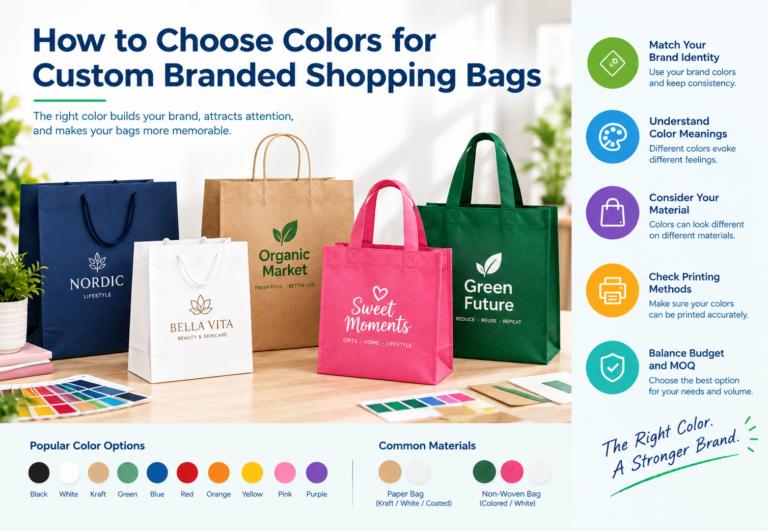

Choosing the right colors for custom branded shopping bags is an important part of building a consistent brand identity. The color of a shopping bag influences how a logo appears, how products are presented, and how packaging fits into a company’s overall marketing strategy.
For retailers, wholesalers, fashion brands, supermarkets, restaurants, and promotional agencies, custom shopping bags are more than a way to carry products. They are also a physical extension of the brand.
However, selecting a bag color involves more than choosing a favorite shade. Buyers need to consider brand guidelines, product positioning, printing methods, material colors, customer preferences, and production costs.
In this guide, we will explain how to choose colors for custom branded shopping bags, compare popular color combinations, and outline practical steps for preparing a successful bulk order.
1. Start With Your Existing Brand Identity
Before selecting a color for your shopping bags, review your company’s existing brand identity.
Your website, logo, product labels, retail displays, and other marketing materials should work together visually. Using a consistent color palette across these touchpoints helps customers recognize your business.
Identify Your Primary Brand Colors
Most businesses have a primary brand color supported by one or more secondary colors and neutral shades.
When planning custom shopping bags, consider the following questions:
- What is the main color associated with your brand?
- Does your logo have light and dark versions?
- Which colors already appear on your packaging and marketing materials?
- Does your brand use a minimalist, premium, playful, or environmentally focused visual style?
- Are there existing brand guidelines that specify approved color codes?
For example, a fashion retailer with a black-and-white identity may prefer black bags with a white logo. A natural skincare company may choose cream or kraft-colored bags with dark green printing.
The goal is not necessarily to cover the entire bag in your brand color. Sometimes a neutral background with a clearly printed logo creates a more balanced and recognizable design.
Use Brand Colors Consistently
For businesses with multiple stores, franchise locations, or distribution channels, consistency becomes especially important.
If you are ordering bags for several locations, provide the same approved artwork and color specifications to your packaging supplier. This helps reduce unnecessary variations between production batches.
You should also identify which colors are essential to your brand and which can be adjusted to accommodate different materials or printing processes.
2. Understand What Different Colors Can Communicate
Colors can influence how customers interpret a brand, but their meanings are not universal. Industry conventions, cultural background, product category, and the surrounding design all affect perception.
Use color associations as a starting point, then evaluate whether the final design suits your target market.
Black: Refined and Modern
Black shopping bags are frequently used by fashion retailers, cosmetics companies, jewelry brands, and businesses seeking a clean, sophisticated appearance.
Black works particularly well with white logos, selected metallic effects, and high-contrast artwork.
Best suited for:
- Fashion and apparel stores
- Premium retail packaging
- Cosmetics and beauty products
- Jewelry and accessories
- Corporate gifting
One practical consideration is that black materials may show dust, scratches, or surface marks differently from lighter materials. Buyers should evaluate the actual material and finish before confirming the order.
White: Clean and Versatile
White shopping bags provide a neutral background that can accommodate many logo colors and design styles.
They are useful when a business wants its logo, product illustration, or promotional message to stand out without competing with a strongly colored background.
Best suited for:
- Beauty and skincare brands
- Boutiques
- Bakeries and specialty food businesses
- Healthcare and wellness retailers
- Minimalist branding
White bags can show dirt more easily during transportation and use, so the intended application and finish should be considered.
Brown Kraft: Natural and Understated
Brown kraft paper is a popular option for brands that want a natural, simple, or craft-inspired appearance.
Dark green, black, navy, and other sufficiently dark colors can work well against a kraft background. Very light inks may be less visible, depending on the material and printing method.
Best suited for:
- Cafés and bakeries
- Grocery and specialty food stores
- Handmade products
- Natural skincare brands
- Businesses using kraft-based packaging
If sustainability is part of your brand positioning, make sure any environmental claims are supported by the actual material specifications and relevant documentation. A brown color alone does not establish that a bag is recyclable, compostable, or environmentally preferable.
Green: Fresh and Nature-Inspired
Green is often associated with plants, freshness, growth, and environmental themes.
It can be suitable for organic product retailers, gardening businesses, natural cosmetics brands, and companies that want a connection to nature in their visual identity.
Green can be used as the main bag color or as a logo color on white or kraft material.
However, avoid choosing green solely because your business wants to communicate sustainability. Material selection, product performance, and credible environmental information remain important.
Blue: Professional and Dependable
Blue is commonly used by businesses that want a professional, stable, or contemporary appearance.
Navy blue can create a restrained retail design, while brighter blues may suit promotional campaigns and younger consumer brands.
Best suited for:
- Corporate merchandise
- Technology businesses
- Professional service companies
- Retail chains
- Trade shows and business events
For dark blue bags, a white or light-colored logo may offer stronger visibility than a similarly dark logo.
Red, Orange, and Yellow: Bold and Energetic
Bright colors can help shopping bags stand out in busy retail environments and promotional settings.
Red may communicate energy or urgency, orange can feel lively and approachable, and yellow can create a bright visual accent.
These colors may be suitable for seasonal campaigns, food businesses, entertainment brands, and promotional events.
The key is to maintain enough contrast between the bag and its printed elements. A bright background can become visually overwhelming if the logo, text, and decorative graphics compete for attention.
3. Choose a Color Based on Your Industry and Application
The best bag color depends partly on where the bag will be used and what the business wants it to communicate.
| Industry or application | Color options to consider | Design priority |
|---|---|---|
| Fashion and apparel | Black, white, navy, beige | Brand identity and presentation |
| Cosmetics and beauty | White, cream, blush pink, black | Clean design and logo visibility |
| Jewelry and luxury retail | Black, deep navy, cream | Refined appearance |
| Cafés and bakeries | Kraft brown, white, dark green | Product presentation and practicality |
| Supermarkets and grocery stores | White, green, blue, bold brand colors | Visibility and everyday use |
| Trade shows and promotions | Bright brand colors, contrasting combinations | Recognition from a distance |
| Corporate gifting | Navy, black, white, custom brand colors | Consistency and professional presentation |
| Seasonal campaigns | Red, green, orange, metallic accents where suitable | Campaign recognition |
These combinations are starting points rather than strict rules. A distinctive brand may benefit from using a color that differs from the usual choices in its industry, provided the design remains recognizable and practical.
4. Choose the Right Color for Your Bag Material
One of the most important considerations in custom packaging is that the material itself affects the final appearance of printed colors.
A color displayed on a computer screen may look different when printed on kraft paper, coated paper, non-woven fabric, or laminated material.
Before finalizing your design, consider the following material options.
Custom Paper Bags
Paper bags are available in several material types, including kraft paper, white card paper, coated paper, and specialty papers.
Each material offers a different visual foundation for your design.
Kraft paper bags
Kraft paper has a natural brown background. Dark, bold artwork is often a practical choice because it can provide good contrast against the paper.
Light pastel colors may appear less vivid, and some shades may shift because the paper itself contributes to the final appearance.
White card paper bags
White card paper offers a neutral background for many logo colors. It can be suitable for detailed branding, multicolor artwork, and designs that require a bright base.
Coated paper bags
Coated paper provides a different surface from uncoated paper and may support a more polished printed appearance. The actual result depends on the coating, printing method, and finishing options.
For more information about available styles and customization options, visit our custom paper bags product page.
Custom Non-Woven Bags
Non-woven bags offer a different set of color and branding possibilities. They are commonly used for shopping, promotional campaigns, exhibitions, and reusable retail packaging.
The final appearance depends on the fabric color, material construction, printing process, and artwork.
For example, a white non-woven bag may provide a versatile background for multicolor logos, while a navy bag with white printing can create a strong visual contrast.
When selecting colored non-woven bags, confirm which base colors are available for your required material and order quantity. Also check whether the selected printing process can reproduce the intended logo colors accurately.
Explore our custom non-woven bags for business branding and wholesale supply for more information about customization options.
5. Make Sure Your Logo Stands Out
A shopping bag may have an attractive background color, but the design will not work well if customers cannot easily identify the logo.
Contrast should be a primary consideration when selecting the bag and printing colors.
Light Backgrounds and Dark Logos
White, cream, and other light-colored bags can work well with black, navy, dark green, and selected bright logo colors.
These combinations are often suitable for detailed artwork and simple text-based branding.
Dark Backgrounds and Light Logos
Black, navy, and dark green bags may work well with white or other sufficiently light-colored logos.
For some designs, a simplified one-color logo can be more effective than a detailed multicolor version.
Kraft Backgrounds and Bold Artwork
On brown kraft paper, dark green, black, and dark blue may provide a clear contrast.
However, the actual result depends on the paper shade, ink opacity, and printing process. Always evaluate the artwork on the intended material.
Avoid Low-Contrast Combinations
Some combinations can make logos difficult to read, especially when the artwork includes small text or fine lines.
Examples include:
- Pale yellow on white
- Beige on light kraft paper
- Dark navy on black
- Light gray on white
- Similar shades of green on a green bag
These combinations are not automatically unsuitable, but they require careful testing.
For practical guidance, review your logo at its intended print size rather than judging it only on a large computer screen.
6. Understand Printing Methods and Color Reproduction
Your preferred color scheme should be compatible with the printing method used to manufacture the bags.
Different processes have different capabilities, costs, and limitations. The best method depends on the bag material, artwork, order quantity, and required finish.
One-Color Printing
One-color printing can be an effective choice for businesses with simple logos, wordmarks, or minimal graphics.
Potential benefits include:
- A clean and straightforward design
- Fewer colors to manage
- A practical option for many promotional projects
- Easier coordination with neutral bag materials
A carefully designed one-color logo can look professional without requiring a complicated design.
Multicolor Printing
Multicolor printing is useful when your brand relies on several colors, detailed illustrations, or more complex artwork.
Before production, confirm that the chosen process is suitable for the design and that the artwork is prepared in the correct format.
For multicolor designs, it is particularly important to review the printed proof before approving the order.
CMYK and Pantone Color Specifications
CMYK is commonly used for process-color printing, while Pantone references may be used when a project requires a specified spot color.
These systems serve different purposes, and neither guarantees that a color will look identical across every material and production process.
For brand-critical colors, provide the supplier with the relevant color references and explain which colors require the closest control.
Your supplier can advise whether the requested shade is achievable on the selected material and whether additional testing is necessary.
7. Prepare Your Artwork Before Ordering
Good color selection can be undermined by poorly prepared artwork.
Before requesting a final quotation or approving a production sample, prepare the files and specifications that your manufacturer needs.
Provide the Correct Logo Files
Where possible, provide vector artwork such as AI, EPS, or suitable vector PDF files. These formats can help preserve sharp edges when artwork is resized.
If only raster artwork is available, ask the supplier whether its resolution is sufficient for the intended print size.
Also provide the approved logo variations needed for different backgrounds, such as full-color, single-color, or reversed versions if your brand has them.
Confirm the Color References
Share the applicable brand color codes and identify the colors that matter most.
Depending on the project, this may include:
- Pantone references for specified spot colors
- CMYK values for process printing
- A physical sample or approved color reference
- The intended bag material and base color
Do not rely exclusively on a screenshot or a digital mockup when color accuracy is important.
Review the Artwork Layout
Check that the logo is correctly positioned and that important text remains readable.
Also consider the handle position, folds, seams, gussets, and printable area. These structural details can affect where the artwork can be placed.
For larger orders, approve a proof or sample before proceeding to mass production.
8. Consider Finish, Texture, and Visual Effects
Bag color is only one part of the final appearance. Surface finish and material texture can also change how a design looks.
For paper bags, finishing options may include matte or gloss lamination and selected decorative treatments, depending on the material and manufacturing process.
A matte finish may create a more understated appearance, while a gloss finish can produce a brighter surface effect.
For non-woven bags, the fabric texture and surface characteristics can influence the appearance of printed artwork.
When choosing a finish, consider:
- Your brand’s visual identity
- The intended retail or promotional application
- The selected material
- The printing method
- The overall budget
- The expected handling and use of the bag
Ask your supplier to confirm which finishing options are compatible with your chosen bag material and artwork.
9. Balance Color Choices With Budget and MOQ
For B2B buyers, color decisions also affect production planning and purchasing costs.
The final price may depend on the bag material, custom base color, number of print colors, printing method, finishing, bag dimensions, order quantity, and manufacturing requirements.
A bag with a custom-colored base and complex multicolor artwork may require a different production setup from a neutral bag with a simple logo.
If you are working with a limited budget, consider these approaches:
Option 1: Use a neutral bag with a colored logo.
This can preserve brand recognition while simplifying the overall design.
Option 2: Limit the number of printing colors.
If your logo can be represented clearly in one or two colors, a simplified design may be worth evaluating.
Option 3: Standardize colors across product lines.
Using a consistent color system across multiple bag styles may make future ordering and brand management easier.
Option 4: Compare quotations using identical specifications.
When evaluating suppliers, ensure the bag material, dimensions, base color, printing, finishing, quantity, and packaging requirements are comparable.
Minimum order quantities vary by product, material, and production method. Confirm the applicable MOQ with your supplier before finalizing the design.
Do not reduce quality-critical requirements simply to achieve a lower unit price. The selected color scheme should remain practical, recognizable, and appropriate for the intended use.
10. Common Mistakes to Avoid When Choosing Shopping Bag Colors
Before placing a bulk order, watch out for these common problems.
Choosing Colors Based Only on Screen Appearance
Digital colors may not reproduce exactly in print. Evaluate the actual material and printed proof whenever possible.
Ignoring the Material’s Base Color
The same ink can look different on brown kraft paper, white paper, and colored non-woven fabric. Select the material and printing colors together.
Using Too Many Colors
A design with too many competing colors may weaken visual hierarchy. Focus on a clear primary color, a supporting palette, and enough contrast for the logo.
Forgetting About Future Reorders
If your company plans to reorder bags regularly, document the approved artwork, material, color references, printing method, and sample specifications.
Skipping Sample Approval
A digital mockup is useful for checking layout, but it cannot fully reproduce the physical material, texture, and printing result.
Overlooking the Target Market
A color that suits one product category or campaign may not fit another. Consider your brand identity, customer expectations, and the setting in which the bag will be used.
11. A Practical Checklist for Your Next Custom Bag Order
Before approving your custom branded shopping bags, confirm the following details:
-
Primary brand color and approved logo version
-
Bag material and base color
-
Required logo contrast and readability
-
Printing method and number of print colors
-
CMYK or Pantone references, where applicable
-
Artwork file format and print dimensions
-
Handle placement, folds, and printable areas
-
Surface finish and decorative effects
-
Order quantity, MOQ, and target unit cost
-
Physical sample or proof approval
-
Color references and specifications for future reorders
Preparing these details in advance can make supplier communication more efficient and help reduce avoidable production changes.
Conclusion: Choose Colors That Support Your Brand and Your Business
Choosing colors for custom branded shopping bags requires a balance between brand identity, visual contrast, material compatibility, printing capabilities, and budget.
Black and white offer versatile foundations for many retail designs. Kraft paper can complement natural and understated branding, while green, blue, red, and other brand colors can help businesses create a more distinctive visual identity.
However, no single color is best for every business. The right choice is the one that communicates your brand clearly, works with the selected material, and can be reproduced to an acceptable standard in production.
For B2B buyers ordering custom shopping bags in bulk, the most reliable approach is to define the color requirements early, provide accurate artwork, confirm the material and printing method, and approve a sample before mass production.
Looking for Custom Branded Shopping Bags?
At CXGIAE, we support custom packaging projects for businesses looking for branded paper bags and non-woven bags.
Explore our product options:
Share your logo, preferred bag color, material requirements, estimated order quantity, and intended application to discuss a suitable custom packaging solution and request a quotation.