
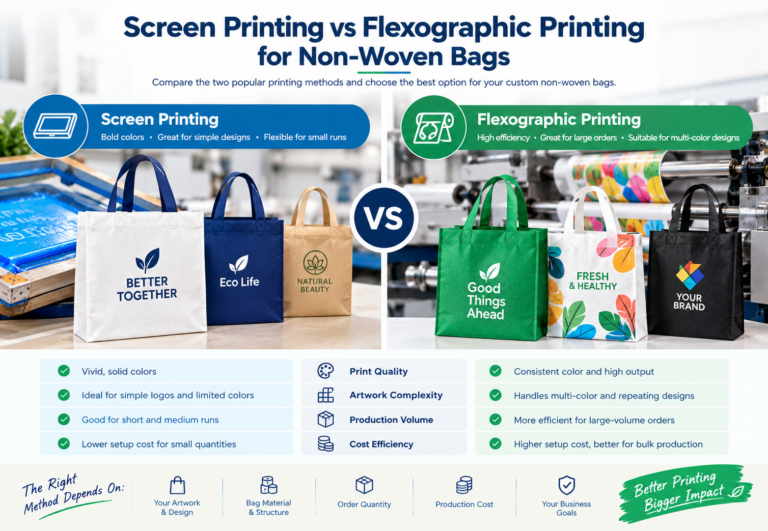

Choosing the right printing method is an important step when ordering custom non-woven bags for your business. The printing process affects logo appearance, color consistency, production efficiency, unit cost, and the overall quality of the finished bag.
Two methods buyers may encounter are screen printing and flexographic printing. Both can be used for suitable non-woven polypropylene (PP) materials, but they work differently and are better suited to different artwork and production requirements.
For businesses ordering branded shopping bags, promotional giveaways, retail packaging, or reusable shopping bags in bulk, understanding these differences can help you make a more informed purchasing decision.
In this guide, we compare screen printing vs flexographic printing for non-woven bags, explain their advantages and limitations, and show you what to consider before requesting a quotation.
1. What Is Screen Printing for Non-Woven Bags?
Screen printing, also known as silk screen printing, transfers ink through a mesh screen onto the surface of a material. A stencil controls where the ink passes through, creating the desired logo, text, or graphic.
For custom non-woven bags, screen printing is commonly used for bold logos, simple illustrations, promotional messages, and designs featuring a limited number of solid colors.
The process can be performed on suitable bag panels or finished bags. Depending on the equipment and production setup, screen printing can also be integrated into a continuous production process.
Advantages of Screen Printing
1. Strong, clear colors
Screen printing can deposit a relatively substantial layer of ink, helping produce bold graphics and solid colors. This can be useful when a brand needs its logo to stand out against the bag’s background.
2. Suitable for simple brand logos
Single-color and two-color logos are common applications. Designs with clear outlines, readable text, and uncomplicated shapes are generally easier to reproduce consistently.
3. Flexible for different bag designs
Screen printing may be suitable for a variety of non-woven bag styles, including shopping totes, promotional bags, and sewn bags, provided the printing equipment can accommodate the bag structure.
4. Practical for many customized orders
For orders with relatively simple artwork, screen printing can be a practical option. The final cost depends on factors such as print size, number of colors, order quantity, bag construction, and manual or automated production requirements.
Limitations of Screen Printing
Each additional color may require a separate screen and setup. As a result, designs with numerous colors, gradients, or photographic details can become more complicated and expensive to produce.
Printing on already assembled bags may also require careful positioning and handling. Large orders can be efficient with suitable equipment, but productivity varies significantly by production line.
Best suited for: Custom non-woven bags with bold logos, simple graphics, and a limited number of colors.
2. What Is Flexographic Printing for Non-Woven Bags?
Flexographic printing, commonly called flexo printing, uses flexible relief plates to transfer ink onto a substrate. It is frequently used in continuous web printing, where material travels through the printing equipment in a roll.
For non-woven bag production, flexographic printing can be used to print suitable non-woven material before it is cut and converted into bags. The exact process depends on the manufacturer’s equipment, substrate, and bag construction.
This approach can be useful for repeating graphics, patterns, and production programs that require consistent printing across a large quantity of material.
Advantages of Flexographic Printing
1. Efficient continuous production
Flexographic printing is designed for roll-fed production. Once the machine is properly set up, it can print long runs of material without handling each finished bag individually.
2. Good potential for large-volume orders
For repeat orders and large production quantities, the initial cost of plates and setup can be spread across more units. This may improve the economics of high-volume projects.
3. Suitable for repeating designs
Repeated logos, patterns, and certain multi-color graphics can be produced efficiently when the artwork and equipment are compatible with the process.
4. Can integrate with bag manufacturing
Printing the material before cutting and converting can support a streamlined workflow. However, print positioning must be coordinated with the subsequent cutting, folding, sealing, and sewing processes.
Limitations of Flexographic Printing
Flexographic printing requires appropriate plates, ink systems, and machine setup. Initial preparation can make it less attractive for short runs or frequent design changes.
Print quality also depends on the non-woven substrate, ink compatibility, surface treatment, drying conditions, plate design, and registration between colors.
Very fine details, small text, and complex color transitions should be reviewed with the manufacturer before production. Not every flexographic setup can reproduce every design equally well.
Best suited for: Suitable roll-fed non-woven material, repeating artwork, and production programs where continuous printing offers a practical cost or efficiency advantage.
3. Screen Printing vs Flexographic Printing: Key Differences
The most suitable method depends on your design, quantity, material, and production route. The following table summarizes the main considerations for B2B buyers.
| Comparison Factor | Screen Printing | Flexographic Printing |
|---|---|---|
| Printing principle | Ink passes through a mesh screen | Flexible relief plates transfer ink |
| Typical production route | Bag panels or finished bags; some roll-fed systems | Commonly roll-fed material before bag conversion |
| Suitable artwork | Bold logos, text, solid-color graphics | Repeating graphics and suitable multi-color designs |
| Color requirements | Particularly practical for simple spot-color designs | Can accommodate multiple colors with suitable equipment |
| Fine details | Depends on mesh, ink, artwork, and substrate | Depends on plate, ink, substrate, and press capability |
| Setup requirements | Screen preparation and setup for each color | Plate preparation and press setup |
| Short-run flexibility | May be practical for simple designs | Setup costs may be harder to justify for short runs |
| Large-volume efficiency | Good with appropriate automated equipment | Particularly useful for continuous roll-fed production |
| Main cost factors | Screens, colors, labor, print area, and quantity | Plates, setup, ink, production volume, and material waste |
Neither method is automatically cheaper or better in every situation. Automated screen printing can also handle high-volume production, while flexographic printing may not be economical for every large order if the artwork, material, or production requirements are unsuitable.
The most useful comparison is based on the same bag specifications, artwork, order quantity, and quality requirements.
4. Which Printing Method Is Better for Your Business?
Your business requirements should guide the decision rather than the printing method alone.
Scenario 1: Retail Bags With a Simple Logo
If your retail business needs non-woven shopping bags with a one-color logo, screen printing is worth considering.
For example, a supermarket may require thousands of bags in a standard bag color with a contrasting company logo. A simple design can be easier to prepare and reproduce than a complex full-color graphic.
The final choice should still consider the bag’s dimensions, print area, quantity, and whether the bags will be printed individually or produced from printed material.
Scenario 2: Promotional Bags for Trade Shows and Events
Promotional bags often prioritize clear branding, practical functionality, and cost control.
For event organizers ordering bags with a company logo and a short message, screen printing may be a suitable option when the artwork uses only a few colors.
If the order involves multiple designs or a repeating pattern across a large quantity of material, flexographic printing may also be worth evaluating.
Scenario 3: Large Retail or Distribution Programs
Businesses that place recurring, high-volume orders should compare the complete production costs of both methods.
Flexographic printing may be attractive when large quantities of roll-fed material can be printed efficiently before bag conversion. Screen printing may remain competitive when the bag design, printing equipment, and production workflow are well suited to the job.
Ask the supplier to compare the total cost per finished bag rather than only the printing charge.
Scenario 4: Detailed or Full-Color Artwork
If your design contains gradients, photographic images, or many closely blended colors, do not assume that either method will reproduce it exactly as shown on a computer screen.
Ask the manufacturer to evaluate the artwork and confirm the achievable color reproduction, registration, and detail level.
Depending on the design and bag construction, heat transfer, digital printing, or printing on laminated film may be alternatives worth discussing.
5. How Does Non-Woven Material Affect Printing Quality?
Choosing a printing method is only one part of achieving a good result. The material itself can influence ink adhesion, color appearance, and the consistency of the finished bags.
Material Weight and Surface
Non-woven bags are commonly produced from polypropylene fabric in different GSM weights. For example, 70 GSM, 90 GSM, and 120 GSM materials can have different thicknesses, stiffness, and surface characteristics.
A heavier material is not automatically easier to print. The surface structure, fabric color, and selected ink system also matter.
Unlaminated vs Laminated Non-Woven Bags
Unlaminated non-woven material has a fabric-like surface. Its texture and fiber structure can influence the appearance of fine lines and small text.
Laminated non-woven bags have an added film layer that changes the surface finish. Depending on the construction and production process, the artwork may be printed directly onto a suitable surface or printed on film before lamination.
For laminated bags, the manufacturer should confirm which printing route is being proposed. Flexographic printing on non-woven fabric and printing on film for lamination are related but distinct production options.
Ink Adhesion and Durability
Polypropylene is not a naturally easy surface for every ink system. Correct ink selection, surface treatment where needed, and suitable drying or curing conditions are important.
Before approving bulk production, ask the supplier to check:
- Whether the ink is compatible with the actual material.
- Whether printed colors remain consistent across the production run.
- Whether the print resists rubbing and normal handling.
- Whether the design remains intact when the bag is folded, stitched, or heat-sealed.
A printed sample is more reliable than judging print quality from an artwork file alone.
6. How Printing Method Affects Your Order Cost
For B2B buyers, the total order cost is more important than the price of the printing process in isolation.
Several factors can influence the final quotation.
Order Quantity
A larger order may help spread setup costs across more bags. However, the savings depend on the method, production line, and quantity required for each individual design.
If you need several versions of a bag, ask whether the quoted quantity and setup charges apply to the total order or separately to each artwork.
Number of Colors
More colors can require additional screens or printing plates, along with more setup and color-registration work.
For a simple corporate logo, reducing the number of colors may help control costs without weakening the design.
Print Area
A small logo and a large printed panel place different demands on the production process. Larger print areas may require more ink, different equipment settings, or additional material handling.
Bag Construction
Sewn bags, heat-pressed bags, foldable totes, and laminated bags can require different manufacturing sequences.
If printing must take place before the bag is assembled, the artwork must be aligned with the cutting and conversion layout. If printing takes place after assembly, the finished bag must fit the printing equipment.
Artwork Changes and Repeat Orders
Frequent artwork changes may increase setup costs, especially when new screens or plates are needed.
For repeat orders, keeping approved artwork files, color references, bag specifications, and samples can make future production easier to manage.
7. How to Prepare Your Artwork for Non-Woven Bag Printing
Good artwork preparation helps reduce production errors and unnecessary revisions.
Before placing a bulk order, prepare the following information:
1. A high-quality logo file
Vector formats such as AI, EPS, or vector PDF are often preferred for production artwork. Confirm the supplier’s required file format before submission.
2. Accurate colors
Provide Pantone references when specific brand colors matter. Ask the supplier how those colors will be reproduced on the selected non-woven material.
3. Final print dimensions
Specify the intended logo width and height, its position on the bag, and the maximum available print area.
4. A clear layout
Show the front and back designs separately if both sides require printing. Include the intended bag dimensions and any relevant construction details.
5. Approval of the production sample
Review the actual print size, placement, color, and finish before approving bulk production.
For a deeper look at available customization options, visit our custom non-woven bags for business branding and wholesale supply page.
8. What Should Buyers Ask Before Confirming an Order?
Before choosing screen printing or flexographic printing, ask your supplier these practical questions:
- Which printing method do you recommend for my specific artwork, and why?
- Will printing take place on the finished bag, bag panels, non-woven rolls, or laminated film?
- What is the minimum order quantity for my selected bag construction and printing method?
- Can you provide a sample using the intended material and print process?
- How will you control logo placement and color consistency during bulk production?
- Are setup, plates, screens, sampling, and packaging included in the quotation?
- What is the estimated production lead time after artwork approval?
These questions help you compare quotations on a like-for-like basis and avoid selecting a method based on price alone.
Minimum order quantities vary by manufacturer, printing equipment, bag style, and customization requirements. Confirm the actual MOQ and lead time for your project rather than relying on a general industry estimate.
9. Frequently Asked Questions
Is screen printing better than flexographic printing for non-woven bags?
Not always. Screen printing is often a practical choice for bold logos and simple spot-color designs. Flexographic printing can be efficient for suitable roll-fed material and large, repeating production runs. The best option depends on the artwork, bag construction, quantity, and available equipment.
Which method is more cost-effective for bulk non-woven bags?
Both methods can be cost-effective under the right conditions. Flexographic printing may benefit from continuous production, while automated screen printing can also be efficient for large quantities. Request quotations based on the same specifications and compare the total finished-bag cost.
Can screen printing reproduce multiple colors?
Yes. Screen printing can reproduce multiple colors by using separate screens and print passes as required. More colors can increase setup complexity, and the achievable detail depends on the artwork and production setup.
Can flexographic printing be used for custom logos?
Yes. Flexographic printing can reproduce suitable logos, text, and repeating graphics. The design must be prepared for the selected press, substrate, plate, and ink system.
Which method is more durable?
Durability depends on more than the printing method. Ink compatibility, surface preparation, drying or curing, substrate condition, and the way the bag is used all affect the result. Ask for a sample and evaluate it under realistic handling conditions.
Can I order custom non-woven bags with different sizes and colors?
Many manufacturers offer customization of bag dimensions, fabric colors, GSM, handles, and printing. Availability and minimum quantities depend on the specific design and production requirements. Share your specifications with the supplier to confirm the available options.
Conclusion
When comparing screen printing vs flexographic printing for non-woven bags, start with your artwork, required quantity, material, and production plan.
Screen printing is often worth considering for simple logos, bold graphics, and designs with a limited number of colors. Flexographic printing can be a strong option for suitable roll-fed materials, repeating artwork, and large production programs.
Neither method is universally superior. The right choice balances print quality, setup costs, production efficiency, and the requirements of the finished bag.
If you are planning a custom non-woven bag project for retail, wholesale, promotional events, or brand marketing, explore our custom non-woven bag solutions. Share your logo, preferred bag style, quantity, and target specifications to request a quotation and discuss the most suitable printing method for your order.