
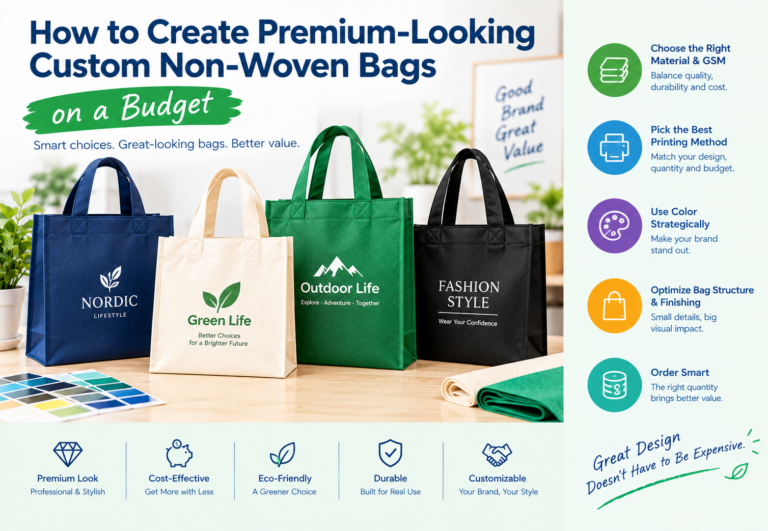

Creating premium-looking custom non-woven bags does not always require an expensive material or complicated design. With the right combination of fabric weight, bag structure, colors, printing methods, and finishing details, businesses can achieve an attractive, professional result while keeping production costs under control.
For retailers, promotional agencies, distributors, and growing brands, custom non-woven bags offer a practical way to deliver branded packaging without the higher costs associated with some traditional packaging materials.
The key is knowing where to invest and where to simplify.
In this guide, we explain how to create premium-looking custom non-woven bags on a budget, including practical design strategies, material choices, printing options, and bulk ordering tips.
1. Choose the Right GSM Instead of Automatically Choosing the Thickest Material
Fabric weight is one of the first decisions to make when customizing non-woven bags. It affects the bag’s hand feel, appearance, structure, durability, and material cost.
GSM stands for grams per square meter. A higher GSM generally means more material per square meter, but the best choice depends on the bag’s intended use.
Here is a practical guide:
| Fabric Weight | General Characteristics | Suitable Applications |
|---|---|---|
| 70 GSM | Lightweight and economical | Promotional giveaways, lightweight products |
| 80 GSM | Balanced weight and flexibility | Shopping bags, trade shows, everyday promotions |
| 90 GSM | More substantial hand feel | Retail packaging, corporate gifts |
| 100–120 GSM | Thicker and more structured | Premium reusable bags, heavier products |
If your goal is to create a premium appearance without significantly increasing costs, 80–90 GSM can be a useful starting point for many projects.
For lightweight promotional giveaways, a lower GSM may be sufficient. For retail packaging or bags intended for repeated use, a heavier material may provide better value over time.
Budget tip: Choose GSM based on the actual load and expected usage rather than selecting the heaviest option by default. A well-designed 80 GSM bag may be more suitable for your project than an unnecessarily heavy bag.
2. Select a Bag Structure That Looks More Refined
The bag’s shape has a major influence on how customers perceive its quality.
Even with the same fabric, different constructions can create very different impressions.
Consider these common styles:
Flat Non-Woven Bags
Flat bags are simple, lightweight, and economical to manufacture. They are suitable for flyers, brochures, lightweight products, and promotional distribution.
Their simple construction makes them a good option when keeping the unit price low is the priority.
Gusseted Non-Woven Bags
Side or bottom gussets provide additional capacity and help the bag accommodate products with greater volume.
This structure can also create a more substantial appearance, making it suitable for supermarkets, retail stores, and product packaging.
Box-Shaped Non-Woven Bags
Box-shaped bags have a more defined structure and can stand upright more easily when properly constructed.
They are often suitable for gift packaging, corporate events, and retail applications where presentation matters.
Foldable Non-Woven Bags
Foldable bags offer convenience and portability. They can be designed with compact folding structures, making them practical promotional products that recipients can keep and reuse.
Budget tip: You do not need an unusually complicated shape to create a premium impression. A clean gusseted or box-shaped design with balanced proportions can look more professional than a basic flat bag with excessive decoration.
3. Use Color Strategically to Create a Premium Appearance
Color is one of the most cost-effective ways to improve the appearance of a custom non-woven bag.
The right color combination can make a relatively simple bag look elegant, modern, and consistent with your brand identity.
Some popular options include:
- Black: Creates a clean, sophisticated appearance and works well for fashion, cosmetics, and premium retail brands.
- Navy Blue: Offers a professional look suitable for corporate gifts, business events, and retail packaging.
- Dark Green: Can support natural, lifestyle, and environmentally focused brand identities.
- Kraft Brown: Creates a simple, understated appearance associated with natural-style packaging.
- White: Provides a clean background that works well with many logo colors.
- Burgundy: Adds a distinctive and refined appearance for gift packaging and specialty retail.
You do not need multiple colors to make a bag look attractive.
A single base color combined with a contrasting logo can create a strong visual identity.
For example, a black bag with a white logo, a navy bag with a silver-colored design, or a natural-toned bag with dark green branding can all look polished without requiring complicated artwork.
Budget tip: Use one main bag color and one or two brand colors. A consistent color palette often looks more professional than adding too many decorative elements.
4. Keep the Logo Design Clean and Easy to Recognize
A premium-looking bag does not need to be covered with graphics.
In many cases, a simple and well-positioned logo creates a stronger impression than a large amount of text and decoration.
When preparing your artwork, consider the following:
Use a Clear Logo
Avoid overly complicated graphics with extremely thin lines or tiny text. Non-woven fabric has a textured surface, so very fine details may not reproduce as clearly as they do on a computer screen.
Choose the Right Logo Size
A logo should be large enough to remain visible when the bag is carried, but not so large that it overwhelms the overall design.
Consider the proportions of the bag and the available flat printing area.
Leave Enough Empty Space
White space helps separate the logo from other visual elements. It gives the design a cleaner and more organized appearance.
Avoid Unnecessary Text
Unless the bag is intended to communicate detailed product information, keep the printed message short.
A brand logo, website, or brief slogan is often sufficient.
Budget tip: A simple one-color logo can reduce printing complexity while maintaining a strong brand presence.
5. Choose a Printing Method That Matches Your Design and Budget
The printing method affects both the final appearance and the total production cost.
For custom non-woven bags, screen printing and heat transfer are two options worth discussing with your manufacturer.
Screen Printing
Screen printing is commonly used for logos and graphics with a limited number of solid colors.
Its advantages include:
- Strong, bold color coverage.
- Suitable for simple brand logos.
- Practical for many medium- and large-volume orders.
- A straightforward option for designs with limited colors.
For businesses that want a clean logo on a colored non-woven bag, screen printing can be a cost-effective choice.
Heat Transfer Printing
Heat transfer printing is useful for designs that contain multiple colors, gradients, or more detailed graphics.
Potential advantages include:
- Reproduction of more complex artwork.
- Greater flexibility for colorful designs.
- Suitable for promotional graphics and detailed branding.
However, the actual print quality and cost depend on the transfer material, bag surface, artwork size, and production setup.
How to Keep Printing Costs Under Control
If your goal is to achieve a premium appearance at a reasonable price:
- Limit the number of print colors where possible.
- Avoid unnecessarily large printing areas.
- Use a simple logo with strong contrast.
- Confirm the printing method before finalizing the artwork.
- Request a sample to evaluate the actual result.
The best printing method is not necessarily the most advanced one. It is the method that produces the appearance you need at a cost that works for your order.
6. Use Lamination and Finishing Details Selectively
Lamination can change the appearance of non-woven bags and create a smoother surface for printing.
Common options include:
Matte Lamination
Matte lamination creates a soft, understated appearance. It is often suitable for fashion brands, cosmetics, gift packaging, and businesses that prefer a modern visual style.
Glossy Lamination
Glossy lamination produces a brighter surface and can make printed colors appear more vivid.
It may be suitable for promotional packaging, colorful retail designs, and brands that want a more eye-catching finish.
Reinforced Handles and Bottoms
Construction details can influence how customers perceive the quality of a bag.
Reinforced handles, stronger attachment points, and a suitable bottom structure can improve usability and help the bag maintain its shape during normal use.
However, not every project needs every upgrade.
Budget tip: Prioritize finishing options that directly support your brand image or product requirements. If the bag already has an attractive color and a well-designed logo, additional decorative effects may not be necessary.
7. Pay Attention to Handle Design
Handles are easy to overlook, but they influence both the appearance and user experience of a non-woven bag.
Common handle options include:
- Loop handles: A familiar option for shopping and promotional bags.
- Die-cut handles: Create a simple integrated handle design.
- Reinforced handles: Provide additional support for applications that require greater carrying strength.
- Extended handles: Allow the bag to be carried more comfortably over the shoulder, depending on its dimensions and construction.
The best option depends on the bag’s size, expected load, and intended use.
For a premium retail bag, comfortable handles with neat attachment points can make a noticeable difference.
Budget tip: Select a handle style that matches the bag’s purpose instead of adding unnecessary accessories. A well-proportioned handle with neat construction can be more effective than a complicated design.
8. Choose Standard Sizes to Reduce Production Costs
Custom dimensions can help your bag fit a specific product, but they may also introduce additional production considerations.
If your product can fit a standard bag size, using an existing size may simplify manufacturing.
Before deciding on dimensions, consider:
- The width and height of the products being packed.
- Whether the bag needs side or bottom gussets.
- The weight of the products.
- How the bag will be stored and transported.
- Whether the bag needs to accommodate several products at once.
For retail businesses, it may also be useful to standardize bag sizes across several product categories.
This can simplify inventory management and make repeat orders easier to organize.
Budget tip: Avoid unnecessary customization. If a standard size meets your packaging requirements, use it as a starting point and spend your budget on the features customers will notice most.
9. Order in the Right Quantity to Improve Unit Cost
Order quantity is an important part of custom packaging budgeting.
The total price of a custom non-woven bag project may include material, printing setup, bag construction, finishing, and packaging.
For many manufacturing processes, fixed setup costs can be distributed across more units when the order quantity increases.
This means a larger order may offer a lower unit price, although the actual savings depend on the bag specifications and production arrangement.
For businesses with predictable demand, planning purchases in advance can help improve cost efficiency.
Consider these practical steps:
- Estimate your expected sales or promotional demand.
- Compare quotations at different quantities.
- Consider whether the bags can be used across multiple campaigns.
- Standardize designs where possible.
- Plan repeat orders before existing inventory runs out.
For manufacturers, minimum order quantities vary by bag style, printing process, and production requirements. Confirm the actual MOQ before placing your order.
10. Avoid These Common Mistakes When Creating Budget-Friendly Premium Bags
Trying to save money in the wrong places can make a bag look cheaper rather than more premium.
Here are some mistakes to avoid.
Choosing the Lowest GSM Without Considering the Application
A lightweight bag may reduce the initial cost, but it may not be suitable for products that require more support.
Always match the fabric weight to the expected load and usage.
Adding Too Many Design Elements
Multiple colors, large graphics, decorative text, and unnecessary patterns can make the design look crowded.
A simple design is often easier to recognize and reproduce.
Ignoring Color Contrast
A logo that blends into the bag background can become difficult to see.
Choose combinations that provide sufficient contrast.
Selecting a Printing Method Based Only on Price
Different printing methods have different strengths and limitations.
A low-cost option is not a good deal if it cannot reproduce your artwork properly.
Skipping Sample Approval
A digital mockup cannot fully demonstrate fabric texture, actual color appearance, handle construction, or print performance.
Reviewing a physical sample before bulk production can help identify problems early.
11. A Practical Checklist for Ordering Premium-Looking Non-Woven Bags
Before requesting a quotation, prepare the following information:
| Specification | What to Confirm |
|---|---|
| Bag application | Retail, shopping, promotional, gift packaging, or events |
| Material | PP non-woven fabric |
| Fabric weight | 70–120 GSM, depending on requirements |
| Bag style | Flat, gusseted, box-shaped, or foldable |
| Bag dimensions | Width, height, and gusset |
| Bag color | Preferred base color |
| Printing | Screen printing, heat transfer, or another suitable method |
| Artwork | Logo file, colors, and print position |
| Handles | Loop, die-cut, reinforced, or extended |
| Quantity | Estimated order volume |
| Finishing | Matte or glossy lamination, if required |
| Delivery | Required delivery date and destination |
Providing these details allows the manufacturer to evaluate your requirements and recommend a practical combination of materials, printing, and construction.
Frequently Asked Questions
1. Can custom non-woven bags look premium without using very thick fabric?
Yes. Fabric weight is only one factor affecting the final appearance. Color selection, bag structure, logo placement, printing quality, and finishing details also contribute to the overall impression. A well-designed bag with suitable GSM can look professional without using the heaviest material.
2. What GSM is suitable for premium-looking non-woven bags?
For many retail and promotional applications, 80–90 GSM is a practical starting range. For heavier products or bags intended for more demanding repeated use, 100–120 GSM may be worth considering. The best choice depends on the bag dimensions, construction, and expected load.
3. Is lamination necessary for a premium non-woven bag?
No. Lamination is optional. It can create a smoother surface and a different visual finish, but an unlaminated bag can also look attractive with the right fabric color, logo, and construction.
4. Which printing method is more affordable for custom non-woven bags?
Screen printing is often a cost-effective choice for simple logos with a limited number of colors. Heat transfer may be more suitable for detailed or full-color artwork. The final cost depends on quantity, print size, material, and production requirements.
5. How can I reduce the cost of custom non-woven bags without sacrificing quality?
Start by selecting a suitable GSM, using standard dimensions where possible, simplifying the artwork, limiting print colors, and choosing only the finishing features that add real value. Comparing quotations with identical specifications is also important.
6. What is the MOQ for custom non-woven bags?
MOQ depends on the bag style and production method. As an indicative reference, sewn non-woven bags may start from around 500 pieces, while heat-pressed non-woven bags may require around 10,000 pieces. Actual requirements should be confirmed based on the design, dimensions, printing, and production plan.
Conclusion
Creating premium-looking custom non-woven bags on a budget is about making smart choices rather than adding expensive features.
The right GSM, a refined bag structure, a consistent color palette, a clear logo, and a suitable printing method can significantly improve the overall appearance without unnecessarily increasing production costs.
For businesses ordering custom bags in bulk, the best approach is to prioritize the features that customers will notice and use while keeping less important specifications simple.
If you are looking for a reliable solution for your next retail, promotional, or packaging project, explore our custom non-woven bags for business branding and wholesale supply.
Share your preferred bag style, dimensions, logo, and estimated quantity with our team to discuss suitable materials, printing options, and a cost-effective custom solution.