
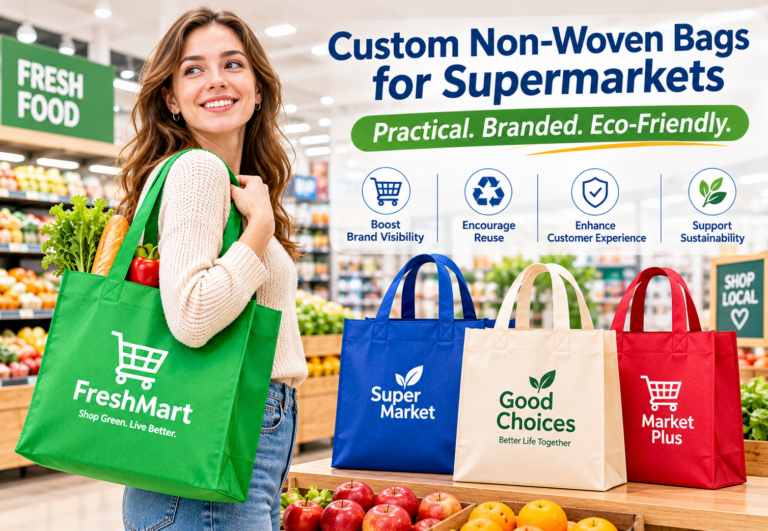

For supermarkets and grocery stores, shopping bags are more than simple packaging. They help customers carry everyday purchases, support checkout operations, and provide retailers with an opportunity to build brand recognition beyond the store.
As reusable shopping becomes more common, many grocery retailers are exploring custom non-woven bags as an alternative to conventional disposable carrier bags. These bags can be customized with store logos, brand colors, different sizes, and practical structural features to meet a wide range of shopping needs.
However, not every shopping bag is suitable for carrying groceries. Food products vary in weight, shape, and packaging requirements. A bag designed for lightweight household items may not perform well when carrying bottles, canned goods, or multiple grocery products.
In this guide, we explain how supermarkets and grocery stores can choose the right custom non-woven bags, from material weight and bag construction to printing, hygiene considerations, and bulk purchasing.
1. Why Do Supermarkets Use Custom Non-Woven Shopping Bags?
Supermarkets handle a large number of customer transactions every day. Their packaging needs to be practical, easy to distribute, and cost-effective.
Custom non-woven bags offer several advantages for grocery retailers.
Reusable for Everyday Shopping
Non-woven polypropylene (PP) bags are designed for repeated use when manufactured with suitable materials and construction.
Customers can keep them at home, in their cars, or in their everyday bags and bring them back for future shopping trips.
For supermarkets, encouraging customers to reuse shopping bags can also support initiatives aimed at reducing reliance on disposable carrier bags.
Lightweight but Practical
Non-woven fabric is relatively lightweight, making it convenient for carrying and storing large quantities of bags.
Retailers can choose different fabric weights and bag structures depending on the products customers typically purchase.
Suitable for Bulk Purchasing
Supermarkets often need thousands of shopping bags for regular operations, promotional campaigns, or new store openings.
Custom non-woven bags can be produced in bulk with consistent specifications, helping retailers manage packaging costs and maintain a uniform brand appearance.
Additional Brand Exposure
A branded grocery bag can continue displaying a supermarket’s logo after the customer leaves the store.
When customers reuse the bag for shopping or everyday activities, the retailer gains additional opportunities for brand visibility.
2. Choosing the Right GSM for Grocery Shopping Bags
GSM stands for grams per square meter. It measures the weight of the non-woven fabric and is one of the specifications buyers should consider when ordering custom bags.
For supermarkets, choosing the right GSM is important because grocery purchases can include products with different weights and shapes.
Here is a general reference for selecting fabric weight:
| Fabric Weight | Typical Applications |
|---|---|
| 70–80 GSM | Lightweight promotional bags and small shopping purchases |
| 90–100 GSM | General grocery shopping and reusable retail bags |
| 110–120 GSM | Larger shopping bags and applications requiring a more substantial fabric |
These ranges are general guidelines, not guaranteed load capacities.
A higher GSM does not automatically mean a bag can carry more weight. Actual performance also depends on bag dimensions, handle construction, seams, bottom reinforcement, and fabric quality.
What GSM Is Best for Supermarkets?
For general grocery shopping, 90–100 GSM can be a practical starting point.
If customers regularly carry heavier products such as bottled drinks, canned goods, or large household items, retailers may consider 100–120 GSM fabric together with reinforced handles and suitable bottom construction.
Before placing a large order, ask your manufacturer to produce samples and evaluate them with representative grocery loads.
3. Select the Right Bag Structure for Grocery Products
Bag structure directly affects how easily customers can organize and carry their purchases.
Supermarkets should consider the typical size, weight, and shape of the products sold in their stores.
Flat Non-Woven Tote Bags
Flat tote bags have a simple construction and are suitable for lightweight shopping items.
They can work well for convenience stores, small grocery purchases, promotional giveaways, and stores that need straightforward branded packaging.
Bottom-Gusset Shopping Bags
Bottom-gusset bags provide additional space at the base, allowing the bag to hold more products.
They are particularly useful for grocery shopping because customers often purchase several items in one transaction.
A wider bottom also helps accommodate products with different shapes.
Side-Gusset Shopping Bags
Side gussets allow the bag to expand horizontally, creating additional internal capacity.
This structure can be suitable for larger grocery purchases, packaged food products, and household goods.
Box-Shaped Non-Woven Bags
Box-shaped bags have a more defined structure, often with a flat bottom and reinforced sides.
They can help the bag maintain its shape when carrying multiple products and are worth considering for supermarkets that want a more structured shopping bag.
Foldable Non-Woven Bags
Foldable bags are designed to take up less space when stored.
They can be offered as reusable shopping bags for customers who want to keep an extra bag in their car, handbag, or backpack.
For supermarkets, they may also work well as promotional products or loyalty program gifts.
4. Handle Design and Reinforcement for Heavy Groceries
Handles are one of the most important structural features of a grocery shopping bag.
Customers may carry bottles, canned food, dairy products, and other relatively heavy items. Poorly designed handles can make the bag uncomfortable to carry or cause premature damage.
Common handle options include:
Loop Handles
Loop handles are widely used on reusable shopping bags.
They are convenient for customers to hold and can be produced in different lengths depending on whether the bag is intended for hand carrying or shoulder carrying.
Reinforced Handles
Reinforced handles use additional material or construction support around the handle area.
This is worth considering for bags intended to carry heavier grocery purchases.
Die-Cut Handles
Die-cut handles are cut directly into the bag material.
They create a simple integrated design and may be suitable for certain lightweight applications. For heavier grocery products, the handle area should be carefully evaluated and tested.
Extended Handles
Longer handles allow customers to carry bags over their shoulders.
This can be convenient when shopping with multiple bags, although the final handle length should be matched to the bag dimensions and intended load.
Buyer tip: Do not evaluate handle strength separately from the rest of the bag. The handle attachment, side seams, bottom construction, and fabric specifications all contribute to overall performance.
5. Custom Printing Ideas for Supermarket Shopping Bags
For supermarket chains and independent grocery stores, custom printing helps make shopping bags recognizable and consistent with the store’s branding.
A good design should be clear, practical, and easy to reproduce across large production quantities.
Print Your Supermarket Logo
The store logo should be easy to recognize and positioned where customers can see it.
Common placements include:
- Centered on the front panel
- Large logo printing on both sides
- Small logo with a simple slogan
- Repeated brand patterns
Use Consistent Brand Colors
Choose fabric and printing colors that match the supermarket’s visual identity.
Consistent colors help connect shopping bags with store signage, promotional materials, and other packaging.
Add Promotional Messages
Shopping bags can also support marketing campaigns.
Examples include:
- Shop Smart, Shop Local
- Fresh Choices Every Day
- Your Neighborhood Grocery Store
- Bring Your Bag, Shop Again
- Special Seasonal Promotions
Keep the design readable and avoid overcrowding the available printing area.
Choose a Suitable Printing Method
Different printing methods may be suitable depending on the artwork and material.
Screen printing: Commonly used for logos, text, and designs with a limited number of colors.
Heat transfer printing: Can be considered for more detailed graphics and multi-color artwork, depending on material compatibility.
Laminated printing: Laminated non-woven bags have an additional surface layer that can provide a smoother appearance and support certain detailed printing requirements.
The best printing method should be confirmed with your manufacturer after reviewing the artwork, material, and production quantity.
6. Food Hygiene and Grocery Bag Management
Hygiene is an important consideration for supermarkets because shopping bags may be used to carry raw meat, fresh produce, packaged food, and household products.
A standard non-woven shopping bag is a carrier bag. It should not automatically be treated as a food-contact container or a substitute for food-grade packaging.
Supermarkets should establish practical bag-use guidelines.
Separate Raw Meat from Other Groceries
Raw meat and seafood should remain in suitable leak-resistant packaging. Retailers should consider separating these products from ready-to-eat food, fresh produce, and other groceries during checkout.
Keep Reusable Bags Clean
Customers should be encouraged to clean reusable bags regularly according to the material and manufacturer’s care instructions.
Retailers can also provide simple reminders about keeping grocery bags clean and dry between uses.
Consider Different Bag Types for Different Products
Not every grocery item needs the same packaging.
For example:
- General packaged groceries can use standard reusable shopping bags.
- Fresh produce may require separate produce bags.
- Raw meat and seafood should use suitable leak-resistant packaging.
- Frozen products may require insulated cooler bags when temperature retention is needed.
Standard non-woven bags are not automatically insulated or leakproof. If temperature control is important, supermarkets should consider a purpose-designed cooler bag.
These distinctions help retailers improve packaging suitability while maintaining a more organized checkout process.
7. How Much Do Custom Non-Woven Grocery Bags Cost?
The price of custom supermarket bags depends on several production specifications.
Understanding these factors helps purchasing teams prepare a realistic budget.
Fabric GSM
Higher fabric weight generally requires more raw material, which can increase the unit price.
Bag Dimensions
Larger bags require more fabric and may involve additional production materials.
Bag Structure
Flat bags, gusseted bags, box-shaped bags, and foldable bags have different construction requirements.
Printing Requirements
The number of printing colors, artwork complexity, print coverage, and selected printing method can all influence the quotation.
Handle and Bottom Reinforcement
Additional reinforcement can increase material and production costs, but it may be worthwhile for bags intended to carry heavier grocery purchases.
Order Quantity
Larger orders can reduce the unit cost by distributing production setup expenses across more bags.
For an accurate quotation, supermarkets should provide the supplier with the following details:
- Required bag dimensions
- Estimated order quantity
- Preferred GSM
- Bag structure
- Handle type
- Printing artwork
- Fabric color
- Packaging requirements
- Delivery destination and schedule
8. What Is the MOQ for Custom Non-Woven Shopping Bags?
Minimum order quantity (MOQ) varies according to the bag design, construction method, printing requirements, and production process.
As an indicative reference:
- Sewn non-woven bags: Around 500 pieces
- Heat-pressed non-woven bags: Around 10,000 pieces
These are general reference quantities rather than fixed production requirements. Actual MOQ should be confirmed according to the specific design and factory production arrangement.
For supermarkets with multiple branches, centralized bulk purchasing may help maintain consistent bag specifications and reduce repeated setup costs.
However, retailers should also consider storage space, inventory turnover, and expected consumption before ordering very large quantities.
9. How to Choose a Reliable Non-Woven Bag Manufacturer
Selecting the right manufacturer is an important part of a successful supermarket packaging project.
A supplier should understand the practical requirements of grocery shopping bags rather than simply offering standard promotional bags.
Here are several points purchasing teams should evaluate.
Experience with Retail and Grocery Bags
Ask whether the manufacturer has experience producing shopping bags for supermarkets, grocery stores, and retail chains.
Material and Construction Options
A capable supplier should be able to discuss different GSM specifications, bag structures, handle options, and reinforcement methods.
Printing Capabilities
Review available printing methods and ask for samples of previous custom bag projects.
Sample Development
Request samples to evaluate dimensions, fabric feel, logo quality, seams, handles, and bottom construction before mass production.
Quality Control
Discuss how the supplier checks material consistency, printing alignment, dimensions, stitching or bonding, and finished bag appearance.
Production and Delivery Capacity
For supermarkets with multiple locations, consistent production quality and reliable delivery schedules are particularly important.
At CXGIAE, we provide custom packaging solutions for businesses looking for branded shopping bags and other retail packaging products.
Explore our Custom Non-Woven Bags for Business Branding to learn more about available materials, bag styles, and customization options.
10. Checklist Before Ordering Custom Supermarket Bags
Before approving your next bulk order, use this checklist to confirm the main specifications.
| Item | What to Confirm |
|---|---|
| Bag dimensions | Width, height, and gusset |
| Fabric weight | Required GSM |
| Material color | Standard or custom color |
| Bag structure | Flat, gusseted, box-shaped, or foldable |
| Handle design | Loop, die-cut, or reinforced |
| Printing | Logo, colors, artwork, and print positions |
| Construction | Sewn or heat-pressed |
| Performance | Sample evaluation and load testing |
| Quantity | Estimated demand and inventory needs |
| Delivery | Production schedule and shipping arrangements |
For supermarket chains, it is also useful to establish a standard specification sheet so that repeat orders and different store locations can maintain consistent packaging.
11. Frequently Asked Questions
Are non-woven bags suitable for supermarket shopping?
Yes. Custom PP non-woven bags can be designed for general grocery shopping, provided the fabric weight, bag dimensions, handles, and construction are appropriate for the intended products.
What GSM is best for grocery shopping bags?
For general supermarket use, 90–100 GSM is a practical starting point. Retailers carrying heavier products may consider 100–120 GSM with reinforced handles and suitable bottom construction. Actual carrying performance should be verified through sample testing.
Can custom non-woven bags carry heavy groceries?
They can be designed for heavier grocery purchases, but load capacity depends on the complete bag construction, not GSM alone. Ask your supplier about reinforcement and request load testing with representative products.
Are non-woven grocery bags waterproof?
Standard non-woven fabric is not automatically waterproof. Its moisture resistance depends on the material and any additional coating or lamination. If your supermarket requires stronger moisture protection, discuss laminated options with your manufacturer.
Can supermarkets print their logos on both sides of the bags?
Yes. Custom non-woven bags can be printed on one or both sides, depending on the design and printing requirements.
What is the MOQ for custom non-woven supermarket bags?
MOQ depends on the bag structure and production method. As a general reference, sewn styles may start at around 500 pieces, while heat-pressed styles may require around 10,000 pieces. Confirm the exact MOQ with your supplier.
Are non-woven bags suitable for carrying fresh meat and frozen food?
Standard non-woven shopping bags should not be treated as leakproof or insulated food packaging. Fresh meat and seafood should remain in appropriate sealed packaging, while frozen products requiring temperature retention should be carried in purpose-designed insulated bags.
Conclusion
Custom non-woven bags can be a practical packaging solution for supermarkets and grocery stores that need reusable, customizable shopping bags for everyday customer purchases.
The most important purchasing decisions involve choosing the right GSM, bag structure, handle design, printing method, and construction quality.
For grocery retailers, functionality should always come first. A shopping bag needs to accommodate different products, remain comfortable to carry, and perform reliably under its intended conditions.
By working with an experienced manufacturer and confirming specifications through samples, supermarkets can develop branded shopping bags that support daily operations while increasing brand visibility.
Looking for custom non-woven shopping bags for your supermarket or grocery store?
Visit CXGIAE Custom Non-Woven Bags and contact our team to discuss your bag design, material requirements, MOQ, and bulk order quotation.