
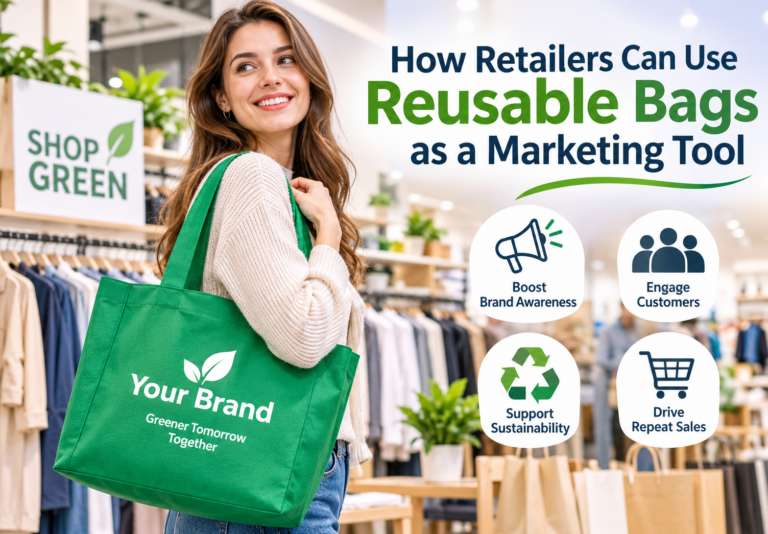

In retail, marketing does not have to stop when customers leave the store. Every shopping bag a customer carries outside can become an opportunity to introduce your brand to new audiences.
Reusable shopping bags are more than practical packaging. With the right design, materials, and branding, they can serve as mobile advertising tools that keep your business visible long after a purchase is completed.
For retailers, supermarkets, fashion brands, boutiques, and specialty stores, custom reusable bags offer a practical way to combine product packaging with brand promotion. This guide explores how retailers can use reusable bags as part of their marketing strategy and how to choose the right bags for their business.
1. Turn Everyday Shopping Bags into Mobile Advertisements
One of the biggest advantages of reusable bags is their potential for repeated exposure.
Unlike many traditional promotional materials that customers may discard shortly after receiving them, a well-designed reusable shopping bag can be used for grocery shopping, commuting, travel, and everyday activities.
Each time a customer carries the bag in public, your brand may be seen by other people.
For example:
- A supermarket bag may be used repeatedly for grocery shopping.
- A fashion retail bag may accompany customers to shopping centers or social events.
- A branded tote bag may be used for work, school, or daily errands.
- A promotional bag may continue attracting attention after a trade show or marketing event.
To maximize this opportunity, retailers should make their brand name, logo, and visual identity easy to recognize. A clean design with strong visual contrast often works better than a bag crowded with too many promotional messages.
2. Strengthen Brand Recognition Through Consistent Design
Brand recognition develops through repeated and consistent visual experiences.
Reusable bags provide retailers with another physical touchpoint where they can reinforce their brand identity. Instead of using generic shopping bags, businesses can customize colors, logos, graphics, and other design elements to match their existing marketing materials.
Consider incorporating these elements:
Brand logo: Place your logo in a prominent position where it can be easily seen.
Brand colors: Use colors that match your website, store interior, product packaging, and other marketing materials.
Typography: Choose readable fonts that reflect your brand personality.
Visual graphics: Add simple patterns, illustrations, or brand-related graphics to make the bag more distinctive.
Brand message: Include a short slogan, website address, or social media handle when appropriate.
Consistency matters. When customers repeatedly see the same visual identity across your shopping bags, packaging, and store environment, it becomes easier for them to recognize and remember your brand.
3. Encourage Repeat Use and Build Long-Term Customer Engagement
A reusable bag becomes more valuable as customers continue using it.
Retailers can encourage repeat use by choosing bags that customers find practical and attractive. A bag that is comfortable to carry, suitable for everyday activities, and appropriate for different shopping occasions has a better chance of staying in use.
Consider these features when selecting reusable bags:
- Suitable capacity: Choose dimensions that accommodate the products customers commonly purchase.
- Comfortable handles: Handle length and construction should match the expected carrying style.
- Appropriate material weight: Select a material weight suitable for the intended use.
- Practical structure: Gussets, reinforced bottoms, or structured sides can improve usability.
- Attractive appearance: A visually appealing bag gives customers more reasons to use it again.
Retailers can also introduce small incentives to encourage customers to bring their bags back. For example, a store might offer loyalty points, a small discount, or participation in a promotional campaign for customers who reuse their branded shopping bags.
The incentive should fit the retailer’s business model and local regulations.
4. Use Reusable Bags in Seasonal and Promotional Campaigns
Reusable bags are particularly useful for campaigns that need consistent branding and practical promotional merchandise.
Instead of creating a completely different promotional item for every campaign, retailers can customize reusable bags around specific occasions, products, or marketing themes.
Some practical campaign ideas include:
Holiday promotions
Create limited-edition bags for Christmas, Halloween, Valentine’s Day, Easter, or other important shopping seasons. Seasonal graphics can make ordinary shopping bags feel more relevant and collectible.
New product launches
Introduce a custom bag featuring the new product line, campaign slogan, or launch artwork. It can be included with qualifying purchases or distributed at launch events.
Customer loyalty campaigns
Offer branded reusable bags as gifts for loyalty program members, repeat customers, or customers who reach a specific purchase threshold.
Store anniversaries
Create special-edition bags featuring the store’s anniversary message or a unique brand design.
Grand openings
Distribute custom bags during new store openings to increase local brand visibility and give visitors a useful promotional item.
For retailers managing multiple campaigns throughout the year, reusable bags can provide a flexible promotional platform.
5. Choose the Right Reusable Bag Material for Your Retail Business
Not all reusable bags serve the same purpose. The right material depends on your products, brand positioning, target customers, budget, and expected usage.
Here are three common options for retail businesses.
PP Non-Woven Bags
PP non-woven bags are a popular option for supermarkets, retail chains, promotional campaigns, and wholesale shopping bag programs.
They are lightweight, available in different sizes and structures, and suitable for a wide range of custom printing requirements.
Common options include:
- Flat or gusseted shopping bags
- Box-style bags with structured bottoms
- Foldable promotional bags
- Die-cut handle bags
- Loop handle bags
- Sewn or heat-pressed constructions
- Matte or glossy laminated finishes
Material weights such as 70–120 GSM are commonly considered for different non-woven bag applications. However, GSM refers to fabric weight, not a guaranteed carrying capacity. Actual performance also depends on bag dimensions, construction, handle attachment, and testing.
Canvas Bags
Canvas bags are often selected by fashion retailers, boutiques, lifestyle brands, and businesses looking for a more substantial fabric appearance.
They can be customized with different colors, sizes, handles, and printing designs. Their style may also make them suitable for customers who want to use shopping bags as everyday carry bags.
Reusable Paper Bags
For retailers that prefer a paper-based packaging presentation, reusable paper bag designs can be considered depending on the paper grade, construction, handle strength, and intended use.
They are commonly used by fashion stores, gift shops, specialty retailers, and businesses that want their packaging to match a particular brand aesthetic.
The best material is not necessarily the most expensive one. It is the option that meets your customers’ needs while supporting your marketing objectives and budget.
6. Make Your Reusable Bags More Memorable with Custom Printing
Printing is one of the most important elements of a branded reusable bag.
A simple logo can establish brand recognition, while a more creative design can turn the bag into a distinctive promotional item.
Depending on the bag material and construction, retailers can consider several customization approaches:
- Screen printing: Suitable for many non-woven and fabric bag designs, particularly logos and relatively simple artwork.
- Heat transfer printing: Useful for designs requiring detailed graphics or multiple colors, subject to material compatibility.
- Laminated printing: Allows printed designs to be applied to laminated non-woven bags, supporting more extensive visual coverage.
- Custom color matching: Helps maintain consistency with established brand guidelines.
When preparing artwork, consider the available printing area, logo proportions, background color, and contrast. A design that looks attractive on a computer screen may need adjustments to work well on an actual bag.
It is also helpful to request a sample or approve a production proof before placing a large order.
7. Add QR Codes and Digital Marketing Elements
Reusable bags can connect offline shopping experiences with online marketing.
By adding a QR code or short website address, retailers can encourage customers to interact with their brand after leaving the store.
Depending on the campaign, a QR code could direct customers to:
- A product catalog
- A seasonal promotion
- A loyalty program registration page
- A brand website
- A social media account
- A customer feedback form
- A special campaign landing page
For example, a fashion retailer could print a QR code on a shopping bag that leads to its latest collection. A supermarket could use the code to introduce weekly promotions or a digital membership program.
Make sure the QR code is large enough to scan, has sufficient contrast, and links to a mobile-friendly page. Test it on a physical sample before mass production.
8. Use Reusable Bags to Support Customer Loyalty Programs
Customer loyalty programs are designed to encourage repeat purchases and strengthen relationships with existing customers.
Custom reusable bags can become part of these programs in several ways.
Reward repeat customers: Offer a branded bag after a customer reaches a purchase milestone.
Create membership gifts: Include reusable bags in welcome packages for new loyalty program members.
Introduce exclusive designs: Release limited-edition bags that are available only to members.
Encourage bag returns: Provide incentives for customers who bring their reusable bags when shopping.
Connect bags with special offers: Add a QR code or campaign message that directs customers to a member-only promotion.
These approaches make reusable bags part of a broader customer engagement strategy rather than simply another packaging expense.
9. Calculate the Marketing Value of Reusable Bags
When planning a reusable bag program, retailers should look beyond the unit price.
A useful evaluation considers both the initial cost and the potential marketing value generated through repeated use.
Important factors include:
- Bag material and GSM
- Bag dimensions and construction
- Printing colors and coverage
- Handle type and reinforcement
- Lamination or additional finishing
- Order quantity
- Packaging and shipping costs
- Expected customer usage
- Promotional distribution strategy
Retailers can also track campaign performance by using unique QR codes, promotional landing pages, discount codes, or customer surveys.
For example, if a campaign bag includes a dedicated QR code, the retailer can measure how many people scan it and which campaign generates more engagement.
This makes it easier to compare different bag designs and promotional strategies over time.
10. Work with a Reliable Custom Bag Manufacturer
For retailers planning to purchase reusable bags in bulk, choosing the right manufacturer is an important part of the process.
A reliable supplier should be able to understand your requirements, recommend suitable materials, support artwork preparation, and maintain consistent production quality.
Before placing an order, consider discussing the following details:
- Product specifications: Confirm bag dimensions, material, GSM, handles, and construction.
- Artwork requirements: Provide your logo, brand colors, and printing files.
- Sampling: Review a physical sample or production proof before approving bulk manufacturing.
- Minimum order quantity: Confirm the MOQ based on your chosen bag style and production method.
- Production schedule: Discuss sample approval, production time, and shipping arrangements.
- Quality inspection: Confirm how printing, stitching, handles, and finished dimensions will be checked.
If you are sourcing custom PP non-woven bags for your retail business, explore our custom non-woven bags for business branding and wholesale supply.
We support custom bag projects with different sizes, materials, printing options, and bag constructions to help businesses develop packaging that matches their branding and purchasing requirements.
Frequently Asked Questions
1. How can reusable bags help retailers promote their brands?
Reusable bags can increase brand exposure when customers carry them in public and use them repeatedly. Custom logos, brand colors, and campaign messages help make each bag a mobile promotional tool.
2. Which reusable bags are best for retail marketing?
PP non-woven bags, canvas bags, and reusable paper bags are common options. The right choice depends on the retailer’s brand positioning, budget, product requirements, and intended customer use.
3. Can retailers print their logos on reusable shopping bags?
Yes. Many reusable bag types support custom logo printing. Available methods depend on the material, bag construction, artwork, and required print quality.
4. Are custom non-woven bags suitable for promotional campaigns?
Yes. PP non-woven bags are widely used for retail promotions, trade shows, customer gifts, and branded shopping bags. They offer flexible customization options, including different sizes, handles, colors, and printing designs.
5. What information should retailers provide when ordering custom reusable bags?
Retailers should prepare the estimated order quantity, bag dimensions, preferred material, GSM or fabric specifications, handle style, logo artwork, printing requirements, and delivery destination.
6. Can reusable bags be customized for seasonal promotions?
Yes. Retailers can create special designs for holidays, product launches, store anniversaries, and other promotional events. Custom printing allows campaign graphics and brand messages to be incorporated into the bag design.
Final Thoughts
Reusable bags can do more than carry products from a store to a customer’s home. With thoughtful design and a clear promotional strategy, they can help retailers increase brand visibility, encourage repeat engagement, and create more consistent customer experiences.
The key is to choose bags that customers genuinely want to use, while making sure the design reflects your brand identity.
For retailers planning their next shopping bag or promotional packaging project, investing in well-designed custom reusable bags can turn everyday packaging into a valuable part of the marketing mix.
Looking for a custom reusable bag supplier?
Explore CXGIAE’s custom non-woven bags and discuss your preferred materials, bag styles, printing requirements, and bulk order needs with our team.