
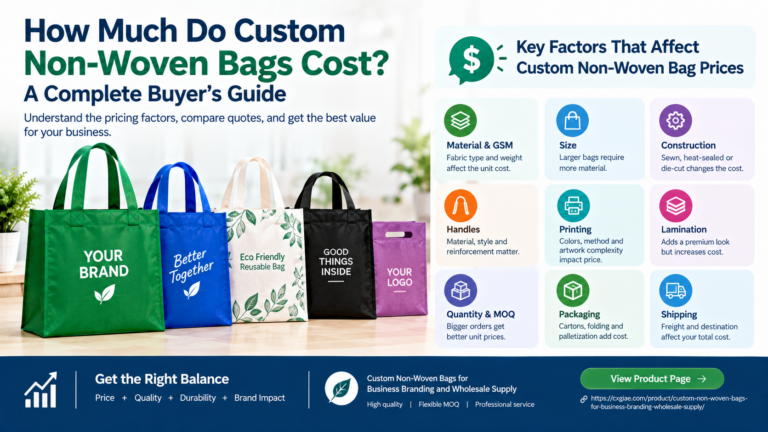

When businesses start sourcing custom non-woven bags, one of the first questions is usually:
How much does a custom non-woven bag cost?
The short answer is: there is no single standard price.
A basic promotional non-woven bag can have a very different cost from a large, reinforced, laminated bag designed for retail shopping. Material GSM, bag size, construction, handles, printing, lamination, order quantity, packaging, and shipping can all affect the final quotation.
For B2B buyers, the most important question is not simply “What is the cheapest price per bag?”
It is:
“What specification gives us the right balance of cost, quality, performance, and quantity?”
This guide explains how custom non-woven bag pricing works and what buyers should consider before requesting a quotation.
1. Why Is There No Fixed Price for Custom Non-Woven Bags?
Custom non-woven bags are manufactured according to a specific set of requirements.
Two bags may both be described as “custom non-woven bags,” but their production costs can be completely different.
For example:
- A lightweight promotional tote with one-color printing
- A medium-weight supermarket shopping bag
- A laminated retail bag with full-color printing
- A reinforced bag with a wide gusset and strong handles
- A custom box-style bag with additional construction
All of these products may use PP non-woven fabric, but they require different amounts of material, labor, printing, finishing, and production time.
Therefore, a supplier cannot provide a meaningful final price based only on the words “custom non-woven bag.”
A complete specification is needed.
2. The Main Factors That Affect Custom Non-Woven Bag Cost
Several variables normally work together to determine the final price.
2.1 Material and GSM
GSM means grams per square meter and is used to describe the weight of non-woven fabric.
A higher GSM generally means more material is used per square meter, which can increase material cost.
For example, a lightweight promotional bag and a heavier reusable shopping bag may use different GSM specifications because they have different performance requirements.
However, choosing the highest GSM available is not automatically the best purchasing decision.
The right GSM should depend on:
- What the bag needs to carry
- How frequently it will be reused
- Desired durability
- Bag dimensions
- Handle construction
- Overall budget
- Target customer experience
For B2B purchasing, the goal should be appropriate GSM, not simply maximum GSM.
2.2 Bag Size
Size is another major cost factor.
A larger bag generally requires more fabric, which increases material consumption.
Consider two bags with identical GSM and construction:
Bag A: 30 × 35 cm
Bag B: 45 × 40 × 10 cm
The second bag requires substantially more material because of its larger surface area and gusset.
This is why buyers should provide exact dimensions when requesting quotations.
A typical specification might include:
Width × Height × Gusset
rather than simply saying:
“Medium-size bag.”
For custom projects, even a small change in dimensions can affect material consumption and shipping volume.
3. Construction Method Can Change the Price
The way a non-woven bag is constructed also affects manufacturing cost.
Common options include:
- Sewn construction
- Heat-sealed construction
- Die-cut construction
- Gusseted construction
- Box-style construction
- Reinforced construction
A simple die-cut promotional bag may require a different production process from a sewn shopping bag with reinforced handles and bottom.
Additional construction steps can increase production time and labor.
However, simpler construction is not always better.
If a bag is intended to carry heavier products or be reused repeatedly, investing in appropriate construction and reinforcement can help prevent performance problems.
The best specification depends on the application.
4. Handles Are an Important Part of the Cost
Handles are sometimes overlooked when buyers compare quotations.
However, the handle is one of the areas that experiences significant stress during use.
Handle cost can depend on:
- Handle material
- Handle width
- Handle length
- Handle style
- Attachment method
- Reinforcement
- Sewing or sealing
- Expected carrying load
For example, a basic handle for a lightweight promotional bag may be very different from a reinforced handle designed for retail shopping.
A supplier should evaluate the fabric, handle, seams, bottom, and expected load as one system.
A heavier fabric cannot completely compensate for a poorly designed handle.
5. Printing Has a Direct Impact on the Final Price
Printing is another important part of custom bag pricing.
The cost can vary depending on:
- Number of printing colors
- Printing method
- Printing area
- One-side or two-side printing
- Artwork complexity
- Color requirements
- Printing coverage
- Special finishing requirements
A simple one-color logo is usually less complicated to produce than a large, detailed, multi-color design.
For brands with strict color requirements, buyers should also consider whether color matching, proofs, or additional sampling is required.
When requesting a quotation, provide the artwork or at least describe:
Logo + printing colors + printing position + printing area.
This gives the manufacturer much more useful information than simply saying:
“With logo.”
6. Lamination Can Increase the Cost
Laminated non-woven bags usually have an additional surface layer compared with standard non-laminated bags.
Lamination can provide:
- A smoother surface
- A different appearance
- Better print presentation
- Additional surface protection
- A more structured feel
However, the additional material and production process can increase the cost.
For buyers comparing quotations, always confirm whether the quoted bag is:
Laminated or non-laminated.
Otherwise, two apparently similar quotations may actually represent different products.
7. Order Quantity Has a Major Effect on Unit Cost
Quantity is one of the most important variables in B2B packaging pricing.
For example, the unit economics of:
- 500 bags
- 1,000 bags
- 5,000 bags
- 10,000 bags
- 50,000 bags
can be very different.
Certain setup and production costs can be distributed across a larger number of units when production volume increases.
As a result, larger orders can often achieve better unit economics.
But this does not mean buyers should always order the maximum possible quantity.
Consider:
Expected demand + inventory + storage + cash flow + shipping + future consumption
before deciding the quantity.
For a new product launch, smaller initial production may reduce inventory risk.
For an established retail program with predictable demand, larger production quantities may make more sense.
8. MOQ Can Affect Your Real Purchasing Cost
MOQ means Minimum Order Quantity.
Different manufacturers may have different MOQs depending on:
- Material
- Bag size
- Construction
- Printing method
- Production process
- Customization requirements
A supplier with a lower MOQ may be more suitable for a market test.
A larger MOQ may provide better unit economics for an established purchasing program.
Therefore, don’t compare suppliers only by asking:
“What is your lowest price?”
Also ask:
“What is the price at my actual purchasing quantity?”
For example, if your business needs 10,000 bags, request pricing specifically for 10,000 pieces.
That gives you a much more useful benchmark.
9. Packaging and Shipping Are Part of the Total Cost
The factory unit price is not always the same as your final procurement cost.
Your total landed cost may include:
Bag production + printing + packaging + inland transportation + freight + customs-related costs + other logistics expenses
For international B2B buyers, shipping can become particularly important when ordering large quantities.
Non-woven bags are relatively lightweight, but the total shipment volume can still affect logistics costs depending on bag dimensions, folding method, carton packing, and order quantity.
Therefore, buyers should consider both:
Product Cost
How much does each bag cost?
Total Procurement Cost
How much does the complete order cost to purchase and deliver?
The second number is often more useful for purchasing decisions.
10. Don’t Compare Quotations Without Comparing Specifications
This is one of the most important rules when sourcing custom non-woven bags.
Imagine receiving three quotations:
Supplier A: $0.35 / piece
Supplier B: $0.48 / piece
Supplier C: $0.62 / piece
At first glance, Supplier A appears cheaper.
But what if:
- A uses lower GSM
- B uses medium GSM
- C uses higher GSM
- A has a smaller bag
- B includes stronger handles
- C includes lamination
- A prints one side
- B prints both sides
- C uses full-color printing
- Different suppliers have different MOQs
The three prices are not actually comparable.
A better purchasing method is:
Same material + same GSM + same size + same construction + same handles + same printing + same quantity + same packaging requirements
Then compare the quotations.
This creates a genuine like-for-like comparison.
11. Example of a Complete Non-Woven Bag Cost Specification
Instead of sending a supplier a short message like:
“Please quote 10,000 custom bags.”
Send a more complete RFQ.
For example:
Product: Custom PP Non-Woven Shopping Bag
Material: PP Non-Woven
GSM: 90 GSM
Size: 400 × 350 × 100 mm
Color: Custom
Construction: Sewn
Handle: Reinforced loop handle
Printing: Custom logo, front and back
Printing: Full-color artwork
Lamination: Not required
Quantity: 10,000 pcs
Packaging: Export cartons
Destination: [Your destination]
A manufacturer can use this information to prepare a much more accurate quotation.
If you are unsure about the appropriate GSM, construction, or handle, you can also ask the manufacturer to recommend a suitable specification based on your application.
12. How to Reduce Custom Non-Woven Bag Costs Without Sacrificing Quality
Cost reduction does not necessarily mean choosing the cheapest material.
Instead, look for unnecessary specifications.
Consider the Right GSM
Don’t automatically choose an excessively high GSM if the bag only carries lightweight products.
Optimize the Size
Avoid making the bag significantly larger than necessary.
Simplify the Artwork
If a simple logo works for your brand, complex printing may not be necessary.
Choose an Appropriate Construction
Use reinforced construction where needed, but avoid unnecessary structural features.
Optimize Quantity
Order enough to achieve reasonable unit economics without creating excessive inventory.
Review Packaging
Efficient folding and carton packing can help manage shipment volume.
Ask for Tiered Pricing
Request quotations at several realistic quantities, such as:
- 1,000 pcs
- 5,000 pcs
- 10,000 pcs
- 20,000 pcs
This allows your purchasing team to see how quantity changes the unit economics.
13. What Is a Reasonable Budget for Custom Non-Woven Bags?
There is no universal price range that applies to every custom non-woven bag.
A simple promotional bag can have a completely different cost from a premium laminated shopping bag.
Instead of setting a budget based on a generic online price, define your requirements first.
At minimum, determine:
- Bag type
- Material
- GSM
- Size
- Construction
- Handle type
- Printing
- Lamination
- Quantity
- Delivery destination
Once these specifications are clear, you can request a supplier quotation based on your actual project.
This is much more reliable than using a generic “price per bag” as your purchasing benchmark.
14. Questions to Ask a Non-Woven Bag Manufacturer
Before placing a bulk order, ask the manufacturer:
Product Specifications
- What material will be used?
- What GSM is recommended?
- What size is included in the quotation?
- Is the bag sewn, heat-sealed, or die-cut?
- What handle construction is included?
- Is reinforcement included?
- Is lamination included?
Printing
- How many printing colors are included?
- Is printing on one side or both sides?
- What printing method will be used?
- Is artwork setup included?
- Can a pre-production sample be provided?
Pricing
- What is the MOQ?
- What is the unit price at my required quantity?
- Are setup costs included?
- Are sample costs included?
- What packaging is included?
- What shipping terms are available?
Production
- What is the production lead time?
- How is quality controlled?
- Can the manufacturer provide production samples?
- How will the finished quantity be packed?
The more complete your questions are, the easier it becomes to compare suppliers.
15. Why the Cheapest Quote May Not Be the Lowest Total Cost
A low unit price can look attractive, but purchasing teams should also consider the cost of problems.
For example:
Low price + poor handle strength → damaged bags
Low price + incorrect size → unusable inventory
Low price + poor printing → brand presentation problems
Low price + inconsistent quality → customer complaints
Low price + late delivery → campaign or retail delays
The purpose of supplier comparison is therefore not simply to identify the lowest number.
It is to identify a specification and supplier combination that meets the project’s commercial requirements.
16. How to Get an Accurate Quote for Custom Non-Woven Bags
The fastest way to obtain a useful quotation is to provide a complete RFQ.
Your request should include:
Product: Custom non-woven bag
Application: Retail / supermarket / event / promotion / packaging
Material: PP non-woven
GSM: Required GSM or supplier recommendation
Size: Exact dimensions
Construction: Sewn / heat-sealed / die-cut / other
Handle: Required handle style
Printing: Artwork, colors, sides and print area
Lamination: Yes / No
Quantity: Required quantity
Packaging: Carton requirements if applicable
Destination: Delivery country and city
Target delivery date: Required arrival date
If you have artwork, product photos, sketches, or an existing sample, include them with the inquiry.
This reduces back-and-forth communication and helps the manufacturer quote the correct product from the beginning.
17. Custom Non-Woven Bags for Business Branding and Wholesale Supply
For retailers, supermarkets, distributors, promotional agencies, event organizers, and brands, custom non-woven bags can be produced in different materials, GSM levels, sizes, construction methods, handle styles, printing options, and finishes.
If you are sourcing bags for a commercial project, it is useful to evaluate the complete specification rather than choosing based on price alone.
You can learn more about available customization options, product applications, and wholesale supply through our Custom Non-Woven Bags for Business Branding and Wholesale Supply product page.
Final Thoughts
The cost of a custom non-woven bag is determined by much more than the fabric itself.
The main factors include:
Material + GSM + Size + Construction + Handles + Printing + Lamination + Quantity + Packaging + Shipping
For B2B buyers, the best approach is to define the application first, create a complete specification, and then request quotations based on the same requirements.
This makes supplier comparisons more accurate and helps you avoid the common mistake of choosing a low unit price for a product that does not actually meet your business requirements.
A well-planned custom bag order should balance price, quality, durability, branding, logistics, and long-term purchasing needs.
That is how you turn a simple bag quotation into a practical procurement decision.