
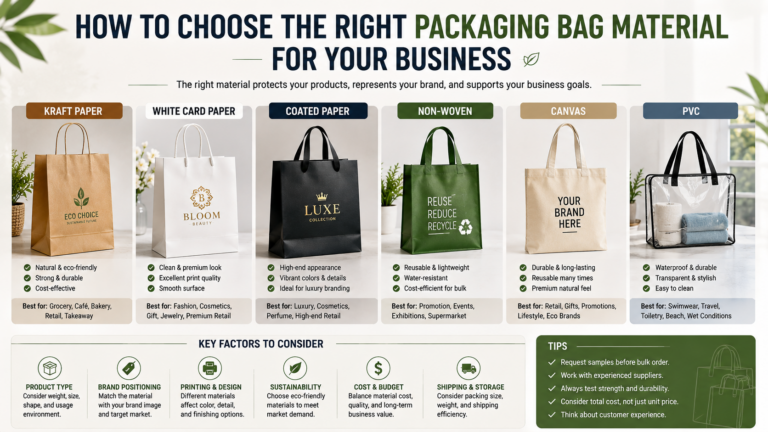

Choosing the right packaging bag material is an important decision for any business selling products, distributing promotional items, or managing retail packaging.
The material affects much more than the appearance of the bag. It influences strength, printing quality, cost, sustainability, shipping efficiency, and customer experience.
For a fashion retailer, a premium white paper bag may be the right choice. A grocery business may prefer strong kraft paper. A swimwear brand may need transparent PVC packaging, while a promotional campaign may benefit from reusable non-woven bags.
With so many options available, how do you determine which material is best for your business?
This guide explains the most common packaging bag materials and the key factors B2B buyers should consider before placing a custom order.
Why Packaging Material Matters
The packaging bag is often the first physical interaction customers have with your brand after making a purchase.
The right material can help you:
- Protect products during transportation
- Improve brand presentation
- Control packaging costs
- Meet sustainability objectives
- Create a better customer experience
- Increase packaging durability
- Support your marketing strategy
The wrong material, on the other hand, can result in unnecessary costs, poor printing, weak handles, or packaging that does not match your brand positioning.
Choosing packaging material should therefore be treated as a business decision rather than simply a design decision.
1. Start With the Product You Need to Pack
The first question is simple:
What will the bag carry?
Different products require different levels of strength, flexibility, moisture resistance, and protection.
Lightweight Products
For items such as:
- Clothing
- Accessories
- Small gifts
- Cosmetics
- Documents
Paper bags, cotton bags, and non-woven bags can all be suitable depending on the desired presentation.
Medium-Weight Products
Products such as shoes, books, packaged food, and multiple retail items require stronger structures.
Reinforced paper bags, laminated non-woven bags, or heavier fabric bags may be better choices.
Heavy Products
For wine bottles, spirits, larger gift sets, or multiple heavy products, material strength becomes particularly important.
The packaging may require:
- Thicker paper
- Reinforced bottoms
- Stronger handles
- Laminated construction
- Additional structural support
Always evaluate the total load capacity, rather than choosing a material based only on appearance.
2. Consider Your Brand Positioning
Your packaging should visually communicate what your brand represents.
Kraft Paper
Kraft paper is an excellent choice for brands seeking a natural and sustainable appearance.
Common applications include:
- Organic products
- Grocery stores
- Cafés
- Bakeries
- Lifestyle brands
- Eco-conscious retailers
Its natural texture creates a simple, authentic look.
White Card Paper
White card paper provides a clean and professional surface for branding.
It is particularly suitable for:
- Fashion retailers
- Beauty brands
- Gift shops
- Corporate packaging
- Premium retail
The bright surface allows logos and colors to appear crisp and vibrant.
Coated Paper
Coated paper is often selected when premium presentation is the priority.
It works well for:
- Luxury fashion
- Cosmetics
- Jewelry
- Perfume
- Premium gifting
- High-end retail
Its smooth surface supports detailed printing and sophisticated finishing.
3. Think About Printing Requirements
Your packaging is also a marketing tool.
Before selecting a material, consider how much visual detail your design requires.
Simple Branding
If your design mainly contains:
- One-color logos
- Text
- Minimal graphics
Kraft paper may be sufficient.
Full-Color Branding
If your design includes:
- Multiple brand colors
- Detailed graphics
- Product photography
- Complex patterns
White card or coated paper generally provides a more suitable printing surface.
Premium Finishing
For techniques such as:
- Hot foil stamping
- Embossing
- Debossing
- Spot UV
- Specialty coatings
white card and coated paper can offer greater design flexibility.
4. Compare Cost and Total Value
Material cost is important, especially for businesses ordering thousands or tens of thousands of bags.
However, buyers should avoid comparing materials based solely on unit price.
Consider the total value of the packaging, including:
- Material cost
- Printing
- Finishing
- Handle options
- Production
- Carton packing
- Shipping
- Expected reuse
- Brand impact
For example, a premium paper bag may cost more than a basic plastic bag, but it can provide additional marketing exposure because customers may reuse it.
The right question is not always:
“Which bag is cheapest?”
It is often:
“Which bag delivers the best value for my business?”
5. Evaluate Sustainability Requirements
Sustainability has become an important consideration for many global brands.
Depending on your market and brand strategy, you may consider:
Recycled Paper
Suitable for businesses emphasizing recycled content and circular packaging.
FSC-Certified Paper
Useful for brands that want responsibly sourced paper materials.
Kraft Paper
Provides a strong natural and recyclable packaging image.
Reusable Non-Woven Bags
Can be used for promotional campaigns and repeated shopping applications.
However, sustainability claims should always reflect the actual material composition and applicable certifications.
6. Consider Moisture and Product Environment
Paper is not the ideal material for every environment.
If your products are exposed to:
- Water
- Humidity
- Wet conditions
- Refrigeration
- Swimming or travel environments
you may need a material with greater moisture resistance.
For example, transparent PVC bags can be suitable for applications such as:
- Swimwear
- Travel products
- Beach accessories
- Toiletries
For dry retail products, paper and non-woven bags may be more appropriate.
7. Think About Reusability
Packaging can continue working for your brand after the original purchase.
A durable reusable bag can be used for:
- Future shopping
- Storage
- Travel
- Gym activities
- Everyday carrying
This creates additional opportunities for brand exposure.
For promotional campaigns, reusable non-woven or canvas bags can therefore offer strong long-term marketing value.
8. Match the Material to Your Industry
Different industries tend to prioritize different packaging characteristics.
| Industry | Recommended Materials | Main Priority |
|---|---|---|
| Fashion | White card, coated paper | Premium branding |
| Cosmetics | White card, coated paper | Print quality |
| Grocery | Kraft paper | Strength & practicality |
| Café & Bakery | Kraft paper | Function & sustainability |
| Luxury Retail | Coated paper | Premium appearance |
| Wine & Spirits | Reinforced paper | Load capacity |
| Promotional Events | Non-woven, canvas | Reusability |
| Swimwear & Travel | PVC | Moisture resistance |
| Corporate Gifting | White card, coated paper | Presentation |
This table is a starting point rather than a fixed rule. Product weight, budget, design, and distribution conditions should also be considered.
9. Don’t Forget Bag Structure
Material is only one part of packaging performance.
The same paper can perform very differently depending on the bag construction.
Important structural factors include:
- Paper GSM
- Bag dimensions
- Bottom construction
- Side gussets
- Handle type
- Handle attachment
- Reinforcement
- Lamination
For heavier products, increasing paper thickness alone may not be enough. A reinforced bottom and stronger handle attachment can make a significant difference.
10. Consider Shipping and Storage
For B2B buyers ordering packaging internationally, logistics should be considered before production.
Packaging bags are often shipped in large quantities, so dimensions and packing methods can affect transportation costs.
Consider:
- Folded or flat-pack designs
- Carton dimensions
- Quantity per carton
- Total shipment volume
- Warehouse storage space
A packaging design that looks good but takes up excessive shipping volume can increase the total landed cost.
Working with the manufacturer during the design stage can help optimize the packaging for both production and logistics.
11. Standardize Materials for Multiple Stores or Products
Retail chains and businesses with multiple locations can benefit from a standardized packaging system.
Instead of creating dozens of completely different bags, consider developing a small material and size portfolio.
For example:
Small: Accessories and cosmetics
Medium: Clothing and everyday retail purchases
Large: Shoes and multiple products
Premium: VIP and corporate gifting
Standardization can simplify:
- Procurement
- Inventory management
- Production
- Quality control
- Shipping
- Store operations
It can also create a more consistent brand experience across locations.
12. Ask Your Packaging Manufacturer the Right Questions
Before placing a bulk order, ask your supplier:
- Which material is best for my product weight?
- What GSM do you recommend?
- What printing method should we use?
- Can the bag support the required load?
- Which handle construction is suitable?
- Is the material recyclable?
- Are certifications available?
- Can you provide samples?
- What is the production lead time?
- How can the packaging be optimized for shipping?
An experienced manufacturer should be able to explain the trade-offs rather than simply recommend the most expensive material.
A Simple Decision-Making Framework
If you are unsure which material to choose, start with these five questions:
1. What does the bag carry?
Determine the required strength and protection.
2. What does your brand want to communicate?
Choose between natural, professional, premium, or highly reusable packaging.
3. What printing quality do you need?
Simple branding and complex full-color designs may require different materials.
4. What is your target cost?
Consider the complete landed cost, not only the factory unit price.
5. What sustainability requirements apply?
Evaluate recycled content, responsible sourcing, recyclability, and relevant certifications.
Once these factors are clear, the material choice becomes much easier.
Final Comparison: Which Material Should You Choose?
There is no universal “best” packaging bag material.
Choose Kraft Paper If:
- You want a natural appearance
- Sustainability is important
- You need strong everyday retail packaging
- You want to control costs
Choose White Card Paper If:
- You need excellent printing
- Your brand has a clean, premium identity
- You sell fashion, cosmetics, gifts, or retail products
Choose Coated Paper If:
- Premium presentation is critical
- You need vibrant, detailed printing
- You want luxury finishing effects
Choose Non-Woven Bags If:
- Reusability is important
- You need promotional packaging
- The bag will be used repeatedly
Choose Canvas Bags If:
- Durability and premium reusability are priorities
- You want a long-lasting promotional product
- Your brand favors a fabric-based aesthetic
Choose PVC Bags If:
- Moisture resistance is important
- Products are used around water
- Transparent packaging is part of the product experience
Conclusion
Choosing the right packaging bag material requires more than comparing prices or selecting the material that looks best.
The ideal solution should balance product protection, brand positioning, printing quality, durability, sustainability, cost, and logistics.
For B2B buyers, the most effective approach is to define the packaging requirements first and then select the material and structure that best fit those requirements.
Whether you need kraft paper bags for everyday retail, premium paper bags for luxury products, reusable non-woven bags for promotional campaigns, or specialized PVC packaging for moisture-sensitive applications, the right material can improve both customer experience and overall packaging efficiency.
Looking for the right custom packaging bag material for your business? We provide professional material recommendations, custom printing, structural optimization, bulk production, and global shipping solutions for businesses worldwide. Contact us to discuss your packaging requirements and request a quotation.