
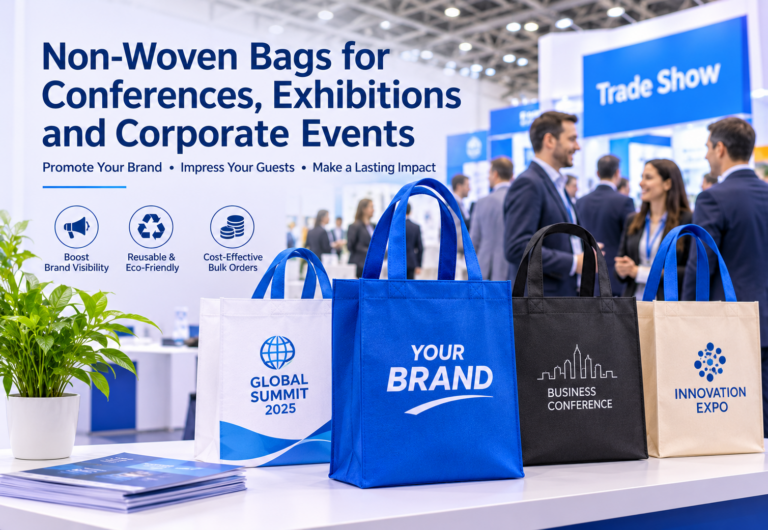

Conferences, exhibitions, and corporate events bring people together to share ideas, build business relationships, showcase products, and promote brands. From international trade fairs and industry conferences to company meetings and product launches, event organizers need practical ways to distribute materials and create a professional experience for attendees.
One simple but effective solution is the custom non-woven bag.
Lightweight, customizable, and available in different sizes and styles, non-woven bags are widely used for conference welcome kits, exhibition materials, corporate gifts, and promotional merchandise. They provide a convenient way to carry event essentials while giving organizers and sponsors an additional opportunity to display their brand identities.
Whether you are planning a business conference, organizing an international exhibition, or preparing corporate event packages, choosing the right non-woven bag can improve both functionality and brand presentation.
In this guide, we’ll explore how non-woven bags can be used for different events, which specifications to consider, and how to plan a successful bulk order.
1. Why Non-Woven Bags Are Popular for Events
Event organizers often need packaging that is practical, visually appealing, and suitable for bulk distribution. Custom non-woven bags offer several advantages.
Convenient for Carrying Event Materials
Conference and exhibition attendees often receive multiple items during an event, including:
- Event programs and schedules
- Brochures and product catalogs
- Notebooks and stationery
- Business cards
- Promotional gifts
- Product samples
- Company information packs
A non-woven bag provides a convenient way to keep these materials together.
Organizers can prepare the bags before the event and distribute them during registration or at designated collection points.
Promote Brands Throughout the Event
Custom non-woven bags provide a visible space for company logos, event names, sponsor information, and promotional messages.
When attendees carry these bags around an exhibition hall or conference venue, the printed designs can increase brand visibility among other participants.
For sponsored events, bags can also display the logos of multiple partners, depending on the agreed design and sponsorship arrangement.
Lightweight and Easy to Distribute
For large events, organizers may need hundreds or thousands of bags.
Non-woven bags are relatively lightweight and can be produced in different sizes and structures. This makes them suitable for bulk distribution and event preparation.
They can also be packed in quantities for easier transportation and storage.
Reusable for Everyday Activities
Many non-woven bags can be reused for shopping, carrying documents, or storing personal items, depending on their material and construction.
This gives attendees a reason to keep the bags after the event and creates opportunities for continued brand exposure.
However, actual durability depends on fabric quality, GSM, bag construction, and how the bags are used.
2. Different Applications for Conferences, Exhibitions and Corporate Events
Although these events share similar packaging requirements, each type of event may need a different bag design.
Conference Welcome Bags
Welcome bags are commonly provided to attendees during registration or check-in.
They can contain event schedules, conference materials, notebooks, pens, name badges, and small gifts.
For conferences, medium-sized non-woven tote bags are often a practical choice because they provide enough space for documents without being unnecessarily bulky.
Organizers can print the conference name, date, venue, and event logo on the front of the bag.
Exhibition and Trade Fair Bags
Exhibition visitors often collect catalogs, flyers, product samples, and promotional items from different exhibitors.
A larger non-woven shopping bag with a gusset can provide additional space for these materials.
Exhibitors may also prepare branded bags for booth visitors, business partners, and potential customers.
For international exhibitions, clear company branding and website information can help visitors identify the exhibitor after the event.
Corporate Meeting and Training Bags
Companies can use custom non-woven bags for internal meetings, employee training sessions, workshops, and business seminars.
These bags can hold training manuals, notebooks, stationery, company documents, and employee gifts.
A simple corporate design with the company logo and brand colors is often sufficient.
Product Launch Events
For product launches, packaging can be designed to match the campaign theme or product identity.
A custom non-woven bag can hold product samples, brochures, promotional gifts, and launch information.
Brands can also include QR codes that direct attendees to a product page, online catalog, or registration website.
Corporate Anniversary and Employee Events
Companies celebrating anniversaries, annual meetings, or employee appreciation events can prepare customized bags as part of their event gift packages.
The bag design can feature the company logo, anniversary year, event slogan, or special graphics.
This helps create a consistent visual identity across event materials and gifts.
3. Choosing the Right Non-Woven Bag Style
The bag structure should match the type and quantity of materials that attendees need to carry.
Here are some popular options for event organizers.
Flat Tote Bags
Flat tote bags feature a simple structure and a large printable surface.
They are suitable for lightweight materials such as brochures, event programs, flyers, and small promotional items.
This style is a practical option for large-scale giveaways where simple branding and cost control are important.
Bottom-Gusset Bags
Bottom-gusset bags provide additional depth and capacity.
They are useful for carrying thicker catalogs, notebooks, folders, and multiple event materials.
For conferences and exhibitions where visitors receive several documents, this structure can offer more practical storage space.
Side-Gusset Bags
Side-gusset bags expand to provide additional internal space while maintaining a convenient shopping bag shape.
They are suitable for event kits containing multiple items or larger promotional products.
Box-Shaped Bags
Box-shaped non-woven bags have a more structured appearance and a defined bottom.
They are suitable for corporate gift packages, premium conference kits, and product launch events where presentation is important.
Foldable Non-Woven Bags
Foldable bags can be compressed into a smaller size when not in use.
They are useful as promotional gifts for attendees who may want to carry an additional reusable bag after the event.
Reinforced Bags
For heavier conference kits or corporate gift packages, organizers can consider reinforced handles and stronger bag construction.
The final carrying performance should be evaluated through sample testing rather than relying on fabric weight alone.
4. How to Select the Right GSM for Event Bags
GSM stands for grams per square meter. It indicates the weight of the non-woven fabric and is an important specification when selecting custom bags.
Different events have different requirements, so the right GSM depends on the bag’s intended contents and expected use.
| Fabric weight | Typical application |
|---|---|
| 70–80 GSM | Lightweight event giveaways, flyers, and simple conference bags |
| 90–100 GSM | General conference kits, exhibition bags, and corporate event bags |
| 110–120 GSM | More substantial bags for thicker catalogs, notebooks, and gift packages |
For large events with lightweight printed materials, 70–80 GSM may be sufficient.
For general conference welcome kits, 90–100 GSM can be a useful starting point.
If the bag needs to carry several catalogs, notebooks, or promotional gifts, 110–120 GSM may be worth considering.
Remember that GSM alone does not determine load capacity. The bag’s dimensions, fabric quality, handle attachment, stitching or bonding, and reinforcement also affect its performance.
For heavier event packages, request a sample and test it with the actual contents before confirming bulk production.
5. Custom Printing Ideas for Event Bags
Printing transforms a standard non-woven bag into a customized event item.
The design should communicate the event identity clearly while providing enough space for sponsor and company branding.
Event Logo and Name
For conferences and corporate meetings, the event logo and name are usually the main design elements.
You can also include the event date, venue, or a short slogan.
A clean layout makes the information easier to recognize.
Sponsor and Partner Logos
Many exhibitions and conferences involve multiple sponsors and business partners.
Depending on the sponsorship agreement, their logos can be arranged on the bag alongside the event organizer’s branding.
Before production, confirm the approved logo files, sizes, and placement requirements with all relevant parties.
Company Website and QR Code
Adding a website address or QR code can connect physical event materials with online information.
Attendees can scan the code to:
- Visit the event website
- View a digital product catalog
- Access presentation materials
- Follow a company social media account
- Register for future events
- Submit a business inquiry
Always test the QR code on a printed sample to ensure that it scans correctly.
Printing Methods
Common printing options for non-woven bags include:
Screen Printing
Suitable for simple logos, text, and relatively straightforward graphics. It can be a practical choice for large quantities with limited colors.
Heat Transfer Printing
Useful for more detailed artwork and colorful designs. It can help reproduce graphics that require more visual detail.
Laminated Printing
Laminated non-woven bags can feature printed designs on a matte or glossy laminated surface. This option is suitable for more extensive graphic coverage and vibrant promotional artwork.
The appropriate method depends on the fabric, artwork, quantity, budget, and desired finish. Buyers should confirm printing details with the manufacturer before mass production.
6. How to Design Bags for Different Corporate Event Styles
A successful event bag should match the purpose and atmosphere of the event.
Professional Business Conferences
For business conferences and industry seminars, consider a clean design with corporate colors, a clearly positioned logo, and minimal additional graphics.
Navy, black, gray, white, and other brand colors are common choices.
International Exhibitions
For international exhibitions, the bag should make the company or event easy to identify.
Consider displaying:
- Company or event name
- Logo
- Website
- Main product category
- QR code
Keep the layout simple enough to remain readable from a distance.
Premium Corporate Events
For executive meetings, VIP events, and corporate celebrations, organizers may prefer a more substantial bag structure, carefully selected colors, and reinforced handles.
A minimalist design with a high-quality printed logo can create a more refined appearance.
Educational and Training Events
For training programs, workshops, and academic conferences, practical features may be more important than decorative details.
Choose dimensions that accommodate folders, notebooks, and printed materials comfortably.
7. How to Plan the Quantity for Your Event
Ordering the right quantity is important for controlling packaging costs and avoiding shortages during the event.
Start by estimating how many people will receive a bag.
For example:
- Expected attendees: 1,000
- Speakers and VIP guests: 50
- Staff and event partners: 50
- Additional reserve: 100
Estimated order quantity: 1,200 bags.
The actual quantity should depend on your registration numbers, distribution plan, and whether bags will be given to every attendee or only selected groups.
For recurring annual events, organizers may also consider ordering standard branded bags in larger quantities if the design will remain relevant for future editions.
For one-time events, customized designs with specific dates or themes may be more appropriate.
8. What to Consider Before Ordering Custom Non-Woven Event Bags
Before placing a bulk order, prepare the following specifications.
1. Event Type and Purpose
Clarify whether the bags are intended for conference welcome kits, exhibition materials, corporate gifts, or promotional giveaways.
2. Bag Dimensions
Determine the size based on the items that will be placed inside, such as folders, catalogs, notebooks, or gift boxes.
3. Fabric GSM
Select an appropriate fabric weight based on the expected contents and required bag construction.
4. Bag Structure and Handles
Choose the bag style, handle type, and reinforcement requirements.
Common handle options include die-cut handles and loop handles.
5. Printing Artwork
Prepare high-resolution or vector artwork, such as AI, EPS, or editable PDF files.
Confirm logo placement, colors, sponsor information, and QR code requirements.
6. Order Quantity and MOQ
Minimum order quantities vary depending on the bag style, printing, size, and production method.
As an indicative reference, sewn non-woven bags may start from around 500 pieces, while heat-pressed styles may require around 10,000 pieces. Actual MOQ should be confirmed according to the specific design and production requirements.
7. Sample Approval
Review a sample before mass production. Check material quality, bag dimensions, printing clarity, handle strength, and overall construction.
8. Production and Delivery Schedule
Event dates are usually fixed, so production and transportation need to be planned carefully.
Confirm artwork approval, sample development, production time, packing arrangements, and shipping schedules with your supplier.
For international events, allow additional time for transportation and customs procedures where applicable.
9. How to Choose a Reliable Non-Woven Bag Manufacturer
When purchasing event bags in bulk, working with an experienced manufacturer can help simplify the sourcing process.
Here are several factors to evaluate:
- Product range: Can the supplier provide different bag styles, sizes, GSM options, and handle designs?
- Customization: Can they support custom logos, colors, printing methods, and event-specific artwork?
- Sample development: Can they provide samples for checking the design and construction?
- Quality control: Do they inspect fabric, dimensions, printing, handles, and finished bags?
- Production capacity: Can they handle the required order quantity within your event schedule?
- Communication: Can they clearly explain specifications, MOQ, pricing, production progress, and delivery arrangements?
A manufacturer with a broad range of customization options can make it easier to coordinate different event requirements and future repeat orders.
At CXGIAE, we provide custom non-woven bags for businesses, event organizers, promotional agencies, and wholesale buyers.
Our customization options include different fabric weights, bag structures, sizes, printing methods, and handle styles.
Whether you need conference welcome bags, exhibition document bags, or customized corporate event bags, we can discuss a suitable solution based on your specifications and order quantity.
Explore our custom non-woven bags for business branding and wholesale supply to learn more about available options.
10. Frequently Asked Questions
Are non-woven bags suitable for conference welcome kits?
Yes. Non-woven bags are suitable for carrying conference programs, notebooks, stationery, brochures, name badges, and small promotional gifts. Their sizes and designs can be customized according to the contents of the welcome kit.
What size should I choose for exhibition bags?
Medium or large bags are often suitable for exhibitions because visitors may collect multiple catalogs and promotional materials. The best dimensions depend on the size and quantity of the items being distributed.
Can multiple sponsor logos be printed on one bag?
Yes. Multiple sponsor and partner logos can be included in the artwork, provided that the final layout and logo usage are approved by the relevant parties.
What GSM is recommended for corporate event bags?
For general corporate event bags, 90–100 GSM is a useful starting point. Lightweight giveaways may use 70–80 GSM, while more substantial bags may use 110–120 GSM. Bag construction and sample testing should also be considered.
Can I customize the bags with an event date and theme?
Yes. You can include event names, dates, slogans, logos, graphics, and QR codes. Customized artwork can be developed for conferences, exhibitions, anniversaries, and corporate celebrations.
What is the MOQ for custom non-woven event bags?
MOQ depends on the bag style and manufacturing method. As an indicative reference, sewn bags may start at around 500 pieces, while heat-pressed bags may require around 10,000 pieces. Contact the manufacturer to confirm the actual MOQ for your design.
How early should I order bags for a conference or exhibition?
It is best to start the sourcing process well before the event. Allow time for artwork confirmation, sample approval, mass production, packing, and transportation. The exact lead time should be confirmed with the manufacturer based on your order details.
Conclusion
Non-woven bags are a practical packaging and promotional solution for conferences, exhibitions, and corporate events.
They help organizers distribute event materials, provide attendees with convenient carrying solutions, and create additional opportunities for brand exposure.
From simple conference tote bags to larger exhibition bags and customized corporate gift bags, the right combination of material, GSM, size, printing, and construction can support different event requirements.
If you are preparing for an upcoming conference, exhibition, or corporate event, explore CXGIAE’s custom non-woven bag solutions.
Contact our team with your event date, bag specifications, and estimated quantity to discuss your custom project and request a wholesale quotation.