
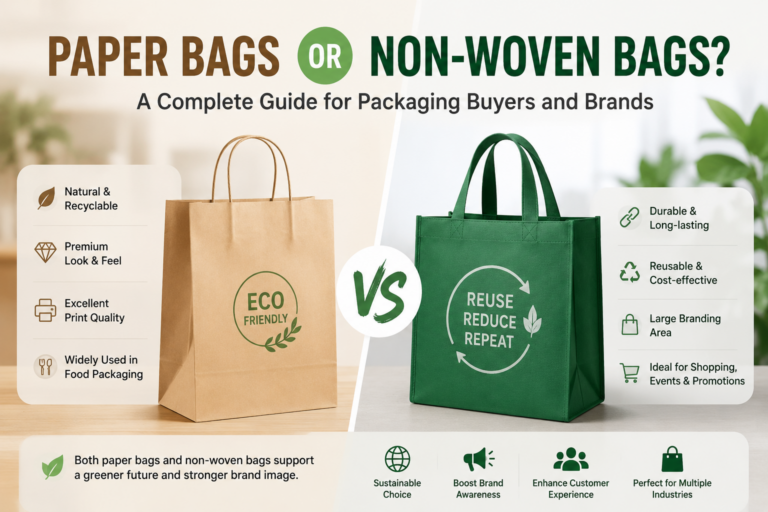

In today’s packaging industry, businesses are no longer choosing bags based only on cost. Modern brands must balance sustainability, durability, visual appeal, customer experience, and long-term marketing value. Whether you operate a retail store, restaurant, supermarket, fashion brand, or promotional business, selecting the right packaging solution can directly influence how customers perceive your company.
Among the most popular packaging options today, paper bags and non-woven bags stand out as two of the most widely used alternatives to traditional plastic packaging. Each offers unique advantages and limitations depending on industry needs, branding goals, and usage scenarios.
This guide explores the strengths and weaknesses of both packaging solutions to help businesses make smarter purchasing decisions.
Understanding Paper Bags
Paper bags are commonly made from kraft paper, white card paper, coated paper, or specialty paper materials. They are widely used in retail shopping, food takeaway, luxury packaging, and gift packaging because of their natural appearance and excellent print quality.
Businesses looking for customizable retail or food-grade packaging often choose paper bags for their premium visual presentation and recyclable material advantages.
👉 Explore custom paper bag solutions here:
Custom Paper Bags Landing Page
Advantages of Paper Bags
1. Strong Eco-Friendly Image
Paper bags are often associated with sustainability because they are recyclable, biodegradable, and made from renewable resources. For environmentally conscious consumers, paper packaging creates a cleaner and more responsible brand perception.
2. Premium Appearance
Paper bags typically offer a more upscale visual feel than many low-cost packaging options. High-quality printing, embossing, foil stamping, and textured finishes help brands create luxurious packaging experiences.
This is especially important for:
- Fashion brands
- Cosmetics companies
- Jewelry stores
- Gift shops
- Boutique retailers
A well-designed paper bag can feel almost like part of the product itself, like packaging wearing a tailored suit instead of a disposable raincoat.
3. Excellent Printing Performance
Paper surfaces allow sharp logo printing, vibrant colors, and detailed graphics. Brands that prioritize aesthetics and visual storytelling often prefer paper packaging because it supports high-end branding more effectively.
4. Widely Accepted in Food Packaging
Many restaurants, bakeries, cafés, and takeaway businesses use kraft paper bags because they fit naturally with modern “green dining” trends.
Limitations of Paper Bags
Despite their advantages, paper bags also come with several practical limitations.
1. Lower Durability
Compared with non-woven bags, paper bags are generally less resistant to tearing, moisture, and repeated heavy use.
Rain, grease, or excessive weight can weaken the structure quickly.
2. Shorter Reuse Cycle
Most customers reuse paper bags only a limited number of times before disposal. This reduces long-term brand exposure compared with reusable bag alternatives.
3. Higher Costs for Premium Finishes
Luxury paper bags with reinforced handles, laminations, or specialty printing can become relatively expensive at scale.
Understanding Non-Woven Bags
Non-woven bags are made from bonded polypropylene fibers rather than woven textiles. They are lightweight, reusable, durable, and highly customizable.
They are widely used in supermarkets, exhibitions, promotional events, retail stores, and reusable shopping programs.
Businesses seeking reusable branded packaging often choose non-woven bags because they combine affordability with long-term functionality.
👉 Explore custom non-woven bag solutions here:
Custom Non-Woven Bags Landing Page
Advantages of Non-Woven Bags
1. Excellent Reusability
One of the biggest advantages of non-woven bags is their long service life. Customers often reuse them for shopping, commuting, storage, travel, or daily errands.
This transforms packaging into continuous brand exposure moving through supermarkets, office buildings, campuses, and city streets like tiny mobile billboards stitched into everyday life.
2. Strong Durability
Non-woven bags can handle heavier products more effectively than most paper bags. They resist tearing and stretching, making them ideal for:
- Grocery stores
- Trade shows
- Bulk retail
- Promotional giveaways
- Food delivery
3. Cost-Effective for Large Orders
For businesses ordering high quantities, non-woven bags often provide better long-term value due to their balance between durability and production cost.
4. Flexible Customization
Non-woven bags can be customized with:
- Logos
- Brand colors
- Slogans
- QR codes
- Event graphics
- Eco-friendly messaging
Different handle types, thickness levels, and lamination options also allow brands to create packaging tailored to specific industries.
Limitations of Non-Woven Bags
1. Less Premium Visual Feel
Although modern non-woven bags can look attractive, they may not deliver the same luxury appearance as high-end paper packaging.
For premium fashion or gift brands, paper bags often create stronger emotional impact.
2. Environmental Debate Around Polypropylene
While reusable, non-woven bags are typically made from polypropylene materials. Some consumers still view them less favorably than paper because they are not fully natural fiber products.
However, their extended reuse cycle often offsets part of this concern compared with single-use packaging.
3. Printing Detail Limitations
Complex high-resolution artwork may appear less refined on non-woven surfaces compared with coated paper printing.
Which Packaging Solution Is Better?
The answer depends on your business goals, customer expectations, and usage scenarios.
Choose Paper Bags If Your Brand Prioritizes:
- Premium presentation
- Luxury retail experience
- High-end printing quality
- Boutique branding
- Food takeaway aesthetics
- Eco-conscious visual identity
Choose Non-Woven Bags If Your Brand Prioritizes:
- Long-term reusability
- Durability
- Promotional exposure
- Lower long-term marketing cost
- Large-scale retail use
- Reusable shopping programs
Many businesses today even combine both solutions for different product lines and customer experiences.
For example:
- Luxury purchases may use premium paper bags
- Promotional events may use reusable non-woven bags
- Restaurants may use kraft takeaway bags
- Supermarkets may sell reusable shopping bags
Sustainability Is No Longer Optional
Modern consumers increasingly pay attention to how products are packaged. Packaging has become part of brand communication, customer experience, and environmental responsibility.
Both paper bags and non-woven bags can support greener branding strategies when used appropriately. The key is selecting packaging that aligns with your business model, customer expectations, and sustainability goals.
In many ways, packaging now behaves like silent sales staff. It speaks before the product is opened and lingers after the transaction ends.
Final Thoughts
Paper bags and non-woven bags each offer distinct advantages for modern businesses. Paper bags excel in premium branding and visual presentation, while non-woven bags provide superior durability and long-term reusability.
The best packaging choice is not simply about replacing plastic. It is about building a stronger customer experience, reinforcing brand values, and creating packaging that customers actually remember.
In a crowded marketplace where attention disappears faster than fingerprints on glass, the right bag can quietly carry your brand far beyond the checkout counter. 🌍