
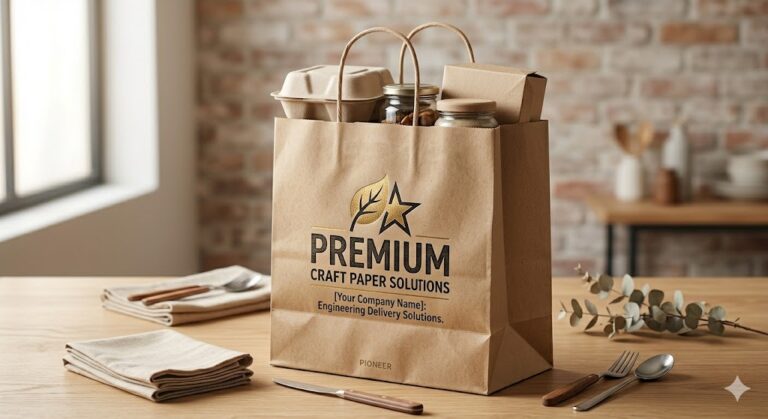

In the delivery-first era of food service, the moment a customer receives their order at their doorstep is the new “table service.” If the bag is soggy, the handle is snapping, or the grease has leaked through to their car seat, the quality of the food inside almost ceases to matter. The brand experience is already tarnished.
A high-performance takeout bag is not just a container; it is a piece of engineered equipment. To ensure your delivery operations are flawless, you need to understand the three pillars of bag anatomy: Strength, Coating, and Design.
1. Strength: The Foundation of Reliability
The strength of a paper bag is determined by its GSM (Grams per Square Meter) and the quality of its fibers.
-
Long-Fiber Kraft: High-performance bags use “virgin” long-fiber Kraft paper. Unlike short-fiber recycled paper, long fibers interlock more tightly, providing superior tensile strength. This ensures the bottom doesn’t “blow out” under the weight of heavy containers.
-
Handle Reinforcement: The point where the handle meets the bag is the most common failure point. Premium bags utilize patch-reinforced handles—where an extra layer of heavy-duty paper is glued inside the rim—to distribute weight evenly.
-
The Weight Test: A standard high-performance bag should comfortably hold 1.5 to 2 times its intended load without visible stretching or tearing at the seams.
2. Coating: The Invisible Shield
In the F&B industry, moisture and oil are the enemies of paper. A “naked” paper bag will absorb steam and grease, leading to structural collapse.
-
Grease-Resistant Barriers: High-quality takeout bags are treated with food-safe, bio-based grease barriers. This prevents oil from fried foods or sauces from staining the exterior, keeping the brand presentation clean.
-
Moisture-Resistant (PE-Free) Coatings: Modern high-performance bags use water-based aqueous coatings instead of traditional plastic (PE) linings. These keep the bag crisp even when filled with steaming hot containers, and most importantly, they remain 100% recyclable and compostable.
-
Internal Lamination: For heavy liquid-based orders (like soups or stews), some bags feature a light internal lamination that provides a secondary layer of protection against minor leaks.
3. Design: More Than Just Aesthetics
Good design is where functionality meets marketing. A well-designed bag solves operational problems while building brand equity.
-
The Wide-Gusset Bottom: “High-performance” means the bag must stand upright on its own. A wide rectangular base (the gusset) allows for stable stacking of square containers, preventing food from shifting or tilting during transit.
-
Ventilation Strategy: Sometimes, a bag that is too sealed traps steam, making crispy food (like fries or fried chicken) soggy. Strategic design includes “breathable” folds or materials that allow steam to escape while retaining heat.
-
Tactile Branding: The choice of texture—whether a raw, matte Kraft finish or a smooth, premium coated finish—communicates the price point of the meal. Premium finishes combined with high-contrast printing turn every delivery into a walking advertisement for your kitchen.
Why “Good Enough” Isn’t Enough
Using a generic, low-GSM bag might save a few cents in the short term, but the cost of a single “failed delivery”—a lost customer, a refund, or a negative 1-star review—outweighs those savings instantly.
Investing in high-performance bags is an investment in your delivery insurance.
At Cxgiae, we don’t just sell bags; we engineer delivery solutions. Our takeout bags are tested for maximum load-bearing capacity and treated with the latest eco-friendly coatings to ensure your food arrives exactly how you intended: hot, fresh, and perfectly presented.
Ready to stress-test your current packaging? Contact us for a sample kit and see the difference a high-performance bag makes!