
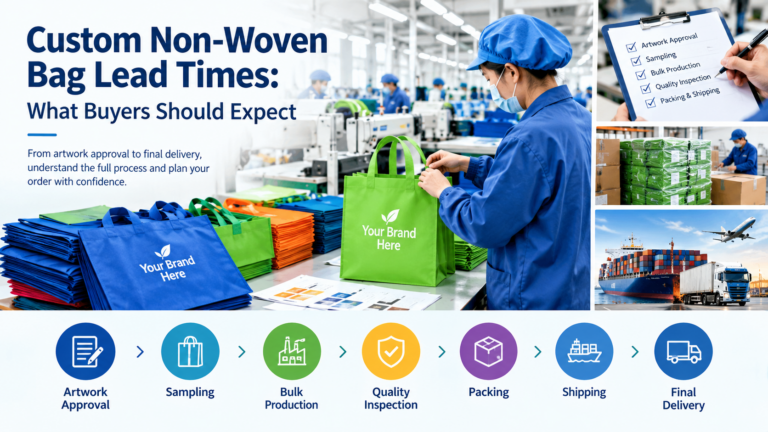

When ordering custom non-woven bags for a retail business, supermarket, promotional campaign, trade show, or wholesale project, one of the first questions buyers ask is: How long will it take to receive the finished bags?
For B2B buyers, delivery timing affects more than purchasing schedules. Late packaging can delay product launches, disrupt promotional campaigns, create inventory problems, and increase transportation costs if urgent shipping becomes necessary.
However, the lead time for custom non-woven bags is not simply the number of days required to manufacture them. The complete process may include specification confirmation, artwork preparation, sampling, material preparation, mass production, quality inspection, packing, and international shipping.
Understanding each stage helps businesses plan orders more accurately, communicate with suppliers, and reduce the risk of missing important deadlines.
This guide explains what affects custom non-woven bag lead times, how to build a realistic purchasing schedule, and what buyers should confirm before placing a bulk order.
1. What Does Lead Time Mean for Custom Non-Woven Bags?
Lead time refers to the period required to move an order from a defined starting point to a specified completion milestone.
The challenge is that buyers and manufacturers may define these milestones differently.
For example, a supplier might quote production lead time beginning after final artwork approval and payment confirmation. The buyer, however, may be counting from the date the inquiry is submitted.
These are two different timelines.
For custom non-woven bags, it is useful to distinguish three types of lead time.
Production lead time
This refers to the time needed to manufacture the bags after the agreed production requirements have been confirmed.
Depending on the supplier, the starting point may require final artwork approval, sample approval, payment, and material availability.
Order-to-dispatch lead time
This covers the stages from order confirmation through manufacturing, quality inspection, packing, and preparation for shipment.
It provides a broader view of when the finished goods may be ready to leave the factory.
Total delivery lead time
This is the most important timeline for many overseas buyers. It covers the entire process until the goods arrive at the required destination.
It may include pre-production preparation, manufacturing, packing, international transportation, customs clearance, and local delivery.
Always confirm what the quoted lead time includes and what event starts the clock. A factory completion date is not necessarily the date your warehouse will receive the bags.
2. How Long Does It Take to Produce Custom Non-Woven Bags?
There is no single production schedule that applies to every custom non-woven bag order.
A straightforward design using readily available materials may require less preparation than a project involving special fabric colors, complex printing, lamination, reinforced handles, or a large production quantity.
The most reliable approach is to request a schedule based on your exact product specifications.
The following factors commonly affect production timing:
- Bag construction: Sewn, heat-sealed, and die-cut bags require different manufacturing processes.
- Order quantity: Larger orders may require more production capacity and a longer production window.
- Material availability: Standard materials may be easier to arrange than special colors or unusual specifications.
- Printing requirements: Multiple colors, complex graphics, and printing on several sides can add preparation steps.
- Special features: Reinforced handles, custom dimensions, lamination, and additional structural details may affect the schedule.
- Sample requirements: Physical samples and revisions add approval stages before bulk production.
- Factory workload: The available production slot can influence when an order begins and finishes.
Some suppliers publish production estimates of several weeks, but these estimates are not universal guarantees. They may also exclude sampling and transportation. Buyers should obtain a written, order-specific schedule rather than planning around a general industry estimate.
3. The Complete Timeline for a Custom Non-Woven Bag Order
A typical order moves through several connected stages. Some activities may overlap, but important approvals generally need to be completed before the relevant production steps can proceed.
Stage 1: Specification Confirmation and Quotation
The first step is to define exactly what you want to purchase.
A complete inquiry should include:
- Bag style and application
- Finished bag dimensions
- Material and GSM
- Fabric color
- Handle type and length
- Sewn or heat-sealed construction
- Printing method and logo placement
- Lamination or other finishing requirements
- Order quantity
- Packaging requirements
- Delivery destination
- Required delivery date
If important details are missing, the manufacturer may need to ask additional questions or revise the quotation later.
For example, requesting a quote for “10,000 custom shopping bags” does not provide enough information to confirm the production schedule. A small, heat-sealed promotional bag and a large, reinforced sewn bag may require different processes.
How buyers can save time: Prepare a complete product brief before requesting the final quotation. Confirm the specifications as early as possible to reduce unnecessary revisions.
Stage 2: Artwork Preparation and Approval
Once the bag specifications are established, the artwork must be prepared for production.
This stage may be relatively straightforward if you already have print-ready files. It may take longer if the logo needs adjustment, brand colors require confirmation, or the design needs to be adapted to the bag dimensions.
Common causes of delay include:
- Low-resolution or unsuitable artwork files
- Incorrect logo proportions
- Printing that extends beyond the available print area
- Unconfirmed brand colors
- Changes to logo placement
- Revisions to the bag size after the artwork has been prepared
Before approval, check the logo size, placement, spelling, color references, and printing sides.
How buyers can save time: Provide the latest approved logo files and consolidate feedback into one clear revision wherever possible.
Stage 3: Sampling and Sample Approval
For many B2B projects, a physical sample is useful before mass production begins.
A sample allows the buyer to check the actual material, dimensions, handles, printing, construction, and overall appearance.
For example, a retail buyer may need to confirm that the bag is large enough for the intended products and that the handle length is comfortable. A promotional agency may prioritize logo placement, print color, and consistency with the client’s branding.
Sampling can add time to the project because the sample must be prepared, reviewed, and possibly revised.
However, skipping a necessary sample may create greater problems if the finished bulk order does not meet expectations.
How buyers can save time: Confirm sample requirements at the quotation stage, appoint the person responsible for approval, and provide specific feedback rather than requesting several rounds of small changes.
Stage 4: Material Preparation
After the required specifications and approvals are confirmed, the factory arranges the materials needed for the order.
These may include PP non-woven fabric, custom-colored material, printing supplies, handles, reinforcement materials, lamination materials, and packaging.
The schedule can be affected by whether the required materials are readily available.
For example, a standard bag color may be easier to arrange than a special color that requires additional preparation. A large order may also require more careful material planning to ensure consistency across the production run.
How buyers can save time: Ask the manufacturer to confirm material availability before finalizing the delivery commitment, especially when the order includes unusual colors or specifications.
Stage 5: Mass Production
Mass production is the stage most commonly associated with factory lead time.
The actual duration depends on the agreed construction, quantity, material, printing requirements, and available production capacity.
A sewn non-woven bag may require cutting, printing, sewing, handle attachment, and finishing. A heat-sealed design follows a different process. Additional reinforcement or special features may introduce more production steps.
Large orders also need to be scheduled around the factory’s available equipment, workers, and production capacity.
How buyers can save time: Finalize the product specification before production begins and ask the supplier to confirm the planned start date, estimated completion date, and any dependencies that could affect the schedule.
Stage 6: Quality Inspection and Packing
When manufacturing is complete, the finished bags should be checked against the agreed requirements.
Depending on the order, inspection may cover:
- Bag dimensions and material consistency
- Printing accuracy and color appearance
- Handle attachment and stitching
- Heat-sealed areas
- Bottom and gusset construction
- Lamination and finishing
- Quantity and packaging
The finished bags then need to be packed according to the agreed requirements.
Quality inspection and packing should be included in the project schedule. They should not be assumed to happen instantly when the production line finishes.
How buyers can save time: Agree on the key quality standards before production and confirm the expected inspection and packing milestones with the manufacturer.
Stage 7: Shipping and Final Delivery
For international orders, transportation can represent a significant part of the total timeline.
The delivery schedule depends on the destination, shipping method, dispatch arrangements, customs clearance, and local transportation.
For example, the date the bags are ready to ship from the factory is different from the date they arrive at a warehouse in Europe or North America.
Buyers should also confirm whether the shipping estimate refers to departure, arrival at a port, customs-cleared delivery, or final delivery to the specified address.
How buyers can save time: Discuss transportation options early, provide the full destination details, and work backward from the date the bags must be available for use.
4. What Factors Have the Biggest Impact on Lead Time?
Understanding the main variables helps buyers identify which parts of the schedule need the most attention.
Order quantity
The quantity affects production planning, material requirements, and the time needed to complete the order.
A larger quantity may require a longer production window, depending on the bag construction and available capacity.
When requesting a quotation, specify the intended quantity rather than asking for a general estimate. If you are comparing different quantities, ask the supplier to provide the corresponding lead-time estimates where possible.
Bag construction
The construction method affects how the bags are manufactured.
Sewn bags may involve more manual operations, while suitable heat-sealed designs may follow a different production process. Die-cut promotional bags also have their own construction requirements.
The simplest design is not always the best choice. The construction should match the bag’s intended use, required strength, appearance, and expected reuse.
Printing and customization
A bag with a simple logo may require less preparation than one with detailed artwork, several printing colors, or printing on multiple panels.
Special finishing, custom fabric colors, and laminated surfaces can also affect the production sequence.
If the artwork or construction changes after approval, the manufacturer may need to reassess materials, setup, and timing.
Material availability
Material selection can influence both cost and lead time.
Readily available material may allow production planning to move forward more quickly. Special colors, unusual GSM requirements, or non-standard finishing may require additional preparation.
If your project depends on a precise brand color, discuss the available options early instead of assuming every shade can be supplied immediately.
Factory production capacity
A supplier’s current workload matters as much as the complexity of the bag.
Even a standard product may need to wait for an available production slot. This is particularly relevant when several orders are scheduled around the same period.
Ask the manufacturer whether the proposed production dates are confirmed or still subject to capacity availability.
Seasonal demand
Retail promotions, holiday campaigns, exhibitions, and new product launches often have fixed deadlines.
If several buyers place orders around the same period, production schedules and shipping arrangements may become less flexible.
For seasonal projects, early planning gives your team more time to approve artwork, evaluate samples, and arrange transportation.
5. How to Calculate Your Required Order Timeline
The safest way to plan a custom non-woven bag order is to work backward from the date the goods must be available.
For example, suppose a retailer needs the bags delivered to its warehouse before a promotional campaign begins.
Instead of asking only when the factory can finish production, build the timeline around the required delivery date.
A practical planning sequence is:
- Confirm the required warehouse delivery date.
- Establish the expected transportation and customs schedule.
- Allow time for packing and dispatch preparation.
- Confirm the production duration with the manufacturer.
- Allow time for material preparation and any required sampling.
- Set deadlines for artwork submission and approval.
- Confirm the final product specifications and purchase terms.
Each duration should be confirmed for the actual order. Avoid filling gaps with assumptions or using the shortest possible estimate as the only planning scenario.
If the deadline is critical, ask the supplier to identify which dates are firm and which depend on approvals, material availability, or transportation.
6. Example: Planning a Bulk Non-Woven Bag Order
Consider this hypothetical project:
| Specification | Requirement |
|---|---|
| Product | Custom PP non-woven shopping bags |
| Material | 90 GSM |
| Size | 400 × 350 × 100 mm |
| Construction | Sewn |
| Handle | Reinforced loop handles |
| Printing | Logo on two sides |
| Quantity | 10,000 pieces |
| Application | Retail promotion |
| Destination | United States |
The buyer should not assume a universal production duration based on these details alone. The supplier still needs to confirm material availability, artwork requirements, current capacity, and the transportation plan.
A useful project schedule would include the following milestones:
| Milestone | What needs to be confirmed |
|---|---|
| Specification approved | Dimensions, GSM, construction, handles, and quantity |
| Quotation confirmed | Pricing, payment terms, and proposed schedule |
| Artwork approved | Final logo file, placement, and colors |
| Sample approved | Physical sample, if required |
| Production released | Required approvals and materials are ready |
| Production completed | Bulk order is manufactured |
| Quality inspection completed | Finished goods meet agreed requirements |
| Goods ready to dispatch | Packing and shipping documents are prepared |
| Delivery completed | Goods arrive at the agreed destination |
The supplier should provide the target dates for these milestones. This creates a shared schedule that both the buyer and manufacturer can monitor.
7. Common Reasons Custom Non-Woven Bag Orders Are Delayed
Many delays are caused by decisions or dependencies that could have been addressed earlier.
Late artwork submission
If the logo or print file is not ready, the factory may be unable to complete the necessary production preparations.
Prevention: Prepare the artwork before the project reaches the final purchasing stage.
Frequent specification changes
Changing the dimensions, GSM, handle style, material, or printing method after approval may affect materials, pricing, and production planning.
Prevention: Freeze the main specifications before confirming the final schedule.
Slow sample approval
A sample may arrive on time but remain unapproved because feedback is delayed or several people need to review it.
Prevention: Assign one decision-maker and agree on an approval deadline.
Special material requirements
Custom colors or non-standard specifications may require additional material preparation.
Prevention: Confirm material availability early and discuss suitable alternatives if the original choice creates a scheduling problem.
Unconfirmed production dates
An estimated production time does not necessarily mean the factory has reserved capacity for the order.
Prevention: Ask for a project-specific schedule and confirm the conditions required to secure the production slot.
Shipping and customs issues
Production may finish on schedule while transportation or customs clearance takes longer than expected.
Prevention: Confirm the shipping arrangement and destination requirements before the goods are ready to dispatch.
8. How to Reduce Lead Time Without Compromising Quality
When the deadline is tight, the goal should be to remove avoidable delays rather than skip essential quality checks.
Here are practical steps buyers can take.
Prepare complete specifications. Provide the bag dimensions, material, GSM, handle details, construction, printing, quantity, and destination in the initial inquiry.
Use production-ready artwork. Supply the correct logo file and clearly identify the approved artwork version.
Finalize decisions early. Avoid changing the bag size, material, or design after approval unless the change is necessary.
Confirm sampling requirements in advance. If a physical sample is important, include it in the schedule from the beginning.
Communicate the required delivery date. Give the supplier a specific date and explain whether it refers to warehouse arrival, event delivery, or another milestone.
Discuss material alternatives. If a special color or material is unavailable within the required period, ask whether a suitable alternative can meet the design and performance requirements.
Plan transportation before production finishes. Confirm the shipping method, destination, and required documentation early.
Keep communication organized. Record approvals and schedule changes in writing so that both parties are working from the same information.
Quality control should remain part of the plan. A rushed order that arrives on time but fails to meet the approved specifications can create a different and potentially more expensive problem.
9. What Should Buyers Ask Their Manufacturer?
Before confirming a bulk order, ask the manufacturer these questions:
- What is the estimated production lead time for my exact specifications?
- What event officially starts the production lead time?
- Does the quotation include sampling and sample revisions?
- Are the required materials available?
- When must the final artwork be approved?
- Is the production slot confirmed?
- What is the estimated date the goods will be ready for dispatch?
- How much time should be allowed for quality inspection and packing?
- What shipping options are available for my destination?
- Does the delivery estimate include customs clearance and final delivery?
- Which milestones could cause the schedule to change?
- When will the supplier notify me if the project is at risk of delay?
These questions help turn a general lead-time estimate into a practical purchasing plan.
10. A Buyer’s Checklist Before Placing an Order
Use this checklist to prepare your next custom non-woven bag inquiry.
-
Confirm the bag style, dimensions, and intended application.
-
Specify material and GSM requirements.
-
Confirm handle type and construction method.
-
Provide the final logo artwork and printing requirements.
-
Confirm the order quantity.
-
Ask whether a physical sample is necessary.
-
Verify material availability.
-
Confirm when production lead time begins.
-
Obtain the estimated production completion date.
-
Confirm quality inspection and packing requirements.
-
Specify the full delivery destination.
-
Confirm the shipping method and estimated delivery schedule.
-
Share the required in-hand date with the supplier.
-
Keep a buffer for approvals and unexpected changes.
A complete brief makes it easier for a manufacturer to assess feasibility and provide a schedule that reflects the actual project.
11. Custom Non-Woven Bags for Business and Wholesale Orders
For B2B buyers, lead time should be considered alongside product quality, customization requirements, order quantity, and delivery arrangements.
The most effective purchasing process starts with a clear product specification and a realistic delivery target. When the buyer and manufacturer agree on the milestones early, it becomes easier to coordinate artwork, sampling, production, inspection, and shipping.
At CXGIAE, businesses can explore customized non-woven bags for retail stores, supermarkets, promotional campaigns, trade shows, and other wholesale applications.
If you are planning a new project, prepare your required bag dimensions, material, GSM, handle style, printing details, quantity, destination, and target delivery date before requesting a quotation.
Explore our Custom Non-Woven Bags for Business Branding and Wholesale Supply to discuss your project requirements and determine a suitable product configuration.
Conclusion
Custom non-woven bag lead time is more than a factory production estimate. It is the complete schedule from specification confirmation to final delivery.
The most important factors include order quantity, bag construction, material availability, printing complexity, sample approval, factory capacity, and shipping arrangements.
For buyers working toward a fixed deadline, the best strategy is to plan backward from the required delivery date, confirm the production milestones with the supplier, approve artwork and samples promptly, and allow enough time for quality inspection and transportation.
A clear schedule helps both the buyer and manufacturer manage expectations, protect product quality, and reduce avoidable delays.
Before placing your next bulk order, confirm not only how long production takes, but also when production starts, when the goods will be ready to dispatch, and when they are expected to arrive.