
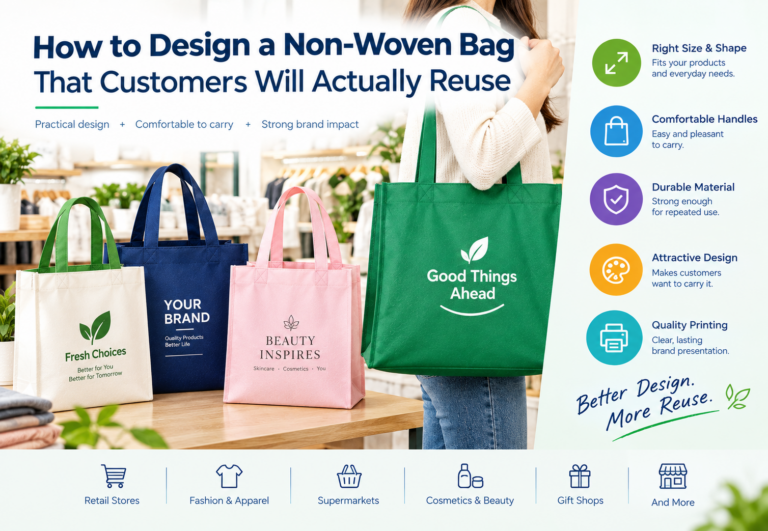

A custom non-woven bag can do more than carry products from a store to a customer’s home. When it is useful, comfortable, and visually appealing, it can become part of a customer’s everyday routine, creating repeated opportunities for brand exposure.
However, not every reusable bag gets reused. Some are too small for everyday shopping, others have uncomfortable handles, and some look more like advertisements than products people want to carry. Even a well-printed logo cannot compensate for a bag that is inconvenient or unattractive.
For retailers, supermarkets, promotional agencies, and brands ordering custom packaging in bulk, the challenge is to create a bag that customers genuinely want to keep.
This guide explains how to design custom non-woven bags that balance functionality, appearance, durability, branding, and production costs.
1. Start with the Customer’s Everyday Needs
The most effective reusable bag designs begin with the people who will use them. Before choosing colors or placing a logo, consider where customers might take the bag and what they need it to carry.
A bag designed for supermarket shopping has different requirements from one used for cosmetics, clothing, or trade show materials.
Consider these common applications:
- Supermarkets and grocery stores: Prioritize useful capacity, comfortable handles, and construction suitable for regular shopping.
- Fashion retailers: Focus on appearance, suitable dimensions for clothing, and a design that complements the brand.
- Cosmetics and beauty brands: Consider smaller sizes, neat construction, and coordinated colors.
- Gift shops: Choose a style that provides enough space for packaged products while maintaining an attractive presentation.
- Trade shows and exhibitions: Make sure the bag can comfortably hold brochures, catalogs, samples, and promotional materials.
- Corporate gifting: Choose a versatile design that recipients can use beyond the original event.
The key question is simple: Would the recipient have a reason to use this bag again after the first purchase or event?
If the answer is yes, the design is already moving in the right direction.
2. Choose a Practical Size and Shape
A reusable bag needs to fit naturally into everyday activities. If it is too small, too bulky, or difficult to store, customers may leave it at home.
Match the Size to the Intended Use
Small bags may work well for cosmetics, accessories, and compact purchases. Medium-sized bags can suit general retail shopping, while larger bags may be appropriate for clothing, groceries, or multiple products.
Avoid choosing dimensions based only on how much printable space is available. Consider the actual items the bag will carry and how customers will handle them.
Consider Gussets for Extra Capacity
Side and bottom gussets can provide additional depth and improve the bag’s ability to accommodate bulkier products.
For supermarkets and general retailers, gusseted designs may be more practical than completely flat bags. For lightweight promotional materials, a simpler structure may be sufficient.
Think About Storage
Foldable bags can be useful for customers who want to keep a spare shopping bag in a handbag, backpack, or vehicle.
If portability is important, consider whether the bag can be folded conveniently without becoming awkward to reopen.
Before approving the final dimensions, ask your supplier for a sample or mock-up so you can assess the proportions and usable capacity.
3. Design Comfortable Handles
Handles are one of the most important functional details because customers interact with them every time they carry the bag.
An attractive bag may be left unused if its handles feel uncomfortable or are unsuitable for the intended load.
Select the Right Handle Length
Short handles can work well for hand carrying, particularly with smaller bags. Longer handles allow some customers to carry the bag over a shoulder, leaving their hands free.
For everyday shopping, shoulder-carrying options may make the bag more convenient. The best choice depends on the bag’s dimensions, expected contents, and target users.
Check Handle Width and Attachment
Handle width, material, attachment method, and reinforcement all influence carrying comfort and performance.
For bags expected to carry heavier merchandise, discuss reinforced handles and appropriate construction with the manufacturer. Do not assume that a higher material GSM automatically guarantees stronger handles.
Test the Bag with Real Products
A sample should be tested with representative items, not just examined while empty.
Check whether the handles remain comfortable, whether the bag hangs properly, and whether the construction performs as expected under the intended load.
Small improvements in handle design can make a noticeable difference to everyday usability.
4. Choose Material Weight Based on Intended Use
Custom non-woven bags are commonly produced from polypropylene (PP) fibers bonded into a fabric-like sheet. Different material weights and construction methods can affect the bag’s feel, structure, and performance.
GSM, or grams per square meter, is a useful specification when comparing material options. However, it should not be treated as the only measure of strength.
The following ranges can serve as a starting point for discussing a project with a supplier.
| Material weight | Potential application | Design priority |
|---|---|---|
| 70–80 GSM | Lightweight giveaways and promotional bags | Keep the bag practical for its intended load |
| 80–100 GSM | General retail and reusable shopping bags | Balance usability, structure, and budget |
| 100–120 GSM | Selected heavier-duty or more structured bags | Evaluate the complete bag construction |
These are general planning ranges rather than universal performance standards. Actual carrying ability also depends on dimensions, handle reinforcement, seams, bottom construction, and material quality.
A thicker material is not automatically the best choice. The goal is to select a specification that performs well for its intended use without adding unnecessary cost or weight.
For more details, explore our custom non-woven bags for business branding and wholesale supply.
5. Make the Design Attractive Enough to Carry in Public
A reusable bag often travels beyond the store where it was distributed. Customers may carry it to work, shopping centers, markets, or other everyday destinations.
That means the design needs to appeal to the person carrying it, not just the business paying for it.
Avoid Overloading the Design
A common mistake is to fill every available area with logos, slogans, websites, social media handles, and product information.
Too many competing elements can make the bag look cluttered. Instead, choose one main visual element and use supporting details sparingly.
Use a Cohesive Color Palette
Color can influence whether a bag feels suitable for everyday use.
Retailers may choose their established brand colors, a neutral background with a contrasting logo, or a combination of colors that complements the products they sell.
For example, a cosmetics brand may prefer a restrained palette, while a supermarket may choose a brighter color that is easy to recognize.
The goal is to balance brand consistency with a design customers are comfortable carrying.
Add a Design Element Beyond the Logo
A small illustration, distinctive pattern, memorable phrase, or well-designed graphic can give the bag visual appeal beyond its commercial purpose.
A lifestyle retailer might use a simple geometric pattern. A bookstore could feature a book-inspired illustration. A food retailer might choose a graphic related to its product category.
The design should remain consistent with the brand while giving customers a reason to like the bag itself.
6. Find the Right Balance Between Logo Visibility and Subtle Branding
Businesses naturally want their logos to be seen. However, making a logo as large as possible is not always the best way to encourage reuse.
If the bag looks too much like a promotional advertisement, some customers may prefer not to carry it in public.
Use a Clear, Well-Proportioned Logo
The logo should be easy to recognize without overwhelming the rest of the design.
For brands with a recognizable symbol, a smaller logo paired with attractive graphics may be enough. Businesses that rely on their brand name may prefer a more prominent wordmark.
Consider Placement Carefully
The center of the front panel is a common location because it provides a straightforward area for branding.
However, logo placement should account for handles, seams, gussets, and how the bag looks when filled. Artwork that appears balanced on a flat computer screen may look different once the bag is assembled and carried.
Keep Supporting Information Minimal
A website address or QR code can help connect physical packaging with digital marketing. Include these elements only when they serve a clear purpose.
Make sure small text remains legible and QR codes can be scanned at a practical size.
For additional guidance, read our article on how to prepare artwork for custom non-woven bag printing.
7. Choose a Printing Method That Preserves the Design
A good design needs a printing method that can reproduce it clearly on the selected material.
Different methods suit different artwork styles, order quantities, and bag constructions.
Screen Printing
Screen printing is commonly used for straightforward logos and designs with a limited number of solid colors.
It can be suitable for bulk orders where the artwork is relatively simple and the desired result is clear, consistent branding.
Heat Transfer Printing
Heat transfer methods can reproduce more detailed, multicolor artwork when the selected materials and transfer process are compatible.
They may be appropriate for promotional graphics, illustrations, and designs that require more color detail.
Printing on Laminated Non-Woven Bags
Laminated non-woven bags have a coated surface that can support particular printing and finishing options.
They may suit designs that need a smoother appearance or more elaborate graphics, depending on the production process.
The best printing method depends on the artwork, material, order quantity, and desired finish. Ask your supplier to recommend a suitable process and confirm the expected result before approving production.
For a detailed comparison, read What Printing Method Is Best for Custom Non-Woven Bags?.
8. Add Functional Features That Encourage Repeat Use
A reusable bag becomes more valuable when it solves everyday problems. Functional details can give customers a stronger reason to keep it rather than discard it after one use.
Depending on the application and budget, consider the following options.
Foldable construction: Helps customers store a spare bag when it is not needed.
Reinforced bottom: May improve support for suitable loads when designed and manufactured correctly.
Additional depth: Gussets provide room for products that do not fit comfortably in a flat bag.
Laminated finish: Can change the appearance and surface characteristics of the bag, depending on the material and finish selected.
Distinctive handles: Contrasting handle colors or a suitable handle design can improve visual appeal while supporting the intended use.
Multiple sizes: A coordinated range can help retailers accommodate different purchases instead of relying on one bag for every situation.
Not every feature is necessary. Choose additions that solve a real customer problem and justify their effect on cost, production, and storage.
9. Design for Long-Term Brand Recognition
A reusable bag offers opportunities for repeated brand exposure, but those opportunities depend on whether customers actually keep using it.
A successful design should combine recognition with everyday usefulness.
Keep the Visual Identity Consistent
Use brand colors, typography, and logos that match the company’s wider identity. Consistency makes it easier for customers to associate the bag with the retailer.
Make the Bag Suitable for More Than One Occasion
A bag designed exclusively for a single event may have limited use afterward. A versatile design can work for shopping, carrying personal items, or storing everyday essentials.
For seasonal campaigns, consider whether the graphics will remain relevant after the promotion ends.
Consider the Customer’s Lifestyle
Think about where the intended audience lives, shops, works, and travels. A compact foldable bag may suit customers who want portability, while a structured shopping bag may be more useful for regular retail purchases.
The most effective design is one that fits naturally into the customer’s routine.
10. Balance Reusability with Cost and MOQ
For B2B buyers, design decisions must also work within the purchasing budget and manufacturing requirements.
A bag with additional features may be more useful, but it can also increase material consumption, labor, or printing costs. The best solution balances the customer’s needs with the project’s commercial goals.
Understand Minimum Order Quantities
Minimum order quantities vary by construction method, dimensions, printing requirements, and customization level.
As an indicative reference, sewn non-woven bags may start at around 500 pieces, while heat-pressed bags may require around 10,000 pieces. Actual MOQs should be confirmed for the specific design and order.
Compare Different Order Quantities
Request quotations at several realistic quantities where possible. This helps you understand how the unit price changes with order volume.
However, avoid ordering more bags than your business can reasonably distribute or store simply to obtain a lower unit price.
Evaluate the Total Cost
Compare the complete order cost, including bag production, printing, finishing, packing, shipping, and any applicable setup or sampling charges.
A slightly more expensive bag may offer better value if it is more suitable for the intended use and has a greater chance of being reused.
11. Approve a Sample Before Bulk Production
A digital mock-up is helpful for reviewing artwork and layout, but it cannot show every aspect of the finished product.
Before placing a large order, request a sample or production proof when appropriate.
Use the review process to check:
- Actual bag dimensions and usable capacity.
- Material feel and weight.
- Handle length, comfort, and attachment.
- Seams, bottom construction, and reinforcement.
- Logo size, position, and print clarity.
- Color consistency against the approved references.
- Overall appearance when the bag is empty and filled.
If the bag is intended for heavier products, test it with representative merchandise.
Once the sample is approved, document the specifications so the production team can follow the same requirements throughout the order and during future reorders.
12. A Practical Checklist for Designing a Reusable Non-Woven Bag
Before sending your design to a manufacturer, review the following checklist.
-
The bag suits the products and activities it is intended for.
-
The dimensions provide enough room without making the bag unnecessarily bulky.
-
The handles are suitable for the expected carrying method.
-
The material and construction match the intended load.
-
The logo is visible but does not overwhelm the design.
-
The colors and artwork are consistent with the brand identity.
-
The printing method is appropriate for the selected material and artwork.
-
Functional features provide a clear benefit to the user.
-
The MOQ, unit price, and total order cost fit the budget.
-
A sample or print proof will be reviewed before bulk production.
-
Production and delivery timelines are confirmed.
Following these steps can help businesses reduce avoidable design mistakes and make more informed purchasing decisions.
Conclusion: Design for the Customer, Not Just the Logo
A non-woven bag that customers actually reuse starts with a simple principle: it must be useful and appealing beyond the original purchase.
Practical dimensions, comfortable handles, appropriate material weight, attractive graphics, and balanced branding all contribute to a better user experience. Printing quality and manufacturing consistency then help ensure that the finished bag reflects the brand as intended.
For retailers, promotional agencies, distributors, and other B2B buyers, the objective is not merely to produce a bag with a logo. It is to create a product that customers have a reason to keep using.
Looking for a manufacturing partner for your next packaging project?
Explore our custom non-woven bags for business branding and wholesale supply to discuss bag styles, material options, printing methods, and bulk order requirements.
Contact our team to request a quotation for custom non-woven bags designed around your brand and customers’ needs.