
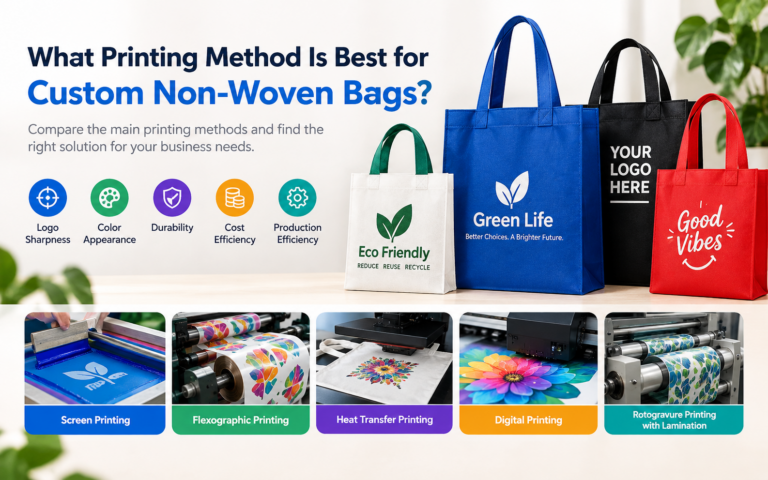

Printing is one of the most important customization decisions when ordering non-woven bags for your business.
A logo may look simple on a computer screen, but the final result can vary significantly depending on the printing method, fabric surface, number of colors, artwork complexity, order quantity, and required finish.
For example, a one-color company logo on a promotional bag does not necessarily need the same printing process as a full-color retail design with gradients and detailed graphics.
So, what printing method is best for custom non-woven bags?
The answer depends on your project.
For many standard B2B orders, screen printing is a practical choice for simple logos and solid colors. For larger-volume projects, flexographic printing can offer production efficiency. Heat transfer can be useful for detailed or full-color designs, particularly for smaller quantities, while laminated non-woven bags can support high-resolution graphics and more complex visual designs.
This guide explains the main printing methods and how buyers can choose the right one.
Why Printing Method Matters for Non-Woven Bags
Non-woven bags are commonly made from polypropylene (PP) non-woven fabric. Unlike smooth paper or plastic film, standard non-woven fabric has a textured surface.
That surface can affect how printed graphics appear.
Printing method can influence:
- Logo sharpness
- Color appearance
- Fine-detail reproduction
- Printing consistency
- Durability
- Setup cost
- Unit cost
- Production efficiency
- Suitable order quantity
- Overall appearance
For B2B buyers, the goal is not simply to find the most advanced printing technology.
The goal is to find the most suitable printing process for the specific bag project.
The Main Printing Methods for Custom Non-Woven Bags
Several printing methods can be used for custom non-woven bags.
The most relevant options for business buyers include:
- Screen printing
- Flexographic printing
- Heat transfer printing
- Digital printing
- Rotogravure printing with lamination
Each method has different strengths.
1. Screen Printing
Screen printing, also known as silk-screen printing, is one of the most commonly used methods for customized non-woven bags.
The basic process involves transferring ink through a mesh screen onto the surface of the bag. Different colors generally require separate screens.
Best for:
- Company logos
- Simple graphics
- Text
- Solid colors
- Promotional bags
- Event bags
- Retail bags
- One to several-color designs
Screen printing works particularly well when the artwork contains bold shapes and clearly defined colors.
It is also relatively straightforward to set up compared with more complex high-volume printing processes.
Advantages of Screen Printing
1. Good for bold branding
Large logos and solid-color graphics can appear clear and visually strong.
2. Suitable for many business applications
It can be used for promotional campaigns, events, retail packaging, trade shows, and branded shopping bags.
3. Practical for small and medium production runs
Because the setup requirements are relatively manageable, screen printing can make sense when the order quantity does not justify more expensive printing cylinders or plates.
4. Flexible for different bag designs
Screen printing can be used on many non-woven bag constructions, subject to the specific fabric and ink requirements.
Limitations
Screen printing is less suitable when the artwork contains:
- Complex photographic images
- Smooth gradients
- Extremely fine details
- Large numbers of colors
Each additional color can also add setup and production considerations.
For this reason, if your design is essentially a logo + text + a few solid colors, screen printing is often a sensible starting point.
2. Flexographic Printing
Flexographic printing, often called flexo printing, uses flexible printing plates to transfer ink onto the material.
It is particularly useful for production environments where relatively large quantities need to be printed efficiently.
Compared with screen printing, flexographic printing can be better suited to continuous or high-volume production. Industry sources describe flexo as a practical option for medium-to-large runs and multi-color graphics.
Best for:
- Large-volume orders
- Repeated production
- Retail programs
- Supermarket bags
- Multi-color branding
- Long production runs
- Designs that require consistent reproduction
Advantages
High production efficiency
Flexographic printing is designed for continuous production, making it useful when a large number of bags need to be produced.
Good color consistency
For large production runs, maintaining consistent printing across thousands of bags is important.
Suitable for more complex designs
Flexo can accommodate more colors and greater design complexity than a basic one-color screen-printing job.
Limitations
The main consideration is setup.
Printing plates need to be prepared for the artwork, so flexographic printing may be less attractive for very small quantities or constantly changing designs.
This is why buyers should evaluate total project cost, rather than simply comparing the printing price per bag.
3. Heat Transfer Printing
Heat transfer printing transfers a printed design onto the bag using heat and pressure.
This method can be useful when the artwork contains detailed graphics, gradients, or full-color elements.
Some industry guides describe heat transfer as particularly useful for short runs and detailed full-color designs.
Best for:
- Detailed graphics
- Full-color artwork
- Gradients
- Illustrations
- Smaller production runs
- Promotional projects
- Special designs
Advantages
Excellent design flexibility
Heat transfer can reproduce artwork that would be difficult to achieve with a simple spot-color screen-printing process.
Good for detailed graphics
If your design contains multiple colors, gradients, or more complicated visual elements, heat transfer can be worth considering.
Useful for smaller orders
Because the setup structure is different from traditional plate- or screen-based printing, it can be practical for certain smaller projects.
Limitations
Heat transfer may have a higher unit cost than high-volume printing methods when production quantities become very large.
The final performance also depends on the transfer material, application temperature, pressure, and the characteristics of the non-woven substrate.
Therefore, buyers should always request a sample when the appearance and durability of the print are important.
4. Digital Printing
Digital printing is another option for custom bag projects, particularly when design flexibility is more important than achieving the lowest possible unit cost at very large volumes.
Digital processes can support detailed, full-color artwork without requiring traditional screens or printing plates for every design.
Some current industry sources identify digital printing as a practical option for short to medium runs and complex artwork.
Best for:
- Short runs
- Detailed artwork
- Full-color designs
- Multiple design variations
- Samples
- Personalized projects
Advantages
No traditional screen or plate setup for every design
This can make digital processes attractive when designs change frequently.
Good artwork flexibility
Photographic images, gradients, illustrations, and other detailed graphics can be easier to reproduce.
Useful for sampling
Digital methods can also be useful when buyers need to evaluate a design before committing to a large production run.
Limitations
For very large orders, traditional high-speed printing processes can offer better production economics.
The exact result also depends heavily on the equipment, ink system, bag material, and surface treatment.
5. Rotogravure Printing With Lamination
For premium, high-volume non-woven bags, buyers may also consider printing on laminated material.
In this approach, artwork can be printed onto a film, often using rotogravure printing, before the printed film is laminated to the non-woven fabric.
The laminated surface is smoother than standard unlaminated non-woven fabric, which can help produce sharper and more detailed graphics.
Best for:
- Large retail programs
- Supermarket chains
- Premium branding
- Full-color artwork
- Detailed graphics
- Large-volume orders
- High-visibility packaging
Advantages
High-quality visual reproduction
The smooth printed film can provide a more refined surface for detailed graphics, gradients, and full-color branding.
Premium appearance
Glossy or matte laminated surfaces can create a different visual effect compared with standard unlaminated non-woven fabric.
Additional surface protection
Lamination can also provide additional surface characteristics such as improved moisture resistance, depending on the material and construction.
Limitations
The setup cost can be considerably higher than simpler printing methods.
For smaller orders, the additional setup may not be economically practical.
Therefore, laminated rotogravure printing is generally something buyers should evaluate for large-volume or premium projects, rather than automatically selecting it for every custom bag.
Custom Non-Woven Bag Printing Methods Compared
| Printing Method | Best For | Artwork Complexity | Small Orders | Large Orders | Main Advantage |
|---|---|---|---|---|---|
| Screen Printing | Logos, promotional bags | Low to medium | Good | Good | Simple and practical |
| Flexographic Printing | High-volume production | Medium | Less suitable | Excellent | Production efficiency |
| Heat Transfer | Detailed graphics | High | Good | Moderate | Full-color flexibility |
| Digital Printing | Short runs and complex artwork | High | Excellent | Moderate | Design flexibility |
| Rotogravure + Lamination | Premium large-volume bags | Very high | Less suitable | Excellent | High-quality full-color finish |
The exact suitability depends on the fabric, bag construction, artwork, quantity, and production equipment available from the manufacturer.
So, Which Printing Method Is Best?
There is no single printing method that is best for every custom non-woven bag.
Instead, use your project requirements to narrow down the options.
If You Have a Simple Logo
For a company logo with one or a few solid colors, screen printing is often a practical choice.
It provides strong visual branding without requiring a highly complex printing process.
If You Need Thousands of Bags
For larger production quantities, flexographic printing may become more attractive because setup costs can be distributed across a larger number of bags.
The exact break-even point depends on the supplier, artwork, material, and order quantity.
If Your Artwork Is Full Color
If the design contains:
- Gradients
- Illustrations
- Multiple colors
- Detailed graphics
- Photographic elements
then heat transfer, digital printing, or laminated printing may be worth evaluating.
The appropriate choice depends on the quantity and the required finish.
If You Need a Premium Retail Appearance
For premium retail packaging with detailed graphics, a laminated non-woven bag can provide a smoother printing surface and a more polished appearance.
This can be particularly useful when packaging itself is an important part of the brand experience.
If You Need a Small Quantity
For smaller projects, avoid automatically choosing a high-volume printing process simply because it offers a lower unit cost at scale.
Setup costs can make a high-volume process less economical for a small order.
Digital or heat-transfer options may be worth comparing, depending on the design and supplier capabilities.
Printing Method vs. Bag Material
One important point is often overlooked:
The printing method cannot be separated completely from the bag material.
Standard unlaminated non-woven fabric has a textured surface.
Laminated non-woven fabric has a smoother surface.
This difference can affect:
- Print sharpness
- Color appearance
- Fine details
- Surface finish
- Ink adhesion
- Overall visual quality
For example, detailed artwork may look different on unlaminated fabric compared with a smooth laminated surface.
Current printing guides consistently emphasize that the substrate surface is an important part of the printing decision.
Therefore, do not simply tell the supplier:
“I need full-color printing.”
Instead, explain what the final bag needs to look like and ask the manufacturer to recommend a suitable combination of material + printing method + finishing.
How Many Colors Are in Your Design?
Color count is another important consideration.
One-color design
Usually straightforward.
Examples:
- Black logo
- White logo
- One-color slogan
- Simple brand name
Screen printing may be a practical option.
Two to four colors
Still relatively manageable for traditional printing methods, especially when the colors are solid.
Multiple colors
When the artwork contains many colors, gradients, or detailed illustrations, digital, heat transfer, flexographic, or laminated printing may become more relevant.
Full-color photographic artwork
For highly detailed images, a smooth laminated surface combined with an appropriate high-resolution printing process can provide better visual reproduction than printing directly onto a textured fabric surface.
Printing Method Also Affects Cost
Printing should not be evaluated only by the quoted price per bag.
A supplier may quote:
- Printing setup cost
- Screen cost
- Plate cost
- Cylinder cost
- Ink cost
- Printing cost
- Lamination cost
- Sample cost
The order quantity can change the economics considerably.
For example, a printing method with a higher setup cost may become more economical per bag when spread across a large production quantity.
On the other hand, a method with minimal setup may be more practical for a small order even if the unit printing cost is higher.
This is why B2B buyers should compare the total project cost, not just the printing line item.
How Printing Method Affects Lead Time
Printing can also affect your production schedule.
Simple screen printing may require relatively straightforward preparation.
Other processes may require:
- Printing plates
- Cylinders
- Film preparation
- Lamination
- Color separation
- Special material preparation
These additional steps can increase the production timeline.
For buyers with a fixed launch date, trade show, seasonal campaign, or retail promotion, printing should therefore be confirmed at the beginning of the project.
Do not finalize the bag design first and ask about production timing afterward.
What Should You Send a Manufacturer Before Requesting a Quote?
To receive a more accurate recommendation, provide as much information as possible.
A useful RFQ should include:
Product Information
- Bag type
- Bag size
- GSM
- Material
- Construction
- Handle type
- Gusset
- Lamination
Printing Information
- Artwork
- Number of colors
- Printing sides
- Approximate print area
- Required color matching
- Whether the design contains gradients or photographs
Order Information
- Quantity
- Required delivery date
- Destination
- Packaging requirements
Quality Requirements
- Expected load
- Reusability
- Print durability
- Surface appearance
The more complete the information, the easier it is for the manufacturer to recommend an appropriate production method.
This is consistent with the broader purchasing process for custom non-woven bags, where material, GSM, size, construction, printing, lamination, quantity, and delivery requirements should be confirmed before production.
Ask for a Physical Sample Before a Large Order
Digital artwork can only tell you part of the story.
A physical sample allows you to evaluate the actual:
- Fabric texture
- Color
- Logo sharpness
- Print coverage
- Print position
- Bag size
- Handle construction
- Surface finish
- Overall appearance
This is especially important when your artwork contains small text, fine lines, gradients, or multiple colors.
A sample can reveal problems that are difficult to identify from a digital mock-up.
For large B2B orders, it is generally better to approve the physical result before mass production.
Common Printing Mistakes Buyers Should Avoid
Mistake 1: Choosing the Method Based Only on Price
The cheapest printing quote may not produce the required visual result.
Mistake 2: Ignoring the Fabric Surface
A detailed design may look different on textured unlaminated fabric compared with laminated material.
Mistake 3: Sending Low-Resolution Artwork
Poor artwork can limit the final printing quality regardless of the printing technology.
Mistake 4: Not Considering Order Quantity
A printing method that makes sense for 500 bags may not be the most economical choice for 50,000 bags.
Mistake 5: Not Requesting a Sample
A digital proof is not always enough to evaluate the real printed result.
Mistake 6: Focusing Only on Color Count
Two designs with the same number of colors can require very different printing approaches if one contains solid shapes and the other contains gradients or photographic details.
A Simple Decision Guide for Buyers
You can use this basic framework when discussing your project with a manufacturer:
Simple logo + solid colors + standard promotional bag
→ Consider screen printing.
Large quantity + repeated design + production efficiency
→ Consider flexographic printing.
Detailed/full-color design + smaller or specialized order
→ Consider heat transfer or digital printing.
Premium retail bag + complex graphics + large quantity
→ Consider laminated printing and a suitable high-resolution printing process.
Not sure which method to use?
→ Send the artwork, bag specifications, quantity, and application to the manufacturer and ask for a recommendation.
The manufacturer’s production equipment and process capabilities also matter, so buyers should not assume that every supplier offers every printing method.
Custom Non-Woven Bags for Business Branding and Wholesale Supply
Custom non-woven bags can be produced in different materials, GSM specifications, sizes, constructions, handle styles, printing methods, and finishes.
For business and wholesale projects, the right combination depends on the intended application, order quantity, artwork, required appearance, and budget.
If you are looking for custom non-woven bags for retail, promotional campaigns, supermarkets, events, trade shows, or wholesale distribution, discuss your specifications with a manufacturer before choosing the printing process.
You can also explore our Custom Non-Woven Bags for Business Branding and Wholesale Supply to review the available customization options.
Final Thoughts
So, what printing method is best for custom non-woven bags?
There is no universal answer.
The right choice depends on five major questions:
- How many bags do you need?
- How complex is your artwork?
- How many colors does the design contain?
- Is the bag laminated or unlaminated?
- What level of visual quality and cost efficiency do you need?
For simple B2B branding, screen printing can be a practical solution.
For high-volume production, flexographic printing may offer better production efficiency.
For detailed or full-color artwork, heat transfer or digital processes can provide greater flexibility.
For premium, high-volume applications, laminated printing can offer a smoother surface and more sophisticated visual result.
The smartest approach is to give the manufacturer your artwork + bag specifications + quantity + application + target delivery date and let the production team evaluate the most suitable printing process.
In B2B packaging, the “best” printing method is not necessarily the most advanced one. It is the one that delivers the required appearance, durability, production efficiency, and total cost for your specific project.