
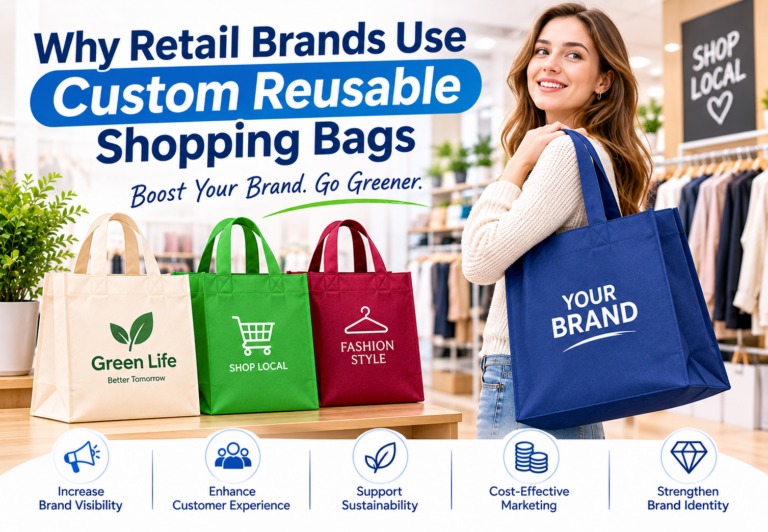

In today’s competitive retail market, brands need more than attractive products and eye-catching advertisements to stand out. Every customer interaction is an opportunity to build brand recognition, create a positive shopping experience, and encourage repeat purchases.
One often-overlooked branding opportunity is the shopping bag.
Custom reusable shopping bags have become a practical choice for retailers because they combine everyday functionality with brand visibility. Instead of serving only as temporary packaging, a well-designed shopping bag can continue representing a business long after the customer leaves the store.
From fashion boutiques and supermarkets to cosmetics retailers and department stores, businesses use custom reusable bags to improve packaging presentation, support promotional campaigns, and create more consistent brand experiences.
So why are retail brands investing in custom reusable shopping bags? Let’s explore the main reasons and how businesses can choose the right bags for their needs.
1. Increase Brand Visibility Beyond the Store
Traditional advertising usually requires continuous investment to maintain exposure. A reusable shopping bag offers a different approach.
When customers reuse a branded bag, the business logo and design travel with them. The bag may appear at supermarkets, shopping centers, offices, schools, public transportation stations, and other everyday locations.
This creates additional opportunities for people to recognize the brand.
For retail businesses, this means packaging can become a practical marketing asset rather than simply an expense associated with each purchase.
Turn Everyday Shopping into Brand Exposure
Consider a fashion boutique that provides customers with custom shopping bags featuring its logo and signature colors.
After the original purchase, customers may reuse those bags for shopping, carrying personal belongings, or running daily errands. Each use creates another opportunity for the brand to be seen.
The key is to create a bag that customers actually want to keep and reuse.
A recognizable logo, attractive colors, comfortable handles, and practical dimensions can all contribute to a better experience.
2. Create a More Memorable Customer Experience
Packaging influences how customers perceive a retail brand.
A carefully designed shopping bag can make an ordinary purchase feel more professional and thoughtful. It also helps create a consistent visual experience between the store, products, and packaging.
For example:
- Fashion retailers can use minimalist bags with coordinated brand colors.
- Cosmetics stores can choose elegant designs with clean logo placement.
- Gift shops can use structured bags with attractive finishes.
- Supermarkets can prioritize spacious bags with comfortable handles.
- Specialty retailers can create seasonal or limited-edition designs.
The bag does not need to be complicated. A practical design that matches the brand identity can make the overall shopping experience feel more complete.
3. Encourage Repeat Use and Long-Term Brand Recognition
The biggest difference between a disposable shopping bag and a reusable bag is its potential to serve customers multiple times.
Customers may keep a useful shopping bag in their car, at home, or inside another bag so they can use it again when needed.
This creates repeated brand exposure without requiring the retailer to pay for a new advertising placement every time the bag is used.
However, repeat use depends heavily on product quality and design.
Retailers should consider:
- Suitable fabric weight
- Comfortable handle length
- Appropriate bag dimensions
- Strong handle attachment
- Practical bottom and side construction
- Printing that maintains its appearance under normal use
A bag that is uncomfortable, too small, or poorly constructed is less likely to become part of a customer’s regular routine.
For this reason, investing in appropriate specifications can be more valuable than choosing the lowest possible unit price.
4. Support Brand Sustainability Initiatives
Sustainability has become an important consideration for many retail businesses. Reusable shopping bags can support efforts to reduce reliance on single-use packaging when customers use them repeatedly.
Custom reusable bags also provide a way for retailers to communicate practical actions related to packaging choices.
However, it is important to make responsible environmental claims.
A reusable bag is not automatically environmentally friendly simply because it can be used more than once. Its overall environmental impact depends on material production, transportation, durability, how often it is reused, and its end-of-life treatment.
A life-cycle assessment published in the Journal of Cleaner Production examined different grocery bag materials in the context of Singapore. It found that reusable polypropylene non-woven bags performed favorably in its model when reused 50 times. The results also demonstrate why reuse frequency and local waste-management conditions matter. Read the study.
For retail brands, the practical lesson is straightforward: choose a bag designed for repeated use and encourage customers to reuse it.
Avoid making broad claims such as “100% environmentally friendly” unless they are supported by appropriate evidence.
5. Provide Cost-Effective Marketing for Retail Businesses
Retail marketing budgets need to be allocated carefully. Businesses often compare different promotional products based on their cost, usefulness, and potential exposure.
Custom reusable shopping bags offer several advantages:
- They serve a practical purpose.
- They can display a company logo and brand colors.
- They can be distributed during everyday purchases.
- They can support seasonal promotions and special campaigns.
- They may continue to be used after the original transaction.
For retailers ordering in bulk, custom non-woven bags can be a cost-conscious option.
The final unit price depends on several factors, including fabric weight, bag size, printing method, construction, and order quantity.
A retailer should evaluate the total value of the bag rather than focusing only on the initial purchase price.
A slightly higher-quality bag may offer better customer satisfaction and a greater chance of repeated use.
6. Strengthen Brand Identity with Custom Designs
Generic shopping bags can serve a basic packaging purpose, but custom designs help retailers create a more recognizable brand experience.
Custom reusable bags can be tailored to match a company’s visual identity and marketing strategy.
Brand Colors
Using consistent brand colors helps customers associate the bag with the business.
Retailers can select fabric colors that match their logos, storefronts, product packaging, and other marketing materials.
Logo Placement
The logo should be easy to recognize without making the design look overcrowded.
Common options include:
- Centered logo printing
- Large front-panel branding
- Small minimalist logos
- Repeated brand patterns
- Logo and slogan combinations
Printing and Finishing
Different printing methods can produce different visual results.
Screen printing is often suitable for simple logos and designs with limited colors. Heat transfer can be considered for more detailed artwork, depending on material compatibility. Laminated non-woven bags can provide a smoother printing surface and may be available with matte or glossy finishes.
The best choice depends on the artwork, bag material, order quantity, and desired appearance.
7. Support Seasonal Promotions and Special Campaigns
Reusable shopping bags can also become part of a retailer’s promotional calendar.
Instead of using the same design throughout the year, businesses can introduce limited-edition bags for special occasions and marketing campaigns.
Examples include:
Holiday shopping campaigns: Create bags with Christmas, New Year, or other seasonal graphics.
Store anniversaries: Produce special bags featuring the anniversary date or campaign message.
New product launches: Use custom bags to support the launch of a new collection or product line.
Gift-with-purchase promotions: Offer a branded reusable bag when customers reach a certain spending threshold.
Loyalty programs: Provide exclusive bag designs as rewards for returning customers or loyalty members.
These campaigns give retailers more opportunities to connect packaging with specific marketing activities.
8. Why Custom Non-Woven Bags Are a Popular Retail Choice
Among the available reusable bag options, PP non-woven bags are commonly used for retail packaging and promotional applications.
They offer flexibility in material weight, bag construction, printing, and customization.
Some common advantages include:
Flexible Material Options
PP non-woven fabric is available in different GSM specifications, allowing retailers to choose materials based on their intended application.
For example:
- 70–80 GSM: Lightweight promotional and shopping bags
- 90–100 GSM: General retail shopping bags
- 110–120 GSM: More substantial retail bags and selected heavier-duty applications
These are general starting points. Actual performance also depends on bag dimensions, seams, handle reinforcement, and construction.
Multiple Bag Structures
Retailers can choose from several styles:
- Flat tote bags
- Bottom-gusset shopping bags
- Side-gusset bags
- Box-shaped bags
- Foldable shopping bags
- Die-cut handle bags
Each structure serves different products and shopping requirements.
Custom Printing and Colors
Non-woven bags can be produced in different fabric colors and customized with brand logos, promotional messages, and campaign graphics.
This makes them suitable for businesses that want consistent packaging across multiple stores.
Different Production Methods
Non-woven bags can be manufactured using sewn or heat-pressed construction.
Sewn bags are assembled with stitching and are often selected when retailers want a more conventional bag structure. Heat-pressed bags use bonding processes and are commonly used for certain high-volume promotional and shopping bag applications.
The appropriate construction depends on the bag design, quantity, and expected use.
For more details, explore our custom non-woven bags for business branding.
9. How Retail Brands Can Choose the Right Reusable Shopping Bags
Before placing a bulk order, retailers should define how the bags will be used.
The following factors can help narrow down the right specifications.
Step 1: Identify Your Main Application
Start by considering the products customers will carry.
A clothing store may need a wide, lightweight tote, while a supermarket may require a larger bag with a reinforced bottom and comfortable handles.
Step 2: Choose the Right Fabric Weight
Select GSM based on product weight, bag dimensions, and expected reuse.
Do not assume that the highest GSM is always the best option. The goal is to balance durability, appearance, and cost.
Step 3: Select the Bag Structure
Choose between flat, gusseted, box-shaped, or foldable designs according to the products and customer experience you want to provide.
Step 4: Prepare Your Artwork
Provide your manufacturer with a high-quality logo file, preferred colors, printing requirements, and any additional design elements.
Vector formats such as AI, EPS, or editable PDF files are often helpful for production.
Step 5: Confirm the Printing Method
Discuss your artwork and material selection with the manufacturer to determine which printing method is most suitable.
Step 6: Request a Sample
Before approving mass production, review a sample whenever possible.
Check the material, dimensions, handle construction, printing quality, and overall appearance.
Step 7: Confirm Quantity and Delivery Schedule
For retailers with multiple locations, coordinate order quantities and delivery timing carefully.
If the bags are intended for a seasonal campaign or store launch, allow sufficient time for artwork approval, sampling, production, inspection, and shipping.
10. How Retailers Can Get More Value from Reusable Bag Programs
Simply offering a reusable bag does not guarantee that customers will use it regularly.
Retailers can improve the effectiveness of their programs by making the bags useful, attractive, and easy to obtain.
Here are several practical ideas:
Offer bags at checkout: Make branded reusable bags available as an alternative to disposable packaging.
Use gift-with-purchase promotions: Offer a custom bag when customers reach a minimum purchase amount.
Create exclusive designs: Introduce limited-edition bags that customers may want to collect.
Promote repeated use: Encourage customers to bring their bags back on future shopping trips.
Match bags with other packaging: Use coordinated colors and graphics across shopping bags, gift boxes, and other packaging materials.
Measure program performance: Track bag sales, distribution quantities, customer feedback, and repeat-purchase participation.
These simple steps can help turn reusable shopping bags into a more structured retail branding initiative.
11. Frequently Asked Questions
Why do retail brands use reusable shopping bags?
Retail brands use reusable shopping bags to provide practical packaging, increase brand visibility, support promotional activities, and encourage customers to reuse their bags. Custom printing also helps maintain consistent brand identity.
Are custom non-woven bags suitable for retail stores?
Yes. Custom PP non-woven bags are suitable for many retail applications, including fashion stores, supermarkets, cosmetics shops, gift stores, and promotional campaigns. They can be customized in different sizes, colors, GSM specifications, and bag structures.
What GSM should retailers choose for reusable shopping bags?
For general retail use, 90–100 GSM can be a practical starting point. Retailers carrying heavier products may consider 100–120 GSM with suitable reinforcement. The final specification should be confirmed through sample evaluation and application testing.
Can reusable shopping bags be customized with a company logo?
Yes. Retailers can customize bags with logos, brand colors, slogans, promotional graphics, and other visual elements. Printing methods depend on the artwork and selected material.
Are reusable non-woven bags environmentally friendly?
Their environmental performance depends on how they are produced, transported, reused, and disposed of. Repeated use is important. Retailers should avoid making unsupported environmental claims and should encourage customers to reuse the bags as much as possible.
What is the MOQ for custom non-woven shopping bags?
MOQ varies according to bag style, construction, printing requirements, and production method. As an indicative reference, sewn non-woven bags may start from around 500 pieces, while heat-pressed bags may require around 10,000 pieces. Confirm the actual MOQ with your supplier before ordering.
Conclusion
Custom reusable shopping bags give retail brands a practical way to connect packaging with marketing, customer experience, and brand identity.
They can increase brand visibility beyond the store, encourage repeated use, support seasonal promotions, and provide customers with useful everyday packaging.
However, successful reusable bag programs begin with the right product. Retailers should carefully consider fabric weight, bag structure, handle design, printing quality, and expected usage before placing a bulk order.
For businesses looking for flexible and cost-conscious branded packaging, custom non-woven bags are worth considering.
Explore CXGIAE Custom Non-Woven Bags to discover customization options for your retail packaging project. Contact our team to discuss your design, quantity, and production requirements.