
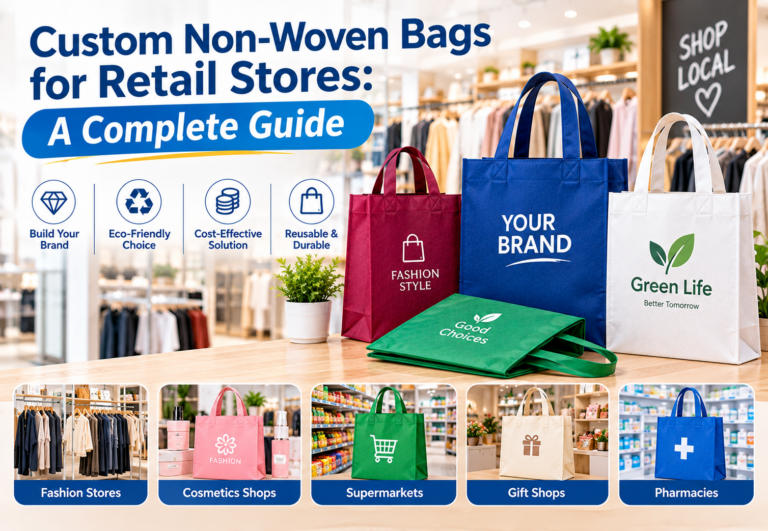

In retail, packaging is more than a way to carry purchased products. It is part of the customer experience and an opportunity to keep your brand visible long after a customer leaves the store.
Custom non-woven bags offer retailers a practical combination of affordability, customization, and reusability. Whether you operate a fashion boutique, supermarket, cosmetics store, gift shop, pharmacy, or retail chain, these bags can be designed to match your products, brand identity, and daily packaging requirements.
However, choosing the right custom non-woven bag involves more than adding a logo to a piece of fabric. Material weight, bag dimensions, handle design, printing method, and construction all influence the final result.
In this guide, we explain how retail businesses can select and customize non-woven bags that balance appearance, functionality, and purchasing costs.
1. Why Are Custom Non-Woven Bags Popular with Retail Stores?
Non-woven bags are commonly made from polypropylene (PP) fibers bonded together to create a fabric-like material. Unlike traditional woven textiles, the fibers are not arranged through a conventional weaving process.
For retailers, this material offers several practical advantages.
Cost-Effective for Bulk Orders
Retail businesses often need packaging in consistent quantities, especially when operating multiple stores or running seasonal promotions.
PP non-woven fabric is suitable for large-scale production, making it a practical option for businesses looking to control packaging costs while maintaining a consistent branded appearance.
Customizable to Match Your Brand
Non-woven bags can be customized in different colors, sizes, shapes, and printing styles.
Retailers can add:
- Company logos and brand names
- Brand colors and visual elements
- Promotional messages and campaign graphics
- Website addresses and social media details
- Seasonal artwork and special-edition designs
This flexibility makes it easier to create packaging that fits your overall brand presentation.
Lightweight and Reusable
Non-woven bags are lightweight and can be designed for repeated shopping use. Customers may reuse them for groceries, personal belongings, or other everyday purposes.
Their practical value depends on appropriate material selection and construction. A bag intended for regular retail shopping should be designed with suitable fabric weight, handle attachment, and bottom support.
Suitable for Different Retail Industries
Custom non-woven bags can serve many types of businesses, including:
- Fashion and clothing stores
- Supermarkets and grocery stores
- Cosmetics and skincare retailers
- Pharmacies and health product stores
- Gift shops and specialty stores
- Bookstores and stationery retailers
- Jewelry and accessory boutiques
- Shopping malls and department stores
The bag design can be adjusted according to the products being carried and the experience a retailer wants to create.
2. Choosing the Right Non-Woven Fabric Weight (GSM)
One of the most important decisions when ordering custom non-woven bags is selecting the correct GSM.
GSM stands for grams per square meter. It measures the weight of the fabric and helps buyers compare different material specifications.
In general, heavier fabric can provide a more substantial feel and better structure. However, GSM alone does not determine the strength of a finished bag. Seams, handles, bag dimensions, and bottom construction also matter.
Here is a practical starting point for retail buyers:
| Fabric Weight | Typical Applications |
|---|---|
| 70–80 GSM | Lightweight shopping bags, promotional packaging, small retail purchases |
| 90–100 GSM | Standard retail shopping bags, reusable totes, gift packaging |
| 110–120 GSM | Premium retail bags, larger shopping bags, heavier products |
These are general selection guidelines rather than guaranteed load ratings. The best specification should be confirmed through samples and testing with the products you intend to carry.
Our recommendation: For everyday retail shopping, consider 90–100 GSM as a starting point. If your store sells heavier products or wants a more structured bag, explore 100–120 GSM options with reinforced construction.
3. Select a Bag Style That Fits Your Store
The bag structure should reflect both the products you sell and how customers will use the packaging.
Flat Tote Bags
Flat tote bags have a simple structure and are suitable for lightweight products, clothing, brochures, and promotional items.
They are a practical choice for boutiques and stores that want a clean, straightforward packaging design.
Bottom-Gusset Shopping Bags
Bottom-gusset bags provide additional space and allow the bag to accommodate bulkier products.
They work well for supermarkets, grocery stores, gift shops, and general retail businesses.
Side-Gusset Bags
Side gussets expand the usable space of the bag and make it easier to carry products with different shapes.
They are useful for larger retail purchases, packaged goods, and products that require more internal room.
Box-Shaped Non-Woven Bags
Box-shaped bags have a more structured appearance, often with a flat bottom and defined sides.
They can be a good option for premium retail packaging, cosmetics, gift sets, and specialty products.
Foldable Shopping Bags
Foldable non-woven bags can be designed to collapse into a smaller form for convenient storage.
They are particularly useful for supermarkets, promotional campaigns, and retailers that want to encourage customers to bring reusable bags on future shopping trips.
The best style depends on your products, expected carrying weight, shelf or storage space, and target packaging budget.
4. Handle Design: Comfort and Durability Matter
Handles influence how customers carry a bag and how well the bag performs under normal use.
Common handle options include:
Loop handles: A popular option for shopping bags. They are easy to hold and can be designed in different lengths.
Die-cut handles: The handle opening is cut directly into the bag material. This creates a simple, integrated appearance and works well for certain lightweight retail applications.
Reinforced handles: Additional material or construction support is used around the handle area to improve durability.
Extended shoulder handles: Longer handles allow customers to carry the bag over their shoulders, making them useful for larger shopping bags.
When choosing handles, consider the size and weight of your products. A bag designed for clothing should not necessarily use the same handle specifications as one intended for groceries or packaged bottles.
For heavier products, ask your supplier about handle reinforcement, seam construction, and sample load testing.
5. Custom Printing Options for Retail Branding
A well-designed retail bag should make your brand recognizable without making the design unnecessarily complicated.
The right printing method depends on your artwork, fabric type, order quantity, and desired finish.
Screen Printing
Screen printing is commonly used for logos, text, and relatively simple graphic designs.
It is worth considering when your artwork uses a limited number of colors and you need consistent branding across a bulk order.
Heat Transfer Printing
Heat transfer printing can reproduce more detailed artwork and multiple colors.
It may be suitable for designs that include gradients, complex graphics, or more elaborate visual elements. The final result depends on the material and transfer process.
Printing on Laminated Non-Woven Bags
Laminated non-woven bags have an additional surface layer that can provide a smoother appearance and support more detailed printed designs.
Common finishes include:
- Matte lamination
- Glossy lamination
Matte finishes create a more understated appearance, while glossy finishes offer a brighter surface.
The most suitable printing method should be confirmed with your manufacturer after reviewing the artwork and material specifications.
6. How to Design Non-Woven Bags That Strengthen Your Retail Brand
Custom packaging should look consistent with your store’s visual identity while remaining practical for customers.
Here are several design recommendations.
Use Consistent Brand Colors
Choose colors that match your logo, storefront, website, and other packaging materials.
Consistent color use helps customers recognize your business across different touchpoints.
Make Your Logo Easy to Recognize
Your logo should be visible without overwhelming the design.
Consider its size, position, background color, and contrast. A simple, well-positioned logo can often create a more professional impression than a bag crowded with text.
Include Useful Brand Information
Depending on your business, you may include:
- Brand name
- Website address
- Short brand slogan
- Social media account
- QR code
Keep additional information readable and avoid overcrowding the printing area.
Match the Bag Design to Your Products
A fashion retailer may prefer a minimal design with elegant colors. A supermarket may prioritize a larger capacity and stronger construction. A cosmetics store may choose a compact bag with a more refined finish.
The bag should feel like a natural extension of the products and shopping experience.
7. Custom Non-Woven Bags for Different Retail Industries
Different retail businesses have different packaging requirements. Below are some common applications.
| Retail Industry | Recommended Bag Features |
|---|---|
| Fashion and clothing | Larger tote, shoulder handles, branded printing |
| Supermarkets | Bottom gusset, suitable GSM, reinforced handles |
| Cosmetics and skincare | Compact size, clean logo placement, matte or glossy finish |
| Gift shops | Box-shaped structure, custom colors, premium printing |
| Pharmacies | Practical size, clear branding, easy-to-carry handles |
| Bookstores | Wider bottom, reinforced construction, comfortable handles |
| Jewelry stores | Smaller dimensions, neat appearance, coordinated colors |
These are starting points rather than fixed specifications. Your final design should reflect the actual dimensions and weight of the products being packed.
8. What Affects the Cost of Custom Non-Woven Retail Bags?
For retail buyers, packaging costs need to be evaluated alongside quality, functionality, and order quantity.
Several factors influence the unit price.
1. Fabric weight and material: Higher GSM generally requires more raw material. Laminated options may also increase material and processing costs.
2. Bag size: Larger bags use more fabric and may require additional production materials.
3. Construction: Stitched bags, heat-pressed bags, reinforced bottoms, and additional structural details can affect production costs.
4. Printing method: The number of colors, print coverage, artwork complexity, and printing process all influence the quotation.
5. Handles and accessories: Handle length, reinforcement, special materials, and additional features can change the final price.
6. Order quantity: Larger orders may reduce the unit cost by distributing setup and production expenses across more bags.
To receive an accurate quotation, provide your supplier with the intended quantity, bag dimensions, GSM, material finish, printing artwork, and handle requirements.
9. What Retail Buyers Should Confirm Before Placing an Order
Before approving a bulk order, it is important to confirm that the specifications match your store’s actual needs.
Use this checklist when communicating with a manufacturer:
- Bag dimensions: Confirm width, height, and gusset measurements.
- Material weight: Specify the required GSM.
- Fabric color: Confirm the material color and any brand color requirements.
- Printing artwork: Provide clear artwork files and approve the logo position.
- Handle construction: Confirm handle length, width, and reinforcement.
- Bag structure: Choose flat, gusseted, box-shaped, or foldable styles.
- Sample approval: Review a physical sample when appropriate.
- Quality requirements: Confirm dimensions, printing consistency, seams, and appearance.
- Packaging: Specify how finished bags should be packed for shipment.
- Delivery schedule: Allow sufficient time for sampling, production, inspection, and shipping.
For chain stores or multi-location retailers, it is especially important to maintain consistent specifications across repeat orders.
10. Why Work with a Custom Non-Woven Bag Manufacturer?
Working directly with a manufacturer can make the customization and purchasing process easier to coordinate.
A capable manufacturing partner should be able to help you evaluate material options, recommend suitable bag structures, review artwork, arrange samples, and manage bulk production.
When comparing suppliers, consider more than the initial quotation.
Look at:
- Experience with custom retail packaging
- Available material and construction options
- Printing and customization capabilities
- Sample development and approval process
- Production capacity and quality control
- Communication and delivery arrangements
A supplier that understands your retail application can help you avoid unnecessary design changes and select specifications that balance cost and performance.
At CXGIAE, we provide custom packaging solutions for businesses looking for branded bags and other retail packaging products.
Explore our Custom Non-Woven Bags for Business Branding to learn more about available customization options.
11. Frequently Asked Questions
What GSM is best for custom non-woven bags for retail stores?
For many standard retail applications, 90–100 GSM is a practical starting point. For heavier products or more structured bags, 100–120 GSM may be worth considering. The final choice should also account for bag size, handles, seams, and expected carrying weight.
Can I customize the size and shape of non-woven retail bags?
Yes. Custom non-woven bags can be produced in different dimensions and structures, including flat totes, bottom-gusset bags, side-gusset bags, box-shaped bags, and foldable bags. Your manufacturer can recommend a suitable structure based on your products.
Can I print my store logo on both sides?
Yes. Depending on the bag design and printing requirements, logos, brand names, and promotional graphics can be printed on one or both sides.
What is the MOQ for custom non-woven bags?
MOQ depends on the bag structure, material, printing requirements, and production method. As an indicative reference, sewn non-woven bags may start from around 500 pieces, while heat-pressed styles may require around 10,000 pieces. Please confirm the actual MOQ with your supplier based on your design.
Are custom non-woven bags suitable for supermarkets?
Yes. They can be designed for grocery and supermarket shopping with suitable fabric weight, bottom gussets, and reinforced handles. For heavier grocery products, request samples and confirm load performance before placing a bulk order.
How can I get a quotation for custom retail bags?
Prepare your bag size, estimated quantity, material or GSM preference, logo artwork, printing requirements, and preferred bag style. Send these details to your manufacturer so they can recommend a suitable solution and provide a more accurate quotation.
Conclusion
Custom non-woven bags are a flexible packaging option for retail stores that want to combine practical shopping functionality with consistent brand presentation.
The key is to choose the right specifications for your business. Consider fabric weight, bag structure, handle design, printing method, and order quantity before moving into production.
Whether you run a single boutique or manage a retail chain, a thoughtfully designed shopping bag can support a better customer experience and keep your brand visible beyond the store.
Looking for a reliable supplier for your next retail packaging project?
Visit CXGIAE Custom Non-Woven Bags and contact our team to discuss your requirements, customization options, and bulk order quotation.