
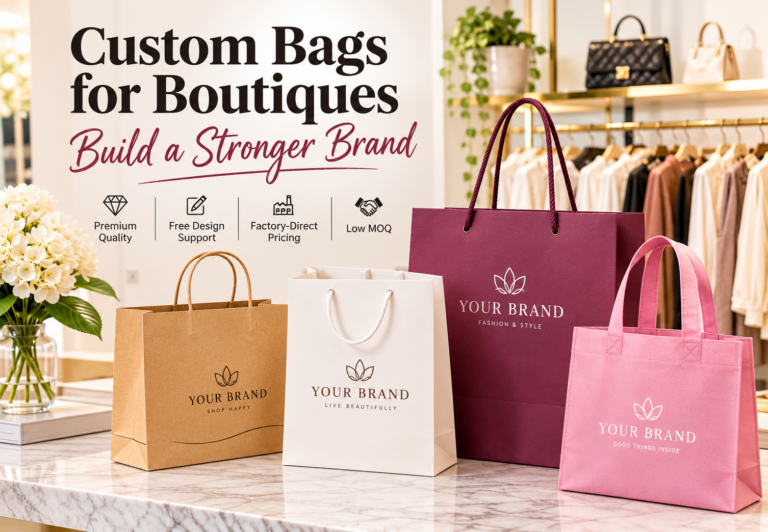

For boutique businesses, branding is about more than the products displayed on the shelves. Every customer interaction contributes to how people perceive your business, from the store atmosphere and product presentation to the packaging they take home.
A carefully designed shopping bag can turn an ordinary purchase into a memorable brand experience. It carries your products, displays your logo, and gives customers something they may continue using long after leaving your store.
Whether you operate a fashion boutique, beauty store, jewelry shop, gift shop, or lifestyle retail business, custom bags can help strengthen your brand identity and create a more consistent shopping experience.
In this guide, we’ll explore why custom bags matter for boutiques, how to choose the right materials and designs, and what to consider when ordering branded shopping bags in bulk.
1. Why Custom Bags Matter for Boutique Branding
Boutiques often compete through product selection, customer service, atmosphere, and brand personality. Packaging is another opportunity to make a lasting impression.
Create a Consistent Brand Identity
A boutique’s visual identity should remain recognizable across different customer touchpoints.
Using custom shopping bags that match your store logo, brand colors, typography, and overall design style helps create a consistent appearance.
For example:
- A minimalist fashion boutique may choose white or beige bags with a simple black logo.
- A luxury clothing store may prefer dark-colored bags with refined typography and premium finishes.
- A lifestyle boutique may use natural kraft paper bags with understated graphics.
- A youthful fashion brand may choose bold colors and large printed logos.
When packaging follows the same visual direction as your store, customers can more easily recognize and remember your brand.
Improve the Customer Experience
Packaging is often the final physical interaction customers have with a boutique after completing a purchase.
A well-made shopping bag with comfortable handles, suitable dimensions, and a neat appearance makes carrying products easier.
For boutiques selling clothing, cosmetics, accessories, or gifts, the right packaging can also make purchases feel more carefully presented.
Increase Brand Exposure
Custom shopping bags can travel beyond the store.
Customers may carry them through shopping centers, streets, workplaces, and other public spaces. If the bag is attractive and practical, they may reuse it for other activities.
This creates additional opportunities for people to see your brand logo and become familiar with your business.
Support Customer Loyalty
Consistent packaging helps reinforce the overall shopping experience. When customers associate your boutique with thoughtful product presentation and recognizable branding, packaging can become one small but meaningful part of why they remember your store.
2. Choosing the Right Custom Bag Material for Your Boutique
Different boutiques have different packaging requirements. The right material depends on your products, brand positioning, budget, and expected customer usage.
Here are three popular options.
Custom Paper Bags
<text>Best for: Fashion boutiques, gift shops, cosmetics stores, jewelry retailers, and premium retail packaging.</text>
Paper bags are a popular choice for boutiques because they offer a clean, professional surface for branding and printing.
Common material options include:
- Kraft paper
- White card paper
- Coated paper
- Specialty paper
You can customize paper bags with different sizes, handle styles, printing colors, and finishing options.
For a premium appearance, boutiques can consider matte or gloss lamination, foil stamping, embossing, or other finishing techniques, depending on the selected paper and production process.
Explore our custom paper bags for different retail and promotional packaging applications.
Custom Non-Woven Bags
<text>Best for: Clothing stores, fashion retailers, promotional campaigns, and reusable shopping bag programs.</text>
Non-woven bags are made from non-woven fabric, commonly polypropylene (PP). They are lightweight, customizable, and available in different structures and fabric weights.
Popular options include:
- Flat tote bags
- Bottom-gusset shopping bags
- Side-gusset bags
- Box-shaped bags
- Foldable shopping bags
- Reinforced heavy-duty bags
Non-woven bags can be customized with printed logos, brand colors, different handles, and various dimensions.
For boutiques that want customers to reuse their shopping bags, non-woven bags can provide a practical option.
Learn more about our custom non-woven bags for business branding and wholesale supply.
Custom Canvas Bags
<text>Best for: Lifestyle boutiques, specialty retailers, merchandise collections, and promotional products.</text>
Canvas bags offer a fabric-based appearance and can be suitable for brands looking for a different style of reusable packaging.
They are often used for merchandise, promotional campaigns, and products where customers may value the bag as an additional reusable item.
Depending on the fabric and construction, canvas bags can offer a more substantial feel than lightweight shopping bags. However, material weight, stitching, and handle construction should be evaluated before ordering.
3. How to Design Custom Bags That Reflect Your Brand
A successful boutique shopping bag should do more than display a logo. Its overall design should communicate the personality and positioning of your business.
Choose Brand Colors Carefully
Color is one of the first things customers notice.
Consider using your existing brand palette rather than introducing too many unrelated colors.
Some common design directions include:
| Brand positioning | Suggested colors |
|---|---|
| Minimalist boutique | White, beige, gray, black |
| Luxury fashion store | Black, burgundy, navy, cream |
| Natural lifestyle brand | Kraft brown, olive green, muted tones |
| Youth fashion boutique | Bright colors, contrasting combinations |
| Beauty and cosmetics store | Soft pink, white, champagne, lavender |
For consistent results, provide your manufacturer with the correct brand color references, such as Pantone values or suitable artwork files.
Make Your Logo Easy to Recognize
The logo is usually the most important visual element on a branded shopping bag.
Avoid making the design unnecessarily complicated. A clear logo with appropriate spacing can be more effective than a crowded layout.
Consider:
- Logo size and placement
- Contrast between the logo and bag material
- Typography and supporting text
- Front and back printing
- Whether additional graphics are necessary
The goal is to make your brand recognizable without overwhelming the design.
Select the Right Handle Style
Handles influence both the appearance and functionality of a shopping bag.
Common options include:
- Twisted paper handles
- Flat paper handles
- Cotton rope handles
- Die-cut handles
- Non-woven fabric handles
- Reinforced loop handles
A premium gift boutique may prefer rope handles, while a clothing retailer may choose comfortable loop handles on non-woven bags.
The handle should match the bag structure and expected contents. Reinforcement may be needed for heavier purchases.
Consider Finishing Details
Finishing options can help create a more distinctive appearance.
For paper bags, options may include:
- Matte lamination
- Gloss lamination
- Foil stamping
- Embossing or debossing
- Spot UV
For non-woven bags, brands can explore matte or glossy lamination, different printing methods, reinforced handles, and custom stitching or bonding details.
Not every finishing option is suitable for every material, so confirm technical compatibility with your manufacturer.
4. Match Your Shopping Bags to the Products You Sell
Choosing the right bag size and structure is just as important as selecting the material.
A bag that is too small may not accommodate your products, while an oversized bag can increase material use and shipping volume.
Here are some general recommendations for different boutique categories.
| Boutique type | Suggested bag options |
|---|---|
| Fashion and clothing boutiques | Medium or large paper bags, gusseted non-woven bags |
| Jewelry stores | Small premium paper bags |
| Cosmetics and beauty stores | Small and medium paper bags |
| Gift boutiques | Specialty paper bags with decorative handles |
| Lifestyle stores | Reusable non-woven or canvas bags |
| Shoe boutiques | Wide-bottom or reinforced shopping bags |
These are general design directions rather than fixed dimensions. The actual size should be based on your product measurements, packaging requirements, and typical order combinations.
If your boutique sells products in different sizes, consider developing two or three standard bag sizes instead of using one design for everything.
5. Custom Bags as Part of Your Boutique Marketing Strategy
Custom bags can serve as more than product carriers. They can become part of your wider brand communication strategy.
Turn Shopping Bags into Mobile Advertising
A customer carrying a branded shopping bag creates a small but visible brand impression.
Unlike many short-term advertisements, a reusable bag may continue appearing in public spaces when customers use it again.
For better visibility, prioritize clear logo placement, recognizable brand colors, and practical bag designs that customers will want to keep.
Create Seasonal and Limited-Edition Packaging
Seasonal packaging can help boutiques refresh their visual presentation throughout the year.
For example:
- Valentine’s Day gift bags
- Spring and summer shopping bags
- Halloween promotional bags
- Christmas gift packaging
- New collection launch bags
- Anniversary and special event packaging
You can keep your main bag design consistent while introducing seasonal colors, printed graphics, or limited-edition details.
This approach helps create variety without changing your entire packaging system.
Use Packaging for Promotional Campaigns
Custom bags can also support marketing activities such as store openings, fashion events, trade shows, customer appreciation campaigns, and brand collaborations.
For example, a boutique launching a new collection could prepare a limited batch of branded shopping bags for customers attending the event.
The packaging becomes part of the campaign rather than simply an afterthought.
6. How to Balance Packaging Quality and Budget
Boutique owners often want packaging that looks attractive without increasing operating costs unnecessarily.
The key is to prioritize the features that matter most to your brand and customers.
Select Materials Based on Actual Requirements
Not every boutique needs the most expensive material or finishing process.
A simple kraft paper bag may work well for everyday purchases, while a boutique selling premium gifts may benefit from coated paper and additional finishing.
Similarly, a standard non-woven tote may be sufficient for promotional distribution, while a heavier construction may be more appropriate for repeated use.
Standardize Bag Sizes
Using a small range of standard sizes can simplify inventory management and make purchasing more efficient.
For example, a fashion boutique could use:
- Small bags for accessories
- Medium bags for shirts and lightweight clothing
- Large bags for jackets and multiple purchases
Standardization can also make it easier to plan repeat orders.
Consider Bulk Purchasing
Ordering custom bags in larger quantities may help reduce the unit cost, depending on the material, printing method, setup requirements, and order specifications.
However, boutique owners should also consider storage space, cash flow, and how quickly packaging designs may change.
The best order quantity is one that balances unit cost with realistic inventory needs.
7. What to Consider Before Ordering Custom Boutique Bags
Before contacting a manufacturer, prepare the key details of your packaging project.
1. Bag Material
Choose paper, non-woven fabric, canvas, or another suitable material based on your products and brand positioning.
2. Dimensions
Confirm the required width, height, and gusset depth. Measure the products or existing bags you want to use as references.
3. Fabric Weight or Paper Specification
For non-woven bags, confirm the GSM and construction. For paper bags, discuss paper type, thickness, and finishing requirements.
4. Printing Artwork
Prepare your logo and artwork in a high-resolution or vector format, such as AI, EPS, or editable PDF.
5. Handle and Construction
Specify handle type, handle length, reinforcement, bottom structure, and other functional requirements.
6. Order Quantity
Confirm the expected quantity and whether you need multiple sizes or designs.
Minimum order quantities vary by material and production method. For reference, sewn non-woven bags may start from around 500 pieces, while heat-pressed styles may require around 10,000 pieces. Actual MOQ should be confirmed for each design.
7. Sample Approval
Request a sample or production proof where appropriate. Check the dimensions, material, logo placement, color, handles, and overall construction before approving mass production.
8. Production and Delivery Schedule
If you are preparing for a store opening, seasonal promotion, or new collection launch, discuss the production and shipping schedule early.
8. How to Choose the Right Custom Bag Manufacturer
A reliable packaging manufacturer can help turn your design ideas into finished products that meet your requirements.
When comparing suppliers, consider the following:
- Customization capabilities: Can the supplier offer different materials, sizes, handles, printing methods, and finishes?
- Production experience: Does the manufacturer have experience producing bags for retail and boutique businesses?
- Sample support: Can they provide samples for checking material, dimensions, and printing quality?
- Quality control: Are there inspection procedures for printing, construction, dimensions, and finished products?
- Production capacity: Can the supplier handle your required quantity and future repeat orders?
- Communication: Can they clearly explain specifications, costs, production schedules, and shipping arrangements?
Working directly with a manufacturer can make it easier to discuss custom requirements and coordinate production for ongoing packaging needs.
At CXGIAE, we provide custom packaging solutions for businesses, including paper bags and non-woven shopping bags. Our customization options support different materials, sizes, printing designs, and bag structures.
Explore our product range:
Share your bag design, specifications, and estimated quantity with our team to discuss a suitable packaging solution for your boutique.
9. Frequently Asked Questions
What type of custom bags are best for boutiques?
Paper bags are popular for fashion, beauty, jewelry, and gift boutiques because of their printable surfaces and range of finishing options. Non-woven bags are suitable for reusable retail shopping bags and promotional campaigns. The best option depends on your products, budget, and brand identity.
Can I customize shopping bags with my boutique logo?
Yes. Custom shopping bags can feature your logo, brand colors, slogans, and other artwork. Available printing and finishing options depend on the selected material and bag construction.
Are custom non-woven bags suitable for luxury boutiques?
Yes, depending on the design and construction. Premium-looking non-woven bags can use carefully selected colors, laminated surfaces, reinforced handles, and clean logo designs. However, boutiques seeking a traditional luxury paper packaging appearance may prefer specialty paper and premium finishes.
What information is needed to get a custom bag quotation?
You should provide the material, dimensions, printing artwork, handle style, construction requirements, estimated quantity, and destination country. These details help the manufacturer prepare a more accurate quotation.
Can I order different bag sizes for my boutique?
Yes. You can develop several bag sizes to accommodate different product categories, such as accessories, clothing, shoes, and gift items. Each size can follow the same brand design for a consistent packaging identity.
How early should I order custom boutique bags?
Order timing depends on design complexity, sample approval, production capacity, and shipping arrangements. For seasonal campaigns and store openings, it is advisable to start discussions well in advance to allow time for revisions and production.
Conclusion
For boutique businesses, packaging is an important part of the brand experience. Custom shopping bags help create visual consistency, improve product presentation, and give customers another way to interact with your brand after leaving the store.
Whether you choose custom paper bags for an elegant retail presentation or reusable non-woven bags for everyday shopping, the right material, design, and construction can make your packaging work harder for your business.
If you are planning to upgrade your boutique packaging or source custom shopping bags in bulk, explore CXGIAE’s custom paper and non-woven bag solutions.
Contact us with your design ideas and purchasing requirements to get a custom packaging quotation.