
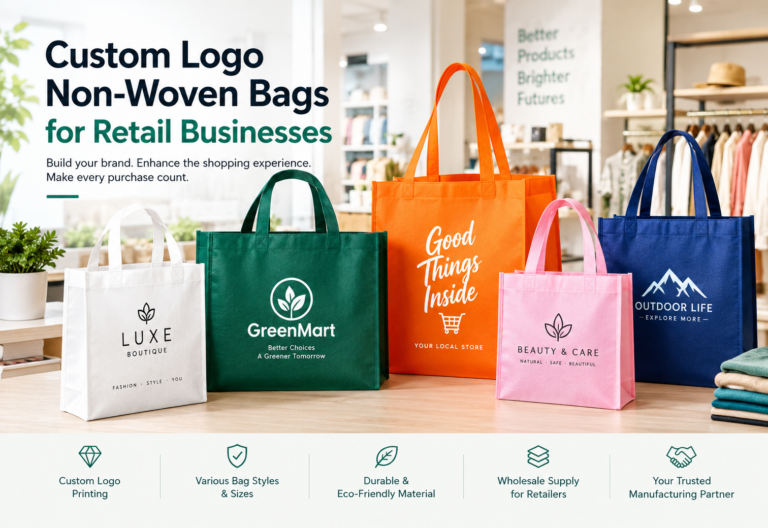

In retail, every customer interaction is an opportunity to strengthen your brand. From the moment shoppers enter your store to the moment they carry their purchases home, packaging helps shape how they remember your business.
Custom logo non-woven bags offer retailers a practical way to combine product packaging with brand promotion. Featuring your company logo, brand colors, or a distinctive design, these bags can support everyday shopping, seasonal campaigns, product launches, and customer loyalty initiatives.
For supermarkets, fashion boutiques, cosmetics retailers, gift shops, and multi-location retail chains, choosing the right custom bag involves more than selecting a color and adding a logo. Material weight, bag dimensions, construction, printing quality, order quantity, and delivery schedules all influence the final result.
This guide explains how retail businesses can select and order custom logo non-woven bags that fit their branding objectives and purchasing requirements.
1. What Are Custom Logo Non-Woven Bags?
Custom logo non-woven bags are bags made from non-woven fabric, commonly polypropylene (PP), and customized with a business’s logo, name, colors, slogan, or promotional artwork.
Unlike traditional woven textiles, non-woven fabric is manufactured by bonding fibers together rather than weaving yarns. This material can be used to produce a variety of shopping bags, promotional totes, and retail carry bags.
Retailers can customize their bags in several ways:
- Logo printing: Display your store name, company logo, or brand symbol.
- Brand colors: Coordinate the bag with your storefront, website, and product packaging.
- Custom dimensions: Match the bag size to your products and typical purchase volume.
- Different bag styles: Choose tote bags, box-style bags, gusseted shopping bags, or die-cut handle bags.
- Material specifications: Select a suitable fabric weight for the intended use.
- Printing options: Choose a suitable process based on artwork complexity and quantity.
- Additional features: Consider reinforced handles, special closures, pockets, or laminated finishes where appropriate.
These options allow retailers to develop bags that reflect their brand identity while meeting practical packaging needs.
2. Why Should Retail Businesses Use Custom Logo Non-Woven Bags?
A retail bag has two jobs: carry the customer’s purchase and represent the business that provided it. With thoughtful design and appropriate construction, it can contribute to both objectives.
Increase brand visibility
When customers reuse a branded shopping bag, your logo may be seen by people outside your store. The bag can travel through shopping centers, offices, public transport, and other everyday settings.
This provides additional opportunities for brand exposure beyond the original transaction.
The value depends on whether customers find the bag useful enough to keep and reuse. A comfortable, appropriately sized bag with a clear design is more likely to remain in circulation than one that is inconvenient or poorly constructed.
Create a consistent shopping experience
Packaging is part of the retail experience. A coordinated bag design can reinforce your brand’s visual identity and help customers recognize your business.
For example, a cosmetics retailer might use a clean layout with a prominent logo, while a supermarket may prioritize a larger bag with practical handles and a bold brand mark.
The goal is to match the bag’s appearance and functionality to the expectations of your customers.
Support promotional campaigns
Custom logo bags can be used for more than everyday checkout packaging. Retailers can order specially designed bags for:
- Seasonal sales and holiday promotions
- New product launches
- Grand openings and store anniversaries
- Loyalty program rewards
- Corporate gifting and VIP customer events
- Trade shows and retail exhibitions
- Promotional product bundles
Using a campaign-specific design can help connect the bag with a particular marketing activity while maintaining recognizable brand elements.
Support bulk purchasing programs
Retail chains and distributors often need packaging that can be ordered repeatedly and supplied to multiple locations.
Standardized bag dimensions, artwork files, material specifications, and quality requirements make it easier to manage repeat orders and maintain a consistent appearance across stores.
For procurement teams, this also makes supplier quotations easier to compare.
3. Which Retail Businesses Benefit From Custom Logo Bags?
Different retail sectors have different packaging requirements. The most suitable bag depends on the products being sold, the customer experience you want to create, and your budget.
Fashion and clothing stores
Fashion retailers can use branded non-woven bags for clothing, accessories, and promotional merchandise.
A structured tote with coordinated colors and a well-positioned logo can create a polished appearance. For garments, check the bag’s width, height, and gusset to ensure that purchases fit comfortably without excessive folding.
Cosmetics and beauty retailers
Beauty products often have distinctive branding and packaging. A custom bag can extend that identity to the customer’s shopping experience.
Consider smaller sizes for individual products and larger formats for gift sets or multiple-item purchases. If the design uses detailed graphics or multiple colors, discuss the appropriate printing method with your manufacturer.
Supermarkets and grocery retailers
Supermarkets generally need bags that are practical, easy to carry, and suitable for a range of product sizes.
Dimensions, handle attachment, bottom construction, and expected carrying loads should be evaluated together. If customers are expected to reuse the bags, request samples and assess the finished construction rather than relying on fabric weight alone.
Gift shops and specialty retailers
Gift shops can use custom logo bags to reinforce their identity across purchases of different sizes and values.
A simple, recognizable logo can work well for everyday orders, while a special design may be appropriate for holiday collections or gift promotions.
Electronics and lifestyle stores
Retailers selling accessories, small electronics, stationery, or lifestyle products may benefit from bags that provide enough room for boxed merchandise while maintaining a professional appearance.
Check the bag dimensions against your largest common product packages and consider whether additional bottom or side gussets are needed.
4. How to Choose the Right Bag Style for Your Store
The bag’s structure affects capacity, appearance, carrying comfort, and production cost.
Tote-style non-woven bags
<text>A classic tote is a versatile option for everyday retail shopping, promotional use, and customer giveaways. It provides a straightforward surface for logo placement and can be produced in a range of dimensions and handle styles.</text>
Consider tote bags when you need a familiar format that can accommodate different products.
Box-style bags
Box-style bags have a more structured shape and can provide a defined space for products. They may suit boutiques, gift retailers, and businesses that want a more organized presentation.
Discuss the base dimensions and side gussets with your supplier to ensure the bag fits your products.
Gusseted shopping bags
Side or bottom gussets increase the bag’s usable capacity, depending on the overall design.
These bags can be useful for grocery shopping, clothing purchases, and retail transactions involving several items. Make sure the expanded capacity is supported by suitable handles and construction.
Die-cut handle bags
Die-cut handle bags have handles formed directly into the bag panel. They may suit certain lightweight retail products and promotional applications.
Because the handle opening affects how the bag carries weight, confirm that the proposed construction is appropriate for the intended contents.
Foldable bags
Foldable non-woven bags can be useful when customers value compact storage and convenience.
Retailers may consider them for travel accessories, promotional campaigns, and reusable shopping programs.
Buyer tip: Before selecting a bag style, measure your common product packages and identify the largest or heaviest combination customers are likely to carry. This gives your supplier a clearer starting point for recommending dimensions and construction.
5. Choose the Right Material and GSM
GSM stands for grams per square meter. It describes the weight of the fabric and is commonly used when specifying non-woven bags.
Higher GSM generally means heavier fabric, but it does not automatically mean a stronger finished bag. Handle attachment, stitching, bottom construction, dimensions, reinforcement, and manufacturing quality also influence performance.
The following ranges can serve as an initial reference:
| Approximate GSM | Potential retail applications | Considerations |
|---|---|---|
| 60–70 GSM | Lightweight promotional bags | Consider intended load and expected reuse |
| 70–80 GSM | General shopping and promotional bags | Balance material use with everyday handling |
| 80–100 GSM | More substantial retail bags | Evaluate dimensions, handles, and construction |
| 100–120 GSM | Heavier-duty or more structured bags | Check whether the added material suits the application |
| Above 120 GSM | Selected specialized projects | Confirm the performance requirements before upgrading |
These are general reference ranges rather than guaranteed performance categories. The correct specification depends on your products, bag design, and supplier’s manufacturing capabilities.
Standard non-woven fabric
Standard non-woven fabric has a fabric-like appearance and can suit many everyday shopping and promotional bags.
It may be a practical choice when your main priorities are functional packaging, straightforward branding, and bulk distribution.
Laminated non-woven fabric
Laminated non-woven bags have an additional surface layer that can create a smoother appearance and support certain detailed printing designs.
They may be suitable for retail brands that want broader printed coverage or a different finish. However, lamination can affect cost, material composition, and end-of-life options, so confirm the specification before ordering.
6. Which Logo Printing Method Should Retailers Choose?
The best printing method depends on the artwork, bag material, color requirements, order quantity, budget, and expected finish.
Screen printing
Screen printing is often suitable for logos, text, and graphics using a limited number of solid colors.
Potential advantages include:
- Clear, bold logo reproduction
- Suitability for many standard non-woven bags
- Practical production for suitable bulk orders
- Straightforward artwork for simple branding
The number of colors and setup requirements can affect pricing. Very fine details and photographic artwork may require a different method.
Heat transfer printing
Heat transfer printing applies a prepared design to the bag using heat and pressure.
Depending on the process and material compatibility, it can be suitable for more detailed or multicolor graphics.
Retailers should ask the manufacturer to confirm how the design will appear on the proposed fabric and whether the finished print meets their quality expectations.
Flexographic printing
Flexographic printing uses flexible printing plates and may be suitable for certain high-volume production projects.
Its cost-effectiveness depends on the equipment, setup, artwork, and order quantity. Discuss it with your supplier if you are planning a large, standardized bag program.
Printing for laminated bags
Laminated non-woven bags can support detailed graphics and broader printed areas using suitable production processes.
This option may work well for retail designs that depend on a smoother surface appearance. Consider the additional production requirements and material composition before choosing it.
How to make the right choice
Before requesting a quotation, prepare your logo files, target quantity, preferred bag color, and desired print coverage.
Ask the manufacturer to recommend a suitable process based on the actual artwork and bag specification. Where color accuracy or detailed graphics are important, consider approving a proof or sample before mass production.
7. How to Design a Retail Bag With Your Logo
A good retail bag design should be recognizable, readable, and consistent with your brand. It should also leave enough space for the bag’s practical features.
Keep your logo easy to recognize
The logo should be visible at the size and position where customers are likely to see it.
Avoid placing important elements too close to handles, seams, gussets, or folds. These areas can interfere with the design or affect how it appears when the bag is filled.
Use consistent brand colors
Provide your manufacturer with approved color references rather than relying only on a screenshot or a computer display.
Different materials and printing processes can produce different visual results. If your brand colors are particularly important, agree on an appropriate color approval process before production.
Avoid overcrowding the design
A bag does not need to display every detail about your business.
For most retail applications, a clear logo and one supporting element, such as a slogan or website, may be sufficient. Keep small text to a minimum and make sure essential information remains readable.
Consider front and back printing
Printing on one side may be sufficient for straightforward branding. Printing on both sides can provide additional space for campaign messages or product information, but it may increase production costs.
Choose based on your marketing objectives rather than adding extra printing automatically.
Prepare artwork for production
Before submitting artwork, confirm the manufacturer’s requirements for:
- Accepted file formats
- Image resolution and actual print size
- Font outlines or embedded fonts
- Color specifications
- Print area, bleed, and safe margins
- Front and back artwork
- Minimum line thickness and text size
Always request the factory’s artwork template when available. The exact requirements vary by printing method and production equipment.
8. How Much Do Custom Logo Non-Woven Bags Cost?
There is no single price for all custom logo non-woven bags. The total cost depends on the complete specification and order requirements.
Key factors include:
Bag size: Larger bags generally require more material.
GSM and material: Heavier fabric or laminated material may increase material costs.
Construction: Gussets, reinforced bottoms, special handles, and additional features can affect pricing.
Printing method: Different methods involve different setup requirements and production efficiencies.
Number of print colors: More complex artwork may require additional production steps.
Printing coverage: Printing on both sides or across a larger area may change the cost.
Order quantity: Larger orders may reduce the unit cost by spreading setup expenses across more bags, although the total purchase amount will increase.
Packing and shipping: Carton requirements, destination, and delivery terms contribute to the total landed cost.
To receive an accurate quotation, provide the supplier with the bag dimensions, GSM, preferred construction, logo artwork, quantity, and delivery destination.
If you are planning a long-term retail program, consider requesting prices for several quantities. This can help you compare the cost of ordering more frequently with the cost and storage requirements of a larger purchase.
9. What Should Retailers Check Before Placing a Bulk Order?
Bulk orders require clear specifications and an approval process. Small misunderstandings about size, color, or construction can affect a large quantity of bags.
Confirm the final specification
Record the bag dimensions, material type, GSM, handle style, construction, print positions, and color requirements.
Ensure that you and your supplier are working from the same approved information.
Request a sample or proof
A digital proof can help verify artwork layout and logo placement. A physical sample is useful when you need to evaluate material feel, bag dimensions, handle construction, and print quality.
For large or recurring orders, decide which approval method is appropriate before mass production.
Check carrying requirements
Consider the products the bag needs to hold and how customers will carry them.
If the bag is intended for heavier purchases or repeated use, ask the supplier to review the handle attachment, seams, bottom construction, and overall dimensions.
Confirm delivery schedules
Allow time for artwork preparation, sample approval, production, quality checks, packing, and transportation.
If the bags are needed for a store opening, seasonal campaign, or promotional event, communicate the required arrival date when requesting a quotation.
Keep records for repeat orders
Save approved artwork, specifications, color references, and sample records. These references help simplify repeat purchasing and improve consistency across stores and production batches.
10. How Retail Chains Can Standardize Custom Logo Bags
For businesses operating multiple stores, consistent packaging can be just as important as the design itself.
A standardized bag program can help procurement teams coordinate ordering, inventory, and branding requirements across locations.
Create a master specification
Document the approved bag sizes, GSM, materials, handle styles, printing methods, and logo positions.
This creates a common reference for purchasing teams and suppliers.
Organize quantities by store or region
Estimate demand across locations before confirming the production quantity.
Consider seasonal demand, promotional calendars, storage capacity, and replenishment requirements to avoid ordering too little or holding excessive inventory.
Establish quality expectations
Define the acceptable appearance, construction, print alignment, and color consistency before production.
If several batches will be ordered over time, retain reference samples and communicate the importance of maintaining the agreed specification.
Plan seasonal designs in advance
Retailers may need special bags for holidays, sales, or product launches. Finalizing artwork and quantities early helps reduce the risk of last-minute changes.
If several versions are required, label each artwork file and quantity clearly to prevent mix-ups during production.
11. How to Choose a Reliable Custom Non-Woven Bag Supplier
The right supplier should be able to understand your retail application and help translate your branding requirements into a practical production specification.
When evaluating a manufacturer, consider:
- Experience with your required bag styles
- Material and construction options
- Printing capabilities that match your artwork
- Artwork review and sample approval procedures
- Clear explanations of minimum order quantities
- Quotations based on complete specifications
- Communication about production schedules
- Quality-control processes
- Support for repeat orders and bulk purchasing
Do not compare suppliers by unit price alone. A lower quotation may cover a different GSM, smaller dimensions, less print coverage, or a different construction method.
For a fair comparison, request quotations using the same specifications.
12. Order Custom Logo Non-Woven Bags for Your Retail Business
If your business is sourcing branded bags for retail stores, supermarkets, boutiques, promotional campaigns, or wholesale distribution, start with a clear description of your requirements.
Prepare the following information before contacting a manufacturer:
- Application: What products will the bags carry?
- Quantity: How many bags do you need for the initial order?
- Dimensions: What size and capacity are required?
- Material: What fabric weight and finish are suitable?
- Design: Do you have a finished logo file and brand color references?
- Printing: Will you need a simple logo or a more detailed design?
- Delivery: Where should the bags be shipped, and when do they need to arrive?
With these details, the manufacturer can assess the project, recommend appropriate options, and prepare a more relevant quotation.
Explore our Custom Non-Woven Bags for Business Branding and Wholesale Supply to learn more about options for business branding, retail packaging, and bulk orders.
Conclusion
Custom logo non-woven bags help retail businesses combine everyday packaging with brand visibility. From fashion boutiques and cosmetics stores to supermarkets and multi-location retail chains, the right bag can support a consistent shopping experience and keep your brand recognizable beyond the point of sale.
To get the best results, select a suitable bag style, match the material and construction to the intended use, choose an appropriate printing method, and approve the final specifications before mass production.
For retail procurement teams, a successful order starts with a clear brief and a reliable manufacturing partner. By planning your design, quantity, quality requirements, and delivery schedule in advance, you can source custom logo non-woven bags that support your branding objectives and business needs.