
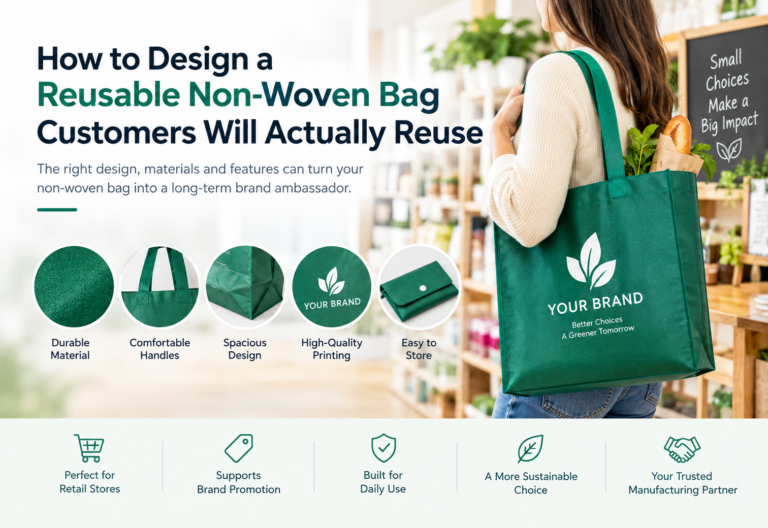

A reusable bag only delivers long-term value when people actually want to use it again.
For retailers, supermarkets, promotional agencies, and consumer brands, custom non-woven bags offer an opportunity to combine practical packaging with brand visibility. But a bag that looks attractive in a product photograph may end up forgotten in a cupboard if it is uncomfortable to carry, difficult to store, or poorly suited to everyday shopping.
The challenge is to design a bag that customers find useful, attractive, and reliable enough to bring along on their next shopping trip.
For B2B buyers, this means thinking beyond the logo. Bag dimensions, handle design, material weight, construction, printing, and overall appearance all contribute to the customer experience.
This guide explains how to design custom non-woven bags that encourage repeated use while meeting your brand’s quality, budget, and procurement requirements.
1. Start With How Customers Will Actually Use the Bag
Before choosing colors or designing artwork, identify the situations in which customers are most likely to use your bag.
A bag intended for supermarket shopping has different requirements from one designed for a fashion boutique, cosmetics store, or trade show.
For supermarket and grocery shopping
Customers may carry groceries, packaged food, household products, or several purchases at once.
Consider a bag with:
- Sufficient width and depth for everyday shopping
- A bottom gusset to accommodate bulkier items
- Comfortable handles
- Suitable handle attachment and bottom construction
- Material and construction selected for the intended load
If the bag is expected to carry heavier products, tell the manufacturer what customers will typically put inside it. Simply requesting a higher GSM does not guarantee better carrying performance.
For fashion and lifestyle retail
Customers may use these bags for clothing, accessories, books, or everyday personal items.
A well-proportioned tote with a clean design can work well. Pay attention to the bag’s silhouette, handle length, color coordination, and logo placement.
For cosmetics and specialty stores
Smaller bags may be suitable for individual products, while larger sizes can accommodate gift sets and multiple purchases.
The bag should fit the products without looking excessively oversized or making customers struggle to carry their purchases.
For promotional events and exhibitions
A promotional bag should be easy to carry and spacious enough for brochures, catalogs, samples, or merchandise.
If attendees are expected to keep using the bag after the event, prioritize a practical design rather than filling every available surface with sponsor logos and advertising messages.
Design principle: Begin with the customer’s real-life use case. The more naturally a bag fits into an existing routine, the more likely it is to be used again.
2. Choose a Practical Bag Size and Shape
A bag that is too small limits its usefulness. A bag that is unnecessarily large can be awkward to carry and may consume more material than the application requires.
The goal is to find a size that fits typical purchases comfortably.
Match the bag to the products
Before requesting a quotation, identify the most common products customers will carry.
For example:
- Clothing retailers may need a taller bag that accommodates folded garments.
- Grocery stores may benefit from a wider base and suitable gussets.
- Bookshops may need dimensions that fit books without excessive bending.
- Cosmetics retailers may require smaller bags for individual products and larger options for gift sets.
- Event organizers may need enough room for catalogs, documents, and promotional items.
Measure representative product packages and discuss the dimensions with your manufacturer.
Consider gussets and usable capacity
A gusset creates additional depth when the bag is opened. Side and bottom gussets can make a bag more practical for products that do not fit comfortably into a flat design.
However, capacity depends on the complete structure, not just the gusset dimensions.
Ask the manufacturer to confirm the proposed width, height, depth, and construction against your intended use.
Make storage convenient
Customers are more likely to keep a bag if it is easy to store between shopping trips.
Consider a design that folds flat without becoming excessively bulky. If compact storage is a priority, discuss the finished bag’s folded dimensions and whether its structure makes repeated folding practical.
A bag that fits easily into a car, office drawer, or household storage space has a better chance of being available when needed.
3. Design Comfortable Handles That Customers Want to Carry
Handle design is one of the most important factors influencing whether a reusable bag feels practical.
Even an attractive bag can become inconvenient when the handles dig into the hand, sit awkwardly on the shoulder, or fail to provide enough clearance for comfortable carrying.
Select the right handle length
Short handles may work well for hand carrying, while longer handles can make shoulder carrying more convenient.
Think about how customers will use the bag, including whether they may carry it over a coat or jacket.
For retail shopping bags intended for repeated use, discuss handle length and carrying style with the manufacturer before finalizing the design.
Consider handle width and attachment
A wider handle may distribute contact pressure more comfortably than a narrow one, depending on the material and construction.
Handle attachment is equally important. The connection between the handle and bag body must suit the intended load and expected use.
Depending on the bag design, suitable options may include:
- Loop handles
- Reinforced loop handles
- Die-cut handles
- Custom-length handles
- Other handle configurations supported by the factory
Do not evaluate handle quality by appearance alone. Request a sample and review the attachment points and finished construction.
Design the handles and body together
Handle length, bag height, gusset depth, and overall capacity should be considered as one system.
For example, a large bag with short handles may be difficult to carry over the shoulder, while a compact bag with oversized handles may look disproportionate.
Ask your manufacturer to review the complete design rather than treating each feature as an isolated decision.
4. Select Material Weight Based on Real Performance Needs
GSM means grams per square meter. It describes fabric weight and is commonly used when specifying non-woven bags.
A higher GSM generally means heavier fabric, but it does not automatically guarantee a stronger or longer-lasting bag.
Performance also depends on the fabric quality, bag dimensions, seams, handle attachment, bottom construction, reinforcement, and manufacturing process.
Use GSM as a starting point
The following ranges can help buyers begin discussing specifications with a manufacturer.
| Approximate GSM | Potential applications | Design considerations |
|---|---|---|
| 60–70 GSM | Lightweight promotional bags | Consider lighter loads and distribution requirements |
| 70–80 GSM | General promotional and shopping bags | Balance material use with intended frequency of use |
| 80–100 GSM | More substantial retail bags | Review handle construction and expected contents |
| 100–120 GSM | Heavier-duty or more structured designs | Confirm whether the added material improves the required performance |
| Above 120 GSM | Specialized projects requiring heavier material | Check whether weight, stiffness, cost, and storage remain practical |
These are general reference ranges, not guaranteed load ratings or service-life predictions.
Avoid choosing the heaviest material automatically
Heavier material may add cost and make the bag less flexible. It may be unnecessary for lightweight purchases or event giveaways.
Instead, tell the manufacturer:
- What products the bag will carry
- The approximate weight of typical purchases
- Whether the bag will be reused frequently
- Whether it needs to fold flat
- Whether a reinforced base or handles are required
The right specification balances usability, construction, appearance, and budget.
5. Make the Logo Attractive Without Making the Bag Feel Like an Advertisement
Brand visibility matters, but a bag covered in oversized logos, slogans, and promotional messages may not suit every customer or brand.
A design that customers feel comfortable carrying in different settings can help extend the bag’s useful life.
Keep the main design simple
Start with your logo and one clear visual direction.
Depending on the brand, this could mean:
- A centered logo with generous space around it
- A smaller logo in a corner
- A brand name paired with a simple graphic
- A minimal design using the company’s signature colors
- A campaign illustration that complements the main logo
The best approach depends on your target customers and brand positioning.
Choose logo placement carefully
The front panel is a common location for branding, but the artwork should not interfere with handles, seams, folds, or gussets.
A centered logo may suit a straightforward retail bag. A smaller logo with a distinctive color or graphic may work better for a brand that prefers a subtle appearance.
Before approving the artwork, check how the logo will look when the bag is empty, filled, and carried.
Use colors customers will want to carry
Brand colors help create recognition, but the bag should also look appropriate for its intended use.
For everyday retail bags, consider how the chosen colors work with different clothing styles and shopping environments. For seasonal campaigns, you may use campaign-specific colors while retaining recognizable brand elements.
If exact color matching matters, provide the manufacturer with approved color references and agree on the proofing process before production.
Avoid overcrowding the print area
Adding more information does not necessarily make a bag more effective.
Too many slogans, small text elements, social media accounts, and graphics can make the design difficult to read.
Choose the information that serves the customer’s needs and your marketing objective. A logo, short slogan, or website may be sufficient for many retail applications.
6. Choose a Printing Method That Supports Long-Term Use
The printing method affects the finished appearance, production cost, and suitability of the design.
The best option depends on the artwork, bag material, order quantity, and required finish.
Screen printing
Screen printing is commonly considered for straightforward logos, text, and graphics with a limited number of colors.
It may suit promotional and retail bags where bold, recognizable branding is the priority.
When selecting this method, review the number of colors, fine details, print coverage, and expected production quantity.
Heat transfer printing
Heat transfer printing applies a prepared design using heat and pressure.
Depending on the process and material compatibility, it can be suitable for more detailed or multicolor graphics.
Ask the manufacturer to confirm how the print will appear on the proposed fabric and whether the finished result meets your requirements for repeated use.
Printing for laminated non-woven bags
Laminated non-woven bags have an additional surface layer that can create a smoother appearance and support certain detailed designs.
They may suit brands that want broader print coverage or a different finish. However, lamination can increase cost and affect material composition, so it should be selected according to a clear design or performance requirement.
Approve the print before mass production
Regardless of the printing method, review the final artwork and, where appropriate, a physical sample.
Check logo placement, color, readability, alignment, and the appearance of the print on the actual bag material.
A design that looks good on a monitor may not reproduce exactly as expected on the finished product.
7. Make the Bag Durable Enough for Its Intended Use
A bag that becomes uncomfortable, loses its shape, or develops damaged handles may be abandoned even if its original design is attractive.
Durability should therefore be considered from the beginning.
Review the main stress points
Pay particular attention to:
- Handle attachment areas
- Side seams
- Bottom seams and corners
- Gusset construction
- Reinforcement points
- Areas exposed to repeated folding
- Printed surfaces that may rub during use
The appropriate construction depends on the bag design and expected load.
Choose construction that fits the application
Non-woven bags may use sewn construction or heat-pressed construction, depending on the design and manufacturing process.
Sewn bags may be appropriate for certain retail and repeated-use applications, while heat-pressed bags may suit other designs and production requirements.
Neither method should be assumed to guarantee better performance in every situation. The complete specification and manufacturing quality matter.
Request a sample and assess it realistically
For a bag intended for frequent use, ask the supplier whether a sample can be evaluated with representative products and carrying conditions.
Check whether the bag feels comfortable, maintains its intended shape, and handles the expected contents appropriately.
If your business requires a particular load capacity or service-life target, define the requirement and agree on an appropriate validation method with the manufacturer.
8. Add Features That Make the Bag More Useful
Extra features can improve convenience, but they should solve a real customer problem rather than simply make the specification more complicated.
Foldable construction
A bag that folds flat can be easier to store in a car, handbag, or drawer.
Discuss how the bag folds and whether the design remains practical after repeated opening and folding.
Reinforced bottom
A reinforced base or suitable bottom construction can help support certain carrying requirements.
The design should reflect the expected products and load, not simply add material without a defined purpose.
Pockets and compartments
For selected applications, pockets may help customers organize smaller items such as keys, receipts, or promotional materials.
However, pockets add material and production steps. Consider whether customers will actually use them.
Practical dimensions
The most useful feature may simply be the right size.
A bag that fits everyday purchases comfortably is more likely to become part of a customer’s routine than one that is attractive but inconvenient.
A useful rule: Before adding any feature, ask whether it improves comfort, capacity, storage, appearance, or durability enough to justify its cost.
9. Design for Your Target Customer, Not Just Your Brand
A bag can reflect your brand identity while still being designed around customer preferences.
The balance differs across retail sectors.
Supermarkets and grocery retailers
Prioritize usable capacity, comfortable handles, suitable construction, and a design that is easy to recognize.
A practical bag that works for regular shopping may deliver more long-term value than one designed primarily for appearance.
Fashion and lifestyle brands
Consider proportions, colors, print placement, and a silhouette that fits the store’s visual identity.
A restrained design may encourage customers to carry the bag in more settings, while a bold graphic may work well for a campaign or a recognizable lifestyle brand.
Cosmetics and beauty retailers
Focus on a suitable size, coordinated colors, and a clean layout that complements the products.
For gift sets, confirm the bag’s dimensions against the actual boxes and packaging.
Promotional agencies and event organizers
Think about what attendees will carry during the event and whether the bag will remain useful afterward.
Avoid filling the design with so many sponsor logos that the overall layout becomes difficult to read. Agree on logo sizes and positions before production.
Corporate and wholesale programs
For orders distributed across multiple locations, consistent specifications and artwork are important.
Create a master design and retain the approved files so that future orders can follow the same standards.
10. Consider Sustainability Without Making Unsupported Claims
Reusable bags may support efforts to encourage repeated use, but environmental performance depends on more than whether a bag is described as reusable.
PP non-woven bags are made from polypropylene, a plastic-based material. Their overall impact depends on factors such as material production, manufacturing, transportation, frequency of reuse, and end-of-life management.
For sustainability-focused projects:
- Select a design suitable for the intended period of use.
- Avoid unnecessary material and decorative components.
- Ask the manufacturer about material composition.
- Confirm recycling options before making recyclability claims.
- Use environmental claims that can be supported with relevant evidence.
- Provide customers with accurate information about reuse and disposal.
A bag should not be marketed as environmentally harmless simply because it is reusable. Credible messaging and practical product design are more useful than broad claims that cannot be verified.
11. Test the Design Before Ordering in Bulk
A sample can reveal practical problems that are difficult to identify from artwork alone.
Before approving a large order, consider reviewing the following areas.
| What to check | Questions to ask |
|---|---|
| Dimensions | Does the bag fit the products it is intended to carry? |
| Handles | Are they comfortable and appropriate for the intended carrying style? |
| Construction | Are seams, handle attachments, and the base suitable for the expected load? |
| Material | Does the GSM and fabric feel appropriate for the application? |
| Printing | Is the logo clear, correctly positioned, and consistent with the approved design? |
| Storage | Can the bag be stored conveniently when not in use? |
| Overall appearance | Would the target customer want to carry this bag again? |
For projects with defined performance requirements, agree on the evaluation criteria with the manufacturer before approving the sample.
Keep a record of the approved material, dimensions, artwork, colors, construction, and quality requirements. This is especially important for repeat orders.
12. What B2B Buyers Should Include in a Custom Bag Request for Quotation
A clear request for quotation helps the manufacturer recommend a suitable design and provide pricing based on the actual requirements.
Include the following details:
1. Intended application: Retail shopping, supermarket use, promotional campaigns, exhibitions, corporate gifts, or another purpose.
2. Target quantity: The number of bags required for the initial order and any expected repeat orders.
3. Bag dimensions: Width, height, gusset depth, and special capacity requirements.
4. Material specification: Preferred GSM, standard or laminated non-woven fabric, and any relevant material requirements.
5. Construction: Handle style, sewn or heat-pressed construction, reinforcement, and additional features.
6. Branding requirements: Logo files, brand colors, print positions, number of print sides, and artwork complexity.
7. Quality expectations: Any specific requirements for load, appearance, construction, or repeated use.
8. Delivery requirements: Destination, preferred delivery date, and packaging requirements.
9. Approval process: Whether you need a digital proof, physical sample, or another approval stage.
If you are comparing multiple suppliers, ask each one to quote against the same specification. This makes it easier to compare pricing, construction, and production arrangements fairly.
13. Order Custom Non-Woven Bags Designed for Repeat Use
For brands and retailers planning a custom bag project, the next step is to translate the design concept into a manufacturing specification.
A suitable supplier should be able to discuss your intended use, bag dimensions, material weight, construction, printing requirements, quantity, and delivery schedule.
Review our Custom Non-Woven Bags for Business Branding and Wholesale Supply to explore options for custom branded bags for retail, promotional, and wholesale projects.
When requesting a quotation, provide your target quantity, preferred size, logo artwork, intended application, and required delivery date. If you are unsure which material or construction is appropriate, explain how customers will use the bag and ask the manufacturer to recommend a suitable specification.
This approach helps you focus on a finished product that is not only visually consistent with your brand but also practical for customers to keep and reuse.
Conclusion
Designing a non-woven bag that customers will actually reuse requires more than an attractive logo.
The bag needs to fit real shopping habits, carry products comfortably, offer suitable construction, remain easy to store, and look appealing beyond the original purchase.
For B2B buyers, the most effective approach is to start with customer needs, select the right dimensions and material, design comfortable handles, choose a suitable printing method, and evaluate a sample before mass production.
A bag that customers genuinely find useful can create more lasting brand exposure than one designed only to look good at checkout.
The ultimate goal is simple: create a branded bag that customers choose to carry again because it works well for their everyday lives.