

When ordering custom non-woven bags for a retail program, promotional campaign, supermarket, trade show, event, or wholesale project, one question usually comes up early:
How long will it take to receive the finished bags?
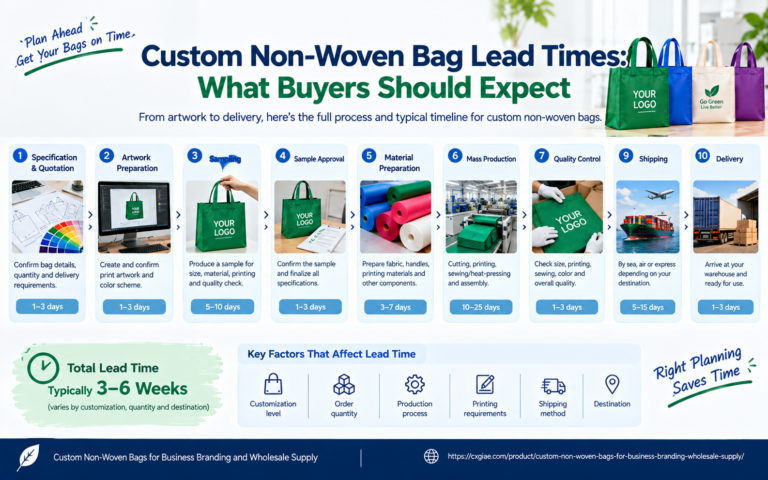
For B2B buyers, lead time is more than the number of days required for factory production. A complete procurement timeline can include specification confirmation, quotation, artwork preparation, sampling, approval, material preparation, mass production, quality control, packing, and international shipping.
The actual schedule depends on the bag specifications, order quantity, customization level, factory workload, and destination.
This guide explains the main stages of a custom non-woven bag order and what buyers should consider when planning their purchasing schedule.
What Does Lead Time Mean for Custom Non-Woven Bags?
In packaging procurement, lead time generally refers to the time between confirming an order and receiving the finished goods.
However, buyers and manufacturers do not always calculate lead time in exactly the same way.
For example, a manufacturer may quote a production lead time that begins after:
- Final artwork approval
- Sample approval, if required
- Final specifications are confirmed
- Deposit or payment is received
- Materials are ready for production
This means a quoted “production time” may not include design discussions, sample approval, or international transportation.
For an overseas B2B order, buyers should therefore separate the timeline into several stages rather than treating everything as one number.
A useful planning model is:
Specification → Artwork → Sample → Approval → Production → QC → Packing → Shipping → Delivery
This approach gives purchasing teams a much clearer picture of the actual project schedule.
How Long Do Custom Non-Woven Bags Usually Take?
There is no universal production time for every custom non-woven bag.
As a general planning principle, a straightforward custom order may require several weeks for manufacturing, while projects involving complex construction, special printing, lamination, large quantities, sampling, or strict delivery requirements can take longer.
For example, current supplier examples show production timelines ranging from roughly two to six weeks depending on customization and supplier setup. One supplier lists approximately 25 business days for production after artwork approval and payment confirmation, while another lists around five to six calendar weeks for standard production.
These figures should be treated as planning references rather than universal guarantees.
For international buyers, the total order-to-warehouse timeline can be significantly longer because shipping is separate from factory production.
The safest approach is to ask the manufacturer for a project-specific timeline based on your exact specifications.
The Main Stages of a Custom Non-Woven Bag Order
Understanding each stage helps buyers identify where delays can occur.
1. Specification and Quotation
The process normally begins with the buyer providing the basic product requirements.
A complete RFQ should ideally include:
- Bag type
- Material
- GSM
- Size
- Gusset
- Bag color
- Handle type
- Handle length
- Construction
- Printing requirements
- Lamination
- Quantity
- Application
- Delivery destination
- Required delivery date
The more complete the specification, the easier it is for a manufacturer to recommend a suitable construction and provide an accurate quotation.
Incomplete specifications can create additional rounds of questions and revisions before production can begin.
For buyers working toward a fixed deadline, this early communication stage should not be underestimated.
2. Artwork and Design Confirmation
After the product specifications are established, the artwork needs to be prepared and approved.
This can be very quick when the buyer already has production-ready artwork.
However, additional time may be required if:
- The logo needs to be adjusted
- The printing area needs to be changed
- Brand colors need confirmation
- Multiple printing sides are involved
- The bag dimensions change
- The artwork does not match the selected bag size
- A new design or mock-up is required
For this reason, buyers should prepare final artwork as early as possible.
A factory may be ready to produce the bags, but production cannot start until the artwork and specifications are approved.
Artwork approval is therefore a key milestone in the purchasing schedule.
3. Sampling
For important B2B orders, buyers may request a physical sample before mass production.
A sample allows the buyer to evaluate:
- Actual material
- GSM and fabric feel
- Bag dimensions
- Handle length
- Handle attachment
- Printing quality
- Color
- Lamination
- Stitching or heat sealing
- Bottom construction
- Overall appearance
For a large order, the approved sample can become a reference for mass production.
This is particularly useful when the bags are intended for retail stores, supermarkets, product packaging, or long-term promotional programs.
Sampling does add time to the project, but skipping an important sample can create greater risks later if the mass-produced bags do not match expectations.
Your existing ordering guide also recommends treating the approved sample as a production benchmark for important B2B projects.
4. Material Preparation
Once the specifications are confirmed, the factory needs to prepare the materials required for production.
Depending on the order, this can involve:
- PP non-woven fabric
- Specific GSM
- Custom fabric color
- Printing materials
- Handles
- Reinforcement materials
- Lamination materials
- Packaging materials
Material availability can affect the schedule.
A standard material that is readily available may be easier to arrange than a special color, unusual GSM, or customized material requirement.
For large orders, material preparation is particularly important because the factory needs enough material to support the entire production run.
5. Mass Production
This is the stage most buyers think of when they hear “lead time.”
However, production time can vary considerably depending on the product.
Factors include:
Order Quantity
A few hundred bags and tens of thousands of bags obviously create different production requirements.
Larger orders may require more production capacity and more time to complete.
Bag Construction
Sewn bags, heat-sealed bags, and die-cut bags involve different production processes.
A simple promotional bag may move through production faster than a heavily reinforced sewn shopping bag.
Printing
Printing requirements can affect production preparation and processing time.
Complex artwork, multiple colors, multiple printing sides, or special printing requirements may require additional production steps.
Lamination
Laminated bags involve additional processing compared with standard unlaminated bags.
Special Handles and Reinforcement
Custom handles, reinforced attachment points, special bottoms, or other structural features can add production steps.
Factory Workload
Even when the product itself is relatively simple, the factory’s production schedule can affect the available production slot.
Your custom bag ordering guide identifies material availability, quantity, printing method, bag structure, finishing, and factory production schedule as key factors that can affect lead time.
6. Quality Control
Production does not necessarily end when the last bag comes off the production line.
The finished goods should also be checked before shipment.
Depending on the project, quality inspection can include:
- Material consistency
- GSM
- Bag dimensions
- Printing accuracy
- Color consistency
- Handle attachment
- Stitching
- Heat sealing
- Bottom construction
- Lamination
- Quantity
- Packing
For large B2B orders, consistency is especially important.
A buyer may approve one sample, but the real challenge is ensuring that thousands or tens of thousands of bags maintain the same specifications.
Quality control should therefore be included in the purchasing timeline rather than treated as an afterthought.
7. Packing and Shipping Preparation
After inspection, the bags need to be packed for transportation.
Before shipment, buyers should confirm:
- Bags per carton
- Number of cartons
- Carton dimensions
- Gross weight
- Pallet requirements, if applicable
- Shipping method
- Delivery address
- Required shipping documents
These details are particularly important for international B2B orders.
The factory may finish production on schedule, but inefficient packing, delayed documentation, or shipping arrangements can still affect the final delivery date.
8. International Shipping
For overseas buyers, production lead time is not the same as total delivery lead time.
Suppose a factory completes the bags in several weeks.
The goods may still need:
Production → QC → Packing → Export preparation → Port/airport handling → International transportation → Customs clearance → Local delivery
The final delivery date therefore depends not only on factory production but also on the selected shipping method and destination.
For buyers in Europe or North America, it is especially important to work backward from the date the bags need to be available in the warehouse, rather than simply asking when production will finish.
What Can Cause a Custom Non-Woven Bag Order to Be Delayed?
Several common issues can extend the original schedule.
1. Late Artwork Approval
If artwork keeps changing, production cannot move forward according to the original schedule.
2. Changing Specifications
Changing the size, GSM, handle, printing, or construction after quotation can require the manufacturer to recalculate materials and production arrangements.
3. Sample Revisions
If the first sample does not meet expectations, additional sample rounds may be required.
4. Large Order Quantity
Large-volume projects may require additional production capacity and scheduling.
5. Special Materials
Custom fabric colors, unusual GSM requirements, special finishing, or other non-standard specifications may require additional preparation.
6. Complex Construction
Reinforcement, special handles, laminated surfaces, or more complicated bag structures can increase production steps.
7. Peak Production Seasons
Factory schedules can become tighter during busy periods.
For seasonal packaging, waiting until the last minute can therefore create unnecessary pressure.
8. Shipping Delays
Even if production is completed on time, transportation and customs processes can affect the final arrival date.
How Should Buyers Plan Their Order?
The safest method is to work backward from the required delivery date.
For example, imagine a retailer needs custom bags in its warehouse before a major promotional campaign.
Instead of asking:
“When can you produce the bags?”
Start with:
Required warehouse date → Shipping time → Packing/QC → Production → Sample → Artwork → Specification
This creates a more realistic purchasing schedule.
For a fixed-date project, buyers should tell the manufacturer the required delivery date at the beginning of the quotation process.
This gives the supplier an opportunity to evaluate whether the requested schedule is realistic before the purchase order is confirmed.
How to Reduce Custom Non-Woven Bag Lead Time
If the deadline is tight, buyers can often improve the process by reducing unnecessary delays.
Prepare Artwork Early
Have production-ready artwork available before requesting the final quotation.
Confirm Specifications Once
Try to finalize:
Material + GSM + Size + Handles + Construction + Printing + Lamination + Quantity
before production begins.
Request Samples Early
If a sample is required, start the sample process before the final purchasing deadline becomes urgent.
Give the Manufacturer a Real Deadline
Instead of saying “as soon as possible,” provide a specific target date.
For example:
Required delivery date: October 15
A specific date allows the manufacturer to evaluate the project more effectively.
Avoid Unnecessary Changes
Every change after approval can affect the production schedule.
Plan Shipping Together With Production
Do not wait until the bags are finished to start thinking about transportation.
How Early Should You Order Custom Non-Woven Bags?
There is no single answer because the required lead time depends on the project.
However, B2B buyers should allow enough time for:
- Product specification
- Quotation
- Artwork
- Sampling, if required
- Sample approval
- Material preparation
- Mass production
- Quality inspection
- Packing
- International shipping
- Customs and local delivery
For a standard project without complicated customization, production itself may take several weeks. Some suppliers currently publish standard production windows of approximately 3 to 6 weeks, while specific products may be faster or slower.
For large-volume or highly customized projects, buyers should allow additional buffer rather than planning around the shortest possible production time.
For seasonal campaigns, trade shows, new store openings, and product launches, it is generally safer to begin supplier discussions well before the bags are actually needed.
Lead Time Example for a B2B Custom Non-Woven Bag Project
Consider a hypothetical order:
Product: Custom PP Non-Woven Shopping Bags
GSM: 90 GSM
Size: 400 × 350 × 100 mm
Construction: Sewn
Handle: Reinforced loop handles
Printing: Two-side logo printing
Quantity: 10,000 pcs
Application: Retail
Destination: United States
A buyer could plan the project around the following sequence:
| Stage | What Happens |
|---|---|
| Specification | Confirm material, GSM, size, handles and construction |
| Quotation | Manufacturer confirms price, MOQ and schedule |
| Artwork | Final logo and printing artwork are approved |
| Sampling | Physical sample is produced if required |
| Approval | Buyer confirms sample and final specifications |
| Production | Factory manufactures the bulk order |
| QC | Finished bags are inspected |
| Packing | Bags are counted and packed into cartons |
| Shipping | Goods are transported to the destination |
| Delivery | Shipment arrives at the buyer’s warehouse |
The exact number of days for each stage should be confirmed with the manufacturer because production schedules depend on the specific order.
The important point is that the factory production time is only one part of the total procurement timeline.
What Should You Ask a Non-Woven Bag Manufacturer About Lead Time?
Before placing an order, ask these questions:
- What is the production lead time for my exact specification?
- When does the production lead time officially start?
- Does the quoted time include sampling?
- How long will the sample take?
- When must artwork be approved?
- Are materials currently available?
- What is the estimated production completion date?
- How is quality control handled?
- How long does packing take?
- What is the estimated shipping time to my destination?
- Can you meet my required delivery date?
- What happens if the production schedule changes?
These questions help turn a vague delivery promise into a clearer purchasing plan.
Custom Non-Woven Bags for Business and Wholesale Projects
For businesses purchasing custom non-woven bags, the right product specification is closely connected to production time.
Material, GSM, size, construction, handles, printing, lamination, quantity, and application all need to be confirmed before mass production.
Our Custom Non-Woven Bags for Business Branding and Wholesale Supply can be customized for different business applications, including retail, promotional campaigns, events, supermarkets, and other bulk packaging requirements.
Buyers can discuss their required specifications, quantity, target delivery date, and application with the manufacturer before production is scheduled.
Final Thoughts
Custom non-woven bag lead time should never be viewed as a single production number.
A realistic B2B purchasing schedule includes:
Specification → Artwork → Sampling → Approval → Material Preparation → Production → QC → Packing → Shipping → Delivery
The more customized the bag, the more important early planning becomes.
For buyers with a fixed deadline, the best approach is to communicate the required delivery date before placing the order, provide complete specifications, approve artwork and samples quickly, and leave enough time for production and transportation.
A well-planned timeline gives both the buyer and manufacturer more room to manage quality, production capacity, and logistics without turning the project into a last-minute race against the calendar.
For wholesale and business orders, start with the required delivery date, then work backward through every stage of the project. That is a much more reliable way to plan custom packaging procurement.