
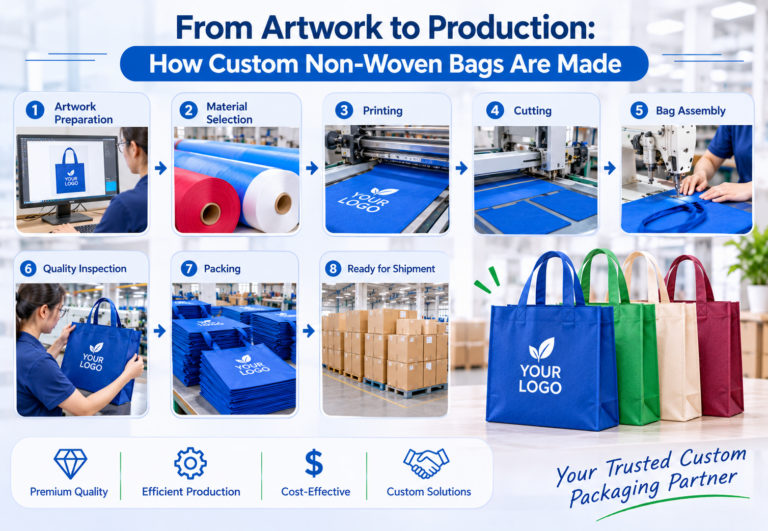

A custom non-woven bag may look like a simple product, but producing a high-quality bag involves several important steps. From preparing the artwork and selecting the right fabric to printing, cutting, sewing, and quality inspection, every stage contributes to the final appearance and performance.
For retailers, wholesalers, promotional agencies, and brands, understanding the manufacturing process can make ordering custom non-woven bags much easier. It helps buyers prepare accurate specifications, communicate clearly with manufacturers, and avoid unnecessary production delays.
So, how does a custom non-woven bag go from a digital design to a finished product?
In this guide, we walk through the complete process, explain the key production stages, and highlight what B2B buyers should check before approving a bulk order.
1. Artwork Preparation: Turning Your Brand Idea into a Production Design
Every custom non-woven bag project starts with an idea. It may be a company logo, a promotional graphic, a retail packaging concept, or a complete bag design.
Before production begins, the artwork needs to be reviewed and prepared for manufacturing.
What Information Should Buyers Provide?
To help the manufacturer understand your requirements, prepare the following details:
- Logo and artwork: Provide your company logo and any additional graphics or text.
- Bag dimensions: Specify the desired width, height, and bottom or side gusset.
- Bag style: Choose between flat, gusseted, box-shaped, foldable, or other available structures.
- Material color: Identify your preferred fabric color or provide a reference.
- Printing requirements: Specify the logo colors, printing area, and preferred appearance.
- Quantity: Provide an estimated order quantity.
- Handle design: Indicate whether you prefer loop handles, die-cut handles, or reinforced handles.
Vector artwork formats such as AI, EPS, and vector PDF are often preferred because they can be scaled without losing image quality.
If your brand uses specific colors, provide Pantone references where possible. The manufacturer can then assess how closely those colors can be reproduced on the selected material.
From Artwork to a Production Mockup
After receiving the design files and product specifications, the manufacturer can prepare a digital mockup showing the bag’s overall appearance.
This stage helps confirm:
- Logo size and position.
- Front and back artwork.
- Bag proportions.
- Color combinations.
- Handle placement.
- Printing area.
Reviewing the mockup carefully can prevent misunderstandings before materials and production resources are committed.
2. Material Selection: Choosing the Right Non-Woven Fabric
Once the design is confirmed, the next step is selecting the material.
Most standard non-woven shopping bags are made from polypropylene (PP) spunbond non-woven fabric. This material is widely used for shopping bags, promotional bags, retail packaging, and reusable carrier bags.
The fabric is typically supplied in rolls and converted into individual bags during production.
Understanding GSM
GSM means grams per square meter. It indicates the weight of the fabric and is one of the specifications buyers should consider.
Common options include:
| Fabric Weight | General Characteristics | Typical Applications |
|---|---|---|
| 70 GSM | Lightweight and economical | Promotional giveaways |
| 80 GSM | Flexible with a practical hand feel | Shopping and retail bags |
| 90 GSM | More substantial material | Branded shopping bags |
| 100 GSM | Thicker and more structured | Retail and reusable bags |
| 120 GSM | Heavier material | Premium or more demanding applications |
These are general reference points rather than fixed quality grades. Actual performance also depends on fabric construction, bag dimensions, handle design, and manufacturing quality.
Other Material Considerations
In addition to GSM, buyers should confirm:
- Fabric color and consistency.
- Material surface and texture.
- Whether lamination is required.
- Expected carrying load.
- Intended frequency of use.
For example, a lightweight promotional bag may not require the same fabric weight as a retail bag designed to carry heavier products.
Choosing the right material at the beginning helps balance product performance and production cost.
3. Printing: Applying Your Brand Identity
Printing is one of the most visible stages of custom non-woven bag production.
A well-printed logo helps customers recognize your brand and gives the bag a more professional appearance.
The printing method depends on the artwork, material, quantity, and production equipment.
Screen Printing
Screen printing is commonly used for logos, text, and simple graphics with a limited number of colors.
Its advantages include:
- Bold, solid colors.
- Clear logo presentation.
- Practical production for many customized orders.
- Suitable for many promotional and retail designs.
For businesses that need a simple company logo on a non-woven shopping bag, screen printing is often worth considering.
Heat Transfer Printing
Heat transfer printing can be suitable for designs containing multiple colors, gradients, or more detailed graphics.
It offers greater flexibility for certain complex designs, although the final result depends on the transfer material, surface compatibility, and production conditions.
Printing on Laminated Non-Woven Bags
Laminated non-woven bags have an additional film layer that changes the surface appearance.
Depending on the construction, branding may be printed on the film before lamination or applied through another compatible process.
Matte and glossy finishes can create different visual effects:
- Matte lamination gives the bag a softer, understated appearance.
- Glossy lamination creates a brighter, more reflective surface.
The manufacturer should confirm the printing route and material combination before production.
What Should Buyers Check?
Before approving printing, review:
- Logo size and placement.
- Color accuracy.
- Text readability.
- Print edges and fine details.
- Overall consistency with the approved artwork.
If the design uses specific brand colors, reviewing a physical sample can provide a more realistic understanding of the final result than a computer display alone.
4. Cutting: Preparing the Fabric for Bag Assembly
After the printing stage, the fabric is prepared for bag construction.
Depending on the production method, printing may take place on fabric rolls or on individual panels. The printed material is then cut according to the required bag dimensions.
Cutting determines the size and shape of the bag components.
These may include:
- Front and back panels.
- Side gussets.
- Bottom sections.
- Handle pieces.
- Additional reinforcement components.
Accurate cutting is important because the dimensions of each component affect the final bag’s proportions and assembly.
For printed designs, the manufacturer must also consider artwork positioning. Logos and patterns need to align with the cutting layout so that they appear in the intended position on the finished bag.
5. Bag Assembly: Sewing or Heat Pressing
After cutting, the individual components are assembled into a finished bag.
Two common construction methods are sewn production and heat-pressed production. The right option depends on the bag design, required construction, quantity, and intended use.
Sewn Non-Woven Bags
Sewn non-woven bags use stitching to connect the fabric panels and attach handles.
The production process may include:
- Aligning the front and back panels.
- Sewing the side and bottom seams.
- Attaching the handles.
- Adding reinforcement where required.
- Trimming loose threads.
- Checking the finished bag structure.
Sewn construction is suitable for many shopping totes, gusseted bags, and designs requiring a stitched appearance.
It also provides flexibility for different bag shapes and handle configurations.
Heat-Pressed Non-Woven Bags
Heat-pressed bags use heat and pressure to bond suitable material sections together.
Depending on the bag structure and equipment, the production process may include:
- Positioning the fabric components.
- Folding the material into the required shape.
- Applying heat and pressure to the joining areas.
- Forming the bag body and bottom.
- Attaching or forming the handles.
- Checking the bonded seams.
Some automated production lines use ultrasonic welding, which bonds compatible thermoplastic materials through high-frequency mechanical vibrations.
Ultrasonic welding and conventional heat pressing are related bonding approaches, but they are not identical processes.
Sewn vs Heat-Pressed Non-Woven Bags
| Comparison | Sewn Bags | Heat-Pressed Bags |
|---|---|---|
| Construction | Thread stitching | Heat and pressure bonding |
| Appearance | Visible stitched seams | Cleaner bonded seams |
| Design flexibility | Suitable for various sewn structures | Depends on compatible machine and bag structure |
| Production process | Requires sewing operations | Can use dedicated bag-making equipment |
| Common applications | Shopping totes, gusseted bags, promotional bags | Standard promotional and shopping bags |
| Cost considerations | Depends on stitching labor and design | Depends on machine setup and production volume |
For reference, our indicative starting MOQs are around 500 pieces for sewn non-woven bags and around 10,000 pieces for heat-pressed bags. Actual minimum quantities depend on the bag design, dimensions, printing requirements, and production arrangement.
6. Handle Attachment and Finishing Details
Handles are an important part of a non-woven bag because they influence comfort, appearance, and usability.
Common handle styles include:
Loop Handles
Loop handles are widely used for shopping bags and promotional totes. They can be made from suitable non-woven material or other compatible handle materials.
Die-Cut Handles
Die-cut handles are formed by cutting an opening into the bag body or a reinforced section. They create a simple integrated appearance.
Reinforced Handles
Reinforced handles use additional material or construction support around the attachment area.
They may be suitable for bags intended to carry heavier products, depending on the overall design and testing requirements.
Additional Finishing
Depending on the bag specifications, finishing operations may include:
- Trimming excess threads or material.
- Folding and shaping.
- Reinforcing handle attachment points.
- Checking seam and bonding areas.
- Cleaning visible marks.
- Preparing bags for packing.
These finishing details may appear small, but they contribute to the consistency and presentation of the final product.
7. Quality Inspection: Checking Every Important Detail
Before custom non-woven bags are packed, the finished products should undergo quality inspection.
A proper inspection helps identify visible defects and production inconsistencies before shipment.
Material Inspection
Check whether the fabric matches the confirmed specifications, including material color, GSM, and surface condition.
Printing Inspection
Review the printed logo and artwork for:
- Correct color appearance.
- Accurate positioning.
- Clear text and graphics.
- Consistent printing.
- Visible defects or smudging.
Dimension Inspection
Check the bag width, height, gusset, and handle dimensions against the approved specifications.
Sewing and Bonding Inspection
For sewn bags, inspect the stitching, seams, and handle attachment points.
For heat-pressed bags, check the bonded areas for incomplete sealing, uneven bonding, or visible damage.
Functional Checks
Depending on the product requirements, the manufacturer may also conduct appropriate handling or load checks.
For bags intended to carry heavier products, it is particularly important to evaluate the complete construction rather than focusing only on fabric weight.
A quality inspection process should be based on the agreed specifications and approved sample.
8. Packing and Preparing for Shipment
After inspection, the finished bags are counted, folded where appropriate, and packed according to the order requirements.
The packing process may include:
- Separating bags by size, color, or design.
- Counting the required quantities.
- Folding and arranging the products.
- Placing bags into protective packaging.
- Packing them into export cartons.
- Checking carton quantities and shipping marks.
For international B2B orders, carton dimensions, gross weight, and packing quantities are important because they can affect freight arrangements and warehouse handling.
Buyers should confirm the packing requirements before production is completed, especially when the bags will be delivered to multiple warehouses or distribution locations.
9. How Long Does It Take to Manufacture Custom Non-Woven Bags?
Production lead time depends on several factors, including:
- Artwork approval.
- Material availability.
- Bag dimensions and construction.
- Printing method and number of colors.
- Order quantity.
- Sewing or heat-pressing requirements.
- Sample approval.
- Production schedule.
A straightforward design using available material may be easier to schedule than a project involving special colors, complex printing, multiple bag styles, or several rounds of sample revisions.
To avoid unnecessary delays, buyers should provide complete specifications and approve artwork and samples as early as possible.
It is also important to distinguish between sample preparation time, bulk production time, and international shipping time when planning a delivery schedule.
10. How to Make Your Custom Bag Order More Efficient
A smooth production process starts with clear communication between the buyer and manufacturer.
Here are several practical ways to make your next order easier to manage.
Prepare your artwork early.
Provide the final logo and design files before production planning begins.
Confirm all bag specifications.
Dimensions, GSM, colors, handles, printing, and construction should be clearly documented.
Choose a suitable printing method.
Discuss your artwork and quantity with the manufacturer instead of selecting a printing process based on assumptions.
Approve the sample carefully.
Check the physical material, printing, dimensions, and construction before approving bulk production.
Plan your order quantity.
Consider your sales forecast, promotional schedule, and inventory requirements.
Keep a record of approved specifications.
Saving the final artwork, color references, sample details, and production requirements can make repeat orders more consistent.
Frequently Asked Questions
1. What material is used to make custom non-woven bags?
Most standard custom non-woven shopping bags are made from polypropylene (PP) spunbond non-woven fabric. Buyers can select different GSM weights, colors, and finishes depending on their intended application.
2. Can I customize the size and color of non-woven bags?
Yes. Many manufacturers offer customized dimensions, fabric colors, GSM, handle styles, printing, and finishing options. The available choices and MOQ depend on the specific design.
3. What is the difference between sewn and heat-pressed non-woven bags?
Sewn bags use thread to join the fabric panels, while heat-pressed bags use heat and pressure to bond compatible material sections. The best option depends on the bag construction, appearance, quantity, and intended use.
4. Can I print my company logo on both sides of a non-woven bag?
Yes, printing on both sides is available for many bag styles. The final cost and production requirements depend on the printing method, artwork, and print area.
5. Do I need to approve a sample before bulk production?
Sample approval is strongly recommended, especially for first-time orders or projects involving specific brand colors, special dimensions, or detailed artwork. It allows you to check the actual material, printing, construction, and overall appearance.
6. What is the MOQ for custom non-woven bags?
MOQ varies according to the construction method and customization requirements. As an indicative reference, sewn non-woven bags may start from around 500 pieces, while heat-pressed bags may start from around 10,000 pieces. Confirm the actual MOQ with your manufacturer before ordering.
7. Can I follow the production process after placing an order?
Production updates depend on the manufacturer’s communication and tracking arrangements. Buyers can ask for updates on material preparation, printing, bag assembly, quality inspection, and packing to stay informed about project progress.
Conclusion
From artwork preparation to final shipment, manufacturing custom non-woven bags involves a series of connected steps. Each stage plays an important role in determining the bag’s appearance, construction, consistency, and suitability for its intended use.
For B2B buyers, understanding this process makes it easier to prepare specifications, evaluate suppliers, and manage bulk orders with greater confidence.
Whether you need sewn shopping bags, heat-pressed promotional bags, laminated retail bags, or custom printed totes, choosing the right materials and production process is essential.
Looking for a manufacturer for your next custom bag project?
Explore our Custom Non-Woven Bags for Business Branding and Wholesale Supply.
Share your logo, preferred bag style, dimensions, and estimated quantity with our team. We can help you discuss suitable materials, printing options, production methods, and a customized solution for your business.