
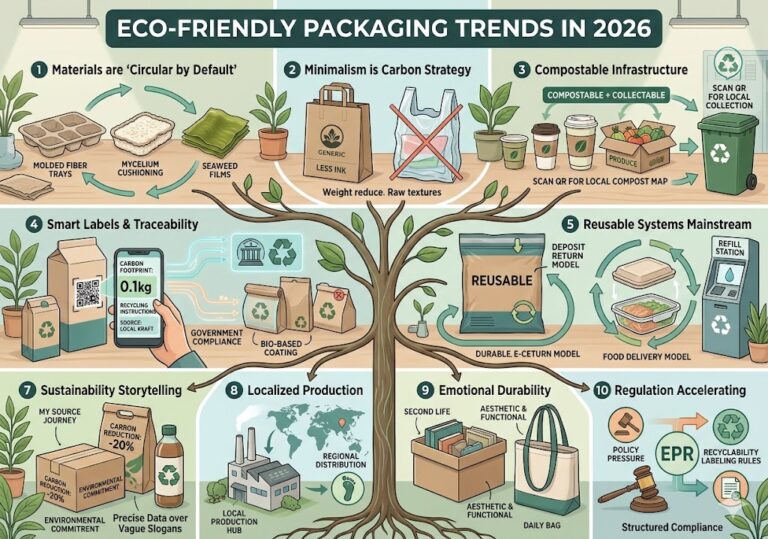

If packaging used to be the silent wrapper around a product, 2026 is the year it finally starts talking back. Not loudly, but responsibly. The message is clear: less waste, smarter materials, and designs that behave more like part of a circular system than a disposable shell.
Eco-friendly packaging is no longer a niche design choice. It has become a commercial expectation, a regulatory direction, and in many cases, a brand identity itself. What’s changing now is how far innovation is going beyond “recyclable” and into genuinely regenerative thinking.
Let’s unpack the key trends shaping eco-friendly packaging in 2026.
1. Materials Are Becoming “Circular by Default”
The old goal was recyclability. The new goal is circularity that actually works in real systems, not just on labels.
In 2026, brands are shifting toward materials that can re-enter production loops with minimal degradation. This includes:
- Molded fiber replacing plastic inserts and foam
- Seaweed-based films for flexible packaging
- Mycelium (fungus-based) cushioning for protective packaging
- Mono-material plastics designed for easier recycling separation
What’s important here is not just material innovation, but system compatibility. Packaging is being designed with municipal recycling limitations in mind, not just lab performance.
If it cannot be processed in real-world waste streams, it is increasingly considered outdated.
2. Minimalism Is Now a Sustainability Strategy
Minimalist packaging used to be a design trend. Now it is a carbon strategy.
Brands are aggressively reducing:
- Ink coverage
- Layered packaging
- Decorative coatings
- Non-functional inserts
The idea is simple: every extra layer is extra transport weight, extra production energy, and extra waste complexity.
In 2026, “less packaging” is not interpreted as cheap. It is interpreted as intelligent. Even premium brands are leaning into raw textures, uncoated paper finishes, and visible material honesty.
A kraft paper bag with a simple print is no longer “basic.” It is often positioned as a premium sustainability statement.
3. Compostable Packaging Moves From Concept to Infrastructure
For years, compostable packaging sounded like a perfect solution that rarely had a real-world exit route.
That is changing.
In 2026, compostable systems are expanding alongside industrial composting infrastructure in more cities and commercial zones. This shift is especially visible in:
- Food service packaging
- Coffee cups and lids
- Produce packaging in supermarkets
- Event and festival supply chains
The key evolution is not just compostable materials, but compostable + collectable systems. Packaging is increasingly designed with disposal pathways in mind, not just material science.
However, a major challenge remains: consumer confusion. Brands are now adding clearer disposal instructions, sometimes even QR-based sorting guides.
4. Smart Labels and Digital Traceability
Sustainability is becoming trackable.
In 2026, packaging is increasingly integrated with digital identity systems such as QR codes and NFC tags that reveal:
- Material composition breakdown
- Carbon footprint estimates
- Recycling instructions by location
- Supply chain transparency data
This shift is not only about consumer education. It is also about compliance. Governments and retail partners are pushing for verifiable sustainability claims rather than marketing language.
Packaging is evolving into a data carrier, not just a container.
5. Reusable Packaging Systems Enter Retail Mainstream
Reusable packaging is no longer limited to experimental pilot programs.
We are seeing structured reuse systems in:
- E-commerce returnable packaging
- Food delivery containers with deposit models
- Retail refill stations for household goods
- Durable shipping mailers designed for multiple cycles
The key change in 2026 is convenience. Earlier reuse systems failed because they required too much effort. Now, logistics networks are absorbing that complexity.
The result is packaging that behaves more like an asset than a disposable item.
6. Water-Based and Bio-Based Coatings Replace Plastic Layers
One of the most overlooked sustainability upgrades is happening at the coating level.
Traditional plastic coatings made packaging difficult to recycle, even when the base material was paper.
Now, water-based, plant-based, and mineral coatings are replacing plastic laminations across:
- Paper bags
- Food cartons
- Beverage packaging
- Retail boxes
This improves recyclability without changing the look or feel of packaging too dramatically, which is why adoption is accelerating quickly in mainstream retail.
7. Branding Through Sustainability Storytelling
In 2026, packaging is not just protecting products. It is telling origin stories.
Brands are using packaging surfaces to communicate:
- Material sourcing journeys
- Carbon reduction milestones
- Community impact initiatives
- Environmental commitments with measurable targets
But there is a clear shift away from vague “eco-friendly” messaging. Consumers are now more skeptical and demand specificity.
So instead of broad claims, packaging increasingly includes precise data points or traceable references.
Sustainability has moved from slogan to proof.
8. Localized Production Reduces Packaging Footprint
Global supply chains are still powerful, but there is a growing shift toward regional production hubs for packaging materials.
This reduces:
- Transport emissions
- Lead times
- Over-packaging for long-distance shipping durability
Localized production also allows packaging to be tailored to regional recycling systems, which vary significantly between countries and even cities.
The result is a more adaptive packaging ecosystem that behaves differently depending on geography.
9. Emotional Durability Becomes Part of Sustainability
A newer idea gaining traction in 2026 is “emotional durability.”
If packaging is aesthetically or functionally desirable enough to be reused by consumers, its lifespan naturally extends.
Examples include:
- Strong canvas tote-style packaging reused as daily bags
- Decorative paper boxes kept for storage
- High-quality rigid packaging designed for secondary life use
This does not replace recyclability, but it complements it by reducing immediate disposal behavior.
10. Regulation Is Accelerating Everything
Perhaps the biggest driver behind all these trends is policy pressure.
Governments are tightening rules around:
- Single-use plastics
- Extended producer responsibility (EPR)
- Recyclability labeling accuracy
- Carbon disclosure requirements
What used to be “voluntary sustainability” is becoming structured compliance.
And when regulation moves, design follows.
Final Thoughts
Eco-friendly packaging in 2026 is no longer defined by one material or one strategy. It is a layered ecosystem combining materials science, logistics, digital transparency, and behavioral design.
The direction is clear: packaging is no longer disposable by default. It is expected to have a lifecycle, a traceable footprint, and sometimes even a second life.
The most successful brands in this new landscape will not just “use green packaging.” They will design packaging that understands where it comes from, how it is used, and where it goes next.
In other words, packaging is finally growing up.