
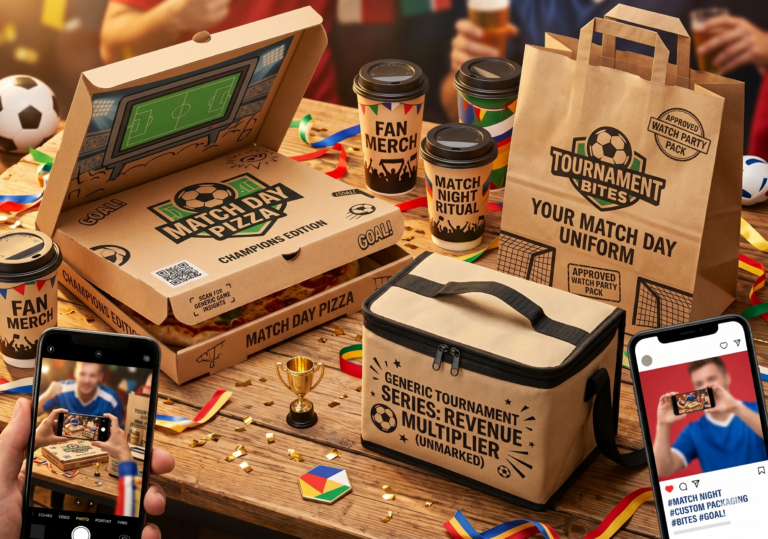

Every four years, the food and beverage industry quietly enters one of its most profitable emotional cycles. When the FIFA World Cup begins, restaurants, cafés, and delivery brands don’t just sell food—they sell match-day experience in edible form.
And increasingly, custom packaging has become the invisible driver behind that transformation.
1. World Cup Years = Demand Surges Across Food & Beverage
Historical consumption patterns from past World Cup cycles (notably 2014, 2018, and 2022) consistently show a similar trend:
- Food delivery orders increase significantly during match hours
- Late-night dining and snack consumption spikes
- Beverage sales rise during group stage and knockout matches
- Shared meals become more frequent than individual dining
While exact percentages vary by region and platform, industry reports across multiple tournament cycles commonly show double-digit growth in order volume during peak match windows, especially in urban markets where viewing parties are concentrated.
In short:
The World Cup doesn’t just change what people watch—it changes when and how they eat.
2. Packaging Becomes the “Match-Day Uniform” of Food Brands
In World Cup seasons, packaging is no longer just operational—it becomes contextual branding.
Restaurants and food delivery platforms begin to treat packaging as part of the entertainment layer:
- Pizza boxes become “stadium screens”
- Coffee cups become “fan merchandise”
- Takeout bags become “walking billboards”
- Dessert packaging becomes “celebration props”
This shift turns ordinary food delivery into something closer to a cultural product.
3. 2018 & 2022: The Rise of Shareable Packaging Moments
Looking at recent cycles provides a clear pattern:
2018 World Cup (Russia)
Brands began experimenting heavily with football-themed packaging, especially in fast food and beverage sectors. The biggest impact was not just sales, but social media visibility, as consumers increasingly posted “match night meals” online.
2022 World Cup (Qatar)
This was the tipping point for integration between packaging and digital engagement:
- QR codes linked to match predictions
- Limited-edition packaging tied to national teams
- Delivery apps introducing World Cup-themed visuals
- Restaurants designing “watch party kits” with unified packaging systems
The key shift:
Packaging stopped being single-use and became content for sharing.
4. Why Food Brands Benefit More Than Any Other Industry
The food and beverage sector is uniquely positioned during World Cup years for three reasons:
1. Timing aligns perfectly with consumption
Matches often occur during:
- Dinner hours
- Late-night snack periods
- Weekend social gatherings
2. Food is inherently social
World Cup viewing is rarely solo—it’s group-driven. Packaging becomes part of the shared environment.
3. Visual appeal matters more under emotional excitement
Fans in high emotional states are more likely to:
- Take photos of meals
- Share delivery setups
- Post “watch party” aesthetics
This creates organic marketing loops without paid media.
5. Packaging as a Revenue Multiplier, Not Just Branding
The most important shift in World Cup packaging strategy is economic:
It no longer functions only as branding—it directly influences behavior.
Well-designed tournament packaging can:
- Increase repeat orders during match periods
- Encourage larger group orders (bundling effect)
- Improve perceived product value
- Strengthen customer recall after the tournament ends
In many cases, brands report that themed packaging campaigns outperform standard seasonal campaigns because they are tied to real-time global emotion, not just calendar events.
6. The Hidden Advantage: Delivery Platforms Become Amplifiers
Another key factor often overlooked is the role of delivery ecosystems.
During World Cup years:
- App interfaces shift into themed experiences
- Restaurants with strong visual packaging stand out more in listings
- Unboxing moments become part of the user experience
This creates a competitive edge for brands that invest in packaging early, because visibility is no longer just digital—it becomes physical + digital combined.
7. Final Insight: Packaging Turns Food into a Cultural Broadcast
The biggest lesson from past World Cup cycles is simple:
Food brands are not just selling meals during the FIFA World Cup.
They are selling participation in a global ritual.
And packaging is the medium that carries that ritual from kitchen to couch, from restaurant to stadium screen, from transaction to memory.
When done right, a takeout box isn’t just packaging anymore—it becomes part of the match night story people tell, share, and remember long after the final whistle.