
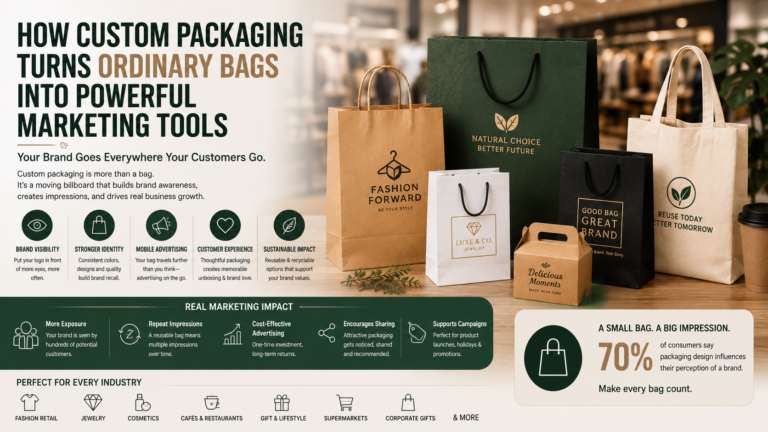

A shopping bag may only be used for a few minutes inside a store, but its marketing potential can last much longer.
For retail brands, cafés, restaurants, fashion companies, jewelry stores, cosmetic brands, and other businesses, packaging is often one of the most visible physical touchpoints between a brand and its customers.
A plain bag simply carries a product.
A custom branded bag can carry a logo, color scheme, message, website, and entire brand identity into the real world.
This makes packaging more than a functional product. With the right design and strategy, it can become a cost-effective offline marketing tool.
In this article, we’ll explore how custom packaging can transform ordinary bags into valuable brand assets and how businesses can maximize their marketing potential.
1. Packaging Is More Than a Product Carrier
The primary purpose of a shopping bag is obvious: carry products.
But from a marketing perspective, a branded bag performs several additional functions.
It can:
- Increase brand visibility
- Reinforce brand identity
- Improve customer experience
- Create product awareness
- Encourage word-of-mouth exposure
- Support seasonal campaigns
- Strengthen perceived product value
- Generate repeat brand impressions
Consider what happens after a customer leaves a store carrying a branded bag.
The logo may be seen by:
- Other shoppers
- People in shopping centers
- Employees
- Friends and family
- People on public transportation
- Customers in restaurants or cafés
- Social media followers
The packaging continues communicating even though the original transaction has already ended.
That is the basic marketing advantage of branded packaging.
2. A Custom Bag Becomes a Moving Brand Advertisement
Traditional advertising requires dedicated media space.
A billboard occupies one location.
A digital advertisement appears on a screen.
A shopping bag moves through different environments with the customer.
This makes a well-designed bag a small mobile advertising surface.
For example, a custom paper bag can display:
Logo + Brand Colors + Website + Tagline
A customer may carry that bag through a busy shopping district for 20 or 30 minutes.
During that time, the brand receives additional visibility without paying separately for every impression.
The bag itself becomes part of the advertising process.
3. Logo Placement Creates Instant Brand Recognition
The logo is usually the most important visual element on a branded shopping bag.
However, simply placing a logo on the bag is not enough.
Its:
- Size
- Position
- Color
- Contrast
- Spacing
all influence how effectively it communicates.
For many retail brands, a clean logo placed prominently in the center can create stronger recognition than a complicated design.
For example:
Minimal kraft bag + black logo
can create a very recognizable visual identity.
Meanwhile:
White paper bag + carefully matched brand color + centered logo
can create a cleaner, more premium appearance.
The objective is simple:
Make the brand recognizable before the customer even reads the details.
4. Brand Colors Make Packaging More Memorable
Color is one of the fastest visual signals customers process.
A consistent packaging color can become strongly associated with a brand.
Think about how some brands are recognizable from color alone.
Retail businesses can use this principle in their packaging by maintaining consistent:
- Bag color
- Handle color
- Logo color
- Printing colors
- Tissue paper
- Gift boxes
For example, a fashion brand might consistently use:
Deep green + cream + gold
across its bags, boxes, and promotional materials.
Over time, customers may begin recognizing the packaging before consciously reading the logo.
This is why packaging should follow the company’s broader brand guidelines.
5. Custom Paper Bags Create High-Visibility Brand Exposure
Custom paper bags are particularly useful because they provide a large printable surface.
Brands can use this space for:
- Logos
- Patterns
- Illustrations
- Brand slogans
- Website addresses
- QR codes
- Social media handles
- Seasonal messages
The design can remain simple or become highly creative.
For example, a cosmetic brand might use a minimalist logo and one strong color.
A children’s retailer may use illustrations and colorful graphics.
A luxury jewelry brand may use a restrained logo combined with embossing or foil stamping.
The packaging format stays the same.
The marketing strategy changes with the brand.
6. Packaging Can Tell a Brand Story
A good package doesn’t have to shout.
It can communicate a story through small details.
For example, a sustainable brand could use:
- Recycled paper
- Natural kraft texture
- Minimal printing
- Simple botanical graphics
- Reusable packaging
A premium fashion brand might use:
- White card paper
- Sophisticated typography
- Embossed logo
- Premium rope handles
A handmade brand could use:
- Kraft paper
- Artisan-inspired graphics
- Natural cotton handles
- Simple messaging
The customer may never consciously analyze these choices.
But together, they create an impression of what the brand represents.
7. Turn Every Purchase Into a Branding Opportunity
Every customer interaction can become a marketing touchpoint.
A retail transaction might look like:
Customer enters store → Purchases product → Receives branded bag → Leaves store → Carries bag in public → Uses bag again
Without custom packaging, the marketing opportunity ends at checkout.
With branded packaging, the brand continues traveling with the customer.
This is especially valuable for businesses located in:
- Shopping malls
- High streets
- Tourist areas
- Commercial districts
- Busy city centers
The more visible the packaging, the more opportunities it has to create impressions.
8. Reusable Bags Extend the Marketing Lifecycle
Disposable packaging has a limited lifespan.
Reusable bags can create repeated exposure.
Options include:
- Canvas bags
- Cotton totes
- PP non-woven bags
A reusable branded bag may continue being used for:
- Grocery shopping
- Daily commuting
- Travel
- Gym visits
- Shopping
- Events
This means the brand logo can remain visible long after the original purchase.
For promotional campaigns, reusable bags can therefore function as both:
Packaging + Marketing Merchandise
That dual purpose can make them particularly attractive for brands planning long-term customer engagement.
9. Packaging Can Encourage Social Media Sharing
Today’s packaging also needs to work in a digital environment.
Customers increasingly photograph:
- Products
- Gift boxes
- Shopping bags
- Unboxing experiences
- Seasonal packaging
- Limited-edition designs
A visually distinctive package can therefore become part of user-generated content.
This is particularly relevant for:
- Fashion brands
- Jewelry brands
- Beauty brands
- Lifestyle businesses
- Specialty food brands
A well-designed bag can appear in:
- Instagram posts
- TikTok videos
- Stories
- Unboxing videos
- Customer photos
The original packaging investment can therefore generate additional digital exposure.
10. Seasonal Packaging Creates Marketing Urgency
Custom packaging can also support short-term marketing campaigns.
Retail brands can create limited-edition packaging for:
- Christmas
- Valentine’s Day
- Mother’s Day
- Halloween
- New Year
- Black Friday
- Product launches
- Anniversary campaigns
For example, a standard paper bag can be redesigned with seasonal:
- Colors
- Graphics
- Messages
- Patterns
- Finishing
Limited-edition packaging can create a sense of exclusivity.
Customers may perceive the seasonal package as part of the campaign rather than just another shopping bag.
11. QR Codes Can Connect Physical Packaging to Digital Marketing
A shopping bag can also become a bridge between offline and online marketing.
Brands can add a QR code linking to:
- Website
- Product catalog
- Loyalty program
- Social media
- Seasonal campaign
- Discount page
- Brand story
- Online store
This creates a simple path:
Physical packaging → Smartphone → Digital brand experience
For brands investing heavily in digital marketing, this can help connect physical retail activity with online customer journeys.
The QR code should be large enough to scan easily and positioned where it doesn’t interfere with the main branding.
12. Packaging Can Promote New Products
A branded bag does not have to advertise only the product inside.
It can also introduce customers to other products or services.
For example:
Discover Our New Collection
Scan to Explore
Shop Our Latest Products
Join Our Loyalty Program
This is especially useful for brands with multiple product categories.
A customer purchasing one product can be introduced to another part of the brand portfolio through the packaging.
The bag becomes a low-cost cross-selling channel.
13. Packaging Can Strengthen Perceived Value
Marketing is not only about visibility.
It is also about perception.
A carefully designed bag can make a purchase feel more premium.
This is particularly relevant for:
- Jewelry
- Fashion
- Cosmetics
- Luxury gifts
- Specialty food
- Lifestyle products
Material, structure, printing, and finishing all contribute to the impression.
For example:
High-quality paper + strong handles + precise printing + subtle foil
can create a more premium experience than a thin generic bag.
The packaging doesn’t change the product itself.
But it can change how the customer experiences the product.
14. Finishing Techniques Can Make Branding Stand Out
For brands looking to create a stronger visual impact, finishing can be useful.
Common techniques include:
Foil Stamping
Gold, silver, or other metallic foil can make logos and graphics stand out.
Embossing
Creates a raised tactile effect.
Debossing
Creates a recessed logo or pattern.
Matte Finish
Creates a smooth, understated appearance.
Gloss Finish
Creates a brighter and more reflective surface.
Spot UV
Adds selective gloss to specific areas.
The best approach depends on the brand positioning.
Premium packaging doesn’t require every available finishing technique.
Often, one carefully selected detail is enough.
15. Packaging Can Communicate Sustainability
For environmentally conscious brands, packaging can reinforce sustainability positioning.
Potential options include:
- Recycled paper bags
- Kraft paper
- Reusable canvas bags
- Cotton bags
- PP non-woven bags
- Right-sized packaging
- Reduced material usage
However, brands should avoid treating sustainability as a generic marketing slogan.
Instead, packaging can communicate specific information where appropriate.
For example:
Made with recycled paper
or
Reusable by design
provides customers with a clearer message.
The packaging should support the brand’s actual sustainability strategy rather than making vague claims.
16. The Handle Is Also a Marketing Element
The handle may seem like a purely functional component, but it contributes to the overall design.
Common options include:
- Twisted paper handles
- Flat paper handles
- Cotton rope
- Polyester rope
- Ribbon handles
Handle colors can be coordinated with the brand.
For example:
Black bag + black rope + white logo
creates a strong monochrome identity.
Meanwhile:
Kraft bag + natural cotton handle + dark green logo
can create a more organic appearance.
Because customers physically hold the handle, this small detail contributes to the overall tactile experience.
17. Packaging Can Build Customer Loyalty
A positive packaging experience can contribute to customer satisfaction.
This is particularly true when packaging is:
- Easy to carry
- Attractive
- Strong
- Gift-ready
- Reusable
- Clearly branded
A customer who enjoys the overall purchase experience may be more likely to remember the brand and return.
Packaging alone cannot create customer loyalty.
But it can support a larger experience that includes:
Product Quality + Service + Brand Identity + Packaging + Customer Experience
Every element reinforces the others.
18. Consistency Is Essential for Multi-Store Retail Brands
For businesses with multiple locations, packaging can help create a consistent customer experience.
A retail chain with 100 stores should ideally have consistent:
- Bag dimensions
- Paper specifications
- Logo placement
- Colors
- Handles
- Printing
- Finishing
This ensures that customers receive the same brand experience regardless of which store they visit.
For procurement teams, standardized packaging also simplifies:
- Purchasing
- Inventory
- Quality control
- Supplier communication
- Repeat orders
Packaging therefore serves both a marketing function and an operational function.
19. Choose the Right Bag Size for the Marketing Impact
Larger bags provide more printable space, but bigger does not always mean better.
An oversized bag can:
- Waste material
- Increase shipping volume
- Be inconvenient to carry
- Increase costs
An undersized bag can:
- Damage products
- Look unprofessional
- Limit usability
The ideal size should be based on:
- Product dimensions
- Product weight
- Number of items
- Carrying requirements
- Storage
- Branding needs
Good packaging design balances marketing visibility with practical efficiency.
20. Don’t Let Marketing Compromise Functionality
A bag is still a bag.
It has to work.
The strongest marketing message cannot compensate for:
- Broken handles
- Weak bottoms
- Poor sizing
- Difficult carrying
- Damaged products
For this reason, packaging development should include practical testing.
Important factors include:
- Paper GSM
- Handle strength
- Bottom reinforcement
- Bag dimensions
- Load capacity
- Printing durability
The marketing function and functional performance should support each other.
21. Use Packaging to Support Different Marketing Campaigns
Brands don’t have to use the same packaging design all year.
A core packaging system can support multiple campaigns.
Everyday Packaging
Focus on:
- Brand recognition
- Logo
- Core colors
Seasonal Packaging
Add:
- Holiday graphics
- Special messages
- Limited-edition artwork
Product Launch Packaging
Add:
- New product graphics
- Campaign messaging
- QR code
Promotional Packaging
Add:
- Discount message
- Event information
- Social media campaign
This makes packaging a flexible marketing channel rather than a static product.
22. Calculate Packaging as a Marketing Investment
B2B buyers often compare packaging primarily by unit price.
But the cheapest bag is not necessarily the most cost-effective marketing solution.
A more useful calculation considers:
Packaging Cost ÷ Number of Potential Brand Impressions
A branded bag may generate multiple impressions after leaving the store.
A reusable bag may generate dozens or even hundreds of additional uses.
This doesn’t mean every bag needs to be expensive.
It means businesses should evaluate packaging based on its total marketing and functional value, not just its purchase price.
23. How to Design a Marketing-Focused Custom Bag
A practical process can look like this:
Step 1: Define the Objective
Decide whether the bag should primarily:
- Build awareness
- Promote a product
- Support a seasonal campaign
- Improve customer experience
- Encourage reuse
Step 2: Identify the Audience
Consider:
- Age
- Lifestyle
- Industry
- Purchasing behavior
- Brand expectations
Step 3: Select the Material
Choose kraft, white card, recycled, coated, canvas, non-woven, or another suitable material.
Step 4: Create the Visual Identity
Finalize:
- Logo
- Colors
- Typography
- Graphics
Step 5: Add Marketing Elements
Consider:
- Website
- QR code
- Social media
- Campaign message
Step 6: Select Finishing
Choose only the effects that support the design.
Step 7: Test the Physical Product
Check:
- Appearance
- Strength
- Size
- Handle performance
Step 8: Approve the Sample
Confirm the final specification before mass production.
24. A Simple Example of Packaging as a Marketing Tool
Imagine a fashion retailer selling a new seasonal collection.
Instead of using a generic shopping bag, the retailer creates:
**Matte black paper bag
- white logo
- seasonal silver foil
- QR code
- premium rope handle**
The customer leaves the store carrying the bag.
The bag is then:
- Seen by other shoppers.
- Recognized as part of the fashion brand.
- Photographed during an unboxing.
- Connected to the retailer’s website through the QR code.
- Potentially reused for another shopping trip.
One packaging product has now performed several marketing functions.
That is the power of thoughtful custom packaging.
25. B2B Buyers Should Think Beyond the Unit Price
When evaluating custom packaging suppliers, procurement teams should compare more than the quoted price per bag.
Consider:
- Material quality
- Printing quality
- Structural strength
- Customization options
- MOQ
- Sampling
- Production capacity
- Quality control
- Lead time
- Carton packing
- Shipping
- Repeat-order consistency
A slightly higher unit price may be worthwhile if the packaging provides better durability, stronger branding, and a better customer experience.
The goal is to find the right value-to-cost ratio.
Custom Packaging Marketing Checklist
Before placing a custom packaging order, ask:
-
Is the logo clearly visible?
-
Does the design match our brand identity?
-
Are the brand colors consistent?
-
Is the bag size appropriate?
-
Is the paper strong enough?
-
Are the handles durable?
-
Can customers easily carry the bag?
-
Would the packaging look good in photos?
-
Can we include a QR code?
-
Can the bag support seasonal campaigns?
-
Is reusable packaging appropriate?
-
Is the packaging aligned with our sustainability goals?
-
Have we tested a physical sample?
-
Is the supplier capable of repeat production?
-
Does the total cost make sense?
Conclusion
A shopping bag may look like a small part of a customer’s purchase, but from a marketing perspective, it can have a surprisingly long life.
With the right material, size, printing, colors, finishing, and messaging, an ordinary bag can become a recognizable extension of a brand.
Custom packaging can:
- Increase brand visibility
- Reinforce brand identity
- Improve perceived value
- Support seasonal campaigns
- Encourage social sharing
- Connect offline customers to digital channels
- Create additional advertising exposure
- Extend brand visibility through reusable bags
The key is to stop viewing packaging as simply an operational expense.
For brands that invest thoughtfully in design and functionality, packaging can become a marketing asset that travels with the customer.
And unlike an advertisement that disappears when the campaign ends, a well-designed reusable bag may continue telling the brand’s story every time it leaves the house.
Looking for custom packaging that works as both a product carrier and a marketing tool? Custom paper bags, reusable non-woven bags, canvas bags, gift boxes, and other packaging solutions can be developed around your brand identity, campaign goals, product requirements, and B2B order volume.