
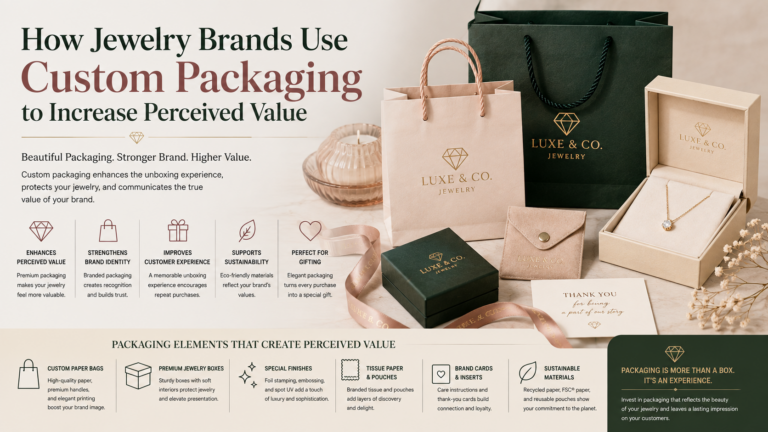

For jewelry brands, the product itself may be small, but the experience surrounding it can be remarkably important.
A necklace, bracelet, ring, or pair of earrings can represent a significant emotional and financial purchase. Before the customer even sees the jewelry, they may already be forming an impression of the brand through the packaging.
A carefully designed jewelry box, paper bag, gift box, pouch, tissue paper, or branded insert can make the entire purchase feel more considered and valuable.
This is why successful jewelry brands increasingly treat packaging as part of their brand experience, rather than simply a container for the product.
The goal is not necessarily to make packaging more expensive.
The goal is to make it feel intentional, consistent, premium, and worthy of the product inside.
In this guide, we’ll explore how jewelry brands use custom packaging to increase perceived value, strengthen brand identity, improve gifting experiences, and encourage repeat purchases.
1. What Is Perceived Value in Jewelry Packaging?
Perceived value is the value customers associate with a product based on more than its physical specifications.
Two jewelry products may be similar in material and craftsmanship, but the brand presentation can influence how customers perceive them.
Packaging contributes to this perception through:
- Material quality
- Visual design
- Color
- Texture
- Structure
- Printing
- Finishing
- Presentation
- Unboxing experience
- Brand consistency
A simple branded paper bag can make a purchase feel more complete.
A carefully coordinated box, pouch, tissue paper, insert card, and shopping bag can turn the same transaction into a much more memorable experience.
This is especially important for jewelry because the product is often purchased for gifting, milestones, celebrations, and personal occasions.
2. Jewelry Packaging Is Part of the Product Experience
When customers purchase jewelry, the experience often follows a sequence:
See the brand → Choose the jewelry → Receive the packaging → Open the package → Discover the product → Share the experience
Packaging occupies several stages of that journey.
For a physical jewelry store, the shopping bag may be the first branded item customers take away.
At home, the box becomes part of the unboxing experience.
For online orders, packaging may be the first physical interaction customers have with the brand.
That makes packaging a valuable brand touchpoint.
3. Custom Paper Bags Create Immediate Brand Recognition
Custom paper bags are one of the simplest ways for jewelry brands to strengthen their visual identity.
A jewelry shopping bag can include:
- Logo
- Brand colors
- Website
- Tagline
- Minimal graphics
- Pattern
- Social media information
Because the bag is carried outside the store, it can also create additional brand exposure.
Imagine a customer leaving a shopping mall carrying a beautifully designed jewelry bag.
Other people may notice:
The logo.
The color.
The shape.
The overall aesthetic.
The packaging becomes a mobile brand impression.
For jewelry businesses with physical stores, this makes shopping bags more than a functional purchase carrier.
4. Material Choice Influences Premium Perception
Material is one of the first things customers notice, even if they don’t consciously analyze it.
Different paper materials create different impressions.
Kraft Paper
Kraft paper can communicate:
- Natural
- Minimalist
- Sustainable
- Handmade
- Contemporary
It can work particularly well for independent jewelry brands, handmade jewelry, and brands with an organic aesthetic.
White Card Paper
White paper provides a clean and refined background.
It works well for:
- Minimalist jewelry brands
- Fine jewelry
- Contemporary brands
- Fashion jewelry
Coated Paper
Coated paper can provide a smoother surface and strong printing performance.
It may be suitable for:
- Detailed brand graphics
- High-quality photography
- Premium visual presentation
- Complex color designs
Specialty Paper
Textured or specialty papers can create an additional tactile element.
For premium jewelry packaging, texture can sometimes communicate quality more effectively than adding excessive graphics.
5. Color Creates an Emotional Signal
Color plays a major role in luxury and fashion branding.
Jewelry brands often use restrained palettes such as:
- Black
- White
- Cream
- Deep green
- Burgundy
- Navy
- Soft beige
- Metallic tones
A consistent packaging color can become strongly associated with the brand.
For example, a jewelry brand may use:
Matte black bag + white logo + black rope handle
for a sophisticated identity.
Another brand may choose:
Cream paper + dark green logo + natural rope
to communicate a more organic and sustainable positioning.
The important point is consistency.
A premium-looking bag in an unrelated color can weaken the visual identity even if the bag itself is high quality.
6. Minimalist Design Can Make Packaging Feel More Premium
Jewelry packaging often benefits from restraint.
Customers don’t necessarily need to see:
- Five logos
- Multiple slogans
- Large promotional messages
- Every social media account
- A complicated graphic pattern
Sometimes the strongest design is simply:
Logo + carefully selected color + quality material
Minimalism gives the customer’s attention somewhere to land.
For premium jewelry, the packaging should support the product rather than compete with it.
7. Finishing Techniques Can Increase Perceived Value
Custom finishing can make a simple paper bag or box feel significantly more sophisticated.
Popular options include:
Hot Foil Stamping
Metallic gold, silver, or other foil can highlight a logo or selected design element.
Gold foil is particularly compatible with jewelry branding, but it should be used carefully.
Embossing
An embossed logo creates a raised tactile effect.
Customers can see and feel the brand mark.
Debossing
The logo is pressed into the surface, creating a recessed effect.
This can produce a subtle premium appearance.
Matte Finish
A matte surface can create a sophisticated and understated feel.
Gloss Finish
Gloss can create stronger visual contrast and a more vibrant appearance.
The key is not to use every finishing technique available.
One well-executed detail can be more effective than excessive decoration.
8. Handles Can Add Unexpected Premium Value
Handles are often overlooked when designing shopping bags.
But customers physically interact with them.
Options include:
- Cotton rope
- Polyester rope
- Twisted paper
- Flat paper
- Ribbon
- Custom-color handles
For jewelry brands, premium rope or ribbon handles can create a stronger tactile impression.
Handle color can also be coordinated with the packaging.
For example:
Dark green bag + matching rope + gold logo
creates a cohesive visual system.
Small details like this can make packaging feel deliberately designed rather than mass-produced.
9. The Jewelry Box Is the Center of the Unboxing Experience
The shopping bag creates the first impression.
The jewelry box creates the reveal.
For this reason, the box should be designed around the product.
A jewelry box may include:
- Custom logo
- Interior lining
- Product insert
- Ring holder
- Necklace support
- Earring holder
- Printed message
- Magnetic closure
- Ribbon
- Custom color
The opening sequence should feel natural.
The customer should not have to fight with the packaging to reach the jewelry.
Good packaging creates anticipation and then delivers the product smoothly.
10. Packaging Layers Can Create a Sense of Discovery
Premium jewelry packaging can use several layers:
Shopping Bag → Tissue Paper → Jewelry Box → Pouch → Jewelry → Brand Card
Each layer creates another moment of discovery.
But more layers are not automatically better.
Over-packaging can increase:
- Material costs
- Shipping costs
- Storage requirements
- Packaging waste
The better approach is to select layers that have a clear purpose.
For example:
- Box = product protection
- Pouch = storage/reuse
- Tissue = presentation
- Card = brand story or care instructions
- Shopping bag = carrying and branding
Every layer should earn its place.
11. Packaging Can Increase Gift Appeal
Jewelry is one of the most common categories associated with gifting.
Customers may purchase jewelry for:
- Birthdays
- Anniversaries
- Weddings
- Valentine’s Day
- Mother’s Day
- Christmas
- Graduations
- Personal milestones
Packaging can therefore influence whether a product feels immediately gift-ready.
A coordinated gift packaging system can eliminate the need for customers to wrap the product themselves.
For jewelry brands, this can become a competitive advantage.
Instead of simply selling:
“A necklace”
the brand is selling:
“A complete gifting experience.”
12. Custom Packaging Supports Brand Storytelling
Packaging can communicate what the brand stands for.
For example, a sustainable jewelry brand might emphasize:
- Recycled paper
- Responsible materials
- Minimal packaging
- Reusable pouches
- Natural textures
A luxury jewelry brand might emphasize:
- Premium paper
- Embossing
- Foil stamping
- Sophisticated colors
- Structured boxes
A handmade jewelry brand might use:
- Kraft paper
- Handwritten-style graphics
- Natural cotton
- Simple packaging
- Artisan-inspired textures
The packaging should answer a subtle question:
“What kind of brand is this?”
13. Sustainable Packaging Can Add Brand Value
Sustainability is increasingly relevant to jewelry brands, particularly those targeting younger and environmentally conscious consumers.
Possible packaging strategies include:
- Recycled paper bags
- Recycled paper boxes
- Reusable cotton pouches
- Reduced packaging layers
- Right-sized bags
- Paper-based packaging
- Reusable shopping bags
However, brands should avoid vague environmental claims.
Instead of simply describing packaging as “eco-friendly,” businesses should communicate specific material information where appropriate.
For example:
Made with recycled paper
is more meaningful than a generic environmental slogan.
Sustainability becomes more credible when the packaging design and the brand’s broader practices tell the same story.
14. Reusable Packaging Can Extend Brand Exposure
A disposable bag has a limited lifespan.
A reusable bag can have a much longer one.
For jewelry brands, reusable:
- Canvas bags
- Cotton totes
- Non-woven bags
can be used as promotional or premium packaging.
Customers may use them for:
- Shopping
- Travel
- Storage
- Daily errands
Every additional use creates another opportunity for the brand logo to be seen.
This makes reusable packaging particularly interesting for jewelry brands looking to combine packaging with long-term brand visibility.
15. Packaging Should Match the Jewelry Price Point
Not every jewelry product requires luxury packaging.
A useful approach is to create different packaging tiers.
Everyday Jewelry
Use:
- Simple custom paper bag
- Standard jewelry box
- Printed insert
Premium Collection
Use:
- Higher-grade paper
- Premium handles
- Custom box
- Embossing or foil
- Branded pouch
High-End Jewelry
Use:
- Premium rigid box
- High-quality interior
- Custom tissue
- Luxury shopping bag
- Sophisticated finishing
This helps brands control costs without creating a mismatch between packaging and product positioning.
A $20 accessory does not necessarily need a highly engineered luxury box.
Likewise, a high-value jewelry purchase may feel underwhelming if it arrives in a thin generic package.
16. Packaging Consistency Builds Brand Recognition
Imagine a customer sees a brand’s packaging several months after making a purchase.
They may not remember the exact product.
But they may remember:
The black bag.
The gold logo.
The textured paper.
The distinctive box.
Consistent packaging helps create these visual memory cues.
Brands should standardize:
- Logo placement
- Colors
- Typography
- Bag sizes
- Handle styles
- Box design
- Finishing
This is especially important for jewelry chains with multiple stores.
A customer should receive essentially the same brand experience whether they visit Store A or Store B.
17. Custom Packaging Can Support Omnichannel Jewelry Brands
Modern jewelry brands may sell through:
- Physical boutiques
- E-commerce
- Social commerce
- Marketplaces
- Pop-up stores
- Wholesale retailers
Packaging requirements differ between these channels.
Physical Retail
Focus on:
- Shopping bags
- Presentation
- Carrying experience
- Gift readiness
E-Commerce
Focus on:
- Product protection
- Shipping efficiency
- Unboxing
- Carton dimensions
Wholesale
Focus on:
- Consistency
- Cost
- Storage
- Repeat ordering
A packaging system should therefore be flexible enough to support multiple sales channels.
18. Packaging Efficiency Still Matters
Premium packaging should not mean uncontrolled packaging costs.
Jewelry brands should evaluate:
Unit Cost + Printing + Finishing + Storage + Shipping
For paper bags, size optimization is particularly important.
A bag that is 30% larger than necessary may increase:
- Material consumption
- Carton volume
- Warehouse space
- Shipping costs
Choosing the correct dimensions can reduce cost without making the packaging feel cheaper.
In other words:
Premium design begins with smart specifications, not simply expensive materials.
19. Order Samples Before Mass Production
For jewelry packaging, small visual differences can have a major impact.
Before approving a large order, brands should request samples to evaluate:
- Paper texture
- Color
- Logo size
- Logo position
- Printing quality
- Handle attachment
- Box structure
- Finishing
- Overall proportions
A physical sample is especially important for foil stamping and embossing.
The design on a screen cannot fully reproduce the tactile experience of the final packaging.
20. Work With a Supplier That Understands B2B Custom Packaging
For jewelry brands ordering packaging at scale, the supplier should be able to manage the entire process.
Ideally, the workflow should include:
Design Support → Material Selection → Artwork Confirmation → Sampling → Production → Quality Control → Packing → Shipping
This helps reduce communication problems between different suppliers.
It also makes repeat orders easier.
Once a brand has approved a packaging specification, the supplier can use that specification as a reference for future production.
21. A Practical Jewelry Packaging Strategy
A jewelry brand could build a packaging system such as:
Standard Retail Packaging
- Medium custom paper bag
- Branded jewelry box
- Logo card
Premium Packaging
- Premium paper bag
- Custom rigid box
- Branded pouch
- Tissue paper
- Care card
Gift Packaging
- Custom gift box
- Premium shopping bag
- Gift message card
- Ribbon or special finishing
Promotional Packaging
- Reusable canvas or non-woven bag
- Seasonal artwork
- Limited-edition branding
This approach provides flexibility without requiring every customer to receive the most expensive packaging option.
22. How to Increase Perceived Value Without Increasing Costs Too Much
You don’t always need expensive materials.
Consider these lower-cost improvements:
Improve Proportions
A well-proportioned bag can look more premium immediately.
Standardize Colors
Consistent brand colors create stronger recognition.
Simplify Graphics
A clean logo often looks more premium than a crowded design.
Upgrade Handles
A better handle can significantly improve tactile quality.
Add One Finishing Detail
For example, foil stamping the logo instead of applying multiple finishing effects.
Improve Packaging Coordination
Matching the bag, box, tissue paper, and insert can create a much more cohesive experience.
These changes can produce a significant visual impact without dramatically increasing the overall packaging budget.
Jewelry Packaging Buyer Checklist
Before placing a custom packaging order, jewelry brands should confirm:
- Brand positioning
- Product price range
- Packaging format
- Paper material
- Paper GSM
- Bag dimensions
- Handle type
- Handle color
- Printing method
- Logo placement
- Finishing
- Jewelry box structure
- Interior protection
- Sustainability requirements
- MOQ
- Sample approval
- Production lead time
- Quality standards
- Shipping requirements
Conclusion
For jewelry brands, packaging can influence how customers perceive the product before they even touch the jewelry.
The right combination of material, color, structure, printing, finishing, and presentation can make a product feel more considered and more aligned with its price point.
But increasing perceived value does not mean adding every premium feature available.
The most effective packaging is usually the one that feels intentional.
A minimalist paper bag with a precisely positioned logo can be more powerful than an overloaded design. A carefully selected handle can improve the tactile experience. A well-structured jewelry box can make the product reveal feel special. And a consistent packaging system can turn individual purchases into recognizable brand experiences.
For jewelry brands, the real opportunity is to stop thinking of packaging as an afterthought.
The jewelry is the product. The packaging is the stage on which the product makes its entrance.
A well-designed stage does not steal the spotlight. It makes the spotlight brighter.
Looking for custom packaging for your jewelry brand? Custom paper bags, gift boxes, reusable bags, pouches, printing, finishing, and other packaging formats can be developed around your brand identity, product requirements, and B2B order volume.