
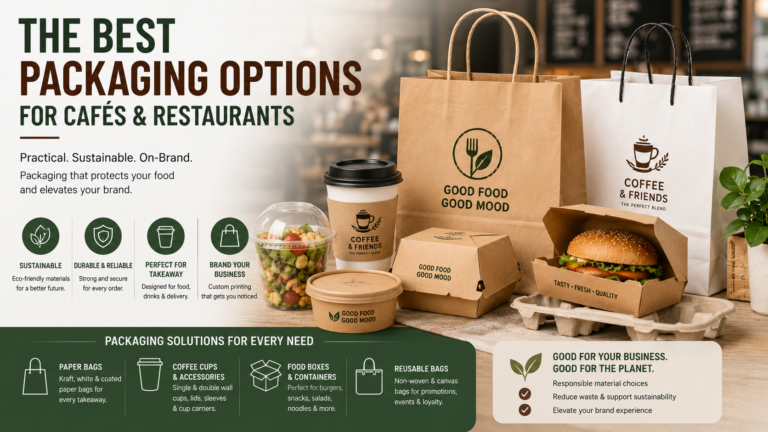

For cafés and restaurants, packaging is no longer just a practical way to transport food and drinks.
It is part of the customer experience.
A well-designed takeaway bag can protect products, make carrying easier, reinforce brand identity, and even encourage customers to remember and share the business. On the other hand, packaging that is too weak, oversized, difficult to carry, or poorly designed can create unnecessary costs and a disappointing customer experience.
For cafés, bakeries, restaurants, takeaway businesses, and food brands, choosing the right packaging means balancing functionality, cost, appearance, durability, sustainability, and branding.
This guide explores the most practical packaging options for cafés and restaurants and explains how to choose the right solution for different foodservice applications.
1. What Makes Good Restaurant Packaging?
Before comparing different packaging materials, it is useful to define what good foodservice packaging should achieve.
A suitable packaging solution should ideally provide:
- Adequate strength
- Easy handling
- Appropriate size
- Protection during transportation
- Good presentation
- Efficient storage
- Cost control
- Custom branding
- Suitable material performance
- Practical disposal or reuse options
Not every restaurant needs premium packaging.
A busy takeaway restaurant may prioritize cost and durability, while a specialty coffee shop may focus more on brand presentation and sustainability.
The best packaging is therefore not necessarily the most expensive option.
It is the one that matches the business model.
2. Custom Paper Bags
Custom paper bags are one of the most versatile packaging options for cafés and restaurants.
They can be used for:
- Takeaway meals
- Bakery products
- Coffee orders
- Sandwiches
- Gift sets
- Delivery orders
- Retail merchandise
Paper bags offer a large printable surface, making them particularly useful for branding.
A restaurant can customize:
- Logo
- Brand colors
- Slogan
- Illustrations
- Website
- Social media information
- Seasonal artwork
A simple takeaway order can therefore become another branded customer touchpoint.
Why Paper Bags Work Well
Paper bags are available in different paper grades, sizes, handle styles, and constructions.
For example, a small café might use compact kraft paper bags for pastries and drinks, while a restaurant may require larger reinforced bags for multiple meal containers.
3. Kraft Paper Bags
Kraft paper is particularly popular in foodservice packaging.
Its natural appearance works well with:
- Cafés
- Bakeries
- Organic food brands
- Restaurants
- Farmers’ markets
- Takeaway businesses
Kraft paper can create a simple, natural visual identity without requiring complicated graphics.
A kraft bag with a one-color logo can be highly effective for a small coffee shop.
For larger restaurants, kraft bags can also be customized with full-color printing or other branding elements.
Advantages of Kraft Paper Bags
- Natural appearance
- Good printability
- Available in different weights
- Easy to customize
- Suitable for many takeaway applications
- Strong branding potential
The exact paper specification should be selected according to the weight and type of products being carried.
4. White Paper Bags
White paper bags provide a cleaner and more polished visual background.
They can be a good choice for:
- Premium cafés
- Dessert shops
- Fashionable restaurants
- Bakeries
- Specialty food brands
- Catering companies
The white surface provides strong contrast for logos and graphics.
It can also be useful when a brand has specific corporate colors that need to be reproduced clearly.
For example, a restaurant with a bright red or dark green brand identity may achieve a more consistent visual result on a white paper background.
5. Coated Paper Bags for Premium Branding
For brands that place a strong emphasis on visual presentation, coated paper can provide a smoother surface for printing and finishing.
It may be suitable for:
- Premium restaurants
- Luxury cafés
- Gourmet food brands
- Gift packaging
- Special events
Coated paper can support detailed graphics and polished visual effects.
However, premium finishing should be used strategically.
A restaurant does not necessarily need a highly sophisticated bag for every takeaway order.
Instead, premium bags can be reserved for:
- VIP orders
- Gift sets
- Seasonal campaigns
- Corporate catering
- Special product collections
This can help control packaging costs while maintaining a premium customer experience.
6. Paper Bags for Food Delivery
Food delivery creates additional packaging challenges.
The bag needs to carry several items while remaining stable during transportation.
A typical delivery order may contain:
- Food containers
- Drinks
- Sauces
- Cutlery
- Napkins
- Desserts
This means the bag needs enough capacity and structural strength.
Important factors include:
Bag Size
The bag should fit the expected order without leaving excessive empty space.
Bottom Construction
A reinforced bottom can help support heavier orders.
Handle Strength
Handles should be appropriate for the expected load.
Paper Weight
The selected GSM should match the product weight and transportation conditions.
Internal Organization
For some orders, using separate bags for hot food, cold drinks, or fragile products may be more practical.
The packaging system should be designed around the actual delivery workflow.
7. Takeaway Cups and Cup Carriers
For cafés, packaging does not stop at bags.
Coffee and beverage packaging is equally important.
Common takeaway beverage packaging includes:
- Single-wall paper cups
- Double-wall paper cups
- Ripple-wall cups
- Cup sleeves
- Cup carriers
- Lids
Single-Wall Cups
A cost-effective option for many beverage applications, especially when used with a sleeve.
Double-Wall Cups
Provide additional insulation and can reduce the need for a separate sleeve.
They can be particularly useful for hot coffee and tea.
Cup Carriers
Useful when customers order multiple beverages.
For cafés with a high volume of takeaway orders, the combination of cups, lids, carriers, and bags should be considered as one packaging system.
8. Food Boxes and Paper Containers
Restaurants may also require boxes or containers for:
- Burgers
- Sandwiches
- Fried foods
- Pastries
- Cakes
- Noodles
- Rice dishes
- Salads
The right format depends on the food.
For example, crispy foods need packaging that helps manage moisture, while delicate desserts may require greater structural protection.
Packaging should therefore be selected according to the food’s characteristics, not simply its appearance.
Consider:
- Heat
- Moisture
- Grease
- Weight
- Fragility
- Ventilation
- Stacking
For food-contact applications, businesses should also confirm that the selected materials and printing systems meet applicable food-contact requirements for their market.
9. Custom Non-Woven Bags for Reusable Restaurant Packaging
Some cafés and restaurants can benefit from reusable bags, particularly for promotional campaigns, grocery-style food businesses, or larger takeaway orders.
PP non-woven bags can provide:
- Reusability
- Durability
- Large printing areas
- Lightweight construction
- Multiple color options
They may be particularly suitable for:
- Supermarkets with food counters
- Catering companies
- Food festivals
- Promotional campaigns
- Restaurant loyalty programs
- Grocery cafés
- Brand collaborations
For a restaurant running a customer loyalty campaign, a reusable branded bag can become a useful promotional product rather than disposable packaging.
10. Canvas and Cotton Bags for Premium or Promotional Use
Canvas and cotton bags are another option for restaurants that want a more premium or lifestyle-oriented packaging experience.
They can work well for:
- Specialty coffee brands
- Premium bakeries
- Restaurant merchandise
- Corporate events
- Food festivals
- Limited-edition campaigns
A café might sell or distribute a branded canvas tote alongside coffee beans, merchandise, or gift sets.
This transforms the bag from packaging into a long-term brand asset.
Customers can continue using the bag after the original purchase, creating additional brand visibility.
11. Sustainable Packaging: Look Beyond the Material Name
Sustainability is an important consideration for many foodservice businesses.
But choosing a material simply because it sounds environmentally friendly is not enough.
Brands should consider the complete packaging system.
Ask:
- Is the packaging appropriately sized?
- Is unnecessary material being used?
- Can the package be reused?
- Is it recyclable in the target market?
- Is the material suitable for the application?
- Can the packaging survive the intended use?
- Is the packaging unnecessarily over-engineered?
For example, reducing the size of an oversized takeaway bag can reduce material consumption and shipping volume.
A durable reusable bag may also make sense when customers are likely to use it repeatedly.
Sustainability is therefore about designing the right packaging, not just choosing a particular material.
12. Custom Printing Turns Packaging Into Advertising
Every takeaway order creates a branding opportunity.
A custom printed bag can display:
Logo + Brand Colors + Website + Social Media + Message
This means customers can see the brand after leaving the restaurant.
The effect becomes even more valuable when customers carry the bag in public.
For cafés located in busy commercial areas, branded takeaway bags can create repeated local exposure.
The bag can function as a small mobile advertising surface without requiring additional advertising space.
13. Minimalist Packaging Can Be More Effective
Restaurants sometimes assume that more printing means better branding.
Not necessarily.
A simple kraft bag with a clean logo can look more distinctive than a bag covered with too many messages.
For example:
Natural kraft + black logo
can communicate a very different identity from:
Full-color graphics + multiple slogans + promotional messages.
The right design depends on the brand.
Premium and minimalist brands often benefit from restraint.
Promotional brands may benefit from more visual energy.
The packaging should reflect the restaurant’s personality.
14. Packaging Size Should Match Your Menu
One of the easiest ways to reduce packaging costs is to standardize sizes.
Instead of ordering ten different bag sizes, a restaurant might identify three core formats:
Small
For:
- Pastries
- Snacks
- Small takeaway orders
Medium
For:
- Regular takeaway meals
- Sandwiches
- Bakery boxes
Large
For:
- Family meals
- Multiple food containers
- Catering orders
This simplifies:
- Inventory
- Storage
- Purchasing
- Staff training
- Packaging selection
It can also make forecasting easier.
15. Strength Testing Is Essential for Takeaway Bags
A bag may look strong but still fail under real-world conditions.
For restaurant packaging, practical testing can include:
- Static load testing
- Handle testing
- Bottom testing
- Drop testing
- Transportation testing
The test should reflect actual usage.
For example, if a restaurant commonly puts four meal containers and two drinks into one bag, test that exact combination.
Packaging should be designed around the real customer order, not an imaginary average order.
16. Storage and Inventory Should Be Part of the Decision
Restaurants often have limited storage space.
Packaging that looks affordable at the unit level may become inconvenient if it occupies excessive warehouse space.
Before ordering, consider:
- Bags per carton
- Carton dimensions
- Monthly consumption
- Storage capacity
- Delivery frequency
- Seasonal demand
For restaurant groups with multiple locations, centralized purchasing can help standardize packaging while allowing each store to receive the required quantities.
17. Single-Use vs Reusable Packaging
The decision between disposable and reusable packaging depends heavily on the business model.
Single-Use Packaging
Often suitable for:
- High-volume takeaway
- Fast-service restaurants
- Delivery
- Everyday food orders
The priority is usually cost, convenience, and performance.
Reusable Packaging
May be more suitable for:
- Loyalty programs
- Promotional campaigns
- Premium products
- Coffee merchandise
- Grocery-style businesses
- Events
A restaurant does not have to choose only one.
A hybrid packaging strategy can be more practical.
18. Packaging for Different Restaurant Types
Different businesses have different packaging requirements.
| Business Type | Recommended Packaging |
|---|---|
| Café | Paper bags + paper cups + cup carriers |
| Bakery | Kraft bags + bakery boxes |
| Fast-casual restaurant | Paper bags + food containers |
| Premium restaurant | Custom premium paper bags + gift packaging |
| Takeaway brand | Reinforced paper bags + food boxes |
| Catering company | Large reinforced bags + boxes |
| Specialty coffee brand | Paper bags + reusable canvas/non-woven bags |
| Food festival vendor | Custom paper/non-woven bags |
| Restaurant chain | Standardized multi-size packaging system |
The best solution is always application-specific.
19. How to Choose the Right Packaging Supplier
For B2B restaurant packaging, the supplier should be able to support more than just printing.
Before placing an order, ask about:
- Available materials
- Paper GSM
- Bag sizes
- Handle options
- Printing methods
- Finishing
- Food-contact suitability where applicable
- MOQ
- Sample availability
- Production lead time
- Quality control
- Carton packing
- International shipping
For restaurant chains, it is particularly useful to work with a supplier that can maintain consistent specifications across repeat orders.
20. A Practical Ordering Process for Cafés and Restaurants
A simple workflow can reduce purchasing mistakes.
Step 1: Analyze Your Orders
Identify your most common order sizes and product combinations.
Step 2: Choose Packaging Formats
Determine which bags, boxes, cups, and carriers are actually required.
Step 3: Select Materials
Choose materials based on product weight, moisture, heat, durability, and brand positioning.
Step 4: Define Your Brand Design
Prepare logos, colors, graphics, and required information.
Step 5: Request Samples
Test size, appearance, strength, and usability.
Step 6: Confirm the Specification
Finalize material, dimensions, printing, handles, and packaging.
Step 7: Calculate Quantity
Use actual monthly consumption and seasonal demand.
Step 8: Start Production
Approve the final sample before mass production.
Step 9: Inspect Quality
Check the finished products against the approved specification.
Step 10: Plan Delivery
Coordinate shipping and inventory before existing packaging runs out.
Restaurant Packaging Checklist
Before ordering custom packaging, review:
- Product type
- Food weight
- Bag size
- Paper GSM
- Handle type
- Bottom construction
- Printing
- Brand colors
- Food-contact requirements
- Sustainability goals
- Monthly consumption
- MOQ
- Storage space
- Production lead time
- Shipping method
- Sample approval
- Quality standards
This simple checklist can prevent many common purchasing problems.
Conclusion
The best packaging for cafés and restaurants is not necessarily the cheapest, strongest, or most sustainable material available.
It is the packaging that creates the right balance between performance, cost, customer experience, branding, and sustainability.
For many businesses, custom paper bags provide an excellent foundation because they combine practical functionality with strong branding potential. Kraft paper, white paper, recycled paper, and coated paper can serve different positioning and performance requirements.
Cafés and restaurants can then build around them with takeaway cups, food boxes, cup carriers, reusable non-woven bags, canvas totes, and other packaging formats.
The most effective approach is to think of packaging as a complete system, rather than a collection of individual products.
When the right materials, sizes, structures, printing, and quantities are brought together, packaging can do much more than carry food.
It can protect the order, improve the customer experience, reinforce the brand, and keep the business visible long after the customer leaves.
Looking for custom packaging for your café or restaurant? We provide custom paper bags, takeaway packaging bags, non-woven bags, canvas bags, and other packaging solutions for B2B buyers, with custom printing, professional design support, bulk production, quality control, and global shipping.