

If you are planning to order custom non-woven bags for your business, one of the first questions you will probably ask is:
How much do custom non-woven bags cost?
The answer is not as simple as giving one price per bag.
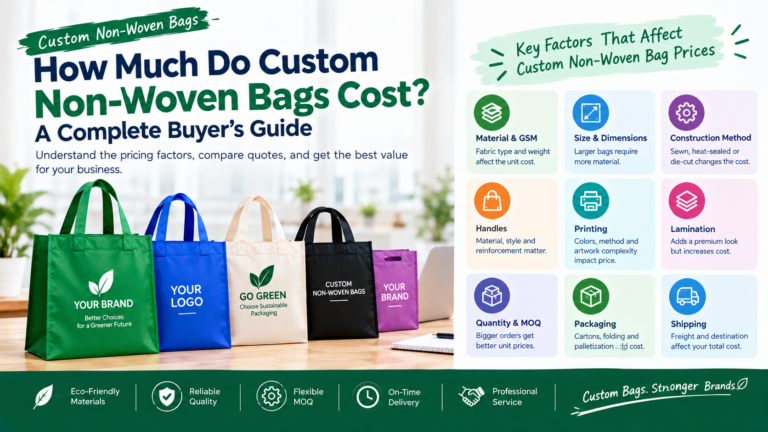
Custom non-woven bag pricing can vary significantly depending on the material, GSM, bag size, construction method, handles, printing, lamination, order quantity, packaging, and shipping requirements.
A lightweight promotional bag with simple printing can have a very different production cost from a heavy-duty retail bag with reinforced handles, lamination, and complex branding.
For B2B buyers, understanding how the price is calculated is more useful than looking for a single “standard” price.
This guide explains the main factors that affect custom non-woven bag costs and shows how buyers can request accurate quotations, compare suppliers, and control their total purchasing cost.
Is There a Standard Price for Custom Non-Woven Bags?
No. There is no universal price for a custom non-woven bag.
Manufacturers normally calculate the quotation according to the complete product specification.
Important pricing factors can include:
- Material type
- GSM
- Bag dimensions
- Fabric consumption
- Bag construction
- Handle type
- Handle reinforcement
- Printing
- Lamination
- Quantity
- MOQ
- Packaging
- Shipping requirements
- Production requirements
For example, two suppliers may both quote a “custom non-woven shopping bag,” but their prices can be different because one quotation uses 70 GSM material while the other uses 100 GSM material, or because one includes lamination and reinforced handles.
That is why B2B buyers should compare complete specifications, not simply compare the final unit price.
1. Material and GSM Affect the Cost
Material is one of the most important factors in custom non-woven bag pricing.
Commercial non-woven bags are commonly made from PP non-woven fabric, and different projects can use different GSM specifications.
GSM means grams per square meter and describes the weight of the fabric.
For example:
- 70 GSM uses less material
- 80 GSM provides a lightweight commercial option
- 90–100 GSM can offer a balance between cost and durability
- 110–120 GSM provides a thicker and more substantial material
These are general examples rather than fixed pricing categories. The appropriate GSM depends on the application, bag dimensions, construction, and expected load.
Higher GSM generally means more material is used, which can increase material consumption and therefore affect the final cost. It can also affect the finished bag’s feel, structure, and shipping weight.
Should You Always Choose a Higher GSM?
Not necessarily.
If you are producing thousands of promotional bags for a short-term event, a very high GSM may add unnecessary cost.
If you are producing reusable retail shopping bags, a heavier specification may be more appropriate.
The objective is to select the right GSM for the application, not simply the highest GSM available.
2. Bag Size Has a Direct Impact on Material Consumption
Bag dimensions are another major cost factor.
A larger bag requires more material than a smaller bag.
For example, these two bags may look similar in a product catalog:
- 350 × 300 × 80 mm
- 450 × 400 × 120 mm
But their material consumption can be substantially different.
When requesting a quotation, provide the manufacturer with:
- Width
- Height
- Gusset
- Bottom dimensions
- Handle dimensions
If the bag needs to hold a particular product, measure the product first.
This helps the manufacturer determine an appropriate bag size and prevents you from paying for unnecessary material.
For B2B buyers, optimizing the bag size can be one of the simplest ways to control material cost.
3. Construction Method Changes the Price
Custom non-woven bags can be produced using different construction methods.
Common options include:
Sewn Bags
Sewn non-woven bags use stitching to connect the bag components and attach handles.
They are commonly considered for:
- Retail shopping bags
- Reusable bags
- Promotional bags
- Heavier applications
- More structured designs
Heat-Sealed Bags
Heat-sealed bags use heat to bond the non-woven material.
They can be suitable for certain high-volume production requirements and simpler designs.
Die-Cut Bags
Die-cut bags can use an integrated handle design and relatively simple construction.
They are often considered for:
- Events
- Promotional campaigns
- Giveaways
- Lightweight applications
The production method affects manufacturing processes, labor, equipment, and overall cost.
Therefore, when comparing two quotations, make sure both suppliers are quoting the same construction method.
4. Handle Design Can Increase the Cost
The handle is not just a design element. It is also an important structural component.
Custom bags can use different handle styles, lengths, widths, and attachment methods.
The quotation may change depending on whether the bag requires:
- Standard handles
- Longer handles
- Wider handles
- Reinforced handles
- Sewn handles
- Integrated die-cut handles
- Additional handle reinforcement
For bags designed to carry heavier products, reinforcement may be necessary.
A stronger handle construction can increase production cost, but it may also improve carrying performance and reduce the risk of handle failure.
For this reason, buyers should specify the expected carrying weight instead of simply asking for the cheapest handle option.
5. Printing and Artwork Affect the Price
Custom printing is one of the main reasons businesses choose non-woven bags.
Your bag may include:
- Company logo
- Brand colors
- Product graphics
- Slogan
- Website
- Promotional information
- Event graphics
Printing cost can depend on:
- Number of printing sides
- Printing area
- Number of colors
- Printing method
- Artwork complexity
- Required color accuracy
- Production quantity
A simple one-color logo can have different production requirements from a large multi-color design covering both sides of the bag.
When requesting a quotation, provide the artwork whenever possible.
This allows the manufacturer to evaluate the actual printing requirements rather than estimating from a vague description.
For brand-sensitive projects, it is also useful to approve an artwork proof or physical sample before mass production.
6. Lamination Can Change the Total Cost
Another option that can affect pricing is lamination.
Non-woven bags may be produced as:
- Non-laminated
- Matte laminated
- Glossy laminated
Lamination can provide a different surface appearance and can affect how the printed design looks and feels.
It may be considered for:
- Retail packaging
- Promotional bags
- Premium branded packaging
- Designs requiring a smoother surface
However, lamination adds an additional production/material component.
If your project does not require it, a non-laminated bag may provide a more economical solution.
When comparing supplier quotations, always confirm whether lamination is included.
7. Quantity and MOQ Have a Major Impact on Unit Price
Order quantity can significantly influence the unit economics of custom non-woven bags.
Manufacturers may have different MOQs depending on:
- Material
- Construction
- Printing
- Bag size
- Production method
- Customization requirements
In many manufacturing projects, larger quantities can distribute certain setup and production costs across more units.
However, ordering more bags is not automatically the best financial decision.
You also need to consider:
- Inventory
- Storage
- Cash flow
- Seasonal demand
- Shipping
- Expected consumption
- Future repeat orders
For a new product launch, a smaller initial order may reduce inventory risk.
For an established retail program with predictable demand, a larger production quantity may make more sense.
The right quantity is the one that balances unit cost and inventory risk.
8. Packaging Can Affect the Final Cost
When buying custom bags internationally, do not look only at the factory unit price.
You should also consider how the finished bags will be packed.
Important questions include:
- How many bags are packed per carton?
- What are the carton dimensions?
- What is the gross weight?
- What is the net weight?
- Are individual polybags required?
- Are special export cartons required?
- Can the bags be compressed or folded for shipping?
Packaging requirements can add production costs and can also affect shipping costs.
For large B2B orders, ask the supplier to provide estimated carton dimensions and weight before finalizing the logistics plan.
9. Shipping Is Part of Your Total Cost
The factory quotation is not necessarily your final landed cost.
For international buyers, the total purchasing cost may include:
Product Cost + Packaging Cost + Shipping Cost + Other Applicable Import or Logistics Costs
Shipping can depend on:
- Order quantity
- Bag size
- Shipment weight
- Shipment volume
- Destination
- Shipping method
- Delivery timeline
Non-woven bags are relatively lightweight, but large orders can still occupy considerable shipping volume.
This is particularly important when comparing suppliers from different countries.
A supplier with a lower factory price may not necessarily result in a lower total landed cost if the shipping or packaging requirements are significantly different.
10. Quality Requirements Can Affect Pricing
Quality is another factor that should be included in the purchasing calculation.
For example, your project may require:
- Consistent GSM
- Precise dimensions
- Accurate logo placement
- Consistent printing colors
- Strong handles
- Reinforced seams
- Controlled stitching
- Consistent lamination
- Pre-production samples
- Final inspection
More demanding quality requirements may require additional inspection, sampling, production controls, or testing.
That can affect the total project cost.
However, for B2B buyers, the goal should not be to eliminate every quality-control step simply to reduce the initial quotation.
A quality problem in a large production order can create much higher costs through rework, replacement, delayed launches, customer complaints, or unusable inventory.
11. Sampling Can Add a Small Upfront Cost
For large custom orders, a physical sample can be extremely useful.
A sample allows you to check:
- Fabric feel
- GSM
- Color
- Dimensions
- Handle construction
- Printing
- Lamination
- Stitching
- Overall appearance
- Carrying performance
The sampling process may involve additional costs or time, depending on the project.
However, for a large B2B order, the purpose of sampling is to reduce uncertainty before mass production.
Think of the sample as a checkpoint before the production train leaves the station.
12. Why Two Suppliers May Quote Very Different Prices
Suppose you send the same basic inquiry to three manufacturers:
“Please quote 10,000 custom non-woven bags.”
You may receive three different prices.
That does not necessarily mean one supplier is overcharging.
The quotations may be based on different specifications.
For example:
| Factor | Supplier A | Supplier B |
|---|---|---|
| GSM | 70 GSM | 100 GSM |
| Construction | Heat-sealed | Sewn |
| Handles | Standard | Reinforced |
| Printing | One side | Two sides |
| Lamination | No | Matte |
| Quantity | 10,000 pcs | 10,000 pcs |
These are not the same product.
This is why a professional B2B RFQ should contain as much specification information as possible.
13. How to Request an Accurate Custom Non-Woven Bag Quote
Instead of sending:
“How much for 20,000 non-woven bags?”
Send a more complete RFQ.
For example:
Product: Custom PP non-woven shopping bag
Quantity: 20,000 pcs
Size: 400 × 350 × 100 mm
Material: PP non-woven
GSM: 90 GSM or supplier recommendation
Construction: Sewn
Handle: Reinforced loop handles
Printing: Custom logo, front and back
Lamination: Matte
Application: Retail shopping
Expected load: Approximately 5 kg
Packaging: Export cartons
Destination: United States
Required delivery: [Date]
This gives the manufacturer a much better basis for calculating the production cost.
If you do not know the correct GSM or construction, say so.
For example:
“We need a reusable retail bag that can carry approximately 5 kg. Please recommend the appropriate GSM, construction, and handle design.”
An experienced manufacturer can then recommend a suitable specification rather than simply quoting the cheapest possible configuration.
14. How to Compare Custom Non-Woven Bag Prices
When comparing quotations, create a simple comparison sheet.
Check whether each supplier has quoted the same:
- Material
- GSM
- Size
- Color
- Construction
- Handle
- Reinforcement
- Printing
- Lamination
- Quantity
- Packaging
- Shipping terms
- Delivery schedule
- Quality requirements
Only after these specifications match should you make a meaningful unit-price comparison.
A quotation of $X per bag means very little if you do not know what is included in that $X.
15. Focus on Total Cost, Not Just Unit Price
The lowest unit price is not always the lowest total cost.
Consider this example.
Option A
Lower unit price but:
- Lower GSM
- Basic handles
- No sample
- Longer production time
- Limited quality inspection
Option B
Higher unit price but:
- More suitable GSM
- Reinforced handles
- Approved sample
- Clear QC requirements
- Better production schedule
If Option A produces bags that do not meet your requirements, the apparent savings may disappear.
For B2B purchasing, the better question is:
What specification gives us the required performance at the most reasonable total cost?
This approach helps buyers avoid both over-specification and under-specification.
16. How to Reduce Custom Non-Woven Bag Costs
If your quotation is higher than your target budget, you do not necessarily need to change suppliers immediately.
First, review the specification.
Optimize the Bag Size
Avoid making the bag larger than necessary.
Review the GSM
Ask whether a slightly lower GSM can still meet the required load and durability.
Simplify the Construction
If a complex construction is not necessary, ask whether a simpler design can achieve the same purpose.
Review the Printing
Consider whether printing on both sides or using a large printing area is necessary.
Evaluate Lamination
If lamination does not provide a meaningful benefit for your application, consider a non-laminated version.
Optimize Quantity
Compare different quantities and calculate the relationship between unit price and inventory cost.
Improve Packaging Efficiency
Ask whether the packing method can reduce shipping volume without compromising product quality.
The goal is not to make every specification cheaper.
The goal is to remove unnecessary costs while protecting the specifications that actually matter.
17. Custom Non-Woven Bags for Business Branding and Wholesale Supply
For retailers, supermarkets, brands, distributors, promotional agencies, event organizers, and other B2B buyers, custom non-woven bags can combine practical packaging with brand visibility.
If you are looking for a manufacturer for a specific project, discuss your:
- Bag size
- Material
- GSM
- Construction
- Handle requirements
- Printing
- Lamination
- Quantity
- Application
- Delivery destination
You can also explore custom non-woven bags for business branding and wholesale supply to review available customization options and discuss your project requirements with a manufacturer.
18. Custom Non-Woven Bag Cost Checklist
Before requesting a quotation, prepare the following information:
Product Specifications
- Material
- GSM
- Bag size
- Gusset
- Construction
- Handle type
- Handle length
- Reinforcement
- Lamination
Branding
- Logo
- Artwork
- Printing sides
- Printing area
- Number of colors
- Brand color requirements
Commercial Requirements
- Quantity
- MOQ
- Target cost
- Packaging
- Shipping destination
- Delivery date
Quality Requirements
- Sample required
- GSM requirement
- Dimensional tolerance
- Printing standard
- Handle strength
- QC requirements
- Final inspection
The more complete your RFQ is, the easier it becomes for suppliers to provide accurate and comparable quotations.
Final Thoughts
So, how much do custom non-woven bags cost?
There is no single answer.
The final cost depends on the complete specification, including material, GSM, size, construction, handles, printing, lamination, quantity, packaging, quality requirements, and shipping.
For B2B buyers, the most effective approach is not to search for the cheapest bag.
Instead:
Define the application → determine the required performance → build the specification → request detailed quotations → compare like-for-like → approve a sample → confirm production and QC requirements.
This process makes it easier to understand what you are actually paying for and helps prevent unnecessary costs.
If you want to reduce your purchasing cost, start with the specification rather than simply asking the supplier for a lower price.
The right question is not:
“What is the cheapest custom non-woven bag?”
It is:
“What is the most cost-effective specification for the performance, branding, quantity, and delivery requirements of our project?”
That is the question that turns a simple price comparison into a professional B2B purchasing decision.