
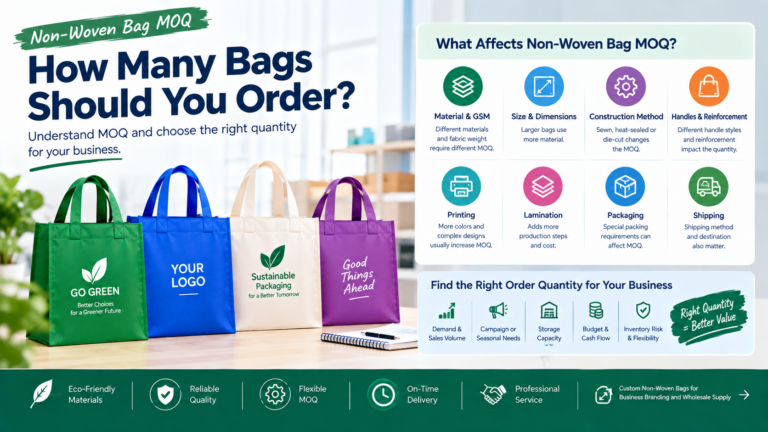

When buying custom non-woven bags for a business, one of the first questions buyers usually ask is:
“What is the MOQ?”
MOQ means Minimum Order Quantity, or the smallest quantity a manufacturer is willing to produce for a specific custom order.
But knowing the MOQ is only the beginning.
The more important question is:
How many custom non-woven bags should your business actually order?
Ordering too few bags may result in a higher unit cost, while ordering too many can create excess inventory, storage costs, and unnecessary cash flow pressure. The right quantity depends on your product specifications, sales volume, campaign requirements, expected demand, and production method.
For B2B buyers, MOQ should therefore be treated as a purchasing decision rather than simply a supplier requirement.
What Does MOQ Mean for Custom Non-Woven Bags?
MOQ is the minimum production quantity required for a particular custom bag specification.
For example, a supplier may have different minimum quantities depending on:
- Bag construction
- PP non-woven material
- GSM
- Bag size
- Printing method
- Number of printing colors
- Handle design
- Lamination
- Custom colors
- Production setup
- Packaging requirements
This means there is no single MOQ that applies to every custom non-woven bag.
A simple promotional bag may have a different MOQ from a reinforced sewn shopping bag. A standard design may have a different MOQ from a fully customized bag with special dimensions, lamination, and multiple printing areas.
This is why buyers should always ask:
“What is the MOQ for this exact specification?”
rather than simply asking:
“What is your non-woven bag MOQ?”
Why Do Manufacturers Set an MOQ?
Custom manufacturing involves production preparation and fixed costs.
Before a factory starts producing a large order, it may need to:
- Purchase or prepare raw materials
- Set up production equipment
- Prepare printing
- Prepare cutting or forming processes
- Arrange handles and accessories
- Adjust machines
- Prepare packaging
- Schedule production capacity
- Perform quality inspections
If the order quantity is extremely small, these fixed costs are spread across fewer bags.
As a result, the unit price can become relatively high.
For larger production runs, setup and production costs can be distributed across more units, which can make the per-bag cost more competitive.
This is one reason why MOQ and unit price are closely connected.
However, a lower unit price does not automatically mean a better purchasing decision.
The real goal is to find a quantity that matches your business demand.
What Is a Typical MOQ for Non-Woven Bags?
There is no universal industry-wide MOQ for custom non-woven bags.
Different factories use different production processes and have different equipment, material purchasing requirements, and production capabilities. Existing supplier guidance also emphasizes that MOQ can change according to material, construction, printing, size, and customization.
For planning purposes, buyers may encounter quantities ranging from several hundred pieces to several thousand pieces or more.
But the number itself is less important than what the MOQ applies to.
For example, you should clarify whether the MOQ is based on:
- Total order quantity
- One bag style
- One size
- One color
- One artwork
- One printing design
- One construction method
A supplier saying “MOQ 500 pieces” does not necessarily mean you can freely combine 250 pieces in one color and 250 pieces in another design.
Always confirm the MOQ rules before finalizing your purchasing plan.
Our Non-Woven Bag MOQ Reference
For buyers considering custom production, our MOQ can vary according to the construction method.
As a general reference:
Sewn / stitched non-woven bags: MOQ from 500 pieces
Heat-pressed non-woven bags: MOQ from 10,000 pieces
These quantities are production references rather than universal rules for every project. The final MOQ can depend on the material, size, printing, construction, customization requirements, and production arrangement.
For buyers with a specific project, providing the complete specification allows the manufacturer to confirm the appropriate MOQ and quotation.
Should You Order the Minimum Quantity?
Not necessarily.
Ordering exactly at MOQ can make sense when:
- You are launching a new product
- You are testing a new market
- Demand is uncertain
- You have limited storage
- You are running a small promotional campaign
- You want to reduce initial inventory risk
However, ordering only the minimum quantity may not always provide the most competitive unit cost.
For example, imagine a buyer needs approximately 8,000 bags.
The supplier may quote different prices for:
- 5,000 pieces
- 8,000 pieces
- 10,000 pieces
- 20,000 pieces
The 10,000-piece price may be only slightly higher in total than the 8,000-piece order while offering a noticeably lower unit price.
Therefore, it is often useful to request tiered quotations before making a final decision.
How Many Non-Woven Bags Should You Order?
A practical way to calculate your order quantity is:
Expected usage + safety stock + campaign requirements – existing inventory
For example, suppose a retailer expects to use:
- 3,000 bags per month
- For the next 6 months
- Plus 2,000 bags for promotional events
The basic expected requirement would be:
3,000 × 6 + 2,000 = 20,000 bags
The buyer could then discuss quantities such as 20,000, 25,000, or 30,000 pieces with the manufacturer.
The final decision should also consider storage space, cash flow, shipping costs, and the possibility of future design changes.
1. Consider Your Expected Sales Volume
Your sales forecast should be one of the first factors you consider.
If your business regularly uses 10,000 bags every month, ordering only 2,000 pieces may create unnecessary reordering work and potentially higher unit costs.
On the other hand, if you only expect to use 1,000 bags over several months, ordering 20,000 pieces simply to obtain a lower unit price could create excess inventory.
For established brands, historical consumption data can be extremely useful.
Look at:
- Average monthly usage
- Seasonal demand
- Previous campaign consumption
- Customer growth
- Retail store expansion
- Upcoming promotions
- Expected repeat orders
The more reliable your demand forecast is, the easier it becomes to choose an appropriate quantity.
2. Consider Whether the Bags Are for a One-Time Campaign
Not every packaging project has the same consumption pattern.
For example, bags for:
- Trade shows
- Product launches
- Grand openings
- Corporate events
- Conferences
- Promotional campaigns
- Holiday promotions
may have concentrated demand over a short period.
In these situations, calculate the quantity based on the actual campaign requirements rather than your normal monthly consumption.
If you need 5,000 bags for an event, ordering 20,000 may not make sense unless the remaining bags can be used for future campaigns.
3. Consider Seasonal Demand
Seasonal packaging requires additional planning.
For example, a retailer may need customized non-woven bags for:
- Christmas promotions
- Back-to-school campaigns
- Summer events
- Black Friday promotions
- New store openings
- Annual trade shows
If the design is strongly tied to a specific event or season, excessive inventory can become a problem.
A bag printed with a general company logo can often be reused throughout the year.
A bag printed with a specific event date may have a much shorter useful life.
Therefore, seasonal orders should usually be calculated more carefully.
4. Consider Your Storage Capacity
A lower unit price can be attractive, but physical inventory still needs somewhere to go.
Before placing a large order, consider:
- Warehouse space
- Carton dimensions
- Number of cartons
- Storage conditions
- Inventory handling
- Internal logistics costs
- Expected storage period
For international buyers, packaging volume can also affect shipping costs.
This means the purchasing decision should not focus only on price per bag.
You should consider the total cost of holding and moving the inventory.
5. Consider Your Cash Flow
Inventory requires upfront investment.
Suppose ordering 5,000 bags requires a relatively small initial payment, while ordering 50,000 bags requires a much larger investment.
Even if the 50,000-piece order has a lower unit cost, the larger order may tie up capital that could otherwise be used for:
- Marketing
- New products
- Retail expansion
- Inventory of other products
- Sales activities
- Working capital
For growing businesses, cash flow can be just as important as unit price.
6. Compare Different Quantity Tiers
One of the most useful strategies when requesting quotations is to ask for multiple quantity levels.
Instead of asking:
“Please quote 10,000 bags.”
Ask the manufacturer to quote several quantities, such as:
- 5,000 pcs
- 10,000 pcs
- 20,000 pcs
- 30,000 pcs
This allows you to see how the unit price changes as quantity increases.
More importantly, it shows you whether moving to a higher quantity creates meaningful savings.
Existing B2B ordering guidance also recommends considering quantity alongside production setup, printing, material purchasing, packaging, shipping, inventory, and cash flow rather than looking at MOQ alone.
7. Do Not Compare MOQ Without Comparing Specifications
This is a common mistake when buyers compare suppliers.
Supplier A may offer:
MOQ: 500 pcs
Supplier B may offer:
MOQ: 1,000 pcs
It may appear that Supplier A has the more flexible MOQ.
But what if Supplier A’s quotation is based on:
- 70 GSM material
- Simple construction
- One-color printing
- Standard handles
while Supplier B’s quotation includes:
- 100 GSM material
- Reinforced construction
- Two-side printing
- Reinforced handles
- Matte lamination
The two quotations are not directly comparable.
Before comparing MOQ, confirm that the following specifications are the same:
| Specification | What to Confirm |
|---|---|
| Material | PP non-woven |
| GSM | Exact fabric weight |
| Size | Finished dimensions |
| Construction | Sewn, heat-pressed, etc. |
| Handle | Type, length and reinforcement |
| Printing | Location, colors and method |
| Lamination | Matte, glossy or none |
| Quantity | Exact production quantity |
| Packaging | Carton and packing method |
| Shipping | Destination and shipping terms |
A detailed RFQ makes supplier quotations much easier to compare.
8. MOQ and Unit Price Are Not the Same Thing
Buyers sometimes assume:
Lower MOQ = Better Price
This is not necessarily true.
A supplier may accept a small order but charge a higher unit price because fixed production costs are spread across fewer units.
Likewise:
Higher quantity = Lower Unit Price
may be true in many production situations, but the lowest unit price is not always the lowest total business cost.
For example:
| Quantity | Unit Price | Inventory Risk |
|---|---|---|
| 5,000 pcs | Higher | Lower |
| 10,000 pcs | Medium | Medium |
| 20,000 pcs | Lower | Higher |
| 50,000 pcs | Lowest | Much higher |
The correct choice depends on your actual demand.
Think of MOQ as a production threshold, not a target quantity.
9. What If Your Required Quantity Is Below MOQ?
If your required quantity is below the manufacturer’s standard MOQ, you still have several questions to ask.
You can discuss:
Option 1: Simplify the Specification
A simpler bag may require fewer production resources.
For example, you might consider:
- Standard material
- Standard color
- Simpler construction
- Fewer printing colors
- Standard handle
- No lamination
Option 2: Increase the Quantity
If the bags have a long useful life and can be stored, increasing the order may reduce the unit price and make production more practical.
Option 3: Ask About a Different Construction
Different production methods can have different MOQs.
Option 4: Plan a Larger First Order
If you expect repeat demand, you can calculate whether one larger order makes more sense than multiple small orders.
The key is to discuss the project with the manufacturer rather than assuming that MOQ is completely fixed.
10. When Should You Order More Than MOQ?
Ordering above MOQ may be reasonable when:
You Have Predictable Demand
If your company uses the same bags every month, larger production runs may be easier to justify.
You Have Repeat Orders
A standard branded bag can often be used repeatedly across stores, campaigns, or sales periods.
The Bag Design Is Stable
If you do not expect the logo, dimensions, or packaging requirements to change soon, excess inventory risk is lower.
The Higher Quantity Has a Meaningful Price Advantage
Ask for quantity tiers and calculate the total savings.
You Have Enough Storage
Make sure the additional inventory can be stored efficiently.
11. When Should You Avoid Ordering Too Many?
Large orders deserve more caution when:
- Your business is still testing the market
- Demand is uncertain
- The design may change
- You are testing a new bag size
- The product is seasonal
- The campaign is one-time only
- Your warehouse space is limited
- Cash flow is tight
- You expect to change suppliers soon
In these situations, a smaller first order can reduce inventory risk.
A lower initial quantity may cost slightly more per unit, but it can provide more flexibility.
12. Request a Sample Before a Large MOQ Order
For important B2B projects, a sample is worth considering before committing to a large production quantity.
The sample allows you to check:
- Fabric quality
- GSM
- Bag dimensions
- Handle length
- Handle attachment
- Bottom construction
- Printing quality
- Color
- Lamination
- Overall appearance
- Carrying performance
This is particularly important when ordering thousands or tens of thousands of bags.
A sample can help prevent a situation where you receive a large shipment and discover that the size, material, printing, or construction does not match your expectations.
For large orders, the approved sample can also serve as a production reference.
13. Build Your MOQ Around the Actual Product Specification
One of the best ways to avoid MOQ confusion is to prepare a complete specification before requesting quotations.
For example:
Product: Custom PP Non-Woven Shopping Bag
Material: PP Non-Woven
GSM: 90 GSM
Size: 400 × 350 × 100 mm
Color: Custom
Printing: Front and back logo
Handle: Reinforced loop handles
Lamination: Matte
Construction: Sewn
Quantity: 10,000 pcs
Application: Retail shopping
Destination: United States
This gives the manufacturer enough information to evaluate the production requirements and provide a meaningful quotation.
A vague inquiry such as:
“I need 10,000 non-woven bags. Please send your price.”
leaves too many variables open.
The result may be several quotations based on completely different products.
14. How to Choose the Right Quantity for Different Business Situations
There is no universal answer, but the following framework can help.
New Brand or Market Test
Prioritize:
Lower inventory risk + manageable cash flow
A smaller production run may make sense if the demand forecast is uncertain.
Established Retail Brand
Prioritize:
Stable supply + competitive unit economics
Historical consumption can help determine a larger production quantity.
Promotional Campaign
Prioritize:
Exact campaign requirement + small safety margin
Avoid producing large quantities that may never be used again.
Seasonal Packaging
Prioritize:
Demand forecast + campaign timing + remaining inventory
Calculate carefully because seasonal designs may have limited reuse.
Long-Term Corporate Packaging
Prioritize:
Annual consumption + repeat orders + storage capacity
Larger production quantities may be easier to justify when the same design is used throughout the year.
15. Ask for a Quantity-Based Quotation
When contacting a manufacturer, you can ask for a quotation at several quantities.
For example:
Please quote the same specification at 5,000 / 10,000 / 20,000 / 30,000 pcs.
Then ask the supplier to clarify:
- Unit price
- MOQ
- Sample cost
- Printing cost
- Packaging
- Production lead time
- Shipping
- Payment terms
- Price validity
This creates a much clearer purchasing picture.
You can then calculate:
Total Purchase Cost = Unit Price × Quantity + Other Applicable Costs
Do not focus on the unit price alone.
16. Consider Total Landed Cost
For international B2B buyers, the cost of the bags is only one part of the project.
Your total cost may include:
- Product cost
- Sampling
- Printing setup
- Packaging
- Domestic transportation
- International freight
- Import-related charges
- Warehouse handling
- Storage
For example, ordering a very large quantity may reduce the product unit price but increase freight and inventory costs.
This is why the ideal MOQ is not necessarily the quantity with the lowest unit price.
It is the quantity that provides a practical balance between unit economics, inventory, logistics, and demand.
17. MOQ Should Be Evaluated Together With Bag Quality
A supplier offering a very low MOQ may appear attractive at first.
But procurement teams should also evaluate:
- Material quality
- GSM consistency
- Sewing quality
- Handle reinforcement
- Printing accuracy
- Color consistency
- Dimensional accuracy
- Quality control
- Production capacity
- Delivery reliability
For a large retail or promotional project, a small difference in unit price may be less important than consistent quality across the entire shipment.
The right supplier should be able to manufacture the required specification consistently at the required volume.
18. Custom Non-Woven Bags for Business and Wholesale Orders
For businesses looking for customized non-woven bags, the specification can be adjusted according to the intended application.
Common options include:
- Different PP non-woven GSM
- Custom dimensions
- Custom colors
- Screen or other printing options
- Sewn construction
- Heat-pressed construction
- Reinforced handles
- Die-cut handles
- Loop handles
- Matte or glossy lamination
- Retail shopping bags
- Promotional tote bags
- Event bags
- Supermarket bags
- Corporate giveaway bags
You can review the available customization options and product information on our Custom Non-Woven Bags for Business Branding and Wholesale Supply page.
19. A Simple MOQ Checklist for Buyers
Before placing your order, check the following:
Product
- What type of non-woven bag do I need?
- What material should I use?
- What GSM is appropriate?
- What size is required?
Construction
- Sewn or heat-pressed?
- Do I need a gusset?
- Does the bottom need reinforcement?
- What handle type is required?
Branding
- How many printing sides?
- How many colors?
- What artwork will be used?
- Is lamination required?
Quantity
- What is my expected monthly usage?
- Is this a one-time campaign?
- Is the product seasonal?
- How much safety stock do I need?
- How much storage space do I have?
- What quantity gives me a reasonable unit price?
Supplier
- What is the MOQ for this exact specification?
- Can I order a sample?
- Can the supplier provide quantity-tier pricing?
- What is the production lead time?
- Can the factory handle repeat orders?
- What quality control process is used?
Final Thoughts: How Many Non-Woven Bags Should You Order?
There is no single “correct” MOQ for every business.
The right quantity depends on your demand, product specification, production method, budget, storage capacity, campaign schedule, and expected repeat orders.
For new projects, a smaller order can reduce inventory risk. For established programs with predictable demand, larger quantities may provide better unit economics.
The most effective approach is to:
- Define the complete bag specification.
- Confirm the MOQ for that exact specification.
- Request several quantity tiers.
- Compare unit price and total project cost.
- Consider inventory and storage.
- Calculate shipping and landed cost.
- Request a sample for important projects.
- Choose the quantity based on actual business demand.
In other words, do not ask only “What is the MOQ?”
Ask:
“What quantity gives my business the right balance of price, supply, inventory, and flexibility?”
That is the more useful question for B2B procurement.