
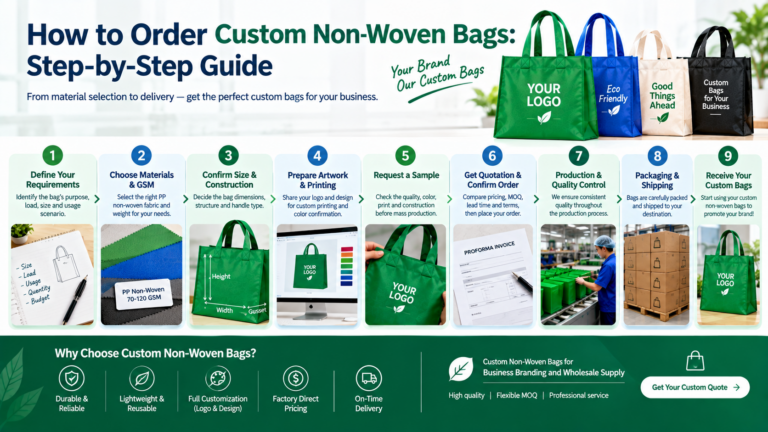

Ordering custom non-woven bags may seem simple at first. You choose a bag style, add your logo, tell the supplier how many you need, and wait for production.
For B2B buyers, however, a successful custom bag order involves much more than printing a logo on a bag.
Material, GSM, size, construction, handles, printing, lamination, quantity, packaging, quality control, delivery requirements, and production timelines can all affect the final product and total project cost. A clear ordering process helps buyers avoid specification gaps, unexpected costs, production delays, and quality problems.
This guide explains how to order custom non-woven bags step by step, from defining your requirements to receiving the finished products.
Step 1: Define What the Bags Will Be Used For
The first step is to determine what the bags actually need to do.
Before asking a manufacturer for a quotation, consider:
- What products will the bags carry?
- How heavy are the products?
- How large are the products?
- Will customers reuse the bags?
- How frequently will they be reused?
- Are the bags for retail, promotional events, trade shows, supermarkets, or corporate use?
- Does the bag need to stand up by itself?
- Will the bag be exposed to moisture or demanding handling?
These questions are important because the intended application influences almost every other specification.
For example, a lightweight promotional bag designed to carry brochures does not necessarily require the same construction as a reusable retail shopping bag carrying boxed products.
The goal is not to order the heaviest possible bag. The goal is to specify a bag that is appropriate for the actual application.
Step 2: Choose the Non-Woven Material
PP non-woven fabric is widely used for commercial custom bags because it is lightweight, flexible, printable, and available in different fabric weights and constructions.
When requesting a quotation, avoid simply saying:
“I need non-woven bags.”
Instead, specify that you need PP non-woven bags and discuss the appropriate fabric weight with the manufacturer.
Depending on the project, buyers may also need to decide whether the bag should be laminated.
Lamination can change the appearance, surface feel, print presentation, and certain functional characteristics of the bag. It should therefore be treated as part of the overall product specification rather than an afterthought.
Step 3: Decide the GSM
GSM means grams per square meter and describes the weight of the non-woven fabric.
Different applications can require different GSM levels. Commercial non-woven bags are often produced in ranges such as 70–120 GSM, although the appropriate specification depends on the application and construction.
A simplified starting point might look like this:
| Application | Possible Direction |
|---|---|
| Promotional giveaways | Lightweight fabric |
| Trade shows | Lightweight to medium GSM |
| Retail shopping | Medium GSM |
| Supermarket bags | Medium to higher GSM |
| Reusable shopping bags | Medium to higher GSM |
| Heavy-duty applications | Higher GSM and reinforced construction |
However, higher GSM does not automatically mean a stronger finished bag.
Bag dimensions, handles, seams, bottom construction, reinforcement, material quality, and manufacturing quality can all affect durability.
For this reason, tell the manufacturer what the bag needs to carry instead of specifying GSM alone.
For example:
“The bag should carry approximately 5 kg of retail products.”
This gives the manufacturer a practical performance requirement.
Step 4: Confirm the Bag Size
Next, determine the finished dimensions.
A typical specification might include:
- Width
- Height
- Gusset depth
- Handle length
- Handle width
- Bottom construction
For example:
400 × 350 × 100 mm
The order in which dimensions are written can vary between suppliers, so make sure the manufacturer confirms exactly what each measurement represents.
For large B2B orders, it is particularly important to confirm dimensions before production because even a small specification difference can affect product fit, appearance, and packing efficiency.
If possible, provide the manufacturer with the dimensions of the products that will actually go inside the bag.
Step 5: Choose the Bag Construction
Custom non-woven bags can be manufactured using different construction methods.
Common options include:
Sewn Non-Woven Bags
Sewn bags use stitching to connect the bag panels and attach components such as handles.
They can be suitable for reusable shopping bags, retail packaging, promotional bags, and applications where a more substantial construction is required.
Heat-Pressed or Heat-Sealed Bags
Heat-sealed construction uses controlled heat to bond PP non-woven material.
This approach can be suitable for certain high-volume designs and automated production processes.
Die-Cut Bags
Die-cut designs can provide a simple structure and integrated handle design for appropriate applications.
The right construction depends on the bag design, expected load, quantity, appearance, and production requirements.
When requesting a quotation, ask the supplier which construction method they recommend for your intended application instead of choosing purely based on unit price.
Step 6: Choose the Handle Design
Handles are one of the most important structural components of a reusable bag.
Consider:
- Handle length
- Handle width
- Handle material
- Handle attachment
- Stitching
- Reinforcement
- Shoulder carrying requirements
For retail bags carrying heavier products, handle reinforcement can be particularly important.
A bag can have relatively thick fabric but still perform poorly if the handles or attachment points are not properly designed.
Therefore, when ordering custom non-woven bags, do not specify only the fabric GSM. Discuss the complete handle structure with the manufacturer.
Step 7: Decide Whether You Need Lamination
Lamination is an optional specification for many non-woven bags.
Depending on the design, buyers may choose different surface finishes, such as:
- Matte lamination
- Glossy lamination
- No lamination
Lamination can influence:
- Surface appearance
- Print presentation
- Surface feel
- Brand perception
- Certain surface protection characteristics
For brands with detailed graphics or a more polished packaging appearance, lamination may be worth considering.
For cost-sensitive promotional campaigns, an unlaminated design may be sufficient.
The right choice depends on the purpose of the bag and the desired balance between appearance, function, and cost.
Step 8: Prepare Your Logo and Artwork
Once the physical specifications are defined, prepare the artwork.
Provide the manufacturer with:
- Logo files
- Brand colors
- Artwork dimensions
- Printing position
- Printing sides
- Required graphics
- Text
- Images
- Any color references or brand guidelines
Vector artwork such as AI, EPS, or PDF files is often useful for production because it allows manufacturers to work with scalable graphics.
Before production, ask the supplier to provide an artwork proof or digital mockup.
Check:
- Logo size
- Logo position
- Color
- Spelling
- Printing area
- Front and back artwork
- Handle position
- Overall proportions
A small artwork error can become a large problem when thousands of bags have already been produced.
Step 9: Determine the Printing Requirements
Printing requirements should be clearly specified in the quotation.
Tell the manufacturer:
- Which side needs printing
- How many colors are required
- Whether both sides need printing
- Whether full-color graphics are required
- Whether the artwork contains fine details
- Whether the design includes large solid-color areas
The supplier can then recommend an appropriate printing process based on the artwork and production volume.
For B2B orders, it is better to approve a digital proof or physical sample before mass production whenever the design is important to the brand.
Step 10: Determine the Quantity and MOQ
Next, determine how many bags you actually need.
The quantity can affect:
- Unit price
- Production setup
- Printing cost
- Material purchasing
- Packaging
- Shipping
- Inventory requirements
MOQ means Minimum Order Quantity, and different manufacturers may have different MOQs depending on the material, construction, printing method, size, and customization requirements.
Do not automatically order the largest quantity simply to obtain a lower unit price.
Instead, consider:
Expected sales + campaign requirements + inventory + storage + cash flow + future demand
For a new product or market test, a smaller initial quantity may reduce inventory risk.
For established retail programs, larger quantities may improve unit economics.
Step 11: Send a Complete RFQ
Once your requirements are clear, send the manufacturer a complete RFQ, or Request for Quotation.
Instead of sending:
“Please quote 10,000 custom non-woven bags.”
Provide as much information as possible.
For example:
Product: Custom PP Non-Woven Bag
Material: PP Non-Woven
GSM: 90 GSM
Size: 400 × 350 × 100 mm
Color: Custom
Printing: Front and back logo printing
Handle: Reinforced loop handles
Lamination: Matte
Construction: Sewn
Quantity: 10,000 pcs
Application: Retail shopping
Destination: United States
Required Delivery: Specific target date
A detailed specification allows manufacturers to quote a more comparable product.
It also reduces the risk of different suppliers quoting different bag constructions while using the same basic product name.
Step 12: Compare Supplier Quotations Carefully
When you receive quotations, do not compare only the unit price.
Check whether the quotations are based on the same:
- Material
- GSM
- Size
- Construction
- Handle design
- Printing
- Lamination
- Quantity
- Packaging
- Shipping terms
- Delivery requirements
For example, Supplier A may quote a lower price because the bag uses a lighter GSM or simpler handle construction.
Supplier B may quote more because reinforcement, lamination, or a different construction method is included.
A useful comparison should therefore be based on the same product specification, not simply the lowest number.
Step 13: Request a Sample
For important B2B projects, requesting a sample before mass production is a valuable step.
A sample allows you to evaluate:
- Actual fabric
- GSM and material feel
- Dimensions
- Handle length
- Handle attachment
- Bottom construction
- Printing quality
- Color
- Lamination
- Overall appearance
If the order is large, do not treat the sample as merely a visual reference.
Use it as a specification benchmark.
Once approved, the sample should become the reference for mass production.
Step 14: Confirm the Pre-Production Details
Before approving production, review the final specification one more time.
Your purchase confirmation should clearly state:
- Product type
- Material
- GSM
- Size
- Color
- Printing
- Artwork
- Construction
- Handles
- Lamination
- Quantity
- Packaging
- Delivery destination
- Required delivery date
This is the point where vague descriptions should disappear.
For example, instead of:
“Large strong shopping bag.”
Use:
“PP non-woven bag, 100 GSM, 450 × 380 × 120 mm, sewn construction, reinforced loop handles, matte laminated, front and back logo printing, 10,000 pcs.”
The second description gives the manufacturer measurable requirements.
Step 15: Confirm the Production Timeline
Ask the supplier to confirm the expected production schedule.
Depending on the project, the timeline may include:
- Artwork confirmation
- Material preparation
- Printing
- Cutting
- Sewing or heat pressing
- Finishing
- Quality inspection
- Packing
- Shipment
The actual timeline depends on the order specifications, quantity, production schedule, and supplier capacity.
If the bags are needed for a product launch, trade show, holiday campaign, or retail opening, communicate the deadline before placing the order.
Do not wait until after production begins to mention a fixed delivery date.
Step 16: Confirm Quality Control Requirements
Quality control should be considered before production, not only after the goods are finished.
Depending on the project, buyers can discuss inspection of:
- Fabric material
- GSM
- Bag dimensions
- Printing
- Color
- Handle attachment
- Stitching
- Heat sealing
- Bottom construction
- Lamination
- Packing
- Quantity
For large orders, consistency is particularly important.
Receiving one good sample does not automatically guarantee that every bag in a mass-production order will be identical.
The supplier should have a production and quality-control process capable of maintaining the approved specifications across the order.
Step 17: Confirm Packaging and Shipping
Before the goods are packed, confirm how the bags will be prepared for transportation.
Important questions include:
- How many bags per carton?
- What are the carton dimensions?
- What is the carton gross weight?
- How many cartons are required?
- Is palletization required?
- What is the shipping method?
- What is the delivery destination?
For international B2B orders, packaging can affect both transportation efficiency and total logistics cost.
If your company has specific warehouse requirements, communicate them to the manufacturer before production.
Step 18: Inspect the Finished Goods
For larger orders, consider inspecting the finished goods before shipment.
The inspection can verify whether the production matches the approved specifications.
A basic inspection may include:
Appearance
Check:
- Color
- Printing
- Surface quality
- Shape
- Cleanliness
Dimensions
Check:
- Width
- Height
- Gusset
- Handle length
- Handle position
Construction
Check:
- Stitching
- Heat sealing
- Handle attachment
- Bottom construction
- Reinforcement
Quantity and Packing
Check:
- Total quantity
- Quantity per carton
- Carton labeling
- Packaging condition
For bags designed to carry specific product weights, load testing can also be discussed with the manufacturer. Durability depends on the complete bag structure rather than GSM alone.
A Simple Custom Non-Woven Bag Ordering Checklist
Before placing your order, make sure you have confirmed the following:
Product Requirements
- Intended application
- Product weight
- Bag size
- Gusset
- Material
- GSM
- Construction
- Handle type
- Handle length
- Reinforcement
- Lamination
Branding Requirements
- Logo
- Artwork
- Brand colors
- Printing sides
- Printing area
- Artwork proof approved
Commercial Requirements
- Quantity
- MOQ
- Unit price
- Packaging
- Shipping method
- Destination
- Production lead time
- Required delivery date
Quality Requirements
- Sample approved
- Final specifications confirmed
- Quality-control requirements discussed
- Load requirements confirmed if applicable
- Mass-production standard established
Common Mistakes When Ordering Custom Non-Woven Bags
Mistake 1: Focusing Only on Price
The lowest quotation may not represent the lowest total cost.
A cheaper bag may use a different GSM, simpler construction, weaker handles, or fewer finishing options.
Always compare equivalent specifications.
Mistake 2: Specifying Only GSM
GSM is important, but it is only one part of the product.
A durable bag depends on:
Material + GSM + Size + Handles + Construction + Bottom + Reinforcement + Manufacturing Quality
Mistake 3: Sending Incomplete Artwork
If the supplier does not have clear artwork instructions, production may require additional confirmation.
Provide the final artwork and approve the proof before production.
Mistake 4: Skipping the Sample
A digital image cannot always show the actual material feel, construction, printing, and handle strength.
For important projects, a physical sample can reduce uncertainty before bulk production.
Mistake 5: Ordering Too Many Bags
A lower unit price is not useful if thousands of bags remain in storage for months.
Estimate actual consumption before deciding the final quantity.
Mistake 6: Ignoring the Delivery Deadline
If bags are needed for a trade show, product launch, retail opening, or seasonal campaign, the delivery date should be discussed at the beginning of the project.
Production and shipping both require planning.
How to Make Your Custom Bag Order Easier
The easiest way to order custom non-woven bags is to treat the project as a specification process rather than simply a product purchase.
A clear process looks like this:
Application → Material → GSM → Size → Construction → Handles → Printing → Lamination → Quantity → Artwork → Sample → Quotation → Production → QC → Shipping
Each step answers an important question before the next step begins.
This approach makes supplier communication more efficient and makes quotations easier to compare.
For businesses purchasing custom non-woven bags in bulk, a manufacturer that can support material selection, customization, sampling, production, quality control, and delivery can simplify the entire procurement process.
Custom Non-Woven Bags for Business Branding and Wholesale Supply
If you already know the application and basic specifications, the next step is to discuss your requirements with a custom bag manufacturer.
For retail brands, supermarkets, promotional agencies, event organizers, distributors, and other B2B buyers, custom non-woven bags can be produced with different materials, GSM levels, sizes, handles, printing methods, construction methods, and finishing options.
When requesting a quotation, provide your quantity, size, material requirements, artwork, intended application, and delivery destination.
This gives the manufacturer enough information to recommend a suitable specification and prepare a more accurate quotation.
Final Thoughts
Ordering custom non-woven bags does not need to be complicated.
The key is to define the requirements before production begins.
Start with the application and expected load. Then determine the material, GSM, size, construction, handles, printing, lamination, quantity, and packaging requirements.
After that, request a detailed quotation, compare suppliers using the same specifications, approve a sample, confirm the final production details, and establish clear quality and delivery requirements.
For B2B buyers, the most important principle is simple:
Do not order a generic “non-woven bag.” Order a clearly specified packaging product designed for your business application.
A well-defined specification makes supplier communication easier, improves quotation accuracy, reduces production misunderstandings, and gives both buyer and manufacturer a clear standard for the finished product.