
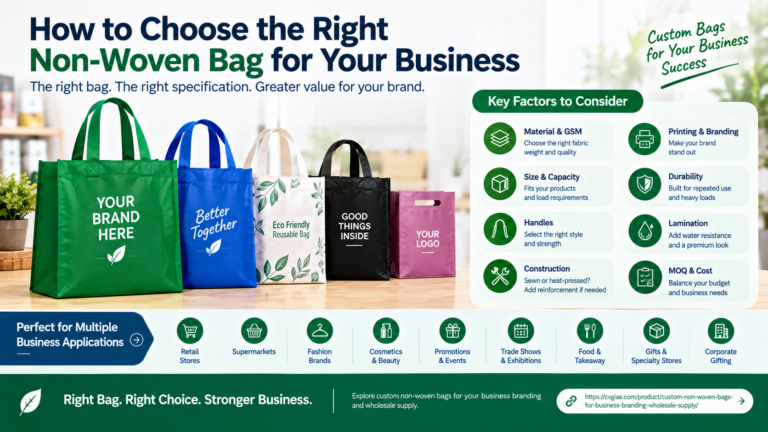

Choosing the right non-woven bag is not simply a matter of selecting a color and adding a logo.
For retailers, supermarkets, promotional companies, event organizers, distributors, and brands, the wrong bag specification can lead to unnecessary costs, poor carrying performance, inconsistent printing, or a product that does not match the intended use.
A successful non-woven bag project starts with the application.
What will the bag carry? How much weight will it hold? How often will customers reuse it? Does it need to look premium? Will it be exposed to moisture? How important are printing and brand visibility? What quantity do you need?
These questions determine the right combination of material, GSM, size, construction, handles, printing, lamination, and reinforcement.
This guide explains how B2B buyers can choose the right non-woven bag specification for their business.
1. Start With the Intended Application
Before choosing GSM or bag color, define what the bag actually needs to do.
A promotional bag for a trade show has very different requirements from a reusable supermarket shopping bag.
For example:
Trade Show Bags
Usually need to carry:
- Brochures
- Catalogs
- Flyers
- Business cards
- Lightweight samples
The priority may be low weight, competitive cost, large printing areas, and easy distribution.
Retail Shopping Bags
May need to carry:
- Clothing
- Shoes
- Cosmetics
- Accessories
- Packaged products
Here, durability, appearance, handle strength, and branding become more important.
Supermarket Bags
May need to carry:
- Bottles
- Canned food
- Packaged groceries
- Household products
These applications require more attention to load capacity, handle reinforcement, bottom construction, and fabric specification.
Promotional Giveaways
The priority may be:
- Large-volume production
- Competitive unit cost
- Attractive printing
- Lightweight construction
- Easy transportation
The first purchasing principle is therefore simple:
Choose the bag based on the job it needs to perform, not simply on the bag’s appearance.
2. Choose the Right Non-Woven Material
Most commercial non-woven shopping and promotional bags are made from polypropylene (PP) non-woven fabric.
PP non-woven fabric is popular because it combines relatively low weight, flexibility, printability, customization options, and suitable durability for many commercial applications.
However, saying that a bag is made from “PP non-woven” is not enough information for a B2B quotation.
Two bags can both be made from PP non-woven material while having very different performance.
Buyers should specify:
- Fabric GSM
- Material color
- Bag dimensions
- Construction method
- Handle type
- Printing
- Lamination
- Reinforcement
- Intended load
- Quantity
The complete specification determines the final product.
3. Understand GSM Before You Place an Order
GSM stands for grams per square meter.
It describes the weight of the non-woven fabric and is one of the most commonly discussed specifications when purchasing PP non-woven bags.
Commercial bags can be produced in different GSM levels, including approximately 70, 80, 90, 100, 110, and 120 GSM, depending on the supplier and application.
A practical starting point looks like this:
| GSM | General Characteristics | Typical Applications |
|---|---|---|
| 60–70 GSM | Lightweight and economical | Events, giveaways, promotional campaigns |
| 70–80 GSM | Lightweight with improved structure | Trade shows, promotions, light retail |
| 80–100 GSM | Balanced performance and cost | Retail, supermarkets, shopping bags |
| 100–120 GSM | Thicker and more substantial | Reusable shopping, premium packaging |
| 120+ GSM | Heavy-duty specification | Specialized high-load applications |
These are general guidelines rather than universal standards.
Important: Higher GSM Does Not Automatically Mean a Better Bag
This is one of the most important points for buyers.
It is tempting to think:
120 GSM = better than 80 GSM
But the actual performance of a finished bag also depends on:
- Bag size
- Handle width
- Handle attachment
- Stitching
- Bottom construction
- Reinforcement
- Fabric quality
- Manufacturing quality
A higher GSM bag may be unnecessary for a lightweight promotional campaign.
Conversely, a relatively heavy shopping application may require more than simply increasing fabric GSM.
The objective is to find the right GSM, not the highest GSM.
4. Match GSM to the Products You Carry
A useful way to select GSM is to start with the expected product weight.
Lightweight Products
For brochures, promotional materials, clothing, or lightweight merchandise, lower GSM materials may be sufficient.
A lighter specification can reduce material consumption, shipping weight, and overall cost.
Medium-Weight Products
For general retail shopping, cosmetics, packaged products, and supermarket applications, a medium GSM specification can provide a practical balance between cost and durability.
Heavy Products
For groceries, bottles, books, or other relatively heavy products, buyers should consider a higher GSM together with stronger construction.
Do not rely on GSM alone.
For heavier loads, ask the manufacturer to evaluate the entire bag structure, especially the handles and bottom.
5. Choose the Correct Bag Size
Bag size is one of the easiest specifications to overlook.
A bag that is too small creates an obvious usability problem.
A bag that is unnecessarily large can increase material consumption, shipping volume, and cost.
When specifying dimensions, consider:
- Product dimensions
- Product quantity
- Product weight
- Required internal space
- Handle length
- Gusset requirements
- Storage conditions
For example, a cosmetics retailer may need a relatively compact bag.
A supermarket may need a larger gusseted bag.
A fashion retailer may prefer a taller bag that accommodates folded clothing.
A promotional company may want a larger format to hold catalogs and samples.
The ideal dimensions should be based on the products rather than simply choosing a standard size.
6. Pay Attention to Handle Design
Handles are one of the most important structural components of a shopping bag.
When a customer lifts a loaded bag, a significant amount of stress is transferred through the handle and its attachment points.
Common handle options include:
- Loop handles
- Die-cut handles
- Reinforced loop handles
- Custom-length handles
- Different handle widths
- Integrated handles
For lightweight promotional bags, simple handle construction may be sufficient.
For reusable retail or supermarket bags, stronger handle construction and reinforcement may be more appropriate.
If the bag will carry heavy products, tell the manufacturer the expected load rather than simply asking for a specific GSM.
This allows the supplier to evaluate the handle attachment and overall construction.
7. Choose Between Sewn and Heat-Pressed Construction
Non-woven bags can be manufactured using different construction methods.
Two common approaches are sewn construction and heat-pressed or heat-sealed construction.
Sewn Non-Woven Bags
Sewn bags are assembled using stitching.
They are suitable for applications where buyers want a more substantial construction and may require stronger structural performance.
Sewn bags can also accommodate different handle and reinforcement designs.
They are often considered for:
- Retail shopping
- Supermarkets
- Reusable bags
- Heavy-duty applications
- Premium promotional bags
Heat-Pressed Non-Woven Bags
Heat-pressed bags use heat and pressure to form or seal parts of the bag.
They can be suitable for high-volume promotional applications where production efficiency and cost are important.
Typical applications can include:
- Events
- Conferences
- Giveaways
- Promotional campaigns
- Large-volume distribution
The right construction depends on the intended use, quantity, load requirements, and target budget.
8. Decide Whether You Need Lamination
Lamination is another specification that buyers should consider.
Laminated non-woven bags can have a different surface appearance and feel compared with standard non-laminated fabric.
Common options include:
- Matte lamination
- Glossy lamination
Lamination can be useful when a brand wants:
- A smoother surface
- A different visual finish
- More prominent graphics
- A more structured appearance
- Additional surface protection
However, lamination can also add material, production steps, and cost.
If the bag is intended for a simple promotional campaign, it may not be necessary.
If the bag is intended for premium retail branding, lamination may be worth considering.
9. Think About Printing and Brand Visibility
One of the major reasons businesses choose custom non-woven bags is branding.
A large flat bag surface creates significant space for:
- Company logos
- Product graphics
- Campaign messages
- Website information
- Slogans
- Seasonal designs
- Promotional artwork
Before production, buyers should confirm:
- Front printing
- Back printing
- Side printing
- Number of colors
- Artwork dimensions
- Logo position
- Color requirements
- Printing method
- Proof approval
For large B2B orders, approving artwork and print samples before mass production can help reduce the risk of inconsistent branding.
The bag should not only be functional.
It should represent the brand correctly every time a customer carries it.
10. Consider Your Brand Positioning
The right bag should also match the image your company wants to communicate.
A budget promotional campaign may prioritize:
Low cost + high quantity + simple printing
A supermarket may prioritize:
Durability + reusable design + practical carrying capacity
A premium brand may prioritize:
Higher GSM + structured construction + lamination + sophisticated printing
A trade show organizer may prioritize:
Large printing area + lightweight material + easy transportation
There is no single “best” non-woven bag for every business.
The right product is the one that matches the brand, application, customer, and budget.
11. Don’t Forget the Expected Reuse Frequency
If the bag is intended to be reused, durability becomes more important.
Ask:
How often do we expect customers to use this bag?
A promotional bag distributed once at an event may have a different expected lifespan from a supermarket bag intended for repeated grocery shopping.
For reusable retail programs, buyers should consider:
- Fabric GSM
- Handle construction
- Stitching
- Reinforcement
- Bottom design
- Bag size
- Product weight
The goal is not to make every bag as heavy as possible.
The goal is to make the bag durable enough for its intended service life.
12. Consider Storage and Shipping Costs
B2B buyers sometimes focus heavily on the unit price and overlook logistics.
For large orders, thousands or tens of thousands of bags may need to be:
- Packed
- Stored
- Transported
- Imported
- Delivered to warehouses
- Distributed to stores
Because non-woven fabric is lightweight, it can be practical for large-volume packaging programs.
However, the final packed volume still matters.
Ask the supplier about:
- Bags per carton
- Carton dimensions
- Gross weight
- Net weight
- Total shipment volume
- Packing method
These figures help procurement teams estimate the real landed cost rather than looking only at the factory unit price.
13. Choose the Quantity Based on Your Business Plan
MOQ is another important purchasing factor.
Different bag constructions can have different minimum order requirements.
For example, a simple promotional bag and a highly customized sewn retail bag may require different production arrangements.
When requesting a quotation, specify:
Required quantity + bag specification + delivery destination
Instead of asking only:
“How much is a non-woven bag?”
A better RFQ might say:
Custom PP non-woven shopping bag, 90 GSM, 400 × 350 × 100 mm, reinforced loop handles, two-side logo printing, 10,000 pcs.
This gives the manufacturer enough information to provide a meaningful quotation.
14. Always Request a Sample for Important Projects
Samples are especially important for large B2B orders.
A sample allows you to check:
Material
Does the GSM and fabric feel match your expectations?
Dimensions
Does the finished size fit your products?
Handles
Can the handles comfortably support the expected load?
Printing
Are the logo size, colors, and position correct?
Construction
Are the stitching, seams, gussets, and bottom properly finished?
Appearance
Does the finished bag match your brand positioning?
Practical Performance
Can the bag actually carry the products it was designed for?
A sample is much more informative than a specification sheet alone.
15. Create a Complete Non-Woven Bag Specification
One of the easiest ways to improve procurement efficiency is to create a complete specification before contacting suppliers.
A useful specification can include:
| Specification | Example |
|---|---|
| Product | Custom PP Non-Woven Bag |
| Application | Retail Shopping |
| Material | PP Non-Woven |
| GSM | 90 GSM |
| Size | 400 × 350 × 100 mm |
| Color | Custom |
| Construction | Sewn |
| Handle | Reinforced Loop |
| Printing | Front + Back |
| Lamination | Optional |
| Quantity | 10,000 pcs |
| Packaging | Export Cartons |
| Delivery | Required destination |
| Target Date | Required delivery date |
This approach makes supplier comparison much easier.
Instead of comparing vague quotations, you can compare suppliers based on the same specifications.
16. Evaluate the Manufacturer, Not Just the Bag
The bag specification is important, but so is the supplier.
For large B2B projects, consider whether the manufacturer can provide:
- Clear product specifications
- Professional artwork support
- Samples
- Consistent production
- Quality control
- Production capacity
- Clear lead times
- Export packaging
- Reliable communication
- After-sales support
A low quotation is not necessarily the lowest total cost if the supplier cannot maintain consistent quality or delivery.
For procurement teams, supplier reliability can be just as important as the initial unit price.
17. A Simple Decision Guide
If you’re unsure which specification to choose, start with this framework.
Choose a Lightweight Non-Woven Bag If:
- The products are light
- The bag is mainly promotional
- Large quantities are required
- Cost is a major consideration
- The expected usage period is relatively short
Choose a Medium-Weight Bag If:
- The bag is for general retail
- Customers will reuse it
- You need a balance between cost and durability
- The products have moderate weight
- Branding is important
Choose a Higher-GSM Bag If:
- Products are relatively heavy
- Repeated use is expected
- A more substantial feel is important
- The bag needs additional durability
- The application is premium or heavy-duty
But remember:
Higher GSM alone does not determine the strength of the finished bag.
Handles, seams, bottom construction, reinforcement, dimensions, and manufacturing quality all contribute to performance.
18. Common Mistakes Buyers Should Avoid
Mistake 1: Choosing the Highest GSM Automatically
Higher GSM can increase material and shipping costs.
Choose the GSM that matches the application.
Mistake 2: Ignoring Handle Strength
A strong fabric does not help if the handles or attachment points are inadequate.
Mistake 3: Focusing Only on Unit Price
Consider production, packaging, shipping, storage, quality, and expected reuse.
Mistake 4: Ordering Without a Sample
A sample provides valuable information about the actual finished product.
Mistake 5: Sending Incomplete Artwork
Unclear artwork can create unnecessary delays.
Provide the logo, dimensions, colors, and printing requirements clearly.
Mistake 6: Giving the Supplier No Information About the Product Load
Tell the manufacturer what the bag needs to carry.
This is much more useful than simply saying “I need a strong bag.”
Mistake 7: Comparing Different Specifications
When comparing supplier quotations, make sure the material, GSM, dimensions, construction, handles, printing, quantity, and packaging are comparable.
19. Where Can Custom Non-Woven Bags Be Used?
Once properly specified, non-woven bags can serve a wide range of B2B applications.
Common uses include:
- Retail shopping
- Supermarkets
- Fashion stores
- Grocery stores
- Cosmetic brands
- Promotional campaigns
- Trade shows
- Corporate events
- Conferences
- Product launches
- Gift packaging
- Brand merchandise
- Wholesale distribution
Their flexibility is one of their biggest commercial advantages.
A single manufacturer can often produce different sizes, colors, structures, and printing configurations for different business requirements.
20. How to Choose the Right Non-Woven Bag: Final Checklist
Before placing an order, check these questions:
Application
- What will the bag be used for?
Product Load
- How much weight must it carry?
Material
- Is PP non-woven suitable for the application?
GSM
- What fabric weight provides the right balance of performance and cost?
Size
- Does the bag fit the products?
Construction
- Should it be sewn, heat-pressed, gusseted, or reinforced?
Handles
- Can the handles support the intended load?
Printing
- How much branding is required?
Lamination
- Is a matte or glossy finish necessary?
Quantity
- What is the required order volume?
Sample
- Has the finished specification been tested?
Supplier
- Can the manufacturer provide consistent quality and reliable delivery?
If you can answer these questions before production, you are already much closer to selecting the right product.
Conclusion: Choose the Bag That Fits the Job
There is no single non-woven bag specification that works for every business.
A promotional company may prioritize lightweight construction and competitive pricing.
A supermarket may need stronger handles, higher GSM, and reinforced construction.
A fashion brand may prioritize premium printing, lamination, and appearance.
A retail chain may focus on durability, consistency, logistics, and long-term cost.
The right choice comes from matching the bag specification to the actual application.
Start with the products you need to carry.
Then determine the required load, size, GSM, construction, handle, printing, lamination, quantity, and expected reuse.
Finally, work with a manufacturer that can turn those requirements into a consistent finished product.
For businesses looking for customized PP non-woven bags for retail, promotional, supermarket, event, or branding applications, explore our Custom Non-Woven Bags for Business Branding and Wholesale Supply to review available customization options and discuss your requirements.
A well-designed non-woven bag is not simply a carrier.
It can be a reusable packaging solution, a practical customer tool, and a moving extension of your brand.