

For businesses sourcing custom paper bags internationally, the product price is only part of the total cost. Shipping expenses can account for a significant portion of the overall procurement budget, especially for large-volume orders.
With rising freight rates and increasing pressure to optimize supply chains, more retailers, distributors, and brand owners are looking for practical ways to reduce logistics costs without compromising packaging quality.
Fortunately, smart packaging design can make a substantial difference. By focusing on flat-pack design, volumetric weight optimization, and shipment consolidation, businesses can significantly lower transportation costs while improving warehouse efficiency.
In this article, we’ll explore how these strategies help reduce shipping expenses and maximize your packaging investment.
Why Shipping Costs Matter for Paper Bags
Paper bags are lightweight, but they occupy considerable space during transportation. In many cases, shipping companies calculate charges based on volumetric (dimensional) weight rather than actual weight.
This means that inefficient packaging can increase freight costs even when the products themselves are relatively light.
Reducing the space each shipment occupies is often more effective than simply reducing material weight.
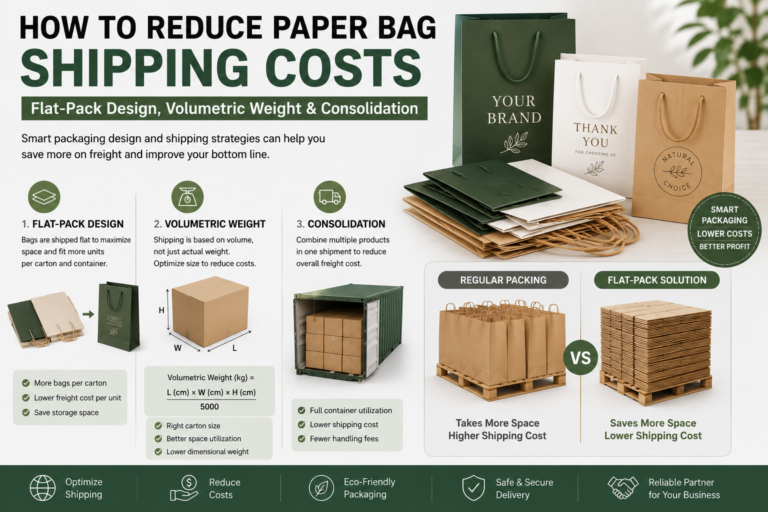
1. Flat-Pack Design Maximizes Container Space
One of the simplest and most effective ways to lower shipping costs is choosing paper bags designed for flat packing.
Flat-packed paper bags are delivered unfolded, allowing thousands of bags to occupy far less space than assembled packaging.
Benefits of Flat-Pack Design
- More bags fit into each shipping carton
- Higher container loading efficiency
- Lower freight cost per unit
- Reduced warehouse storage requirements
- Easier inventory management
For importers ordering hundreds of thousands of bags annually, even a small improvement in packing density can result in substantial freight savings.
Optimize Folding Structure
Modern manufacturers carefully engineer folding lines so bags remain easy to assemble while minimizing storage volume.
Well-designed flat-pack structures include:
- Precision folding creases
- Reinforced fold areas
- Stable bottom construction
- Quick assembly after delivery
This balance between structural strength and shipping efficiency is becoming increasingly important for retail packaging.
2. Understand Volumetric Weight
Many buyers focus only on product weight, but freight companies often charge based on dimensional weight.
The standard formula is:
Volumetric Weight = Length × Width × Height ÷ Carrier Conversion Factor
This means large cartons filled with lightweight products may cost more than expected.
For paper bag procurement, reducing carton dimensions often has a greater impact than reducing paper thickness.
How Packaging Design Affects Volumetric Weight
Several design decisions influence shipping volume:
Bag Size
Selecting dimensions that closely match product requirements avoids unnecessary empty space.
Oversized bags increase shipping volume without adding customer value.
Handle Style
Different handles affect packing density.
For example:
- Twisted paper handles often compress efficiently.
- Flat handles reduce stacking height.
- Cotton rope handles create slightly larger packing volume.
Choosing the right handle depends on balancing appearance, durability, and shipping efficiency.
Paper Thickness
Heavier paper increases strength but may reduce the number of bags packed per carton.
An experienced manufacturer can recommend the optimal paper weight for your application.
3. Shipment Consolidation Reduces Freight Costs
Instead of arranging multiple smaller shipments throughout the year, many businesses save money through consolidated shipping.
Consolidation combines multiple products or orders into a single shipment.
Examples include:
- Paper bags
- Gift boxes
- Food packaging
- Paper cups
- Tissue paper
- Labels
Shipping these products together improves container utilization and lowers transportation costs per unit.
Benefits of Consolidated Shipments
Businesses typically gain:
- Lower ocean freight costs
- Reduced customs processing fees
- Fewer import handling charges
- Simplified logistics management
- Better inventory planning
For companies sourcing multiple packaging products, consolidation is one of the most effective long-term cost-saving strategies.
Choose Standard Carton Dimensions
Experienced manufacturers optimize outer carton sizes based on international pallet standards and container dimensions.
Benefits include:
- Better pallet stability
- Higher warehouse efficiency
- Improved loading speed
- Reduced wasted container space
Proper carton planning often reduces shipping costs without changing the product itself.
Consider Regional Warehousing
For businesses with consistent purchasing volumes, regional inventory programs may further reduce logistics expenses.
Instead of shipping small orders repeatedly, companies can:
- Import larger quantities
- Store inventory locally
- Deliver smaller batches domestically
This approach shortens lead times while reducing international freight frequency.
Work with an Experienced Packaging Manufacturer
A knowledgeable packaging supplier considers shipping efficiency during the design stage, not after production.
They can help optimize:
- Bag dimensions
- Folding structure
- Paper selection
- Carton configuration
- Container loading plans
- Export packaging methods
These improvements often reduce logistics costs without affecting product appearance or functionality.
Additional Tips to Reduce Shipping Costs
Consider these practical strategies:
- Order seasonal packaging in advance to avoid expensive air freight.
- Standardize bag sizes across multiple product lines.
- Combine packaging orders whenever possible.
- Review carton specifications before production begins.
- Request container loading plans from your supplier.
- Balance material strength with transportation efficiency.
Small adjustments can generate significant savings over the course of a year.
Conclusion
Reducing paper bag shipping costs isn’t simply about finding cheaper freight rates. It’s about designing smarter packaging and optimizing the entire logistics process.
Flat-pack designs maximize container space, volumetric weight optimization lowers transportation charges, and shipment consolidation improves overall supply chain efficiency.
For retailers, distributors, restaurants, and global brands, these strategies help reduce total packaging costs while maintaining product quality and customer satisfaction.
By partnering with an experienced custom paper bag manufacturer, businesses can achieve the right balance between attractive packaging, operational efficiency, and long-term cost savings.
Looking for a packaging partner that understands both manufacturing and logistics? Contact us today for a free consultation and discover how optimized custom paper bag solutions can help reduce your shipping costs while supporting your business growth.