
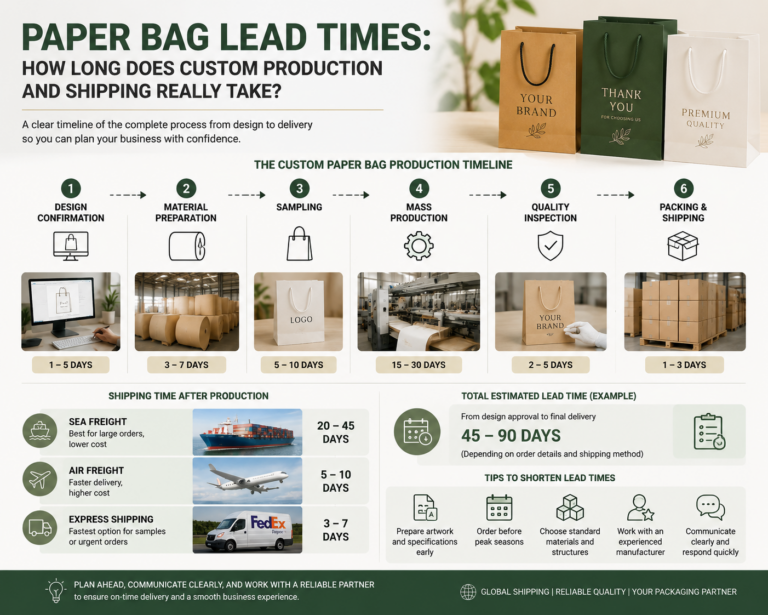

For businesses ordering custom paper bags, one of the most common questions is:
“How long will it take to receive my order?”
Whether you are preparing for a seasonal promotion, launching a new retail collection, or replenishing packaging inventory, understanding the complete production timeline is essential for avoiding delays and managing your supply chain effectively.
The actual lead time for custom paper bags depends on several factors, including design approval, material selection, production complexity, order quantity, and shipping method.
In this guide, we will break down each stage of the process and explain how long custom paper bag production and delivery typically take.
Why Understanding Lead Times Matters for Businesses
Packaging delays can directly affect sales opportunities.
For retailers, late packaging may mean:
- Missing seasonal campaigns
- Delayed product launches
- Increased emergency shipping costs
- Inventory shortages
- Poor customer experience
For brands and distributors, reliable packaging timelines are just as important as product quality and pricing.
Planning ahead allows businesses to secure production capacity, choose cost-effective shipping methods, and avoid last-minute problems.
The Complete Custom Paper Bag Production Timeline
A typical custom paper bag order includes several stages:
- Design confirmation
- Material preparation
- Sampling
- Mass production
- Quality inspection
- Packaging and shipping
Each stage plays an important role in determining the final delivery time.
Step 1: Design Confirmation (1–5 Days)
Before production begins, the manufacturer needs to confirm all project details.
This includes:
- Bag size
- Paper material
- Handle type
- Printing colors
- Logo placement
- Surface finishing
- Packaging requirements
If customers already have finished artwork files, this process can be completed faster.
However, if design adjustments are needed, additional time may be required for artwork revisions and approval.
How to Reduce Design Time
Businesses can speed up this stage by preparing:
- Logo files in vector format
- Brand guidelines
- Reference samples
- Required bag dimensions
- Printing preferences
Clear communication helps prevent unnecessary production delays.
Step 2: Material Preparation (3–7 Days)
After design approval, the factory prepares the required materials.
Common materials include:
- Kraft paper
- White cardboard paper
- Coated paper
- Specialty paper
- Recycled paper
For custom colors or special materials, preparation time may be longer because suppliers may need to arrange specific paper stocks.
Popular materials usually have shorter preparation times compared with unique customized materials.
Step 3: Sampling Process (5–10 Days)
For new projects, many businesses request samples before mass production.
Samples allow buyers to check:
- Printing quality
- Color accuracy
- Paper thickness
- Handle strength
- Overall appearance
A professional sample helps prevent costly mistakes during large-scale production.
For repeat orders with unchanged specifications, businesses can often skip the sampling stage and move directly into production.
Step 4: Mass Production (15–30 Days)
Production time depends mainly on:
- Order quantity
- Bag structure
- Printing complexity
- Finishing requirements
- Factory production schedule
Typical timelines:
Standard Paper Bags
15–20 working days
Suitable for:
- Simple designs
- Standard sizes
- Regular materials
Premium Custom Paper Bags
20–30 working days
Suitable for:
- Luxury finishes
- Special structures
- Complex printing
- High-end retail packaging
Large Volume Orders
30+ working days
For:
- Large retail chains
- Distributors
- Seasonal campaigns
Early planning is especially important for high-volume orders.
Step 5: Quality Inspection & Packing (2–5 Days)
Before shipment, professional manufacturers conduct quality checks including:
- Printing inspection
- Size verification
- Handle strength testing
- Quantity confirmation
- Packaging inspection
Proper quality control ensures that customers receive consistent products and reduces potential issues after delivery.
Step 6: Shipping Time After Production
Shipping time depends on the destination and transportation method.
Sea Freight
Typical delivery:
20–45 days
Advantages:
- Lowest cost
- Best for large orders
- Suitable for planned inventory
Best for:
- Retailers
- Importers
- Distributors
Air Freight
Typical delivery:
5–10 days
Advantages:
- Fast delivery
- Suitable for urgent orders
Disadvantages:
- Higher cost
Best for:
- Samples
- Small urgent shipments
- Time-sensitive campaigns
Express Shipping
Typical delivery:
3–7 days
Best for:
- Samples
- Small quantities
- Prototype testing
Average Total Timeline Example
For a standard custom paper bag project:
| Stage | Estimated Time |
|---|---|
| Design Confirmation | 1–5 days |
| Material Preparation | 3–7 days |
| Sampling | 5–10 days |
| Production | 15–30 days |
| Inspection & Packing | 2–5 days |
| Sea Shipping | 20–45 days |
Total Estimated Lead Time:
Approximately 45–90 days from design approval to final delivery
How to Shorten Custom Paper Bag Lead Times
Businesses can reduce delays by following these strategies:
1. Prepare Artwork Early
Having your logo, design files, and specifications ready allows production to start faster.
2. Order Before Peak Seasons
Holiday periods such as:
- Christmas
- Halloween
- Valentine’s Day
- Black Friday
often create higher production demand.
Ordering early helps secure factory capacity.
3. Choose Standard Materials
Popular paper types and common structures usually have faster production schedules.
4. Work With an Experienced Manufacturer
A reliable factory can provide:
- Faster communication
- Professional design support
- Better production planning
- Stable quality control
- More accurate delivery estimates
Seasonal Packaging Requires Extra Planning
For seasonal campaigns, timing is even more critical.
For example:
- Christmas packaging should usually be prepared months before December.
- Halloween packaging production should begin before peak season demand.
- Promotional event packaging should be completed before campaign launch dates.
Waiting until the last minute often leads to higher shipping costs or limited production options.
Conclusion
Custom paper bag lead times are influenced by many factors, from design approval and material selection to production complexity and shipping methods.
While standard orders may be completed within several weeks, premium custom projects and international shipments require more careful planning.
For businesses, the best approach is to start early, communicate clearly with manufacturers, and choose a supplier that understands both production and logistics.
By planning your packaging timeline properly, you can avoid delays, control costs, and ensure your products are presented perfectly when customers are ready to buy.
Looking for reliable custom paper bag production with professional support and global shipping experience? Contact us today for a free quotation and project timeline consultation.