
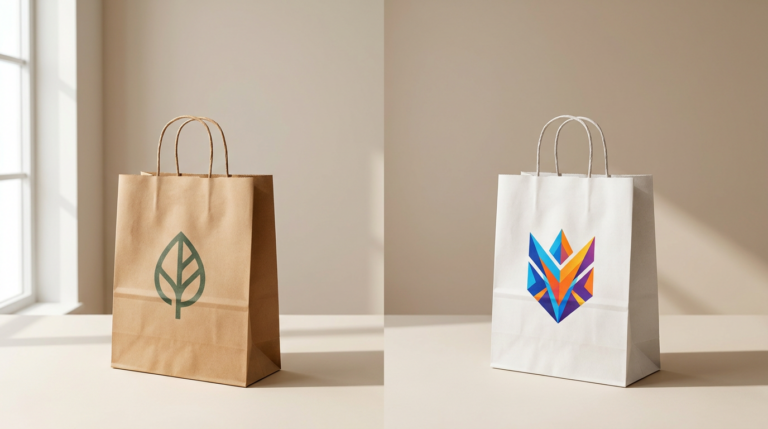

Walk into any retail district and you’ll see both: the warm, earthy brown kraft bag swinging from a coffee shop customer’s hand, and the crisp white boutique bag with a sharp logo that makes you notice the brand before the product inside.
Neither is “better” — but one will fit your brand, your printing needs, and your budget far better than the other. Choosing wrong means either paying a premium you don’t need, or sending a brand signal that contradicts everything else you’ve built.
This guide breaks down the real differences — not just “brown vs white” on the surface, but what each material means for your costs, your design possibilities, your durability needs, and the message your packaging sends the moment a customer touches it.
First, Clarify Your Terms: Not All “White” Bags Are the Same
Before comparing, it’s important to distinguish between the three main paper bag materials you’ll encounter when sourcing:
The cost gap between brown kraft and white kraft is modest — typically 10-20%. The real jump happens when you move from uncoated white kraft to coated art paper, which can cost 2-4x more.
For most retail and food service businesses, the practical choice is between brown kraft and white kraft. Coated art paper enters the picture mainly for luxury retail, cosmetics, jewelry, and high-end gifting where the bag itself is part of the product experience.
Brown Kraft: The Case for Natural
Brown kraft paper is produced through the kraft pulping process and left unbleached. It retains the natural color of wood fibers — ranging from light tan to deep brown depending on the pulp source and recycled content percentage. The word “kraft” itself comes from German, meaning “strength.”
Cost advantage: brown kraft is the most economical paper bag material. It costs less to produce because it skips the bleaching stage entirely — fewer chemicals, less energy, shorter production time. For a medium-size bag, brown kraft typically runs 10-20% cheaper than the same bag in white kraft. For 50,000 bags per year, that difference can translate to $1,000–$3,000 in annual savings.
Durability: brown kraft fibers are longer and stronger than bleached fibers because the bleaching process can slightly weaken fiber structure. At the same grammage, brown kraft bags tend to have marginally higher tear resistance and burst strength. This is why you rarely see a grocery store using white paper bags for heavy items.
Print characteristics: printing on brown kraft results in noticeably different color output. Colors appear muted, earthy, and subdued — a bright cyan prints as a muted teal; a vivid magenta becomes a dusty rose. White ink is rarely an option at scale on brown kraft. Fine details can look slightly softer due to the rougher, more absorbent surface. However, brands that embrace this aesthetic — coffee roasters, organic skincare, farmers’ markets, artisan bakeries — find that the muted, earthy print perfectly complements their identity. A simple one-color logo in dark brown or forest green on kraft can look more intentional and premium than the same design on a white background.
Brand perception: a brown kraft bag signals natural, honest, sustainable, no-nonsense. It evokes farmers’ markets, craft goods, and brands that care about ingredients and materials. It does not signal luxury — and that’s fine, because for many brands, luxury is the wrong signal to send.
Brown kraft works best for: coffee shops and roasters, bakeries and food service, grocery and fresh produce, eco-conscious CPG brands, farmers’ markets and artisan goods, discount and value retail.
White Kraft: The Case for Clean and Crisp
White kraft paper starts as the same kraft pulp as brown, but undergoes a bleaching process to remove lignin and natural coloration. The result is a clean, bright paper surface — ranging from warm off-white to bright white.
Cost: white kraft typically costs 10-20% more than brown kraft at the same grammage and bag size. This premium comes from the additional bleaching step and the higher material waste rate during production. It remains significantly cheaper than coated art paper, however — usually half the cost or less.
Print quality: this is white kraft’s biggest advantage. It delivers accurate, vibrant colors with much higher fidelity than brown kraft. Full-color and photographic printing work well. Fine text and logos are crisp. White elements actually look white. Batch-to-batch color consistency is better. For brands where the bag design is detailed, colorful, or photograph-heavy, white kraft is the practical choice. You simply cannot achieve the same print fidelity on brown kraft.
Durability: the bleaching process can marginally reduce fiber strength, but for the vast majority of retail applications, the difference is negligible. A white kraft bag at 120gsm will hold just fine for clothing, cosmetics, gifts, books, and most non-grocery retail items. If you’re genuinely concerned about strength, the solution is usually to spec a higher grammage rather than switching from white to brown.
Brand perception: a white paper bag signals clean, polished, considered, premium-adjacent. It’s the default for fashion retail, cosmetics, jewelry, bookstores, and any brand where presentation matters as much as the product. A white bag says “we paid attention to the details.” Critically, white kraft can go in either brand direction: minimalist and understated or bold and colorful. Brown kraft has a much narrower brand range.
White kraft works best for: fashion and apparel retail, cosmetics and beauty, jewelry and accessories, bookstores and gifts, high-end food and confectionery, corporate and event gifting.
Head-to-Head Comparison
The Hidden Factors Most Buyers Overlook
-
The “Eco Tax” Perception Gap — Some consumers now perceive brown kraft as more premium precisely because it reads as more sustainable. In younger, urban, environmentally-conscious demographics, a well-designed brown kraft bag with a minimalist logo can feel more intentional than a generic white bag with a loud print. If your customer base values sustainability signaling, brown kraft may deliver higher perceived value at a lower actual cost.
-
Ink Coverage and Hidden Printing Costs — 1-color print on brown kraft is the lowest cost combination. 4-color on brown kraft is a waste of money because the brown base will wash out your colors regardless. A complex, colorful design on white kraft costs more in printing but delivers the intended result. Before choosing your material, know your design.
-
The Handle Factor — Twisted paper handles are the standard, working well with both materials. Ribbon handles typically pair with coated white bags and add $0.10–$0.30 per bag. Rope or cotton handles work with both depending on color. Die-cut handles are most economical for brown kraft.
-
Bag Life Beyond the Purchase — A white bag from a boutique often gets saved and reused for gifting, extending brand visibility. A brown kraft bag from a coffee shop gets reused for practical purposes like carrying lunch. This matters if brand visibility beyond the initial purchase is important to you.
Real-World Scenarios
Scenario A — The Organic Coffee Roaster (20,000 bags/year, simple line-art logo): Brown kraft, 1-color print. The material IS the brand message. The cost savings vs. white kraft ($300–$600/year) is modest, but the brand fit is perfect.
Scenario B — The Mid-Market Fashion Label (50,000 bags/year, full-color logo with gradients): White kraft, CMYK print. The design requires accurate color reproduction that brown kraft simply cannot deliver. The 10-20% material premium is an investment in brand consistency.
Scenario C — The High-End Jewelry Store (5,000 bags/year, embossed logo, foil stamping): Coated white art paper. At luxury price points, the bag is part of the product. The higher per-unit cost ($0.50–$1.00 vs. $0.15–$0.25) is negligible relative to the average transaction value.
Scenario D — The Multi-Channel Grocery Chain (500,000+ bags/year): Brown kraft, 1-2 color print. At this volume, the 10-20% material savings is substantial — potentially $10,000–$30,000/year. Functionally, brown kraft handles heavy groceries better.
Decision Framework
- Is your design full-color, photographic, or gradient-heavy? Yes → White kraft or coated paper. No → Continue.
- Does your brand position as luxury/premium with the bag as part of the product experience? Yes → Coated white art paper. No → Continue.
- Does your brand emphasize sustainability and natural/organic values? Yes → Brown kraft. No → White kraft.
- Are you price-constrained with per-unit cost as a critical KPI? Yes → Brown kraft, 1-color print. No → White kraft.
The Counterintuitive Truth About “Premium”
In 2026, context determines premium, not color. A brown kraft bag from a Michelin-starred bakery with a perfectly set single-color logo can feel far more premium than a poorly printed, generic white bag from a mid-tier clothing store.
What makes a bag feel premium: material weight, handle quality and attachment method, print precision and registration, the tactile experience, and coherence with the brand. None of these factors are inherently tied to brown vs. white. A 160gsm brown kraft bag with reinforced handles and a crisp logo will out-class a flimsy 80gsm white bag every time.
Quick Reference: Industry-to-Material Match
- Coffee shop / café → Brown kraft (cost-effective, craft aesthetic)
- Bakery / patisserie → Brown or white kraft (rustic vs. elegant style)
- Fashion retail (mid-market) → White kraft (design flexibility, clean presentation)
- High-end fashion / designer → Coated white art paper (luxury experience)
- Cosmetics & beauty → White kraft or coated white (polished look)
- Jewelry → Coated white art paper (premium feel)
- Grocery / supermarket → Brown kraft (lowest cost at scale, functional strength)
- Discount / dollar store → Brown kraft (minimal viable packaging)
- E-commerce (unboxing) → Brown kraft inner + custom outer
The Bottom Line
Choose brown kraft when: your brand values align with natural, sustainable, or craft positioning; your design is simple (1-2 colors, no photos); cost efficiency matters; and functional durability is a priority.
Choose white kraft when: your design requires accurate, vibrant color reproduction; your brand positioning is polished, contemporary, or fashion-forward; and you want the broadest design flexibility.
Choose coated white art paper when: packaging is genuinely part of the product experience; the transaction value justifies a $0.50+ bag cost; and your finishing requirements demand the smoothest possible surface.
Most practical advice: if unsure, order 500 samples of each material with your actual design printed. Put products inside. Hand them to customers. See which one feels right. The $200 you spend on samples will save you from ordering 50,000 bags you’re not happy with.