
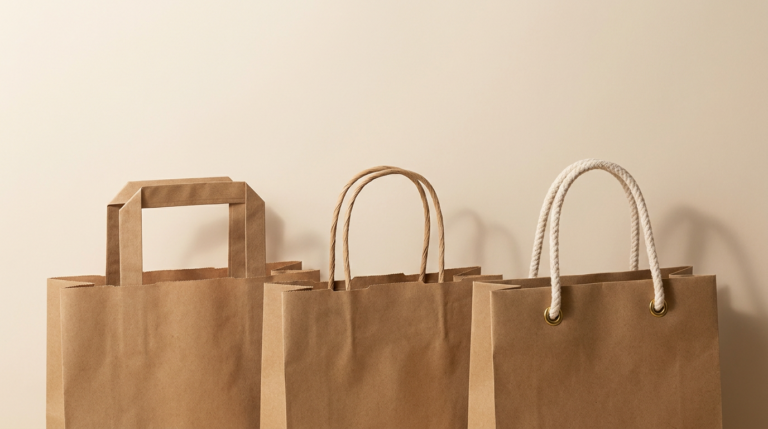

A customer picks up your paper bag. Their fingers wrap around the handle. In that split second, they form a judgment — about the quality of the bag, about your brand, and about whether this bag will survive the walk to the car.
The bag body might be perfectly printed on 180gsm kraft with flawless glue seams. But if the handle is uncomfortable, flimsy, or snaps under weight, none of that matters. The bag failed at its only job: carrying things.
This guide compares the three most common paper bag handle types — twisted, flat, and rope — plus ribbon and die-cut handles where relevant. We’ll cover cost, strength, comfort, appearance, sustainability, and which handle matches which business.
Quick Comparison: At a Glance
Twisted Paper Handles: The Industry Workhorse
Twisted paper handles are made by tightly twisting strips of kraft paper into a cord, then attaching them to the bag body — usually glued between the top fold or secured with a reinforcement patch. They offer the best all-around balance of strength, cost, appearance, and sustainability.
Strength: rated for approximately 2–6 kg of safe carrying weight on a properly constructed bag (120–200gsm paper, reinforced top fold). The handle itself is rarely the failure point — more often, the bag paper tears at the attachment point.
Cost: adds approximately $0.03–$0.08 per unit for a standard medium bag. More expensive than flat handles, significantly cheaper than rope.
Appearance: clean, practical, professional without trying to be luxurious. Pairs naturally with both brown and white kraft paper.
Sustainability: both the handle and bag body are kraft paper, meaning the entire bag can be recycled as a single unit.
Best for: retail clothing stores, bookstores, grocery, takeaway, general merchandise, eco-conscious brands.
Flat Paper Handles: Cost-Efficiency and Practicality
Flat paper handles are made from wide strips of kraft paper folded flat and attached to the bag body. They sit flush against the bag surface and create a lower-profile structure.
Strength: rated for approximately 1–3 kg. The wider surface area distributes weight across the hand and can be more comfortable than a thin twisted cord for light loads. Partial or uneven gluing is the most common cause of failure.
Cost: the cheapest option, adding approximately $0.01–$0.04 per unit. At high volumes (500,000+ bags/year), the savings vs. twisted handles can reach $5,000–$15,000 annually.
Stacking advantage: because they sit flush, flat-handle bags stack more densely — a major reason they dominate the food service industry where speed of dispensing matters.
Appearance: simple, functional, casual. Perfect for takeaway and food service; visually inadequate for premium retail.
Best for: fast food and takeaway, bakeries and cafés, high-volume discount retail, grocery delivery, promotional events.
Rope Handles: Premium, Decorative, Elegant
Rope handles come in multiple materials — cotton rope, paper rope (twisted or braided), and synthetic/nylon rope — and are typically inserted through eyelets or reinforced holes punched into the top of the bag.
Strength: the highest load capacity — typically 3–8 kg. The failure point is almost never the rope itself; it’s the eyelet tearing through the bag paper. Reinforcement patches are essential.
Cost: the most expensive option, adding $0.10–$0.35 per unit. 3–10x the cost of flat handles, 2–5x the cost of twisted handles. The premium comes from material cost and higher manual labor.
Tactile experience: a cotton rope handle is soft, substantial, and pleasant to grip. It communicates care and attention to detail before the customer looks inside.
Sustainability: paper rope keeps the bag single-material and recyclable. Cotton rope complicates recyclability — the handle must be separated from the bag.
Best for: luxury fashion, jewelry, high-end cosmetics, premium gifting, boutique hotels and spas, wedding and event favors.
Ribbon Handles: When the Occasion Calls for Elegance
Ribbon handles are made from satin, grosgrain, or polyester ribbon, threaded through eyelets. Strongly associated with weddings, events, and boutique presentation.
Load capacity: light, approximately 1–2 kg. Not designed for heavy items. Cost: medium to high. Appearance: decorative, elegant, highly customizable.
Ribbon handles work beautifully for wedding favor bags, boutique clothing presentation, and cosmetic gift-with-purchase packaging. Not suitable for everyday commercial use.
Die-Cut Handles: Minimal and Modern
Die-cut handles are cut directly into the bag body — no separate material, no glue, no reinforcement. A die press creates a shaped opening at the top that functions as the handle.
Load capacity: light, approximately 1–2 kg. Cost: the lowest of all options, zero additional material cost. Appearance: minimal, clean, modern. Comfort: moderate — paper edges can be sharp.
Best for: promotional bags, event giveaways, trade show handouts, and lightweight retail where bags hold brochures or very light products.
Cost Comparison (Lowest to Highest)
Load Capacity (Heaviest to Lightest)
Recyclability
Which Handle for Which Business?
- Fast food / QSR chains → Flat paper (lowest cost at scale, fastest dispensing)
- Takeaway coffee / bakery → Flat or twisted paper (flat for economy, twisted for slight upgrade)
- Grocery / supermarket → Twisted paper (best cost-strength balance)
- Mid-range fashion retail → Twisted paper (professional, clean, reliable)
- Premium fashion / designer → Cotton or paper rope (premium feel)
- Cosmetics and beauty → Paper rope or ribbon (polished presentation)
- Jewelry → Cotton rope or ribbon (part of luxury experience)
- Bookstore → Twisted paper (reliable for book weight)
- Corporate gifting → Paper rope or ribbon (client-facing)
- Wedding / event favors → Ribbon (occasion-appropriate)
- Promotional / trade show → Die-cut or flat paper (minimum cost)
- Eco-conscious brand → Twisted paper, paper rope, or die-cut
The Handle Attachment Method — What to Check
Before confirming an order, ask your supplier: “Show me the reinforcement patch — what material, what thickness, what coverage area?” / “What load did you test to? Send me the test report.” / “What’s your handle attachment failure rate on the last production run?”
Common Handle Failures and Prevention
- Handle pulls out of bag → Insufficient glue area → Specify reinforcement patch, increase glue coverage
- Handle cord breaks → Cord too thin → Specify 4mm+ diameter for loads over 3 kg
- Eyelet tears through paper → No reinforcement patch → Require 30mm minimum backing patch
- Handle uncomfortable → Cord too thin or opening too narrow → Increase diameter or width
- Glue bleed-through visible → Excess glue on thin paper → Specify glue quantity, use 140gsm+ paper
- Rope fraying → Poor end finishing → Require heat-sealed or knotted ends
Decision Framework
- How much weight? Under 1.5 kg → Flat, die-cut, or ribbon. 1.5–4 kg → Twisted paper. Over 4 kg → Rope with reinforced eyelets.
- What’s your per-bag cost ceiling? Under $0.05 → Flat or die-cut. $0.05–$0.10 → Twisted paper. Over $0.10 → Paper rope or cotton rope.
- What customer experience? Functional → Flat or die-cut. Professional → Twisted paper. Premium → Rope or ribbon.
- Does single-material recyclability matter? Yes → Twisted paper, flat paper, paper rope, or die-cut. No → Cotton rope or ribbon.
- Does the bag need to stack and dispense quickly? Yes → Flat paper. No → Any type.
The Bottom Line
Flat paper handles win for food service, takeaway, and any high-volume, cost-sensitive application. Cheap, practical, stack well.
Twisted paper handles are the safe default for most retail — the best balance of cost, strength, appearance, and sustainability. If unsure and your product falls in the 2–4 kg range, start here.
Rope handles (cotton or paper) belong on bags that are part of the brand experience — luxury retail, premium gifting, cosmetics, jewelry. Choose paper rope for single-material recyclability; choose cotton rope for maximum tactile quality.
Ribbon handles are for occasions — weddings, events, seasonal gift packaging.
Die-cut handles are the ultimate economy choice for promotional and event use.
Your handle is the only part of the bag your customer physically touches for an extended period. A beautifully printed bag with an uncomfortable handle is a bad bag. A simple kraft bag with a well-chosen, comfortable handle is a good bag. Choose the handle first, then design the bag around it.