
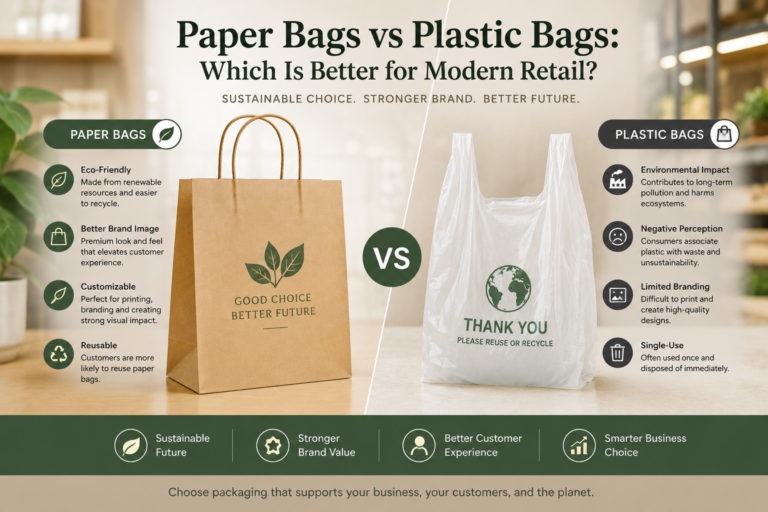

Retail packaging has changed dramatically over the past decade.
Today, customers pay attention not only to the products they buy, but also to the packaging brands use. A shopping bag is no longer just something used to carry products home. It has become part of brand identity, customer experience, sustainability strategy, and even marketing.
This shift has created one major question for modern retailers:
Should businesses choose paper bags or plastic bags?
The answer is not always simple. Both materials have advantages and limitations depending on industry, budget, branding goals, and customer expectations.
However, modern retail trends are clearly reshaping how businesses evaluate packaging decisions.
Why Packaging Matters More Than Ever
In today’s competitive retail environment, packaging directly influences how customers perceive a brand.
A shopping bag can affect:
- Brand image
- Customer experience
- Environmental perception
- Social media visibility
- Repeat purchase behavior
Consumers increasingly associate packaging quality with product quality. Research also shows that many consumers perceive paper-based packaging as more sustainable than plastic packaging.
For retailers, packaging has become both a functional tool and a branding asset.
The Advantages of Paper Bags
Paper bags have become increasingly popular across retail, cafés, bakeries, luxury stores, and takeaway businesses.
One major reason is perception.
Paper bags often feel:
- More premium
- More environmentally friendly
- More modern
- More brand-focused
Their structure, texture, and printing surface make them highly suitable for custom branding and high-end presentation.
Paper bags also support:
- Foil stamping
- Embossing
- Matte finishes
- Minimalist branding
- High-quality logo printing
This is why many fashion brands, cosmetic companies, and boutique retailers prefer paper packaging.
👉 Explore custom paper bag solutions for retail, takeaway, and promotional packaging here:
Custom Paper Bags for Retail & Branding
Sustainability Is Changing Retail Packaging
Environmental awareness has become a major factor in consumer purchasing decisions.
Many consumers now actively prefer brands that reduce plastic usage and adopt recyclable or reusable packaging solutions. Studies from McKinsey & Company show that paper and cardboard packaging are generally perceived as more sustainable than plastic packaging.
Paper bags also offer advantages such as:
- Easier recycling
- Biodegradability
- Reduced plastic perception
- Stronger eco-friendly branding
At the same time, governments in many regions are introducing stricter regulations on single-use plastics, further encouraging retailers to move toward paper packaging.
The Practical Advantages of Plastic Bags
Despite the rise of paper packaging, plastic bags still remain widely used because they offer several practical benefits.
Plastic bags are:
- Lightweight
- Waterproof
- Flexible
- Cost-efficient
- Durable for heavy loads
For supermarkets, grocery stores, and wet-product applications, plastic packaging can still provide better moisture resistance and lower transportation costs.
Plastic bags are also generally cheaper to produce in high volumes. Some industry sources estimate that plastic shopping bags can cost significantly less than paper alternatives for large-scale retail distribution.
This makes plastic packaging attractive for businesses prioritizing operational efficiency and low packaging costs.
Customer Perception Is Driving the Shift
Even though plastic packaging can be practical, customer perception is changing rapidly.
Many consumers now associate excessive plastic packaging with:
- Environmental waste
- Disposable culture
- Low-cost retail
- Unsustainable business practices
Meanwhile, paper bags are often linked with:
- Sustainability
- Better quality
- Premium shopping experiences
- Responsible branding
Research in consumer behavior suggests that paper packaging can positively influence perceived product quality and customer trust.
For modern retailers, perception itself has economic value.
Branding Potential: Paper Often Wins
From a branding perspective, paper bags usually provide greater visual impact.
Paper surfaces support cleaner printing, stronger textures, and more refined finishing effects compared with standard plastic bags.
This makes paper packaging especially valuable for:
- Luxury retail
- Gift packaging
- Fashion brands
- Cosmetic products
- Café and bakery packaging
Many retailers now view shopping bags as mobile advertising tools. Customers carrying branded paper bags through malls, cafés, airports, and city streets naturally increase brand exposure.
A well-designed paper bag can continue promoting a brand long after the original purchase.
Are Paper Bags Always Better for the Environment?
Not necessarily.
The environmental debate is more complex than many people assume.
Some studies suggest that paper bag production may require more water and energy than plastic manufacturing, while plastic bags may have lower transportation emissions because they are lighter.
However, plastic waste creates long-term pollution challenges because plastic breaks down very slowly and can contribute to microplastic pollution.
The most sustainable option often depends on:
- Reusability
- Recycling systems
- Material sourcing
- Consumer disposal behavior
- Product application
In many cases, reusable packaging performs better than single-use solutions regardless of material type.
What Modern Retailers Are Choosing
Today, many retailers are moving toward hybrid packaging strategies.
For example:
- Luxury stores often choose premium paper bags
- Grocery retailers may combine reusable and plastic options
- Cafés frequently use kraft paper takeaway bags
- Event companies prefer reusable non-woven bags
- Eco-focused brands increasingly adopt recyclable paper packaging
The decision is no longer simply about cost.
Modern retail packaging must balance:
- Branding
- Sustainability
- Customer experience
- Functionality
- Budget
- Regulations
Final Thoughts
So, which is better for modern retail: paper bags or plastic bags?
The answer depends on business priorities.
Plastic bags still offer practical advantages in durability, moisture resistance, and low cost. But paper bags increasingly dominate modern retail because they align more closely with today’s consumer expectations around sustainability, branding, and premium presentation.
For many businesses, packaging is no longer just packaging.
It is part of the shopping experience, the marketing strategy, and the brand story itself.
And in modern retail, the bag customers carry out of the store may shape brand perception just as much as the product inside it. 🌍