
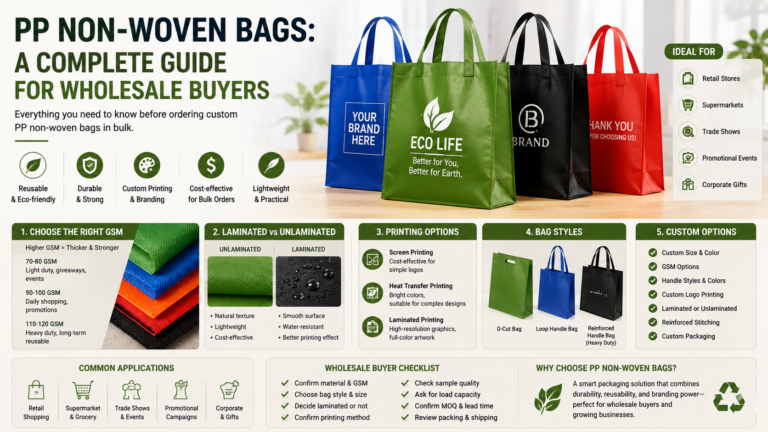

For retailers, promotional companies, supermarkets, event organizers, and distributors, choosing the right reusable bag can have a significant impact on both packaging costs and brand visibility.
PP non-woven bags have become a popular option because they combine lightweight construction, customization flexibility, durability, and competitive pricing. For businesses ordering hundreds, thousands, or even tens of thousands of bags, they can provide an effective alternative to traditional single-use packaging.
But not all non-woven bags are the same.
Material thickness, bag construction, lamination, printing, handles, size, and packaging requirements can all affect the final product and cost.
This guide explains what wholesale buyers should know before ordering custom PP non-woven bags.
What Are PP Non-Woven Bags?
PP non-woven bags are made from polypropylene (PP) fibers that are bonded together to form a fabric-like sheet.
Unlike woven fabric, the fibers are not interlaced into a traditional textile structure. Instead, they are mechanically, thermally, or chemically bonded.
The result is a lightweight material that can be converted into different types of reusable bags.
Common applications include:
- Shopping bags
- Promotional bags
- Trade show bags
- Grocery bags
- Retail packaging
- Event giveaways
- Corporate promotional bags
For B2B buyers, one of the biggest advantages is the combination of customization and cost efficiency.
Why Are PP Non-Woven Bags Popular With Wholesale Buyers?
Wholesale buyers usually have different priorities from individual consumers.
They need to consider:
- Unit cost
- Minimum order quantity
- Production capacity
- Consistent quality
- Printing requirements
- Shipping volume
- Delivery schedules
- Customization options
PP non-woven bags perform well across many of these areas.
Key advantages include:
Lightweight: Lower material weight can help control transportation costs.
Customizable: Logos, colors, sizes, handles, and structures can be customized.
Reusable: Customers can use the bags multiple times.
Durable: Properly designed bags can handle everyday shopping and promotional use.
Cost-effective: PP non-woven material is suitable for large-volume production.
Understanding Non-Woven GSM
One of the most important specifications when buying non-woven bags is GSM, or grams per square meter.
GSM indicates the weight of the non-woven fabric per square meter.
Common options include:
- 70 GSM
- 80 GSM
- 90 GSM
- 100 GSM
- 120 GSM
In general, higher GSM means a thicker and more substantial material, although overall bag strength also depends on construction and handle design.
70–80 GSM
Suitable for:
- Lightweight promotional bags
- Events
- Giveaways
- Simple retail applications
These bags can help minimize material and shipping costs.
90–100 GSM
A good middle-ground option for many businesses.
Suitable for:
- Retail shopping
- Supermarkets
- Promotional campaigns
- Trade shows
They provide a balance between cost, weight, and durability.
110–120 GSM
Suitable for:
- Heavy-duty shopping bags
- Premium promotional campaigns
- Repeated-use applications
- Products requiring additional load capacity
For heavy products, however, simply increasing GSM is not always enough. Handle reinforcement and bottom construction should also be evaluated.
Laminated vs Unlaminated Non-Woven Bags
Wholesale buyers will often need to choose between laminated and unlaminated construction.
Unlaminated Non-Woven Bags
These bags retain the natural texture of non-woven PP material.
Advantages include:
- Lightweight construction
- Lower cost
- Simple appearance
- Suitable for basic promotional applications
They are commonly used for events, trade shows, and high-volume campaigns.
Laminated Non-Woven Bags
A thin laminated layer is added to the surface.
This can provide:
- A smoother appearance
- Improved moisture resistance
- More vivid printing
- Easier surface cleaning
- A more premium appearance
Laminated bags are often suitable for:
- Retail stores
- Supermarkets
- Promotional campaigns
- Branded shopping bags
If visual presentation and surface protection are important, laminated non-woven bags may be worth the additional cost.
Printing Options for PP Non-Woven Bags
One of the main reasons businesses choose non-woven bags is their strong customization potential.
Depending on the design and quantity, common printing methods include:
Screen Printing
Suitable for:
- Simple logos
- Text
- Limited-color designs
It can be a cost-effective option for straightforward promotional bags.
Heat Transfer Printing
Useful for designs requiring:
- More detailed graphics
- Multiple colors
- Smooth visual effects
It can be suitable for certain promotional and retail designs.
Laminated Printing
For laminated non-woven bags, artwork can be printed onto the surface film before it is bonded to the non-woven material.
This can support:
- Full-color graphics
- Detailed patterns
- Product images
- Large-area branding
For retail brands with complex artwork, this can create a more visually impactful result.
Choosing the Right Bag Structure
Material thickness is only one part of bag performance.
Wholesale buyers should also consider the structure.
D-Cut Bags
D-cut bags are simple, lightweight, and economical.
They are often used for:
- Promotional campaigns
- Events
- Retail giveaways
Loop Handle Bags
These bags feature attached handles that provide a more traditional shopping-bag experience.
They are suitable for:
- Retail stores
- Supermarkets
- Promotional packaging
Woven or Reinforced Handles
For heavier products or premium applications, reinforced handles can improve carrying comfort and durability.
How Much Weight Can a Non-Woven Bag Carry?
There is no single load capacity for every PP non-woven bag.
Performance depends on:
- GSM
- Bag dimensions
- Handle design
- Handle attachment
- Bottom construction
- Stitching or sealing
- Material quality
For wholesale projects, buyers should provide the manufacturer with the approximate product weight and intended use.
A professional supplier can then recommend an appropriate structure.
Always request samples and perform load testing before approving a large production order.
PP Non-Woven Bags vs Paper Bags
Both materials are widely used in retail and promotional packaging, but they serve different purposes.
| Feature | PP Non-Woven Bags | Paper Bags |
|---|---|---|
| Reusability | Excellent | Moderate to good |
| Weight | Lightweight | Heavier |
| Durability | Good to excellent | Depends on paper and structure |
| Moisture Resistance | Better, especially laminated | More limited |
| Printing | Excellent | Excellent |
| Premium Feel | Medium | Medium to high |
| Bulk Cost | Competitive | Competitive |
| Best Use | Reusable promotions & shopping | Retail & premium packaging |
For businesses prioritizing repeated use and lightweight transportation, PP non-woven bags can be an attractive option.
For brands emphasizing paper-based packaging and premium retail presentation, custom paper bags may be more appropriate.
How Much Do Custom Non-Woven Bags Cost?
There is no universal wholesale price because the final cost depends on the specifications.
Key factors include:
- Material GSM
- Bag size
- Quantity
- Printing method
- Number of colors
- Lamination
- Handle type
- Reinforcement
- Packaging method
- Shipping destination
For example, increasing the bag size or GSM can increase material consumption. Adding full-color laminated printing or reinforced handles can also affect the unit price.
For an accurate quotation, wholesale buyers should provide as many specifications as possible.
MOQ: What Should Wholesale Buyers Expect?
Minimum order quantities vary between manufacturers and product types.
When requesting a quotation, ask about:
- MOQ
- Price breaks
- Sample availability
- Production lead time
- Repeat-order pricing
If your business expects regular orders, it can also be useful to discuss a long-term production arrangement rather than treating every order as a completely separate project.
How to Reduce Your Total Purchase Cost
Wholesale buyers can often reduce costs without compromising the quality of the final bag.
Standardize Bag Sizes
Using a small number of standard sizes can simplify production and inventory.
Optimize GSM
Do not automatically choose the thickest material.
Select the lowest GSM that reliably meets your required load capacity.
Simplify the Design
If the application is promotional, a simple one- or two-color logo may be more cost-effective than complex full-color artwork.
Consolidate Orders
Combining multiple requirements into larger production runs can improve manufacturing efficiency.
Optimize Carton Packing
Efficient packing can reduce shipping volume and storage requirements.
Sustainability Considerations
PP non-woven bags are reusable, which is one of their key advantages over many single-use bags.
However, buyers should avoid treating “reusable” as automatically meaning environmentally superior in every situation.
The sustainability value of a reusable bag depends heavily on how often it is reused and what happens at the end of its life.
Businesses can improve their packaging strategy by considering:
- Reusability
- Material efficiency
- Recycled content where appropriate
- Responsible manufacturing
- Product lifespan
- End-of-life options
For marketing claims, make sure environmental statements accurately reflect the actual material and applicable certifications.
What Should Wholesale Buyers Ask a Manufacturer?
Before placing a bulk order, ask your supplier:
- What GSM do you recommend for my products?
- What is the bag’s tested load capacity?
- Which handle structure is best?
- Is the bag laminated or unlaminated?
- Which printing method will be used?
- Can you provide a pre-production sample?
- What is the MOQ?
- What is the production lead time?
- How many bags fit in each carton?
- What are the carton dimensions and gross weight?
- Can you provide material or certification documentation if required?
- Can you support repeat orders with consistent specifications?
These questions help buyers compare suppliers based on more than just unit price.
PP Non-Woven Bags for Different Industries
Retail
Custom non-woven shopping bags can provide an affordable way to strengthen brand visibility across multiple stores.
Supermarkets
Higher GSM or reinforced structures can be used for heavier everyday purchases.
Trade Shows
Lightweight bags are convenient for attendees carrying brochures, catalogs, samples, and promotional products.
Corporate Events
Custom logos and company colors can turn reusable bags into practical promotional merchandise.
Promotional Campaigns
Large-volume production and competitive pricing make non-woven bags particularly suitable for marketing campaigns.
A Practical Checklist for Wholesale Buyers
Before approving your order, confirm:
Material
- PP non-woven
- GSM
- Laminated or unlaminated
Size
- Width
- Height
- Gusset
- Handle length
Printing
- Artwork
- Number of colors
- Printing method
- Logo placement
Construction
- Handle type
- Reinforcement
- Bottom structure
- Load requirement
Commercial Terms
- MOQ
- Unit price
- Sample cost
- Production lead time
- Payment terms
Logistics
- Bags per carton
- Carton dimensions
- Gross weight
- Shipping method
- Delivery destination
A clear specification sheet can prevent misunderstandings and make supplier comparison much easier.
Conclusion
PP non-woven bags are a practical and flexible packaging solution for businesses that need custom branding, reusable functionality, competitive wholesale pricing, and scalable production.
The key is to select the right combination of GSM, structure, printing, handles, lamination, and bag size rather than focusing on material price alone.
For promotional campaigns, trade shows, supermarkets, retail stores, and corporate events, a well-designed PP non-woven bag can provide both practical value and long-term brand exposure.
Looking for custom PP non-woven bags for your business? We provide professional material recommendations, custom logo printing, structural customization, bulk production, and global shipping solutions for B2B buyers. Contact us to discuss your specifications and request a quotation.