

Custom packaging bags can do much more than carry products. For retail brands, restaurants, fashion companies, promotional agencies, and corporate buyers, a well-designed bag can strengthen brand recognition, improve customer experience, and create additional marketing value.
However, ordering custom bags for the first time can feel complicated. Buyers need to make decisions about materials, sizes, printing, handles, quantities, samples, production, and shipping.
A clear ordering process can make the project much easier.
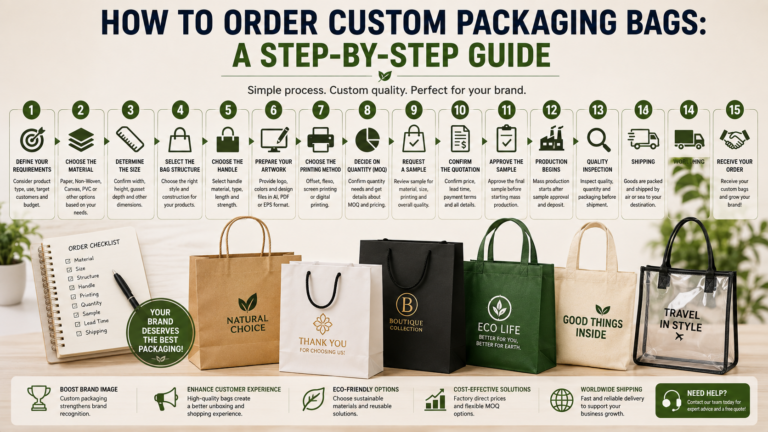
This step-by-step guide explains how to order custom packaging bags, from defining your requirements to receiving the finished products.
Step 1: Define Your Packaging Requirements
Before contacting a packaging manufacturer, determine what you actually need the bags to do.
Start with four basic questions:
What products will the bags carry?
Consider:
- Product type
- Product dimensions
- Product weight
- Number of items per bag
- Whether products have sharp or delicate edges
A lightweight cosmetic product and a heavy wine bottle require completely different packaging structures.
Where will the bags be used?
For example:
- Retail stores
- Restaurants
- Trade shows
- Corporate events
- Promotional campaigns
- Gift packaging
- Takeaway orders
The application will influence your material and construction choices.
How should customers use the bag?
Do you need:
- Disposable packaging?
- Reusable shopping bags?
- Premium gift bags?
- Heavy-duty bags?
- Promotional bags?
Defining the intended use early helps the manufacturer recommend the right solution.
Step 2: Choose the Right Bag Material
Material is one of the most important decisions in a custom packaging project.
Common options include:
Paper Bags
Popular for:
- Retail
- Fashion
- Cosmetics
- Restaurants
- Gift packaging
Common paper options include:
- Kraft paper
- White card paper
- Coated paper
Paper bags can offer excellent printing quality and strong brand presentation.
PP Non-Woven Bags
Non-woven bags are suitable for:
- Promotional campaigns
- Supermarkets
- Trade shows
- Reusable shopping
- Corporate events
They are lightweight, customizable, and suitable for large-volume orders.
Canvas Bags
Canvas is often selected for:
- Premium retail
- Fashion brands
- Corporate gifts
- Long-term reusable packaging
It provides a more substantial and lifestyle-oriented feel.
PVC Bags
PVC bags can be suitable for:
- Swimwear
- Travel products
- Toiletries
- Moisture-sensitive applications
Their transparent construction can also become part of the product presentation.
Step 3: Determine the Bag Size
Once you know the material, determine the required dimensions.
Typically, you will need to specify:
- Width
- Height
- Gusset depth
For example:
250 × 320 × 100 mm
The exact dimensions should be based on the products that will go inside the bag.
Avoid choosing a bag that is significantly larger than necessary. Excessive size can increase:
- Material consumption
- Production costs
- Carton volume
- Shipping costs
At the same time, the bag should provide enough space for easy product placement and removal.
Step 4: Choose the Bag Structure
Two bags with the same material and dimensions can perform very differently depending on their construction.
Important structural options include:
- Flat bottom
- Gusseted bottom
- Reinforced bottom
- Side gussets
- Folded edges
- Reinforced handle area
For heavier products, structural reinforcement can be just as important as material thickness.
For example, a wine bag may require a reinforced bottom and stronger handle attachment rather than simply using thicker paper.
Step 5: Select the Handle
The handle affects both functionality and appearance.
For paper bags, common options include:
- Twisted paper handles
- Flat paper handles
- Cotton rope handles
- Polyester rope handles
- Ribbon handles
For non-woven and canvas bags, options may include:
- Die-cut handles
- Webbing handles
- Fabric handles
- Reinforced handles
Consider both load capacity and customer comfort.
A premium fashion bag may prioritize an elegant rope handle, while a supermarket bag may prioritize strength and practicality.
Step 6: Prepare Your Artwork
Your manufacturer will usually need print-ready artwork before production.
Common file formats include:
- AI
- EPS
- High-resolution vector artwork
Before submitting the design, confirm:
- Logo size
- Logo position
- Brand colors
- Print area
- Bleed requirements
- Front and back artwork
- Side panel artwork
If you do not have professional packaging artwork, ask whether the manufacturer provides design support.
For B2B projects, professional artwork preparation can prevent expensive production mistakes.
Step 7: Choose the Printing Method
The printing method depends on the material, artwork, quantity, and desired appearance.
Common options include:
Flexographic Printing
Often used for simple designs and certain paper or non-woven applications.
Offset Printing
Suitable for detailed graphics and high-quality paper bag printing.
Screen Printing
Common for straightforward logos and promotional bags.
Digital Printing
Useful for detailed designs and certain lower-volume projects.
Specialty Finishing
Premium brands may also consider:
- Hot foil stamping
- Embossing
- Debossing
- Spot UV
- Matte finishes
- Gloss finishes
The goal is not to choose the most complicated printing method. It is to choose the method that delivers the required appearance at a reasonable cost.
Step 8: Decide on the Quantity and MOQ
Custom packaging is normally produced in bulk.
Before requesting a quotation, estimate your required quantity.
For example:
- Initial launch quantity
- Monthly usage
- Annual demand
- Number of stores
- Seasonal campaigns
Ask the manufacturer about:
- MOQ
- Price breaks
- Repeat-order pricing
- Production capacity
Ordering too little may result in a higher unit price, while ordering too much can create unnecessary inventory and storage costs.
For businesses with regular demand, forecasting future requirements can help optimize production quantities.
Step 9: Request a Sample
For important B2B packaging projects, a sample should be considered an essential step rather than an optional extra.
A physical sample allows you to evaluate:
- Material quality
- Bag dimensions
- Printing accuracy
- Color
- Handle strength
- Construction
- Overall appearance
For heavy products, perform a basic load test.
Put the actual products inside the bag and test how the handles, seams, and bottom perform.
This is especially important for:
- Wine bags
- Heavy retail products
- Grocery bags
- Large shopping bags
- Reusable promotional bags
Step 10: Confirm the Quotation
Once the specifications and sample are approved, request a final quotation.
Make sure the quotation clearly states:
- Product material
- Bag size
- GSM or material thickness
- Printing method
- Number of colors
- Handle type
- Quantity
- Unit price
- Tooling or setup fees
- Packaging costs
- Production lead time
- Shipping terms
Do not compare suppliers using unit price alone.
A lower unit price may exclude certain costs or use different specifications.
Compare suppliers based on the total delivered cost and expected quality.
Step 11: Confirm Production Details
Before mass production begins, review the final specifications.
Your purchase order or production confirmation should clearly define:
Material:
PP non-woven / kraft paper / white card / coated paper / canvas / PVC
Size:
Width × height × gusset
Printing:
Artwork and colors
Handle:
Type, length, material, and color
Quantity:
Total units
Packaging:
Units per carton and carton specifications
Delivery:
Destination and shipping method
A clear specification sheet helps prevent misunderstandings between buyer and manufacturer.
Step 12: Approve the Pre-Production Sample
For customized orders, make sure the final artwork and specifications are approved before mass production.
Check:
- Logo placement
- Color accuracy
- Dimensions
- Material
- Handle
- Finishing
- Overall construction
Once approved, keep the final sample or specification record for future repeat orders.
This is particularly useful for retail chains that need consistent packaging across multiple stores.
Step 13: Production Begins
After approval, the manufacturer moves into mass production.
The exact lead time depends on:
- Material availability
- Order quantity
- Printing method
- Bag structure
- Custom finishing
- Factory production schedule
Complex designs and specialty materials may require more production time than standard bags.
If you have a fixed launch date or seasonal campaign, communicate the deadline before placing the order.
Step 14: Quality Inspection
Quality control should be performed before shipment.
Important inspection points include:
- Bag dimensions
- Material consistency
- Printing quality
- Color accuracy
- Handle attachment
- Stitching or bonding
- Bottom strength
- Surface defects
- Quantity
For large B2B orders, it is useful to establish acceptable quality standards before production begins.
Step 15: Shipping and Delivery
After production and inspection, the bags are packed for shipment.
For international orders, buyers should consider:
- Carton dimensions
- Gross weight
- Shipping volume
- Delivery method
- Destination
- Import requirements
- Delivery deadline
Packaging can occupy significant space during international transportation, so efficient carton packing can help reduce logistics costs.
For repeat orders, maintaining consistent carton specifications can also simplify freight planning.
Common Mistakes to Avoid When Ordering Custom Bags
Choosing Material Based Only on Price
The cheapest material may not provide the required strength or appearance.
Instead, balance:
Cost + Quality + Function + Brand Value
Skipping the Sample
A digital design cannot fully show:
- Material texture
- Handle strength
- Actual dimensions
- Structural performance
Always consider a physical sample for important projects.
Ordering the Wrong Size
A bag that is too small creates usability problems.
A bag that is too large wastes material and shipping space.
Measure the actual products before finalizing dimensions.
Ignoring Shipping Costs
A competitive factory price does not necessarily mean a competitive delivered price.
Always evaluate the total landed cost.
Providing Low-Quality Artwork
Poor artwork can result in:
- Blurry logos
- Incorrect colors
- Incorrect proportions
- Printing defects
Whenever possible, provide professional vector artwork.
How to Make the Ordering Process More Efficient
For regular B2B buyers, the process can be simplified by creating a standardized packaging specification.
Keep a record of:
- Material
- GSM
- Dimensions
- Handle
- Printing
- Finishing
- Carton packing
- Approved artwork
- Approved sample
This makes repeat orders faster and helps maintain consistency across different production batches.
For brands with multiple stores, standardizing several bag sizes and materials can also simplify purchasing and inventory management.
Custom Packaging Bag Order Checklist
Before placing your order, confirm:
- Product type and weight
- Bag material
- Material thickness or GSM
- Bag dimensions
- Bag structure
- Handle type
- Printing method
- Artwork
- Finishing
- Quantity
- MOQ
- Sample approval
- Production lead time
- Quality requirements
- Carton packing
- Shipping method
- Delivery deadline
Having these details ready can make communication with your supplier much faster and reduce the risk of production errors.
Conclusion
Ordering custom packaging bags does not have to be complicated.
The key is to follow a structured process:
Define your requirements → Choose the material → Confirm size and structure → Prepare artwork → Request a quotation → Approve the sample → Confirm production → Inspect quality → Ship and deliver.
For B2B buyers, the most important goal is not simply finding the lowest-priced supplier. It is finding a packaging solution that provides the right balance of quality, functionality, branding, cost, and delivery reliability.
Whether you need custom paper bags, PP non-woven bags, canvas bags, or PVC packaging, working with an experienced manufacturer can help you make better material and structural decisions from the beginning.
Looking for custom packaging bags for your business? We provide professional material recommendations, custom design support, logo printing, bulk production, quality control, and global shipping solutions for B2B buyers. Contact us with your requirements and request a customized quotation.