
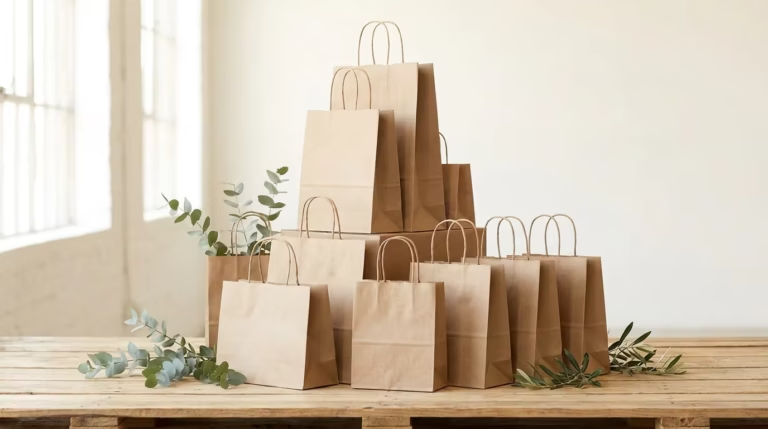

If you’re sourcing paper bags at wholesale volumes, the difference between a good supplier and a bad one isn’t measured in cents per unit — it’s measured in shipments that clear customs, bags that survive the last-mile, customers who don’t complain, and audits you pass without scrambling. In 2026, with the EU PPWR taking effect, food-grade scrutiny tightening, and customer expectations rising, “cheap bags from anywhere” is no longer a viable procurement strategy.
This guide walks you through a structured, professional sourcing process — the same framework experienced B2B buyers, brand owners, and importers use to lock in the right factory, the right specification, and the right total cost. Use it as your checklist.
Step 1 — Define the spec before you contact a single supplier
The #1 reason wholesale sourcing goes sideways is buyers who shop on price before they’ve nailed down what they actually need. Lock these five variables first:
1. Material & GSM (paper weight) GSM (grams per square meter) determines strength, feel, and cost. As a working reference:
2. Bag construction
- Handle type: twisted paper (premium retail), flat paper (economy), die-cut (eco/simple), rope handles (luxury)
- Base type: square bottom (stands up, loads more), flat bottom (cheaper, less rigid), SOS-style (popular for takeout)
- Reinforcement: cardboard insert at the base for heavy loads, reinforced handle patches
3. Surface & finish
- Natural kraft (raw brown) vs bleached white vs custom colored
- Uncoated vs water-based coating vs lamination (and whether the lamination is recyclable — this matters under PPWR)
- Matte / gloss / spot UV / embossing for premium lines
4. Print specification
- 1–4 color flexo (standard, cost-effective) vs offset (high-detail, photographic)
- Print coverage % (heavy coverage costs more in setup and ink)
- Pantone colors specified — never trust “approximate”
5. Sizes and order split Don’t ask for one mega-quantity in one size. Most buyers need 2–4 sizes split across the order. Provide your full size mix upfront — it changes pricing and lead time.
Pro tip: Write your spec as a one-page “RFQ sheet” with all five blocks above. Sending the same structured RFQ to 4–5 suppliers makes quotes truly comparable. Quotes based on vague briefs are not comparable — and you’ll get burned.
Step 2 — Vet the supplier before you vet the price
A factory that quotes 10% cheaper but ships late, fails QC, or gets stopped at customs costs you far more than you saved. Apply this filter:
Factory vs trader vs middleman
- A factory (manufacturer) owns the production lines, controls quality, and offers the best price ceiling.
- A trader marks up factory pricing and adds a layer of communication risk.
- Verify by asking for: factory address (Google Earth it), production line photos/videos, business license, and a virtual factory tour. A real factory will say yes immediately.
Certifications that actually matter for paper bags in 2026
Ask suppliers to send the actual certificates — not just claim them. Verify FSC numbers on the FSC public database.
Experience signals to weigh
- Years in the export business (8+ is a meaningful threshold)
- Existing customers in your target market (US, EU, AU, etc.)
- Sample of past orders at your volume range
- Response speed (a serious factory responds within 24h on workdays)
- Quality of their RFQ response — clear technical answers vs evasive sales pitch
Step 3 — Negotiate MOQ, lead time, and total landed cost
MOQ (Minimum Order Quantity) for paper bags typically starts around 1,000–3,000 pcs per design for custom-printed orders, dropping to lower MOQs for plain/stock bags. If a “factory” tells you they accept 100-pc orders on custom printing, they’re a trader.
Lead times to plan for:
- Sampling: 7–15 days
- Mass production: 20–35 days depending on size and complexity
- Sea freight: 25–40 days to US/EU
- Plan 60–90 days from PO to in-warehouse for the first order. Repeat orders run faster.
Total landed cost — not unit price — is what matters:
Landed Cost=Unit Price+Freight+Duties+QC+Storage
Paper bags are volumetric (light & bulky) — sea freight LCL/FCL economics dominate. Always:
- Get CIF/DDP quotes, not just FOB, for true comparison
- Ask the supplier about flat-pack folding to reduce shipping volume (standard practice for paper bags)
- Confirm carton dimensions and pcs/carton — this drives freight cost more than unit price differences
Step 4 — De-risk with samples, inspections, and payment terms
Samples — three rounds, in order:
- Stock samples of similar specs → confirm quality baseline
- Pre-production samples (PPS) with your printing → confirm spec match before mass production
- Shipment samples pulled from finished goods → verify mass-production quality
Pre-shipment QC inspection — for orders above $5,000, paying for an independent third-party inspection (SGS, Intertek, AsiaInspection) is cheap insurance. Inspect against AQL standards.
Payment terms — industry standard for new B2B relationships is:
- 30% deposit / 70% balance before shipment (T/T)
- For repeat orders or larger relationships: 30/70 against B/L copy, or L/C at sight
- Never pay 100% upfront to a new supplier
- Never pay to a personal account — only to verified company accounts
Step 5 — Build for the long term, not the single order
The biggest cost saving in wholesale paper bag sourcing isn’t squeezing 3% off the next quote — it’s building a stable relationship with the right factory so that reorders run smoothly, quality stays consistent, lead times compress, and pricing improves with volume.
Top B2B buyers consolidate from 6+ trial suppliers down to 1–2 strategic partners using a stage-gate vetting process5. Once you find a factory that delivers on spec, on time, with valid certifications and responsive communication — invest in that relationship.
Buyer’s checklist — print this and use it
✅ Spec defined: GSM, construction, finish, print, sizes, MOQ per size ✅ Supplier verified: factory (not trader), license, address, line photos ✅ Certifications received: FSC, FDA/LFGB if needed, PPWR-ready coatings ✅ Quote requested: CIF/DDP, with carton specs and lead time ✅ MOQ & price tiered: at 10K / 25K / 50K volumes for comparison ✅ Samples staged: stock → PPS → shipment ✅ Payment terms locked: 30/70 T/T, company account, no upfront 100% ✅ QC inspection booked: independent third party for orders > $5K ✅ Long-term plan agreed: reorder cycle, pricing tier, capacity reservation
The bottom line: Wholesale paper bag sourcing in 2026 rewards buyers who specify precisely, verify rigorously, and think in total landed cost — not unit price. Get the process right once, and the next 12 months of reorders take care of themselves.
Looking for a vetted factory partner? With 8 years of OEM/ODM manufacturing experience, FSC and FDA food-grade compliance, and proven export records to North American and European brands, we make B2B sourcing simple — from custom specification through wholesale production and on-time delivery. Explore our custom paper bags and request a structured quote today.