
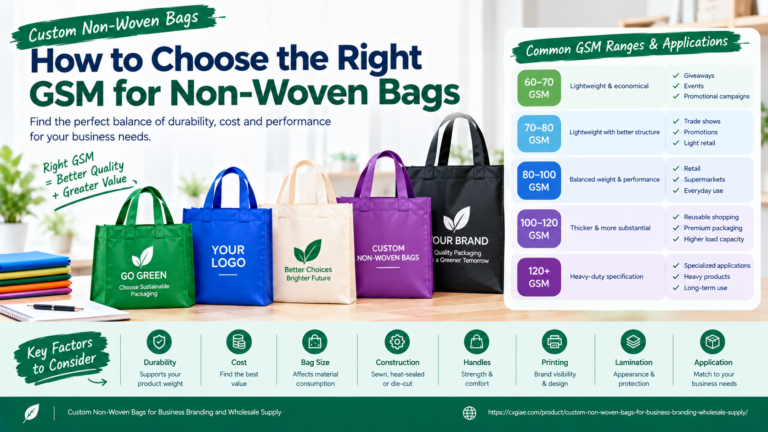

When ordering custom non-woven bags, GSM is one of the most important specifications buyers need to understand.
You may see specifications such as 70 GSM, 80 GSM, 90 GSM, 100 GSM, or 120 GSM on a supplier’s quotation. But what do these numbers actually mean?
More importantly:
How do you know which GSM is right for your business?
A higher GSM does not automatically mean a better bag. The right GSM depends on what the bag needs to carry, how often it will be reused, how the bag is constructed, how much you want to spend, and how the finished bags will be transported.
For B2B buyers, choosing the right GSM is about finding the right balance between strength, appearance, cost, weight, and application.
This guide explains how to choose the appropriate GSM for custom non-woven bags and what other specifications should be considered before placing a bulk order.
What Does GSM Mean in Non-Woven Bags?
GSM stands for grams per square meter.
It describes the weight of one square meter of non-woven fabric.
For example:
- 70 GSM means approximately 70 grams per square meter
- 80 GSM means approximately 80 grams per square meter
- 100 GSM means approximately 100 grams per square meter
- 120 GSM means approximately 120 grams per square meter
In general:
Higher GSM = heavier and more substantial fabric
Lower GSM = lighter and generally more economical fabric
GSM is an important specification because it can affect the feel, material consumption, cost, and overall characteristics of a non-woven bag. However, GSM should not be treated as a direct measurement of the finished bag’s strength.
A bag’s actual performance also depends on its dimensions, handles, seams, bottom construction, reinforcement, material quality, and manufacturing process.
Why Does GSM Matter When Buying Custom Non-Woven Bags?
GSM influences several aspects of a custom non-woven bag.
1. Fabric Feel
Higher-GSM fabric generally feels thicker and more substantial.
This can be useful when a brand wants its packaging to feel more premium when customers handle it.
Lower-GSM fabric feels lighter and can be suitable for promotional campaigns where large quantities need to be produced and transported.
2. Durability
GSM can contribute to the durability of the fabric, but it is only one part of the overall structure.
For example, a 120 GSM bag with weak handles may not perform better than a well-designed 90 GSM bag with reinforced handles and suitable construction.
The complete bag specification matters.
3. Material Consumption
Increasing GSM means more fabric weight per square meter.
If the bag size stays the same, a higher GSM specification generally means greater material consumption.
For large B2B orders, even a relatively small change in GSM can affect the overall material cost.
4. Shipping Weight
Higher-GSM fabric can also increase the total shipment weight.
This matters particularly for international buyers ordering thousands or tens of thousands of bags.
Therefore, selecting the highest GSM available is not necessarily the most cost-effective strategy.
The better approach is to select enough GSM for the intended application without adding unnecessary material.
What GSM Ranges Are Common for Non-Woven Bags?
There is no single GSM standard that applies to every custom non-woven bag.
Commercial PP non-woven bags are commonly produced across different GSM ranges depending on their application and construction. A practical reference used in B2B purchasing is approximately 70–120 GSM, although specifications can vary by manufacturer and project.
A general planning guide looks like this:
| GSM Range | General Characteristics | Typical Applications |
|---|---|---|
| 60–70 GSM | Lightweight and economical | Giveaways, events, promotional campaigns |
| 70–80 GSM | Lightweight with improved structure | Trade shows, promotions, lightweight retail |
| 80–100 GSM | Balanced weight and performance | Retail, supermarkets, promotional bags |
| 100–120 GSM | Thicker and more substantial | Reusable shopping, premium promotional packaging |
| 120+ GSM | Heavy-duty specification | Specialized or higher-load applications |
These are general guidelines, not universal rules.
The appropriate GSM should always be determined together with the bag size, construction, handles, intended load, printing requirements, and expected service life.
Is Higher GSM Always Better?
No.
This is one of the most important points for buyers.
It is easy to think:
120 GSM must be better than 80 GSM.
But packaging procurement does not work quite that simply.
Imagine a company ordering 20,000 bags for a trade show.
The bags may only need to carry:
- Brochures
- Flyers
- Catalogs
- Business cards
- Lightweight promotional products
A very high GSM may add material and shipping costs without providing meaningful additional value.
Now consider a supermarket that wants customers to reuse the bags for grocery shopping.
The project may require:
- More durable material
- Stronger handles
- Reinforced construction
- Suitable bottom structure
- Appropriate GSM
These are completely different applications.
The goal is not to find the highest GSM.
The goal is to find the right GSM for the job.
How to Choose GSM Based on Application
The easiest way to select GSM is to start with the application.
1. Promotional Giveaways
For promotional giveaways, the bags may only need to carry lightweight items.
Typical contents could include:
- Flyers
- Brochures
- Coupons
- Small samples
- Promotional merchandise
In these situations, lower or medium GSM may be appropriate.
The main priorities are often:
Low weight + attractive printing + competitive cost + efficient bulk production
2. Trade Show Bags
Trade show bags commonly carry catalogs, brochures, samples, and promotional materials.
Buyers may prioritize:
- Large printing areas
- Brand visibility
- Lightweight transportation
- Comfortable handles
- Efficient production
- Competitive unit cost
A lightweight or medium GSM specification can be suitable when the expected load is relatively low.
For large events, transportation weight can also become an important consideration.
3. Retail Shopping Bags
Retail bags often need to balance several requirements.
They should look professional while carrying products safely.
Typical contents may include:
- Clothing
- Shoes
- Cosmetics
- Accessories
- Packaged goods
A medium GSM specification can often provide a practical balance between durability, appearance, and cost.
However, the final specification should be based on the actual products being carried.
4. Supermarket Bags
Supermarket applications can involve heavier and more varied products.
For example:
- Bottles
- Canned goods
- Packaged food
- Household products
In this case, GSM should be considered together with:
- Handle width
- Handle attachment
- Bottom construction
- Bag dimensions
- Reinforcement
- Expected load
Simply increasing GSM may not solve a structural problem.
The entire load-bearing design needs to be evaluated.
5. Fashion and Premium Retail Bags
Fashion brands may place greater emphasis on appearance and tactile quality.
They may consider:
- Higher GSM
- Laminated non-woven material
- Premium printing
- Special colors
- Reinforced handles
- Customized dimensions
Here, the goal may not be simply to minimize cost.
The bag itself is part of the customer’s brand experience.
GSM and Load Capacity: What Buyers Need to Know
One of the most common misconceptions is:
Higher GSM automatically means higher load capacity.
This is not necessarily true.
A finished bag’s carrying performance can depend on:
- GSM
- Fabric quality
- Bag size
- Bag shape
- Handle material
- Handle width
- Handle attachment
- Sewing quality
- Bottom construction
- Reinforcement
- Production quality
For example, the handle area may experience significant stress when the bag is filled with heavy products.
A stronger fabric cannot compensate for a poorly designed handle attachment.
This is why manufacturers should evaluate the complete bag structure when recommending GSM.
Existing guidance for non-woven bag buyers similarly emphasizes that GSM should be considered together with handles, seams, bottom construction, dimensions, and manufacturing quality.
GSM vs. Construction Method
The same GSM can perform differently depending on how the bag is manufactured.
Sewn Non-Woven Bags
Sewn bags use stitching to connect fabric panels and attach handles.
They can be suitable for reusable shopping bags and applications where durability is important.
When ordering sewn bags, consider:
- GSM
- Stitching quality
- Handle attachment
- Reinforcement
- Bottom construction
- Expected load
Heat-Pressed Non-Woven Bags
Heat-pressed bags use controlled heat to bond sections of PP non-woven material.
They can be suitable for certain high-volume production applications.
The appropriate GSM depends on the bag design, expected load, size, and production requirements.
Die-Cut Non-Woven Bags
Die-cut bags are produced by cutting the material into a specific shape, sometimes with integrated handles.
They are frequently used for:
- Promotions
- Events
- Giveaways
- Lightweight packaging
For these applications, buyers may place greater emphasis on production efficiency, printing, and cost.
GSM and Bag Size Should Be Considered Together
Bag dimensions can significantly affect material consumption.
Consider two bags:
Bag A: 300 × 250 mm
Bag B: 500 × 400 mm
Even if both use 80 GSM material, the larger bag requires more material.
Therefore, the GSM number alone does not tell you the final material cost or total bag weight.
When requesting quotations, always provide:
- Bag width
- Bag height
- Gusset
- Handle dimensions
- GSM
- Construction method
This allows the manufacturer to calculate the specification more accurately.
GSM and Non-Woven Bag Cost
GSM is one of the factors that can affect the cost of a custom non-woven bag.
Other important cost factors include:
- Bag dimensions
- Material consumption
- Printing
- Number of colors
- Handle type
- Construction
- Lamination
- Reinforcement
- Order quantity
- Packaging
- Shipping
For example, increasing a bag from 80 GSM to 120 GSM may increase material consumption, but the actual price difference depends on the size, quantity, construction, and other specifications.
This is why buyers should compare quotations based on the complete specification, rather than comparing unit prices alone.
Should You Choose 80 GSM, 100 GSM, or 120 GSM?
This is one of the most common questions buyers ask.
A useful starting point is:
Choose around 70–80 GSM when:
- The bag is for promotional giveaways
- Products are lightweight
- Large quantities are required
- Low weight is important
- Cost efficiency is a major priority
Consider around 80–100 GSM when:
- The bag is used for general retail
- Products have moderate weight
- You need a balance between durability and cost
- The bag will be reused occasionally
Consider around 100–120 GSM when:
- The bag needs a more substantial feel
- Repeated reuse is expected
- Products are relatively heavier
- The brand wants a more premium packaging experience
- Stronger construction is also included
Consider 120+ GSM when:
- The application has specialized performance requirements
- Higher material weight is justified
- The complete bag structure has been designed for the intended load
Again, these are starting points rather than fixed specifications.
The manufacturer should evaluate the actual product load and bag design before confirming the final GSM.
GSM and Lamination
Lamination is another factor that can change the appearance and feel of a non-woven bag.
Laminated non-woven bags can provide:
- A smoother surface
- Different visual appearance
- Improved print presentation
- Additional surface protection
- A more structured feel
However, buyers should clarify whether a quoted GSM refers to the base non-woven fabric or the complete laminated material specification.
This is important when comparing quotations from different suppliers.
Two quotations may appear to have the same GSM while using different material structures.
GSM and Printing Quality
GSM itself does not determine printing quality.
Printing performance can also depend on:
- Printing method
- Ink
- Artwork
- Number of colors
- Printing area
- Machine settings
- Material surface
- Production quality
However, material selection can influence the appearance and feel of the finished printed bag.
For brand-sensitive projects, buyers should consider requesting a sample before approving mass production.
A physical sample allows you to evaluate:
- Fabric feel
- GSM
- Color
- Printing
- Logo appearance
- Handle construction
- Overall dimensions
This is particularly important when ordering thousands or tens of thousands of bags.
How to Choose GSM for Reusable Bags
If the bag is intended for repeated use, think beyond the first purchase.
Ask:
How many times do we expect customers to reuse the bag?
A bag used once at a trade show has very different requirements from a supermarket bag that may be used repeatedly.
For reusable bags, evaluate:
- GSM
- Handle strength
- Stitching
- Reinforcement
- Bottom structure
- Bag dimensions
- Expected load
- Manufacturing quality
The objective is not to make the bag unnecessarily heavy.
The objective is to make it durable enough for its expected service life.
How to Choose the Right GSM Step by Step
For B2B buyers, the following process can make GSM selection easier.
Step 1: Define the Application
First determine where and how the bag will be used.
Is it for:
- Retail?
- Supermarkets?
- Trade shows?
- Promotional campaigns?
- Corporate events?
- Fashion?
- Grocery?
- Gift packaging?
Step 2: Determine the Expected Load
Estimate what products the bag will carry.
Instead of telling a supplier:
“I need a strong bag.”
provide more useful information:
“The bag needs to carry approximately 5 kg of retail products.”
This gives the manufacturer a better basis for recommending GSM, handles, construction, and reinforcement.
Step 3: Choose the Target GSM Range
Rather than immediately choosing one exact number, you can start with a range.
For example:
80–100 GSM
Then ask the manufacturer whether the lower or higher end is more appropriate for your application.
This allows the supplier to consider the complete bag structure.
Step 4: Evaluate the Handles
Ask:
- What handle type should be used?
- What handle width is appropriate?
- Does the handle need reinforcement?
- How is the handle attached?
The handle system should match the fabric and intended load.
Step 5: Select Construction
Decide whether the bag should be:
- Sewn
- Heat-pressed
- Die-cut
- Reinforced
- Gusseted
Construction can significantly influence the final performance.
Step 6: Consider Lamination and Printing
If the bag is primarily promotional, visual appearance may be a major priority.
If it is intended for repeated retail use, durability may take priority.
Choose the combination that fits the actual business objective.
Step 7: Request a Sample
Before committing to a large production quantity, inspect the finished product.
Check:
- GSM
- Fabric feel
- Dimensions
- Printing
- Handles
- Stitching or sealing
- Bottom structure
- Overall appearance
Step 8: Confirm the Final Specification
Once the sample is approved, make sure the production specification clearly records:
Material + GSM + Size + Construction + Handles + Printing + Lamination + Quantity
This helps maintain consistency during mass production.
Common Mistakes When Choosing GSM
Mistake 1: Choosing the Highest GSM
Higher GSM is not automatically better.
It can increase material consumption, product weight, and shipping costs.
Mistake 2: Choosing GSM Based Only on Price
A cheaper quotation may use a lighter material or different construction.
Compare complete specifications rather than unit price alone.
Mistake 3: Ignoring Product Weight
A bag designed to carry lightweight promotional materials does not need the same specification as a supermarket shopping bag.
Always tell the manufacturer what the bag needs to carry.
Mistake 4: Ignoring Handle Construction
The fabric may be strong while the handle attachment is not.
Handle design and reinforcement should be evaluated together with GSM.
Mistake 5: Ordering Without a Sample
A specification on paper cannot completely replace evaluating the finished bag.
A sample gives you a much better understanding of actual fabric feel, printing, dimensions, and construction.
Mistake 6: Comparing Suppliers Using GSM Alone
Two suppliers may both quote 100 GSM bags while offering different:
- Sizes
- Materials
- Handles
- Printing
- Construction
- Lamination
- Reinforcement
Make sure you are comparing like-for-like products.
What Should You Tell a Non-Woven Bag Manufacturer?
When requesting a quotation, provide as much information as possible.
A useful RFQ might look like:
Product: Custom PP Non-Woven Shopping Bag
Material: PP Non-Woven
GSM: 80–100 GSM or supplier recommendation
Size: 400 × 350 × 100 mm
Construction: Sewn
Handle: Reinforced loop handle
Printing: Front and back logo
Lamination: Matte
Quantity: 10,000 pcs
Application: Retail shopping
Expected Load: Approximately 3–5 kg
Destination: United States
This gives the manufacturer enough information to recommend an appropriate specification and prepare a more accurate quotation.
Custom Non-Woven Bags for Business and Wholesale Supply
For businesses ordering custom non-woven bags, the right GSM is only one part of the customization process.
A complete specification can include:
- PP non-woven material
- 70–120 GSM options
- Custom sizes
- Custom colors
- Sewn construction
- Heat-pressed construction
- Die-cut designs
- Reinforced handles
- Loop handles
- Custom printing
- Matte or glossy lamination
- Retail shopping designs
- Promotional bags
- Supermarket bags
- Event bags
- Corporate branding bags
For larger B2B projects, manufacturers can evaluate the GSM together with the intended application, bag dimensions, construction, handles, printing, quantity, and delivery requirements.
Businesses looking for customized solutions can review our Custom Non-Woven Bags for Business Branding and Wholesale Supply range and discuss the required specification with the manufacturer.
Non-Woven Bag GSM Buyer Checklist
Before placing an order, ask yourself:
Application
- What will the bag be used for?
- Is it promotional, retail, supermarket, event, or corporate packaging?
Load
- What products will the bag carry?
- What is the approximate maximum load?
GSM
- Is lightweight material sufficient?
- Does the bag need a more substantial feel?
- Is the target GSM appropriate for the expected use?
Construction
- Sewn or heat-pressed?
- Does the bottom require reinforcement?
- Is a gusset needed?
Handles
- What handle type is required?
- Does it need reinforcement?
- Can it support the intended load?
Branding
- How many printing sides?
- How many colors?
- Is lamination required?
Quantity
- What is the required order volume?
- Will the bags be reused?
- How long will the inventory need to last?
Quality
- Can the supplier provide a sample?
- Can the finished bag be load tested?
- Can the approved GSM and specifications be maintained during mass production?
This checklist can help procurement teams avoid choosing GSM based on a single number.
Final Thoughts: What GSM Should You Choose?
There is no universal “best GSM” for custom non-woven bags.
A 70 GSM bag may be the right choice for a lightweight promotional campaign.
An 80–100 GSM bag may provide a practical balance for many retail applications.
A 100–120 GSM bag may be more suitable when a thicker feel, repeated use, or stronger overall specification is required.
But GSM should never be considered alone.
The right choice depends on:
Application + Product Load + Bag Size + Construction + Handles + Printing + Lamination + Quantity + Budget
For B2B buyers, the most effective approach is to define what the bag needs to do first, then work with the manufacturer to determine the appropriate GSM and complete construction.
The objective is not to buy the heaviest bag.
It is to buy the right bag for the job.
When GSM, construction, handles, printing, and application are properly matched, custom non-woven bags can provide a practical balance of durability, branding, cost efficiency, and customer usability.