
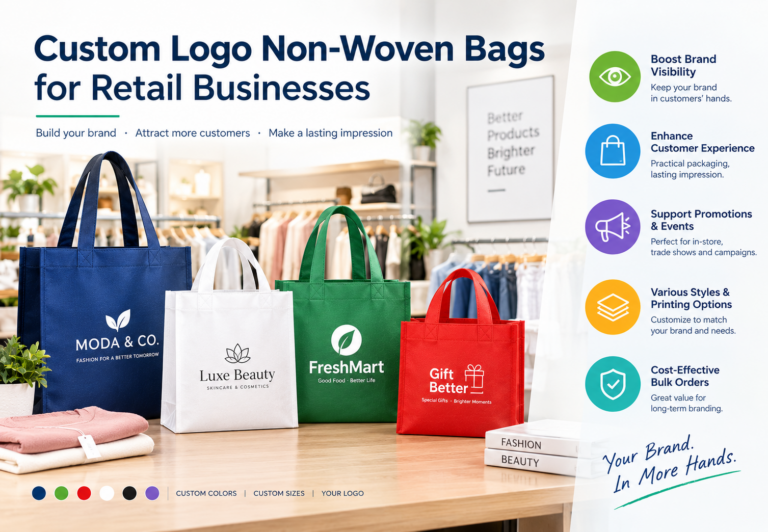

In retail, every customer interaction is an opportunity to strengthen brand recognition. From the moment a shopper receives a purchase to the next time they reuse the shopping bag, packaging can help create a consistent and memorable brand experience.
Custom logo non-woven bags offer retailers a practical way to combine everyday shopping convenience with branded packaging. Available in different colors, sizes, styles, and printing options, these bags can be customized to suit clothing stores, supermarkets, cosmetics retailers, gift shops, specialty stores, and multi-location retail chains.
For businesses purchasing packaging in bulk, the goal is not simply to print a logo on a bag. It is to choose a product that reflects the brand, serves customers well, meets operational requirements, and delivers value across the entire order.
This guide explains how retail businesses can choose, customize, and source non-woven bags that support their branding and packaging strategies.
1. Why Retail Businesses Choose Custom Logo Non-Woven Bags
Retailers need packaging that balances appearance, functionality, and cost. Custom non-woven bags can meet these requirements when the bag construction and specifications are matched to the intended use.
Strengthen Brand Recognition
A printed logo helps customers identify the retailer and reinforces brand consistency across physical stores, promotional campaigns, and customer shopping experiences.
Businesses can customize the bag with their logo, brand colors, slogan, website, or campaign artwork. Consistent use of these elements helps connect the packaging with the company’s wider marketing identity.
Extend Brand Exposure Beyond the Store
Customers may reuse shopping bags for groceries, errands, travel, or carrying personal items. When a bag remains useful after the original purchase, its branding can continue to reach people outside the retail environment.
Although the amount of exposure varies with customer behavior, a practical and attractive bag creates more opportunities for repeated brand visibility.
Support Bulk Packaging Requirements
For retailers distributing bags across multiple stores or during large promotional campaigns, non-woven bags can be customized in quantities suited to the project.
Businesses can coordinate bag colors, logo placement, dimensions, and construction to maintain a consistent presentation across different locations.
Create a More Professional Shopping Experience
Branded packaging helps connect the product, store environment, and customer experience. A carefully designed bag can make an ordinary purchase feel more coordinated and reinforce the impression that the retailer pays attention to detail.
2. Which Retail Businesses Benefit from Custom Logo Non-Woven Bags?
Different retail sectors have different packaging priorities. Choosing a suitable bag starts with understanding the products being carried, the customers receiving the bags, and the brand image the business wants to communicate.
Clothing and Fashion Retailers
Fashion stores often use shopping bags as part of their visual identity. A clean design, coordinated colors, and a prominent logo can complement the store’s interior and product presentation.
Recommended considerations include:
- Medium or large bag sizes for folded clothing.
- Reinforced handles for heavier purchases.
- Coordinated bag colors and logo placement.
- Laminated finishes when a smoother, more polished surface is required.
Supermarkets and Grocery Retailers
Supermarkets often prioritize capacity, practicality, and repeat use. Gusseted bags and structured shopping bags may be suitable for carrying multiple products.
Retail buyers should pay attention to the bag’s dimensions, bottom construction, handle strength, and expected load rather than selecting material weight alone.
Cosmetics and Beauty Stores
Beauty retailers may prefer a more refined appearance that aligns with their packaging and brand identity.
A carefully positioned logo, restrained color palette, and suitable matte or glossy finish can help create a coordinated look. Smaller bags may work for individual products, while larger sizes can accommodate gift sets and multiple purchases.
Gift Shops and Specialty Retailers
Gift stores, bookstores, lifestyle shops, and specialty retailers can use custom logo bags to reinforce their identities while giving customers packaging they may reuse.
The best design depends on the products sold, the expected purchase size, and whether the bag is intended for everyday transactions or premium gift presentation.
Retail Chains and Franchise Businesses
Businesses operating across multiple locations need consistent packaging specifications and reliable replenishment.
A standardized bag design can simplify purchasing, support consistent brand presentation, and make repeat orders easier to manage. Retail chains should document approved colors, artwork files, dimensions, materials, and quality requirements before production begins.
3. Choose the Right Non-Woven Bag Style for Your Store
The bag style influences its appearance, carrying capacity, and practical usefulness. Retail buyers should select the structure before finalizing the artwork.
Non-Woven Tote Bags
<AsyncImage query=”custom printed polypropylene non woven tote shopping bags with retail logos clean product photography” aspectRatio=”5:4″ width=”100%” />
Tote bags are versatile options for fashion retailers, cosmetics stores, promotional shops, and general retail packaging.
They offer broad front and back panels for logo printing and can be customized with different dimensions, handle lengths, fabric colors, and construction details.
Gusseted Shopping Bags
<AsyncImage query=”custom logo non woven gusseted shopping bags with side gussets for retail products product photography” aspectRatio=”5:4″ width=”100%” />
Gusseted bags provide additional depth, making them useful for products that need more internal space.
They can suit supermarkets, grocery retailers, household goods stores, and businesses that sell several items in one transaction.
Box-Shaped Non-Woven Bags
<AsyncImage query=”structured box bottom custom printed non woven retail bags with handles and brand logo” aspectRatio=”5:4″ width=”100%” />
Box-shaped bags have a more structured profile and may offer a stable base for selected products.
They can be useful when retailers want a defined shape that accommodates product boxes, packaged merchandise, or promotional kits.
Foldable Non-Woven Bags
<AsyncImage query=”foldable reusable non woven shopping bags with custom printed logos folded and unfolded product display” aspectRatio=”5:4″ width=”100%” />
Foldable bags are designed to be compact when not in use. They can be suitable for retail promotions, loyalty programs, and campaigns encouraging customers to carry a spare shopping bag.
When comparing styles, consider the intended contents, storage requirements, target customers, and overall budget. The most attractive design is only effective if the bag works for its intended purpose.
4. Select the Right Material Weight and Construction
Non-woven bags are commonly made from polypropylene (PP) fibers bonded together rather than woven into conventional fabric. Different material weights and construction methods affect the bag’s feel, structure, and performance.
GSM means grams per square meter and indicates the weight of the material. It is useful when comparing specifications, but it does not independently determine how much weight a finished bag can safely carry.
The following ranges are general starting points for discussing specifications with a manufacturer.
| Material weight | Potential retail applications | Main consideration |
|---|---|---|
| 70–80 GSM | Lightweight promotional and general shopping bags | Focus on cost and intended load |
| 80–100 GSM | Everyday retail bags and reusable shopping bags | Balance structure, usability, and budget |
| 100–120 GSM | More substantial retail bags and selected heavier-duty designs | Evaluate the full construction and carrying requirements |
Actual suitability depends on bag dimensions, material quality, handle design, seams, bottom construction, and manufacturing quality.
Retail buyers should also decide whether the bag needs:
- Sewn or heat-pressed construction.
- Short or long handles.
- Reinforced handles or bottom panels.
- Matte or glossy lamination.
- Standard or custom dimensions.
- One-sided or two-sided printing.
For orders carrying heavier products, request a sample and test it with representative merchandise before approving bulk production.
5. How to Design an Effective Logo for Retail Bags
A retail bag is a physical representation of the brand. Its design should be recognizable, readable, and consistent with the company’s existing visual identity.
Keep the Logo Easy to Recognize
Place the main logo in a visible area on the front panel. Avoid making it so small that customers cannot identify it from a reasonable distance.
If the logo includes intricate illustrations or fine text, ask the supplier to review whether the details will reproduce clearly on the selected material.
Use Consistent Brand Colors
Match the bag and printed artwork to the brand’s established colors wherever possible.
For color-sensitive projects, provide the correct artwork files and color references. A digital mock-up is useful for reviewing layout, but a physical sample may be necessary when precise color matching is important.
Balance Branding and White Space
A design does not need to cover every available surface. A clearly positioned logo with a limited amount of supporting information can look more professional and remain easier to recognize.
Retailers may choose to include a short slogan, website, or social media account when it serves a clear purpose.
Consider Both Sides of the Bag
Printing on both sides can increase opportunities for logo visibility, although it may affect the total cost.
For budget-conscious projects, one-sided printing may be sufficient. For prominent retail packaging or campaigns where presentation is especially important, two-sided printing may be worth evaluating.
Coordinate Packaging Across Multiple Stores
Retail chains should use standardized artwork and approved specifications across all locations.
This helps reduce differences in logo placement, bag color, and appearance when stores reorder packaging at different times.
6. Which Printing Method Is Best for Custom Logo Non-Woven Bags?
The right printing method depends on the artwork, bag material, order quantity, and desired finish. Buyers should confirm which methods are compatible with their chosen bag construction.
Screen Printing
Screen printing is commonly considered for simple logos and designs using a limited number of solid colors.
It can be suitable for bulk retail orders where the artwork is relatively straightforward. The final result depends on the material, ink system, production settings, and quality control.
Heat Transfer Printing
Heat transfer can support more detailed, multicolor artwork when the selected transfer system is compatible with the bag.
It may be appropriate for promotional graphics or designs that require more color detail than a simple spot-color logo.
Printing on Laminated Non-Woven Bags
Laminated non-woven material has a coated surface that can support different graphic treatments depending on the printing process used.
Retailers considering detailed artwork or a more polished appearance should discuss the material, print method, and finishing options with the supplier before selecting a specification.
There is no single printing method that is best for every order. Before confirming production, compare print quality, setup requirements, unit cost, and compatibility with the selected bag.
For a more detailed comparison, read our guide: What Printing Method Is Best for Custom Non-Woven Bags?.
7. How Much Do Custom Logo Non-Woven Bags Cost?
The cost of custom logo non-woven bags depends on several specifications. Retail buyers should compare quotations based on the same requirements rather than comparing unit prices in isolation.
Important pricing factors include:
Order quantity: Larger quantities may reduce the unit cost, depending on the production method and setup requirements.
Bag dimensions: Larger bags generally require more material.
Material weight: A higher GSM specification may increase material costs.
Construction: Sewing, reinforcement, structured bottoms, and other features can affect labor and production costs.
Printing: The number of print colors, artwork complexity, print positions, and selected method influence pricing.
Finishing: Lamination, special handles, and additional design features can increase the total cost.
Packaging and shipping: Individual packing, carton requirements, delivery destination, and freight arrangements should be considered when calculating the landed cost.
For a meaningful comparison, request quotations at several realistic order quantities. Also confirm whether sample charges, printing setup, packaging, and shipping are included.
The lowest quoted price is not necessarily the best commercial option if the bag fails to meet the retailer’s quality or delivery requirements.
8. What Is the MOQ for Custom Logo Non-Woven Bags?
Minimum order quantity (MOQ) varies according to the bag style, manufacturing process, printing requirements, and degree of customization.
As an indicative starting point for planning:
- Sewn non-woven bags: Orders may start from around 500 pieces.
- Heat-pressed non-woven bags: Orders may require around 10,000 pieces.
These are indicative quantities, not universal industry standards. The actual MOQ should be confirmed for the specific design and production requirements.
For retailers testing a new packaging design, it is worth asking whether a standard bag size or fabric color can simplify the order. Businesses placing orders for multiple stores should estimate total demand across locations before deciding on the quantity.
A practical quantity plan should account for expected sales, promotional events, storage capacity, and the likely timing of the next reorder.
9. How to Ensure Consistent Quality Across Bulk Orders
Packaging quality matters because customers directly interact with the finished product. A poorly printed logo or weak handle can undermine the intended brand experience.
Before approving a large order, retailers should establish clear quality requirements.
Review a Sample
Check the bag’s size, color, material, handle length, construction, and printed logo. If the bag will carry specific merchandise, test it with those products.
Confirm Artwork and Print Placement
Approve the final artwork, print dimensions, and position before production. Make sure the supplier is working from the correct file and version.
Inspect Construction Details
Pay attention to seams, handle attachments, bottom panels, edge finishing, and any reinforcement required for the intended load.
Set Clear Specifications for Repeat Orders
Record the approved material weight, dimensions, color references, printing details, and construction method. This makes future orders easier to reproduce consistently.
Confirm the Production Schedule
Discuss sample approval, production time, inspection, packing, and shipping before confirming the order. Retailers with multiple locations should allow enough time for distribution after the shipment arrives.
A clear approval process helps reduce avoidable errors and makes the purchasing process more predictable.
10. How Retail Chains Can Simplify Repeat Purchasing
For retailers with multiple branches, packaging procurement involves more than choosing a design. It also requires planning inventory and maintaining consistent specifications.
The following practices can make repeat orders easier to manage.
Standardize core specifications. Maintain approved artwork files, dimensions, colors, material weight, and construction details.
Forecast demand across locations. Estimate the combined requirements of all stores and promotional activities instead of ordering separately without a coordinated plan.
Plan reorder points. Consider sales volume, inventory levels, production lead times, and international shipping when deciding when to reorder.
Keep quality records. Save approved samples or clear product specifications so future orders can be checked against the original requirements.
Communicate changes early. If the brand logo, bag size, or campaign artwork changes, confirm how the update affects pricing and production before placing the order.
For larger retail organizations, a consistent procurement process can help reduce packaging variation and improve purchasing efficiency.
11. What to Prepare Before Requesting a Quotation
Retail buyers can help suppliers provide more accurate quotations by preparing a clear project brief.
Use this checklist before contacting a manufacturer:
- Intended use: clothing retail, supermarket, cosmetics, gift shop, or another application.
- Bag style: tote, gusseted, box-shaped, foldable, or another design.
- Dimensions: width, height, and depth where applicable.
- Material: preferred GSM and any lamination requirements.
- Construction: sewn, heat-pressed, reinforced, or another specification.
- Handles: length, style, and reinforcement requirements.
- Artwork: logo file, brand colors, print size, and print positions.
- Quantity: initial order and possible repeat-order volume.
- Delivery: destination and required arrival date.
- Budget: target price range and any essential quality requirements.
Providing these details allows the supplier to evaluate the project more efficiently and recommend suitable specifications.
If you need a manufacturer for customized retail packaging, explore our custom non-woven bags for business branding and wholesale supply.
Frequently Asked Questions
Are custom logo non-woven bags suitable for retail stores?
Yes. They can be used by clothing stores, supermarkets, cosmetics retailers, gift shops, and other businesses that need branded shopping bags. The right style depends on the products being carried, the desired appearance, and the purchasing budget.
Can I customize the color and size of non-woven bags?
Many non-woven bag designs can be customized in size, fabric color, handle style, printing, and construction. Available options and minimum order quantities depend on the manufacturer’s production capabilities.
Can non-woven bags carry heavy retail products?
Their carrying performance depends on material weight, bag dimensions, handle construction, seams, reinforcement, and manufacturing quality. Request a sample and test it with representative products rather than relying on GSM alone.
Which printing method is best for a retail logo?
Screen printing can be suitable for simple, limited-color logos, while compatible heat-transfer processes can accommodate more detailed artwork. The best option depends on the material, artwork, quantity, and required finish.
How can retail chains maintain consistent bag quality?
Use approved artwork, documented specifications, sample approval, and clear quality requirements. Keeping these records also helps suppliers reproduce the same design during future orders.
What should I include when requesting a bulk quotation?
Provide the bag dimensions, material weight, style, construction, logo artwork, printing requirements, quantity, delivery destination, and target delivery date. The more complete the specification, the easier it is to compare quotations accurately.
Conclusion
Custom logo non-woven bags can help retail businesses connect practical packaging with consistent brand presentation. From independent shops to multi-location retail chains, the right combination of bag style, material, logo design, and printing method can support daily operations and create more opportunities for brand visibility.
For B2B buyers, a successful order starts with clear specifications, realistic quantity planning, sample approval, and a reliable production schedule. Choosing a bag based on its intended use rather than price alone helps balance brand presentation, usability, and total purchasing cost.
Looking for a supplier for your next retail packaging project?
Explore our custom non-woven bags for business branding and wholesale supply to discuss bag styles, logo customization, printing options, and bulk order requirements.
Contact our team to request a quotation for custom logo non-woven bags tailored to your retail business.