
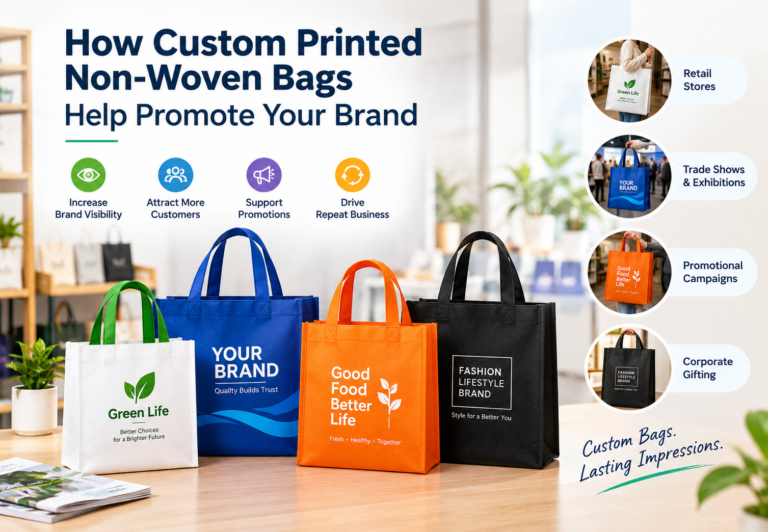

In a competitive market, building brand recognition requires more than running online advertisements. Businesses also need practical ways to keep their brands visible in customers’ everyday lives. Custom printed non-woven bags offer a simple solution by combining useful packaging with effective brand promotion.
For retailers, supermarkets, fashion brands, promotional agencies, event organizers, and distributors, branded non-woven bags can serve as shopping bags, promotional giveaways, event merchandise, and reusable packaging. With a customized logo, brand colors, and a well-planned design, an ordinary bag becomes an additional touchpoint between a business and its customers.
But how do custom printed non-woven bags contribute to brand growth, and how can businesses maximize their marketing value? This guide explores the key benefits, practical applications, and important considerations for B2B buyers.
1. Increase Brand Visibility Beyond the Point of Sale
One of the main advantages of custom printed non-woven bags is their potential to extend brand exposure beyond the original purchase or event.
Traditional packaging is often discarded shortly after use. A reusable shopping bag, however, can accompany customers to supermarkets, shopping centers, offices, gyms, and other public places. Each time someone carries the bag, its logo and design may be seen by other people.
This creates additional opportunities for brand recognition without requiring a new advertising placement for every interaction.
For example, a fashion retailer can provide customers with branded non-woven bags after purchases. Customers may reuse them for shopping, carrying personal items, or running errands. The retailer’s branding continues to travel with the customer long after the original transaction.
To improve visibility, businesses should consider the following design elements:
- Prominent logo placement: Make the logo easy to identify from a reasonable distance.
- Brand-consistent colors: Use colors that match the company’s established visual identity.
- Readable messaging: Keep slogans and supporting text short.
- Balanced layouts: Avoid overcrowding the printable area with too many design elements.
A clear, recognizable design often works better for everyday brand exposure than a bag filled with competing messages.
2. Turn Everyday Packaging into a Marketing Tool
Packaging plays an important role in how customers experience a brand. It can communicate professionalism, reinforce brand identity, and make a purchase feel more complete.
Custom printed non-woven bags allow businesses to combine packaging and marketing in a single product. Instead of using plain bags, companies can add their logos, slogans, campaign graphics, website addresses, or other brand elements.
This approach is especially useful for businesses that distribute products in person or serve customers at physical locations.
Consider these examples:
- Retail stores: Provide branded bags for customers purchasing clothing, accessories, cosmetics, or household products.
- Supermarkets: Use custom shopping bags to strengthen store recognition and support customer loyalty programs.
- Beauty brands: Create coordinated packaging for product launches, gift sets, and promotional events.
- Food and beverage businesses: Use suitable custom bags for takeaway products, packaged goods, or promotional campaigns.
- Corporate buyers: Add branded bags to welcome kits, employee gifts, and conference materials.
The key is to treat the bag as part of the overall customer experience rather than as an afterthought.
For businesses planning a coordinated packaging program, explore our custom non-woven bags for business branding and wholesale supply.
3. Support Trade Shows, Exhibitions, and Promotional Campaigns
Trade shows and exhibitions create opportunities for businesses to connect with potential customers, distributors, and partners. However, companies often compete for attention in crowded exhibition halls.
Custom printed non-woven bags can support these marketing activities in several ways.
Make Your Brand More Visible at Events
Visitors frequently collect brochures, catalogs, samples, and promotional materials during exhibitions. Providing a useful branded bag gives attendees a convenient way to carry these items while displaying your company identity throughout the venue.
Create a More Professional Brand Experience
A bag designed around your exhibition graphics, product range, or campaign message can make promotional materials feel more coordinated. This is particularly valuable for businesses launching new products or presenting a refreshed brand identity.
Extend Exposure After the Event
Attendees may continue using the bags after returning to their offices or homes. If the bags are practical and attractive, the brand may receive additional exposure after the exhibition has ended.
Custom non-woven bags are also suitable for conferences, product launches, community events, school programs, and corporate promotional campaigns.
For B2B buyers, the most effective approach is to match the bag’s size, strength, and design to the materials it needs to carry and the audience receiving it.
4. Build Stronger Brand Recognition Through Consistent Design
Brand recognition improves when customers repeatedly encounter familiar visual elements. Custom printed non-woven bags provide a physical surface for reinforcing these elements.
A successful branded bag should reflect the same visual identity customers see on the company’s website, product packaging, advertisements, and retail displays.
Choose Colors That Match Your Brand
Consistent brand colors help customers associate the bag with your company. Businesses can select a suitable non-woven fabric color and coordinate the printed artwork with their existing brand guidelines.
For logos with specific color requirements, request a production sample or print proof to check how the design appears on the selected material.
Keep the Logo Clear and Readable
The logo should be large enough to remain recognizable without overwhelming the entire design. Fine details, very small text, and complicated graphics may be less effective when viewed from a distance.
Use Both Sides Strategically
Depending on the design and budget, businesses can print on one or both sides of a bag. Two-sided printing may increase visibility from different viewing angles, while single-sided printing can be appropriate for simpler campaigns.
Add a Useful Call to Action
Some brands may benefit from including a website address, social media handle, or QR code. These elements can help connect physical packaging with digital marketing.
However, avoid adding too much information. A simple design with one clear message is often easier to recognize and remember.
5. Reach More Customers with Cost-Effective Bulk Promotion
Marketing budgets need to balance visibility, reach, and cost. Custom printed non-woven bags can be an attractive option for campaigns that require a relatively large quantity of branded items.
The unit cost depends on factors such as bag dimensions, material weight, printing method, construction, finishing, and order quantity. Larger orders may reduce the unit cost, although the final economics should be evaluated against the total project budget and the number of bags that will actually be used.
Businesses can distribute branded bags through several channels:
- In-store purchases and customer loyalty programs
- Trade shows and industry exhibitions
- Product launches and promotional events
- Corporate gifting and employee welcome kits
- Distributor campaigns and retail partnerships
- Community outreach and brand awareness programs
To assess the value of a campaign, buyers can compare the total cost of the bags with the number distributed, the intended usage, and any measurable results, such as QR-code visits, campaign inquiries, or repeat purchases.
A bag should not be judged only by its purchase price. Its usefulness, design quality, and likelihood of being reused also affect its promotional potential.
6. Choose the Right Bag Style for Your Marketing Objective
Different promotional activities call for different bag designs. Selecting a suitable style can improve usability and help the bag reinforce the intended brand message.
Non-Woven Tote Bags
Tote bags are a versatile option for retail packaging, exhibitions, corporate giveaways, and general promotional campaigns. Their broad front and back panels provide useful space for logos and marketing graphics.
Gusseted Shopping Bags
Gusseted bags offer additional depth, making them suitable for carrying multiple products or bulkier purchases. They can work well for supermarkets, retail stores, and product sampling campaigns.
Box-Shaped Bags
Box-shaped designs offer a more structured appearance and can provide a wider base for selected products. Retailers may choose this style when presentation and practical storage are important.
Foldable Promotional Bags
Foldable bags are convenient for campaigns that encourage customers to keep a spare shopping bag in a handbag, backpack, or car. Their portability can support repeated use.
Laminated Non-Woven Bags
Laminated options can provide a smoother surface for detailed graphics and a choice of matte or glossy finishes. They may suit brands seeking a more polished visual presentation.
When choosing a style, consider the intended contents, carrying requirements, distribution method, brand positioning, and available budget.
7. Select a Printing Method That Matches Your Design
The printing method affects the appearance, cost, and suitability of a custom printed non-woven bag. Buyers should evaluate the artwork and order specifications before confirming production.
Common options include:
Screen printing: Often suitable for relatively simple logos and designs with solid colors. It can be economical for appropriate bulk orders.
Heat transfer printing: Can accommodate more colorful and detailed artwork, depending on the material and production process.
Printing on laminated non-woven material: Certain laminated constructions support detailed graphics and broader color reproduction, making them suitable for more elaborate designs.
No single method is best for every project. The right choice depends on the number of colors, artwork complexity, bag construction, order quantity, and required finish.
Before placing a bulk order, confirm the available printing options with your supplier and review a sample or approved print proof when appropriate.
For a more detailed comparison, read our guide: What Printing Method Is Best for Custom Non-Woven Bags?.
8. Make Reusability Part of Your Brand Message
A practical bag has a better chance of being kept and reused than one that is inconvenient or poorly made. Repeated use can create more opportunities for customers and other people to encounter the brand.
Businesses can encourage reuse by choosing appropriate dimensions, comfortable handles, suitable material weight, and a design that customers will want to carry.
For example, a supermarket may prioritize capacity and reinforced handles, while a fashion retailer may focus on color coordination and presentation. An exhibition organizer may need a lightweight bag that comfortably holds brochures and samples.
Polypropylene non-woven bags are made from plastic-based material, so environmental claims should be accurate. Reusability alone does not automatically make a bag environmentally friendly in every situation. Actual benefits depend on factors such as how often the bag is reused, its production, and how it is ultimately disposed of.
If sustainability is part of your brand positioning, communicate specific and verifiable product attributes rather than relying on broad claims.
9. Prioritize Quality to Protect Your Brand Image
A branded bag represents the business that distributes it. Poor printing, weak handles, uneven stitching, or inconsistent dimensions can undermine the intended impression.
For bulk promotional orders, buyers should review several quality factors before approving production.
- Material weight: Select a suitable GSM based on expected use and load requirements.
- Handle strength: Check attachment points and handle construction.
- Printing quality: Look for clear edges, consistent colors, and correct logo placement.
- Construction: Inspect seams, bottom panels, and reinforcement where applicable.
- Dimensions: Confirm that the finished bag matches the approved specifications.
- Production consistency: Ensure the bulk order follows the approved sample and artwork.
It is also important to provide print-ready artwork and confirm the final design before mass production. Clear specifications reduce the risk of avoidable errors, delays, and unexpected costs.
For artwork preparation guidance, see How to Prepare Artwork for Custom Non-Woven Bag Printing.
10. How B2B Buyers Can Plan a Successful Custom Bag Order
For companies purchasing custom printed non-woven bags in bulk, a clear ordering process helps align marketing objectives with production requirements.
Before requesting a quotation, prepare the following information:
- Purpose: Explain whether the bags are for retail packaging, exhibitions, giveaways, or another campaign.
- Quantity: Estimate the number of bags required and whether future repeat orders are likely.
- Specifications: Provide the preferred dimensions, material weight, bag style, handle type, and finishing.
- Artwork: Supply the logo, brand colors, and any supporting text or graphics.
- Printing requirements: Describe the number of colors, print positions, and desired visual finish.
- Budget and timeline: Share the target budget and required delivery date.
- Quality expectations: Confirm the sample approval process and any important inspection requirements.
Minimum order quantities vary by bag style and production method. As an indicative reference, sewn non-woven bags may start at around 500 pieces, while heat-pressed bags may require around 10,000 pieces. The actual MOQ, pricing, and lead time should be confirmed for the specific design and order.
Planning these details before production makes it easier to compare quotations and select a supplier that can meet your commercial requirements.
Conclusion: Turn Custom Non-Woven Bags into a Brand-Building Asset
Custom printed non-woven bags give businesses a practical way to combine packaging, customer convenience, and brand promotion. From retail stores and supermarkets to trade shows and corporate campaigns, a well-designed bag can help businesses maintain visibility beyond the original transaction.
To maximize the benefits, choose a suitable bag style, use consistent branding, select an appropriate printing method, and prioritize quality and usability. Bulk buyers should also confirm specifications, MOQ, pricing, and production timelines before approving an order.
If your business is planning a promotional campaign, retail packaging project, or wholesale purchase, explore our custom non-woven bags for business branding and wholesale supply.
As a custom packaging manufacturer, we can help you evaluate bag styles, printing options, and specifications for your branding requirements. Contact us to discuss your project and request a quotation for your custom non-woven bags.