
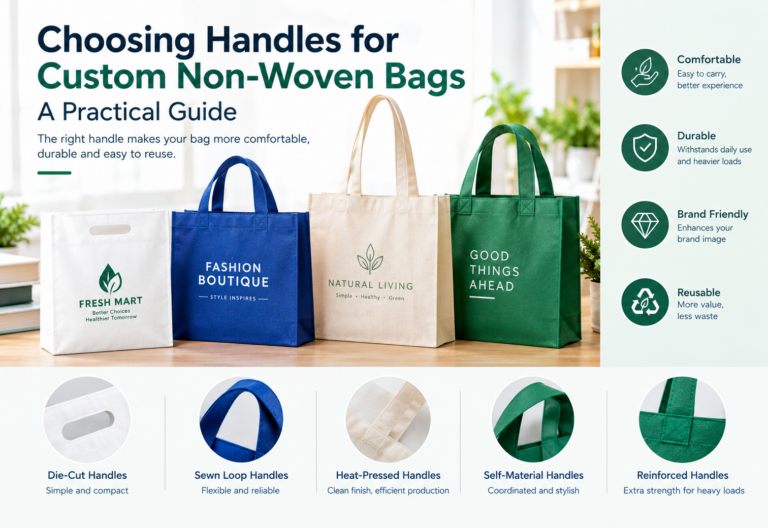

When businesses order custom non-woven bags, they often focus on fabric thickness, bag size, logo printing, and unit price. However, one small detail can make a major difference to the finished product: the handle.
The right handle makes a bag easier to carry, more comfortable to use, and better suited to its intended purpose. The wrong choice can lead to uncomfortable carrying, handle detachment, or damage when the bag is loaded.
For retailers, supermarkets, promotional agencies, and brands ordering bags in bulk, handle selection should be part of the product specification from the beginning.
This guide explains the main handle options for custom non-woven bags, how they compare, and what B2B buyers should consider before placing a bulk order.
1. Why Handle Selection Matters
Handles affect much more than the appearance of a shopping bag. They influence several important aspects of the customer experience and product performance.
Carrying comfort
A bag may be strong enough to hold its contents but still feel uncomfortable when carried for an extended period. Handle width, length, material, and shape all affect how the load feels in the user’s hand.
For example, a bag intended for clothing purchases may benefit from longer handles that can be carried over the shoulder, while a compact promotional bag may only need short handles for hand carrying.
Load-bearing performance
The handle and its attachment points are among the areas that experience significant stress when a bag is lifted. A strong fabric body does not automatically guarantee a strong finished bag.
The handle material, attachment method, stitching or bonding quality, reinforcement, and bag construction should work together. Buyers should communicate the expected load to the manufacturer instead of relying on fabric GSM alone.
Brand presentation
Handles also contribute to the bag’s overall appearance. Coordinated fabric handles can create a clean, consistent look, while a contrasting handle color can make the design more distinctive.
For premium retail packaging, the handle should complement the logo, bag shape, and brand colors rather than look like an afterthought.
Reusability
If customers find a bag comfortable and practical, they have more reasons to use it again. For businesses that want their bags to remain useful beyond the original purchase, handle comfort and durability deserve the same attention as printing and material selection.
2. Common Handle Types for Custom Non-Woven Bags
Different handle styles suit different products, budgets, and usage scenarios. The following options are worth considering when developing a custom non-woven bag.
2.1 Die-Cut Handles
Die-cut handles are created by cutting an opening directly into the bag material. Depending on the design, the opening may have a D-shaped, U-shaped, or other customized profile.
Advantages:
- Simple, compact appearance
- No separate handle strap required
- Suitable for many lightweight promotional applications
- Can support efficient production for suitable bag designs
Limitations:
- The opening can become uncomfortable when the bag is heavy
- Stress concentrates around the cut edges
- Poorly designed openings may tear under excessive load
Best suited for: Trade shows, conferences, lightweight product packaging, promotional giveaways, and short-term campaigns.
When selecting a die-cut handle, consider the opening size, edge clearance, fabric characteristics, and whether additional reinforcement is appropriate. Do not assume that every die-cut design can carry the same weight.
2.2 Sewn Loop Handles
Sewn loop handles are separate strips of material attached to the bag body with stitching. They can be made from matching non-woven fabric or another suitable strap material.
Advantages:
- Flexible design options
- Suitable for many reusable shopping bags
- Can be customized in length, width, and color
- Can accommodate reinforcement for demanding applications
Limitations:
- Stitching adds a manufacturing step
- Handle appearance depends on sewing precision
- Poor attachment design can still cause tearing or stitch failure
Best suited for: Retail shopping bags, supermarkets, fashion stores, gift packaging, and reusable bags intended for frequent use.
For bags that will carry heavier products, ask the manufacturer to evaluate the handle attachment area, stitch pattern, reinforcement, and bag-body construction as a complete system.
2.3 Heat-Pressed or Heat-Sealed Handles
Heat-pressed handles use heat and pressure to bond compatible materials together. Depending on the bag design, the handles may be integrated into the structure or attached as separate components.
Advantages:
- Can create a neat appearance without visible stitching
- Suitable for compatible bag designs and materials
- Can support efficient production for appropriate high-volume orders
Limitations:
- Bond quality depends on material compatibility and process control
- Not every handle design is suitable for heat bonding
- Weak or inconsistent bonding can lead to separation under stress
Best suited for: Selected promotional bags, lightweight shopping bags, and high-volume projects where the design and material are appropriate for heat sealing.
Buyers should confirm the actual construction method with the supplier. A heat-pressed handle should not automatically be considered stronger or weaker than a sewn handle without evaluating the complete design and intended load.
2.4 Self-Material Handles
Self-material handles are made from the same non-woven material as the bag body. They may be sewn, bonded, folded, or otherwise incorporated into the finished construction.
Advantages:
- Consistent material and color appearance
- Clean, coordinated design
- Flexible customization options
- Suitable for cohesive brand presentation
Limitations:
- Comfort depends on handle width, length, and construction
- Matching material does not guarantee sufficient strength
- The attachment area must be designed for the expected load
Best suited for: Branded retail bags, fashion packaging, promotional shopping bags, and businesses seeking a consistent appearance across the bag body and handles.
Self-material handles can be an effective choice when visual consistency matters, but the manufacturer should still verify the handle construction and load requirements.
2.5 Reinforced Handles
Reinforced handles use additional material, stitching, bonding, or an expanded attachment area to improve the strength of critical sections.
Reinforcement is not always a separate handle style. It is a design feature that can be incorporated into sewn or bonded handles and other suitable constructions.
Advantages:
- Can improve resistance to handle pull-out and local tearing
- Suitable for bags intended for repeated use
- Helps address stress at critical attachment points
- Can support more demanding retail applications when properly engineered
Limitations:
- May increase material use and production cost
- Requires suitable construction and quality control
- Does not compensate for an unsuitable bag body or poorly distributed load
Best suited for: Supermarket bags, reusable retail bags, larger shopping bags, and projects where product weight and frequent use are important considerations.
For reinforced designs, ask the supplier to explain what is reinforced, how the handle is attached, and how the finished sample will be evaluated.
3. Handle Comparison: Which Option Fits Your Business?
| Handle type | Main advantage | Important consideration | Typical application |
|---|---|---|---|
| Die-cut | Simple, compact design | Opening comfort and edge strength | Events and lightweight promotions |
| Sewn loop | Flexible design and attachment options | Stitching and reinforcement quality | Retail and reusable shopping |
| Heat-pressed | Neat finish and production efficiency for suitable designs | Bond consistency and material compatibility | Selected high-volume applications |
| Self-material | Coordinated look | Handle width and attachment strength | Branded retail packaging |
| Reinforced | Extra support at critical areas | Added construction requirements and cost | Demanding reusable applications |
These categories can overlap. For example, a self-material handle can also be sewn and reinforced. The best specification depends on how the bag will be used, not simply on the name of the handle style.
4. How to Choose the Right Handle for Your Application
The most effective way to select a handle is to start with the bag’s real-world job.
Retail stores and boutiques
Retail bags often need to balance appearance, comfort, and repeated use.
Consider:
- Sewn loop handles for a versatile shopping-bag design
- Handle lengths that allow comfortable hand or shoulder carrying
- Colors that coordinate with your brand identity
- Reinforcement when the bag will carry heavier products
Fashion and specialty retailers may also want a more structured bag body to complement the handle design.
Supermarkets and grocery businesses
Grocery bags may carry products with different shapes and weights, including bottles, cans, packaged food, and household goods.
Prioritize:
- Expected maximum load
- Handle width and grip comfort
- Attachment strength
- Bottom and side-gusset construction
- Performance when the bag is filled unevenly
A larger handle or thicker fabric alone is not enough. The whole bag needs to be designed for the intended contents.
Trade shows and promotional campaigns
Promotional bags frequently carry brochures, catalogs, samples, and lightweight merchandise.
For these applications, buyers may prioritize:
- Cost-effective construction
- Easy distribution and storage
- Convenient hand carrying
- Sufficient printable area for logos and campaign messages
Die-cut handles may work well for suitable lightweight designs, while loop handles may be preferable when the bag is intended for longer-term reuse.
Corporate gifts and premium packaging
Corporate gift bags need to protect the contents while presenting the brand professionally.
Consider coordinated handle colors, neat attachment points, comfortable grip dimensions, and a bag structure that supports the intended gift items. Reinforced or sewn handles may be appropriate when the bag carries heavier gift boxes or multiple products.
The goal is to create a consistent package in which the handle, body, printing, and finish all support the same brand impression.
5. Handle Length and Width: Small Details, Big Differences
Even when the handle type is correct, its dimensions can affect usability.
Handle length
Handle length determines how the bag sits when carried.
- Short handles: Suitable for hand carrying and compact bags.
- Medium handles: A versatile choice for many retail applications.
- Long handles: Useful when shoulder carrying is important, provided the bag design and intended use support it.
When specifying handle length, confirm how the measurement is defined. A supplier may quote the overall strap length or the usable drop, which is the distance between the top of the bag and the handle’s highest point when held.
These measurements are not interchangeable.
Handle width
Wider handles can spread pressure across a larger contact area and may feel more comfortable when carrying a load. However, the ideal width depends on the handle material, bag size, attachment design, and expected contents.
Ask your supplier to recommend practical dimensions for the intended use. If you have a reference bag that customers already like, providing it can help communicate your preferred carrying experience.
Handle spacing
The distance between handle attachment points influences how the bag hangs and balances. Incorrect spacing may cause the bag to tilt, twist, or feel awkward when filled.
For larger bags, check the relationship between handle spacing, bag width, side gussets, and the distribution of the intended contents.
6. How Fabric GSM Affects Handle Performance
GSM means grams per square metre and describes the weight of the non-woven fabric. It is one factor in the bag’s construction, but it should not be used as the only measure of strength.
A heavier fabric may provide a more substantial feel, but the finished bag’s performance also depends on:
- Handle material and dimensions
- Stitching or heat-sealing quality
- Reinforcement at attachment points
- Bag size and gusset design
- Bottom construction
- Weight and distribution of the contents
For example, increasing fabric GSM will not necessarily solve a handle that is too narrow, poorly attached, or unsuitable for the intended load.
When requesting a quotation, tell the manufacturer what the bag needs to carry and how frequently it will be reused. This provides a more useful starting point than requesting a specific GSM without describing the application.
7. How Handle Choice Affects Your Budget
Handle design can influence the final unit price through material consumption, labor, equipment requirements, and construction complexity.
The main cost factors include:
Material: Separate straps or additional reinforcement may require more material.
Construction: Sewing, bonding, and integrated die-cut designs involve different production processes.
Dimensions: Longer or wider handles may increase material use.
Customization: Special colors, unusual shapes, or additional design requirements may affect production complexity.
Order quantity: The quantity ordered can influence production efficiency and how setup costs are distributed across the order.
The lowest-cost handle is not necessarily the best-value option. If a bag is uncomfortable or fails during normal use, the initial savings may be outweighed by customer complaints, replacement costs, or a weaker brand impression.
For B2B purchasing, compare quotations using the same bag dimensions, material specifications, handle design, printing requirements, and quality expectations.
8. What Should Buyers Check Before Mass Production?
Before approving a large order, request a sample or an appropriate pre-production confirmation of the final design.
Use the following checklist:
-
Confirm the handle type, material, length, and width.
-
Verify the attachment method and reinforcement details.
-
Confirm the bag dimensions, gussets, and intended contents.
-
Review the handle position and overall bag balance.
-
Inspect stitching or bonded areas for visible defects.
-
Carry representative products to assess comfort and usability.
-
Ask the supplier to recommend an appropriate load test.
-
Confirm that the approved sample matches the production specifications.
-
Check handle color and consistency with the brand design.
-
Agree on the quality standards before bulk production begins.
For load testing, the manufacturer should recommend a suitable method based on the bag’s intended application. Any stated carrying capacity should be supported by an agreed test or specification rather than an unsupported estimate.
9. Questions to Ask Your Non-Woven Bag Manufacturer
A clear discussion with your supplier can help prevent misunderstandings and reduce avoidable revisions.
Before confirming an order, ask:
- Which handle styles are available for my bag design?
- Do you recommend sewn, heat-pressed, or die-cut construction for this application?
- What handle dimensions would you recommend?
- Is additional reinforcement necessary for the expected load?
- How will the handle attachment be checked during production?
- Can you provide a sample for approval before mass production?
- How will the handle design affect unit price and production time?
- Can you customize the handle color to match our brand?
- What information do you need to assess the bag’s carrying requirements?
- Can you produce the required quantity while maintaining consistent quality?
A manufacturer should be able to discuss the handle alongside the fabric, bag structure, printing, and intended use. Treating these specifications separately can lead to a bag that looks good on paper but does not perform as expected.
10. Final Thoughts: Choose Handles Around the User, Not Just the Price
Choosing handles for custom non-woven bags is a practical design decision that affects comfort, durability, appearance, and overall value.
Die-cut handles can suit lightweight promotional applications. Sewn loop handles offer flexibility for retail and reusable bags. Heat-pressed designs may be appropriate for compatible materials and production methods, while reinforcement can help address specific structural requirements.
The right choice starts with three questions:
- What will the bag carry?
- How will customers carry and reuse it?
- What balance of performance, appearance, and cost does the project require?
By answering these questions before production, businesses can specify bags that better match their customers’ needs and their own branding goals.
Looking for a Custom Non-Woven Bag Supplier?
Whether you need promotional bags, retail shopping bags, or customized bags for bulk distribution, the handle should be designed together with the bag’s material, dimensions, construction, and branding.
Explore our Custom Non-Woven Bags for Business Branding and Wholesale Supply to discuss bag styles, handle options, printing, and specifications for your next project.
Share your target quantity, bag dimensions, intended use, and expected load with your supplier to help develop a suitable solution for your business.