
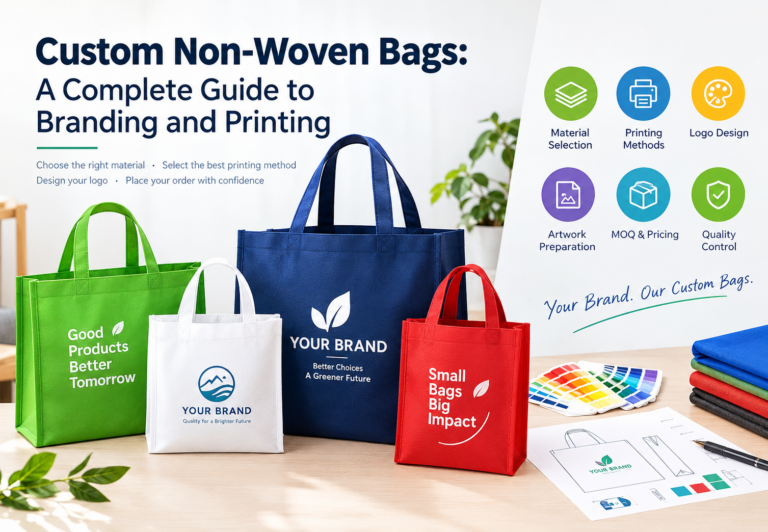

Custom non-woven bags have become a practical packaging and promotional option for retailers, supermarkets, fashion brands, event organizers, and wholesale distributors. By combining functional bag designs with customized colors, logos, and printed messages, businesses can create packaging that supports both daily operations and brand recognition.
However, successful custom bag production involves more than placing a logo on a bag. Buyers need to consider material specifications, bag construction, printing techniques, artwork preparation, order quantities, quality control, and production schedules.
For businesses sourcing custom non-woven bags in bulk, making these decisions early can help control costs, reduce revisions, and achieve a more consistent result across the entire order.
This guide covers the key considerations for branding and printing custom non-woven bags, helping business buyers choose the right specifications for their projects.
1. What Are Custom Non-Woven Bags?
Non-woven bags are commonly manufactured from polypropylene (PP) non-woven fabric. Instead of being produced by weaving yarns together, the material is formed by bonding fibers into a fabric-like structure.
PP non-woven bags are widely used in retail, promotional campaigns, exhibitions, supermarkets, and corporate events because they are lightweight, customizable, and available in a variety of styles.
Businesses can customize several aspects of the bag, including:
- Material weight and fabric color
- Bag dimensions and carrying capacity
- Handle style and reinforcement
- Side gussets and bottom construction
- Logo size and printing position
- Printing method and number of colors
- Additional features such as pockets, closures, or laminated finishes
The best combination depends on how the bags will be used, what they need to carry, and how the brand wants to present itself.
For example, a company distributing promotional bags at a trade show may prioritize lightweight construction and economical logo printing. A retailer selling products in-store may prefer a more structured bag with reinforced handles and carefully matched brand colors.
2. Why Branding Matters for Custom Non-Woven Bags
A branded shopping bag can extend the customer experience beyond the original purchase. When recipients reuse a bag for shopping, commuting, or carrying personal items, the printed design may continue to expose the brand to other people.
For businesses, the value of customization goes beyond adding a logo.
Build consistent brand recognition
Using consistent logos, colors, and typography across bags and other packaging helps customers recognize a business.
Brands with established visual guidelines should provide their official logo files and color references before production begins.
Support marketing campaigns
Custom non-woven bags can be produced for product launches, trade shows, promotional events, seasonal campaigns, and corporate gifting.
The artwork can be adapted to different occasions while retaining recognizable brand elements.
Create a more professional presentation
A carefully selected bag size, suitable material, balanced layout, and clean print finish can make products and promotional materials look more organized and professional.
Support repeated use
A bag that is comfortable to carry and suitable for everyday tasks has a better chance of being reused. Businesses should therefore consider construction, capacity, and handle comfort alongside branding.
Branding works best when the printed design and the practical function of the bag support each other.
3. Choose the Right Non-Woven Bag Material and GSM
Before selecting a printing method, buyers should determine which material and fabric weight fit their application.
GSM stands for grams per square meter and indicates the mass of the fabric per unit area. It is one useful specification when comparing non-woven materials, but it does not determine bag strength on its own.
Common GSM considerations
| GSM range | Potential applications | What to consider |
|---|---|---|
| 70–80 GSM | Lightweight promotional bags and giveaways | Intended load, handle construction, and expected reuse |
| 80–100 GSM | General shopping bags and everyday promotional use | Balance between structure, weight, and cost |
| 100–120 GSM | More substantial shopping bags and selected retail applications | Reinforcement, seams, bag size, and product weight |
These ranges are general purchasing guidelines, not universal performance standards. Actual suitability depends on the material, construction, bag dimensions, and intended load.
For example, a larger bag with wide gussets may require a different construction from a small flat promotional tote, even if both use the same GSM.
Standard versus laminated non-woven bags
Standard non-woven fabric has a textile-like surface and is commonly used for straightforward printed logos.
Laminated non-woven bags include an additional film layer, which can provide a smoother surface for detailed graphics and create a matte or glossy appearance.
Lamination may increase material cost and affect the bag’s flexibility and end-of-life options. Buyers should consider these trade-offs before choosing a finish.
4. Select a Bag Style That Fits Your Business
The bag structure should match the products, distribution method, and customer experience you want to create.
Tote bags
Tote bags are suitable for retail shopping, promotional campaigns, exhibitions, and corporate events. Their broad front and back panels provide convenient areas for branding.
Gusseted shopping bags
Side or bottom gussets create additional volume, making these bags useful for groceries, clothing, packaged goods, and event materials.
Box-shaped bags
Structured, box-shaped bags can provide a wider base and more defined form. They may be suitable for product kits, gift sets, and retail applications where presentation matters.
Foldable bags
Foldable styles are useful for campaigns that emphasize portability and compact storage. Buyers should check the folding design, handle construction, and material durability.
Die-cut handle bags
These bags have handles cut directly into the bag panel. They may be suitable for certain promotional or retail applications, depending on the required load and reinforcement.
When selecting a style, consider the actual products the bag will carry, how it will be distributed, and whether recipients are likely to reuse it.
5. Compare the Main Printing Methods for Custom Non-Woven Bags
Printing is one of the most important decisions in a custom non-woven bag project. Different methods offer different capabilities, setup requirements, and visual results.
The right choice depends on the artwork, material, bag construction, order quantity, and budget.
Screen printing
Screen printing transfers ink through a mesh screen onto the bag surface. Separate screens are generally prepared for different spot colors.
Best suited for:
- Simple company logos
- Solid-color graphics
- Promotional bags
- Trade show giveaways
- Retail bags with limited-color designs
Its main advantage is that it can provide clear, bold branding for many standard applications. For suitable bulk orders, the setup cost can be distributed across the quantity produced.
However, complex gradients and photographic images may be less practical than with other processes.
Heat transfer printing
Heat transfer printing applies a design through a transfer material using controlled heat and pressure.
Depending on the specific technology, it can accommodate detailed graphics, multiple colors, and certain gradient effects.
Best suited for:
- Multicolor artwork
- Detailed illustrations
- Selected short or medium production runs
- Designs that need more color flexibility
The transfer system must be compatible with the bag material. Buyers should also check adhesion, flexibility, and resistance to peeling or cracking through sample testing.
Flexographic printing
Flexographic printing uses flexible printing plates and may be integrated into continuous material production.
It can be suitable for high-volume projects when the factory’s equipment and bag manufacturing process support the required design.
Best suited for:
- Repeated designs
- Compatible large-volume production
- Projects where printing and bag conversion can be coordinated
Setup requirements and artwork complexity should be evaluated before assuming it will be the most economical option.
Rotogravure printing with lamination
Rotogravure printing uses engraved cylinders to transfer ink onto a compatible surface. For certain non-woven bag constructions, the artwork is printed on a film that is then laminated to the fabric.
Best suited for:
- Laminated non-woven bags
- Detailed full-color graphics
- Large printed panels
- Suitable high-volume orders
The process can deliver detailed designs, but tooling and lamination add cost and production complexity.
Printing method comparison
| Method | Typical design suitability | Main consideration |
|---|---|---|
| Screen printing | Simple logos and solid colors | Number of colors and setup cost |
| Heat transfer | Detailed, multicolor artwork | Transfer quality and material compatibility |
| Flexographic printing | Compatible high-volume projects | Production-line requirements and tooling |
| Rotogravure with lamination | Detailed designs on laminated bags | Cylinder setup and lamination cost |
There is no single printing method that is best for every project. Request a recommendation based on your actual artwork and order specifications rather than selecting a process by name alone.
For a more detailed comparison, buyers can consult this guide to custom non-woven bag printing methods.
6. Prepare Print-Ready Artwork
Even a suitable printing method can produce disappointing results if the artwork file is incomplete or incorrectly prepared.
Before submitting your design, confirm the manufacturer’s technical requirements.
Use appropriate file formats
Vector formats such as AI, EPS, or vector PDF are generally preferred for logos, text, and illustrations because they can be resized without pixelation.
High-resolution raster images may also be suitable for photographic or complex artwork. A common starting point is 300 DPI at the intended print size, although the actual requirement depends on the printing process.
Confirm brand colors
Screen colors do not always match printed colors. If your brand requires consistent color reproduction, provide Pantone references or other agreed color specifications where applicable.
The manufacturer should confirm which color mode and file setup are required for the selected printing method.
Keep important content within the safe area
Place logos and text away from seams, handles, folds, and other construction boundaries.
Use the manufacturer’s artwork template whenever possible. Different bag dimensions and styles may have different printable areas.
Check text and fine details
Very small text and thin lines may be difficult to reproduce clearly on textured non-woven fabric.
Review the design at its actual print size and simplify details when necessary.
Approve a sample
A digital proof is useful for checking the layout, but a physical sample provides a better indication of the actual material, color, print finish, and placement.
For additional guidance, read our article on preparing artwork for custom non-woven bag printing.
7. Design Your Bag for Brand Visibility
Effective branding is not simply about making the logo as large as possible. The design should remain recognizable, balanced, and appropriate for the bag’s intended use.
Establish a clear visual hierarchy
The most important brand element should be easy to identify. A company logo may be the primary feature, while a slogan, website, or campaign message plays a supporting role.
Avoid crowding the design with too many elements.
Use sufficient contrast
The relationship between the bag color and the printed artwork affects readability.
A dark logo may stand out on a light-colored bag, while a light logo may be more visible on a dark background. Always evaluate the combination using the actual material and intended printing process.
Choose a practical print size
A large logo can improve visibility, but it should fit the bag’s proportions and printable area.
Consider how the bag looks when empty, filled, folded, or carried. The final design should remain recognizable in normal use.
Consider both sides of the bag
Printing on both sides can create additional branding opportunities. However, it may affect the quotation depending on the process and design.
If you need different designs on the front and back, provide separate artwork files and label each side clearly.
8. Understand MOQ, Pricing, and Bulk Order Planning
For B2B buyers, the unit price is only one part of the purchasing decision.
The overall quotation may depend on material, bag dimensions, GSM, construction, printing method, number of print colors, additional features, order quantity, packaging, and delivery arrangements.
How order quantity affects pricing
Some printing processes require screens, plates, or cylinders before production begins. These setup costs can make small orders relatively expensive per unit.
Larger quantities may spread setup costs across more bags, although the final unit price still depends on the complete specification.
Ask suppliers to quote your planned quantity and, when useful, one alternative quantity. This can help you understand whether a larger order offers meaningful savings.
Confirm the minimum order quantity
MOQ varies by bag style, construction method, material, printing requirements, and manufacturer.
For your planning, the company’s previously provided standard guidance is:
- Sewn non-woven bags: MOQ from 500 pieces.
- Heat-pressed non-woven bags: MOQ from 10,000 pieces.
These are indicative company-specific figures, not universal industry standards. Confirm the current MOQ for your exact design and specifications before placing an order.
Evaluate the total project cost
Compare quotations based on equivalent specifications. A lower price may reflect differences in fabric weight, bag dimensions, printing coverage, reinforcement, packaging, or quality requirements.
A clear specification sheet makes supplier quotations easier to compare.
9. Quality Control for Custom Printed Non-Woven Bags
A successful bulk order should meet both construction and branding requirements.
Before mass production, buyers should agree on the specifications that matter most to the project.
Material and dimensions
Confirm the material type, GSM, bag measurements, gusset dimensions, and handle construction.
Printing quality
Inspect logo placement, color consistency, sharpness, coverage, and alignment.
For repeat orders, retain the approved artwork and a reference sample whenever practical.
Construction quality
Check seams, handle attachment, reinforcement, and the overall shape of the bag.
The appropriate inspection criteria depend on the bag’s construction and intended use.
Packaging and delivery
Confirm the quantity per carton, packing method, shipping marks, and delivery requirements before production is completed.
For larger orders, agree on how defects and quantity discrepancies will be handled.
A written specification and documented sample approval help the buyer and manufacturer work toward the same quality expectations.
10. How to Reduce Delays in Custom Bag Production
Artwork revisions and specification changes can affect the production schedule, particularly when they occur after sampling or production preparation has started.
To reduce avoidable delays:
- Finalize bag dimensions, material, and construction before artwork approval.
- Submit complete, print-ready files.
- Confirm the printing method and color requirements early.
- Review samples and consolidate feedback into one clear revision list.
- Approve the final version in writing.
- Confirm the production schedule, inspection arrangements, and shipping method with the supplier.
Remember that manufacturing lead time and international transit time are different. If the bags are needed for a campaign, exhibition, or seasonal promotion, work backward from the date the goods must arrive.
Build in a reasonable contingency for approvals, production changes, and transportation.
11. A Practical Checklist Before Placing Your Order
Use this checklist when preparing a custom non-woven bag inquiry.
Product specifications
-
Bag style and dimensions
-
Material type and GSM
-
Bag color and handle design
-
Reinforcement and additional features
Branding and printing
-
Final logo and artwork files
-
Brand color references
-
Printing method and number of colors
-
Print area and front/back requirements
-
Sample approval requirements
Commercial and delivery details
-
Estimated order quantity
-
Required MOQ
-
Quotation and payment terms
-
Production lead time
-
Packaging and shipping arrangements
-
Required arrival date
Providing these details at the beginning helps suppliers assess your requirements and prepare a more relevant quotation.
Conclusion: Build a Better Custom Non-Woven Bag for Your Brand
Custom non-woven bags can support retail packaging, promotional campaigns, trade shows, and wholesale distribution when the material, construction, and branding are planned together.
The most important decisions include selecting a suitable bag style and GSM, choosing the right printing method, preparing accurate artwork, confirming the order quantity, and establishing clear quality requirements before production.
For business buyers, a well-defined specification is the foundation of a successful order. It helps reduce misunderstandings, improves quotation accuracy, and gives the manufacturer a clearer target for production.
If you are sourcing custom bags for your business, explore our Custom Non-Woven Bags for Business Branding and Wholesale Supply.
Prepare your logo, preferred bag dimensions, material requirements, estimated quantity, printing preferences, and target delivery date to help your supplier recommend a suitable solution for your project.