

When ordering custom packaging bags, one of the first questions B2B buyers usually ask is:
“What is the MOQ?”
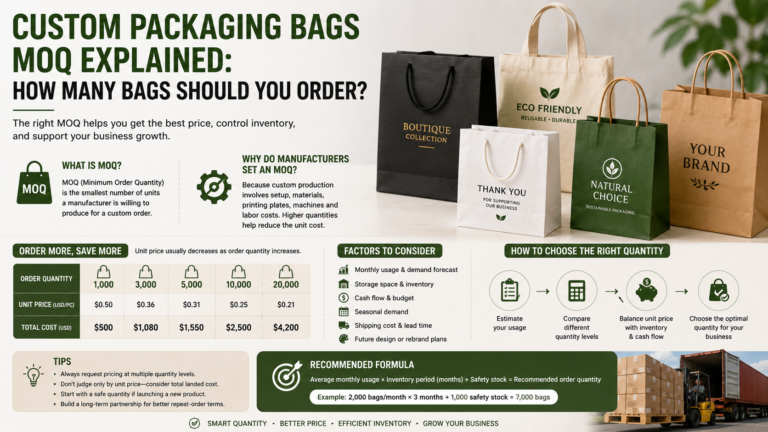
MOQ stands for Minimum Order Quantity, which refers to the smallest quantity a manufacturer is willing to produce for a specific custom order.
For a business ordering custom paper bags, non-woven bags, canvas bags, or other packaging, MOQ can have a significant impact on unit cost, inventory, cash flow, production efficiency, and shipping costs.
Ordering too few bags may result in a higher unit price. Ordering too many can leave you with excess inventory and unnecessary storage costs.
So how many custom packaging bags should you actually order?
This guide explains how MOQ works and how B2B buyers can determine the right order quantity for their business.
What Does MOQ Mean for Custom Packaging Bags?
MOQ is the minimum number of units required for a production order.
For example, if a manufacturer has an MOQ of 1,000 bags, an order of 500 bags may not be accepted under the standard production terms.
However, MOQ is not necessarily the same for every product.
It can vary depending on:
- Bag material
- Bag size
- Printing method
- Number of colors
- Custom artwork
- Finishing
- Handle type
- Production process
- Special materials
- Factory capacity
A simple one-color printed paper bag may have a different MOQ from a premium bag with multiple finishing techniques.
Why Do Manufacturers Set an MOQ?
MOQ exists primarily because custom packaging production involves setup and manufacturing costs.
Before producing your bags, the manufacturer may need to prepare:
- Raw materials
- Printing plates or setup
- Cutting dies
- Printing machines
- Production equipment
- Handles and accessories
- Packaging materials
- Quality control processes
These costs do not always change significantly whether you order 500 or 5,000 bags.
For example, if a printing setup costs the same for a small batch and a large batch, producing more units allows the setup cost to be distributed across more bags.
This is one reason larger orders often have a lower unit cost.
MOQ vs. Best Order Quantity
The MOQ is the minimum you can order.
It is not necessarily the quantity you should order.
This distinction is important.
For example:
MOQ: 1,000 bags
You could order 1,000 bags, but if your business expects to use 10,000 bags over the next year, ordering only 1,000 may not be the most cost-efficient strategy.
Your goal should be to find the optimal order quantity, not simply the lowest acceptable quantity.
How Many Custom Bags Should You Order?
A good starting point is to estimate your expected usage over a specific period.
Consider:
Average monthly usage × expected inventory period + safety stock = recommended order quantity
For example:
If your company uses approximately 2,000 bags per month and wants to maintain three months of inventory:
2,000 × 3 = 6,000 bags
You could then add a small safety margin depending on your demand fluctuations.
This approach is more useful than choosing an order quantity based only on the supplier’s MOQ.
1. Consider Your Monthly Usage
Start by looking at your historical packaging consumption.
Ask:
- How many bags do we currently use each month?
- Is demand increasing?
- Are there seasonal peaks?
- How often do we reorder?
- How much storage space do we have?
For established businesses, historical purchasing data can provide a good foundation.
For a new product launch, you may need to estimate demand using sales forecasts.
2. Consider Your Product Launch Forecast
New businesses often face a different challenge because they do not have historical sales data.
Suppose a new fashion brand expects to sell:
1,500 orders per month
If most customers receive one shopping bag, an initial order of 1,500 bags might appear reasonable.
But it may be safer to consider:
- Launch demand
- Marketing campaigns
- Retail events
- Replacement bags
- Damaged inventory
- Unexpected sales growth
An initial order of 2,000–3,000 bags may be more practical depending on the available budget and supplier pricing.
The exact quantity should be based on the business forecast rather than a fixed formula.
3. Consider Seasonal Demand
Packaging demand is rarely consistent throughout the year.
Retail businesses may experience significant increases during:
- Christmas
- Black Friday
- Valentine’s Day
- Mother’s Day
- Halloween
- Summer sales
- Product launches
For example, a retailer may normally use 3,000 bags per month but require 6,000 or more during the holiday season.
If your custom bags are specifically designed for a seasonal campaign, production should begin early enough to allow for:
Design → Sampling → Production → Inspection → Shipping → Delivery
Running out of seasonal packaging halfway through a campaign can be much more expensive than maintaining a reasonable safety stock.
4. Consider Storage Capacity
Ordering more bags can reduce your unit price, but it also increases inventory.
Before placing a large order, consider:
- Warehouse space
- Carton dimensions
- Number of cartons
- Storage conditions
- Inventory turnover
Paper bags are lightweight, but thousands of bags can occupy considerable space.
A lower unit price is not necessarily a better deal if the packaging sits in your warehouse for years.
5. Compare Different Order Quantities
When requesting a quotation, don’t ask only:
“What is your price for 1,000 bags?”
Instead, ask for several quantity levels.
For example:
| Quantity | Unit Price | Total Cost |
|---|---|---|
| 1,000 | $0.50 | $500 |
| 3,000 | $0.36 | $1,080 |
| 5,000 | $0.31 | $1,550 |
| 10,000 | $0.25 | $2,500 |
The exact figures will vary by material and supplier, but the principle is important.
A larger order may significantly reduce the unit price.
However, you need to balance that saving against inventory requirements.
6. Calculate the Total Landed Cost
Don’t evaluate MOQ using the factory unit price alone.
Your actual cost may include:
- Product cost
- Printing
- Finishing
- Packaging
- Domestic transportation
- International freight
- Duties or taxes where applicable
A larger order can sometimes improve shipping efficiency because the freight cost is distributed across more units.
For international B2B buyers, comparing total landed cost per bag is much more useful than comparing factory prices alone.
7. Consider Cash Flow
Inventory ties up capital.
Suppose you normally need 1,000 bags per month.
Ordering 12,000 bags at once might produce a lower unit cost, but you are paying for a year’s supply upfront.
A smaller order may have:
- Higher unit cost
- Lower initial investment
- Lower inventory risk
- Greater flexibility
A larger order may provide:
- Lower unit cost
- Fewer production cycles
- Better pricing
- Potentially lower average shipping costs
The right decision depends on your company’s cash flow and inventory strategy.
8. Don’t Ignore Product Changes
Packaging designs can become outdated.
Your brand may change:
- Logo
- Brand colors
- Product range
- Store locations
- Marketing strategy
- Packaging requirements
If you order 50,000 bags and redesign your branding six months later, you may be left with a large amount of unusable inventory.
For businesses undergoing rapid growth or rebranding, a smaller initial order can reduce this risk.
9. Consider Repeat Orders
If you expect to reorder the same bag regularly, discuss repeat-order pricing with your manufacturer.
A consistent packaging specification can make future orders easier.
Keep records of:
- Material
- GSM
- Dimensions
- Handle type
- Printing method
- Artwork
- Finishing
- Approved sample
- Carton specifications
This allows the manufacturer to reproduce the same packaging more consistently.
For retail chains and established brands, standardizing packaging specifications can significantly simplify procurement.
10. Should You Order More Than the MOQ?
Sometimes, yes.
Suppose the MOQ is:
1,000 bags
But the manufacturer offers a significantly better price at:
5,000 bags
If your business expects to use 5,000 bags within a reasonable period and you have sufficient storage space, ordering 5,000 may make sense.
However, don’t order a larger quantity simply because the unit price looks attractive.
Always ask:
“How quickly can we realistically use this inventory?”
11. When a Smaller Order Makes Sense
A smaller quantity may be better when:
- You are launching a new product
- Demand is uncertain
- You are testing a new design
- Your branding may change
- Storage space is limited
- Cash flow is tight
- The packaging is seasonal
- You need to test customer response
In these situations, minimizing inventory risk can be more valuable than maximizing unit-price savings.
12. When a Larger Order Makes Sense
A larger order may be appropriate when:
- Demand is predictable
- The packaging design is stable
- You have sufficient storage
- You reorder frequently
- Unit price drops significantly at higher quantities
- Shipping costs can be optimized
- The bags have a long shelf life
For established retail businesses, larger production runs can often provide better purchasing efficiency.
MOQ for Different Types of Custom Bags
MOQ can vary considerably depending on the product.
Custom Paper Bags
MOQ can depend on:
- Paper type
- Bag size
- Printing
- Handles
- Finishing
PP Non-Woven Bags
Often suitable for large promotional campaigns because the material and production process can support high-volume orders.
Canvas Bags
Production may involve additional sewing and textile processes, so MOQ and pricing can differ from non-woven bags.
PVC Bags
MOQ can depend on:
- Material thickness
- Size
- Printing
- Zipper or accessory requirements
- Construction
Therefore, don’t assume that one supplier’s MOQ applies to every bag type.
Can You Negotiate MOQ With a Manufacturer?
Sometimes.
MOQ may be more flexible when:
- You are ordering multiple sizes
- You combine orders
- You have repeat purchasing plans
- The material is readily available
- The design is relatively simple
- The manufacturer has available production capacity
However, MOQ is ultimately determined by the economics of the specific production process.
Instead of simply asking:
“Can you lower the MOQ?”
A better approach is to ask:
“What quantity would give us the best balance between unit price and inventory?”
This creates a more productive conversation with the supplier.
A Practical MOQ Strategy for B2B Buyers
A simple three-level quotation strategy can help.
Level 1: Minimum Order
Request the supplier’s MOQ.
This tells you the lowest possible entry quantity.
Level 2: Target Order
Calculate the quantity you realistically expect to use within several months.
This is often the most practical option.
Level 3: Volume Order
Ask for pricing at a significantly larger quantity.
This helps you understand how much you could save by increasing the order.
You can then compare:
Unit price + inventory cost + shipping cost + cash flow
rather than looking at the unit price alone.
Questions to Ask Your Packaging Supplier
Before confirming your order, ask:
- What is the MOQ for this specific bag?
- Does MOQ change with different sizes?
- Does printing affect MOQ?
- Does the handle type affect MOQ?
- Is there a lower MOQ for repeat orders?
- What are the price breaks at 1,000, 3,000, 5,000, and 10,000 units?
- What is the production lead time?
- How many bags fit into one carton?
- What is the estimated shipping volume?
- Can you provide a sample before mass production?
These questions can help you understand the real cost of your packaging project.
Custom Packaging Bag MOQ Checklist
Before placing your order, confirm:
- Current monthly usage
- Expected annual demand
- Seasonal demand
- Product launch forecast
- Supplier MOQ
- Price breaks
- Storage capacity
- Cash-flow requirements
- Shipping cost
- Packaging specifications
- Sample approval
- Future repeat-order plans
Conclusion
The right quantity of custom packaging bags is not necessarily the supplier’s minimum order quantity.
For B2B buyers, the ideal order should balance unit price, demand, inventory, storage, cash flow, shipping, and future packaging requirements.
A small order can reduce inventory risk, while a larger order can lower unit costs and improve production efficiency.
The best approach is to request pricing at several quantity levels and calculate the total cost based on your actual business needs.
If your packaging demand is predictable and your design is stable, a larger production run may offer significant savings. If you are launching a new product or testing a new design, a smaller initial order may be the safer choice.
Looking for custom packaging bags with flexible MOQ and bulk production options? We provide custom paper bags, PP non-woven bags, canvas bags, and other packaging solutions for B2B buyers, with professional design support, sampling, production, quality control, and global shipping. Contact us with your requirements to get a customized quotation.