
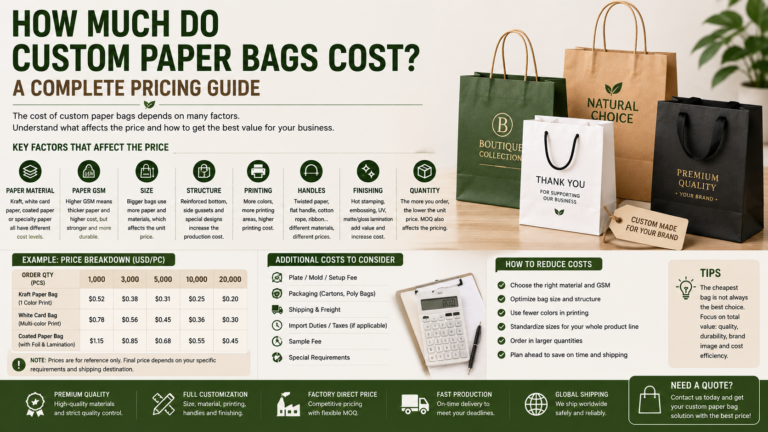

If you are planning to order custom paper bags for your retail store, restaurant, fashion brand, cosmetics business, or promotional campaign, one of the first questions you will probably ask is:
How much do custom paper bags cost?
The short answer is: it depends on the specifications and order quantity.
A custom paper bag is not priced based on paper alone. The final cost can be affected by the paper material, GSM, size, printing, handles, finishing, construction, order quantity, packaging, and shipping.
For B2B buyers, understanding these cost factors is important because the lowest factory price does not always mean the lowest overall purchasing cost.
This guide explains what goes into the price of custom paper bags and how to plan your budget more effectively.
What Determines the Cost of Custom Paper Bags?
The price of a custom paper bag can generally be influenced by several major factors:
- Paper material
- Paper GSM
- Bag size
- Bag structure
- Printing method
- Number of colors
- Handle type
- Special finishing
- Order quantity
- Packaging
- Shipping
- Custom tooling or setup
A useful way to think about the total cost is:
Total Cost = Manufacturing Cost + Packaging + Shipping + Other Applicable Costs
The manufacturing cost itself is made up of multiple components.
1. Paper Material
The type of paper is one of the first factors to consider.
Different papers offer different combinations of appearance, strength, printability, and price.
Kraft Paper
Kraft paper is commonly used for:
- Grocery bags
- Restaurants
- Cafés
- Bakeries
- Retail stores
- Eco-focused brands
It provides a natural appearance and can be a cost-effective choice for everyday packaging.
White Card Paper
White card paper offers a clean printing surface and is often selected by:
- Fashion brands
- Cosmetics companies
- Gift shops
- Retail stores
- Corporate brands
The bright surface can help logos and brand colors stand out.
Coated Paper
Coated paper has a smooth surface and can provide a more premium visual effect.
It is commonly considered for:
- Luxury retail
- Beauty products
- Jewelry
- Premium gifts
- High-end fashion
Depending on the specification, coated paper and additional finishing can increase the overall price.
2. Paper GSM
GSM means grams per square meter and is commonly used to describe paper weight.
For custom bags, common specifications may include different paper weights depending on the application.
Generally, a higher GSM means more paper material is used, which can increase the manufacturing cost.
However, choosing the highest GSM available is not necessarily the best solution.
A better approach is to select a paper weight that matches:
- Product weight
- Bag dimensions
- Expected usage
- Handle construction
- Required durability
For example, a lightweight bag for clothing does not necessarily require the same paper specification as a bag designed to carry heavy bottles.
3. Bag Size
Larger bags generally require more paper.
This means dimensions can have a direct impact on cost.
You will normally need to specify:
- Width
- Height
- Gusset depth
For example:
250 × 320 × 100 mm
A larger bag can increase:
- Material consumption
- Production cost
- Carton volume
- Shipping volume
Therefore, choosing the right size can help control both manufacturing and logistics costs.
Avoid ordering a bag that is significantly larger than the products it needs to carry.
4. Bag Structure
Two paper bags with the same paper material can have different prices because of their construction.
Structural factors may include:
- Flat bottom
- Side gussets
- Reinforced bottom
- Folded edges
- Handle reinforcement
- Special construction
A simple retail bag may require a relatively straightforward structure.
A bag designed for heavy products may need additional reinforcement.
For example, wine and spirits bags often require stronger handles and bottom construction because the products are significantly heavier than clothing or cosmetics.
5. Printing Method
Printing is another important cost factor.
The final price depends on:
- Printing method
- Number of colors
- Print coverage
- Artwork complexity
- Number of printed sides
Simple Logo Printing
A simple one-color or two-color logo is generally easier to produce than a complex full-color design.
This can be a practical option for:
- Promotional bags
- Basic retail packaging
- Corporate bags
- Event bags
Full-Color Printing
Full-color artwork may be more suitable for brands that need:
- Product graphics
- Detailed illustrations
- Complex patterns
- Photographic images
- Large-area branding
However, more complex printing can increase production costs.
6. Number of Printed Sides
Printing only one side and printing multiple sides can have different costs.
For example:
Front only
is generally simpler than:
Front + Back + Both Side Panels
When preparing your design, consider whether every surface needs to carry artwork.
Sometimes a simple design can create a stronger brand appearance while also reducing production complexity.
7. Handle Type
The handle is a small part of the bag, but it can have a noticeable effect on both price and appearance.
Common options include:
- Twisted paper handles
- Flat paper handles
- Cotton rope handles
- Polyester rope handles
- Ribbon handles
Twisted Paper Handles
A practical choice for many everyday retail bags.
Cotton or Rope Handles
Often used for premium packaging because they provide a more substantial look and carrying experience.
Ribbon Handles
Can be suitable for luxury gifts, cosmetics, and fashion packaging.
More premium handle materials and additional reinforcement can increase the unit price.
8. Special Finishing
If you want your paper bags to have a premium appearance, additional finishing can be added.
Popular options include:
- Hot foil stamping
- Embossing
- Debossing
- Spot UV
- Matte coating
- Gloss coating
For example, a cosmetics brand might use a white paper bag with a minimalist logo and gold foil.
These finishing techniques can increase the manufacturing cost, but they may also increase perceived brand value.
The key is to choose finishing based on your brand positioning and target customer rather than simply adding as many effects as possible.
9. Order Quantity
Quantity is one of the most important factors in B2B paper bag pricing.
In many cases, the unit price decreases as order quantity increases.
For example, a supplier might quote different prices at:
- 1,000 bags
- 3,000 bags
- 5,000 bags
- 10,000 bags
- 20,000 bags
The exact pricing will depend on the project.
Why does the unit price often decrease with larger quantities?
Because fixed production costs such as setup, preparation, and tooling can be distributed across more units.
For example:
$500 ÷ 1,000 bags = $0.50 per bag
while:
$2,000 ÷ 10,000 bags = $0.20 per bag
The total order is larger, but the cost per unit can be significantly lower.
10. MOQ Can Affect Your Price
MOQ means Minimum Order Quantity.
A manufacturer may require a minimum number of bags because custom production involves setup costs.
For example, if a factory has a 1,000-piece MOQ, ordering only 500 bags may result in:
- A higher unit price
- Additional setup costs
- Different production arrangements
If your expected usage is high enough, ordering above the MOQ may provide better pricing.
However, you should not automatically order the largest quantity available.
The right quantity should balance:
Unit Price + Demand + Inventory + Storage + Cash Flow
11. Tooling and Setup Costs
Some custom packaging projects may involve additional setup costs.
These can include:
- Printing plates
- Cutting dies
- Special molds
- Production setup
- Special finishing preparation
Whether these costs apply depends on the bag design and manufacturing process.
When comparing quotations, ask whether setup or tooling fees are included in the unit price.
This prevents unexpected costs later.
12. Packaging and Carton Costs
The finished bags need to be packed before shipping.
Packaging costs may depend on:
- Bags per carton
- Carton size
- Carton strength
- Protective packaging
- Number of cartons
Efficient carton packing is especially important for international B2B orders because paper bags can occupy significant shipping volume.
13. Shipping Can Significantly Affect the Final Cost
For international buyers, the factory price is only part of the purchasing equation.
You should also consider:
- Shipping method
- Shipping destination
- Carton dimensions
- Total shipment volume
- Gross weight
- Delivery requirements
For lightweight but bulky products such as paper bags, volumetric considerations can be important.
A supplier offering a slightly lower unit price may not necessarily provide the lowest total delivered cost.
Factory Price vs. Total Landed Cost
When comparing suppliers, it is better to calculate:
Total Landed Cost ÷ Total Number of Bags = Actual Cost per Bag
Total landed cost may include:
- Product cost
- Printing
- Finishing
- Packaging
- Freight
- Applicable duties or taxes
This gives you a more realistic basis for comparing different suppliers.
Example: How Pricing Can Change With Specifications
Imagine two businesses ordering custom paper bags.
Buyer A: Basic Retail Bag
- Kraft paper
- Medium size
- Standard GSM
- One-color logo
- Twisted paper handles
- 5,000 pieces
This type of project is designed primarily around cost efficiency and everyday functionality.
Buyer B: Premium Beauty Bag
- White card or coated paper
- Larger size
- Higher GSM
- Full-color printing
- Cotton rope handles
- Gold foil
- 5,000 pieces
The second project will normally cost more because it uses more material, more complex printing, premium handles, and additional finishing.
This demonstrates why asking only:
“How much is one paper bag?”
does not provide enough information for an accurate quotation.
How to Reduce Custom Paper Bag Costs
If your goal is to reduce costs, you do not necessarily need to compromise the overall quality.
Consider the following strategies.
Optimize the Bag Size
Use a bag that fits the products without excessive empty space.
This reduces material consumption and shipping volume.
Choose the Appropriate GSM
Use enough paper to meet the required strength, but avoid unnecessary material thickness.
Simplify Printing
If your brand identity allows it, a simple logo can be more cost-efficient than a complex full-color design.
Standardize Sizes
Retail chains and businesses with multiple products can reduce complexity by using a limited number of standard bag sizes.
Optimize Order Quantity
Request price quotes at multiple quantity levels.
For example:
1,000 / 3,000 / 5,000 / 10,000 pieces
Then compare the unit price with your actual demand.
Optimize Shipping
Ask your supplier about carton packing and shipping volume before finalizing the order.
Is the Cheapest Paper Bag Always the Best Choice?
No.
A very low-cost bag may have:
- Lower paper GSM
- Simpler handles
- Less reinforcement
- Basic printing
- Limited finishing
This may be perfectly suitable for certain promotional applications.
But a premium fashion or cosmetics brand may need stronger paper, better printing, and higher-end finishing.
The goal should be:
Best value for the intended application, not simply the lowest unit price.
What Information Should You Provide for a Quote?
To receive an accurate quotation from a custom paper bag manufacturer, prepare the following information:
Product Specifications
- Bag material
- Bag size
- GSM
- Bag structure
- Handle type
- Handle color
Printing
- Artwork
- Number of colors
- Printing sides
- Special finishing
Quantity
- Required quantity
- Expected repeat orders
Logistics
- Delivery destination
- Required delivery date
- Preferred shipping method
The more complete your specifications are, the easier it is for a supplier to provide an accurate quote.
Questions to Ask Your Paper Bag Supplier
Before placing an order, ask:
- What paper material do you recommend?
- What GSM is suitable for my products?
- What is the MOQ?
- What is the price at different quantities?
- Are tooling or setup fees included?
- Is the sample cost included?
- What printing method will be used?
- What handle options are available?
- What is the production lead time?
- How are the bags packed?
- What are the carton dimensions and weight?
- What is the estimated shipping cost?
- Can you provide a pre-production sample?
- Can you support repeat orders with consistent specifications?
These questions can help you compare suppliers based on the complete purchasing process rather than unit price alone.
Custom Paper Bag Cost Checklist
Before requesting a quotation, prepare:
- Paper material
- GSM
- Bag dimensions
- Bag structure
- Handle type
- Printing design
- Number of colors
- Finishing
- Quantity
- Delivery destination
- Required delivery date
Having these details ready can significantly speed up the quotation process.
Conclusion
The cost of custom paper bags depends on much more than the paper itself.
Material, GSM, size, printing, handles, finishing, quantity, packaging, and shipping can all influence the final price.
For B2B buyers, the most effective approach is to define the packaging requirements first and then compare quotations based on total landed cost, quality, functionality, and brand value.
A basic kraft paper bag with a simple logo may be an excellent choice for high-volume everyday retail. A premium coated paper bag with specialty finishing may be more appropriate for luxury fashion or cosmetics.
There is no single “best” paper bag price.
There is only the right specification for your business, your products, and your budget.
Looking for custom paper bags for your business? We provide professional design support, material recommendations, custom printing, structural customization, bulk production, quality control, and global shipping for B2B buyers. Contact us with your requirements and request a customized quotation.