
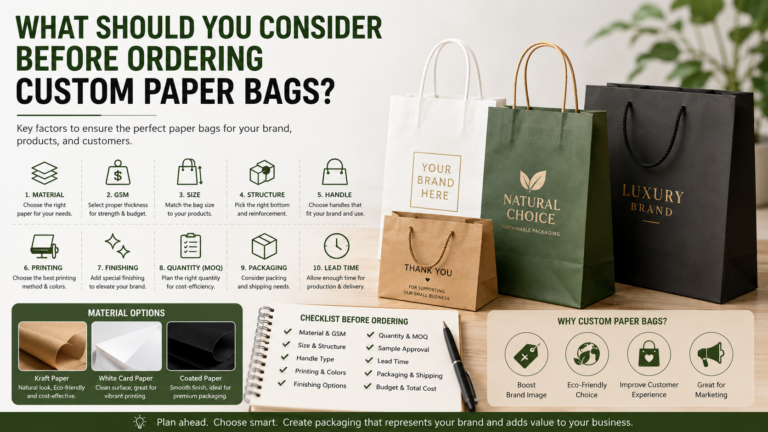

Custom paper bags are more than a simple way to carry products. For retail brands, restaurants, fashion companies, cosmetic businesses, gift shops, and corporate programs, they can become an important part of the brand experience and packaging strategy.
However, ordering custom paper bags involves more than choosing a logo and sending it to a manufacturer.
The right material, size, structure, handle, printing method, quantity, and shipping plan can all affect the final result and total cost.
For B2B buyers, making these decisions before production begins can help prevent quality problems, unnecessary expenses, and delivery delays.
This guide explains the key factors you should consider before ordering custom paper bags.
1. Start With the Products You Need to Pack
The first question should always be:
What will the paper bag carry?
Different products require different packaging specifications.
For example:
- Clothing requires a different bag size than jewelry.
- Shoes need more space and structural support.
- Cosmetics may require premium printing and finishing.
- Wine bottles require reinforced construction and stronger handles.
- Restaurant takeaway products may require suitable dimensions and grease or moisture considerations.
Before contacting a manufacturer, prepare the approximate:
- Product dimensions
- Product weight
- Number of items per bag
- Expected carrying conditions
This information gives the manufacturer a better starting point for recommending the right paper and structure.
2. Choose the Right Paper Material
Paper material has a major impact on the appearance, strength, printing quality, and cost of the finished bag.
Common options include kraft paper, white card paper, and coated paper.
Kraft Paper
Kraft paper is popular for brands looking for a natural and practical appearance.
It works particularly well for:
- Grocery stores
- Cafés
- Bakeries
- Organic products
- Lifestyle brands
- Everyday retail packaging
Its natural brown appearance can also support an eco-conscious brand image.
White Card Paper
White card paper provides a clean, bright printing surface.
It is often used for:
- Fashion brands
- Cosmetics
- Gift packaging
- Retail stores
- Corporate packaging
The white surface allows logos, brand colors, and graphics to appear crisp and vibrant.
Coated Paper
Coated paper has a smoother surface and is often selected for premium packaging.
It can be suitable for:
- Luxury retail
- Beauty brands
- Jewelry
- Perfume
- Premium gifts
It also provides a strong foundation for detailed printing and specialty finishing.
3. Consider Paper GSM
GSM refers to grams per square meter, a common specification used to describe paper weight.
A higher GSM generally means a thicker and more substantial paper, but GSM should not be considered the only indicator of bag strength.
The final performance also depends on:
- Bag dimensions
- Construction
- Bottom design
- Handle attachment
- Paper quality
- Reinforcement
For lightweight products, a lower GSM may provide a cost-efficient solution.
For heavier products, a thicker paper combined with structural reinforcement may be more appropriate.
The goal is not necessarily to choose the thickest paper.
The goal is to choose the right paper specification for the application.
4. Determine the Correct Bag Size
Size is one of the easiest specifications to get wrong.
Your bag should be large enough to comfortably hold the intended products without excessive empty space.
You will typically need to specify:
- Width
- Height
- Gusset depth
For example:
250 × 320 × 100 mm
Before finalizing the dimensions, measure the products that will actually be placed inside the bag.
An oversized bag can increase:
- Material consumption
- Unit cost
- Carton volume
- Shipping costs
- Warehouse requirements
A bag that is too small can create usability and durability problems.
5. Think About Bag Structure
Paper thickness alone does not determine performance.
The bag structure is equally important.
Consider:
- Flat or gusseted construction
- Bottom reinforcement
- Folded edges
- Handle reinforcement
- Side gussets
- Internal support
For heavier products, a reinforced bottom and strong handle attachment can significantly improve performance.
For example, a wine and spirits retailer may need a different structure from a fashion store selling lightweight clothing.
6. Choose the Right Handle
The handle is both a functional and visual element of a paper bag.
Common options include:
Twisted Paper Handles
A popular choice for everyday retail bags.
They offer:
- Practicality
- Good strength
- Cost efficiency
- A classic paper-bag appearance
Flat Paper Handles
These provide a clean and simple appearance and can work well for retail packaging.
Cotton or Rope Handles
These are often used for premium packaging.
They can provide:
- Higher perceived value
- Better carrying comfort
- A more luxurious appearance
Ribbon Handles
Ribbon handles can be suitable for:
- Gift bags
- Cosmetics
- Fashion
- Premium retail
The handle should be selected based on both load requirements and brand positioning.
7. Define Your Printing Requirements
Your logo is only one part of the packaging design.
Before production, consider:
- Number of colors
- Logo placement
- Front and back printing
- Side panel printing
- Background colors
- Patterns
- Images
- Print coverage
For simple branding, one- or two-color printing may be sufficient.
For complex designs, full-color printing may be more appropriate.
The paper surface also affects the final visual result, so printing requirements should be considered together with material selection.
8. Consider Premium Finishing
If your packaging needs a premium appearance, additional finishing options can make a significant difference.
Common techniques include:
- Hot foil stamping
- Embossing
- Debossing
- Spot UV
- Matte coating
- Gloss coating
For example, a beauty brand might combine a clean white paper bag with foil stamping for a sophisticated look.
However, premium finishing adds cost and production complexity.
The best approach is to choose finishing techniques that support your brand rather than adding effects simply because they are available.
9. Think About Sustainability
Sustainability is an increasingly important consideration for brands and consumers.
When choosing paper bags, consider:
- Recycled paper content
- Responsibly sourced paper
- Recyclability
- Paper weight
- Ink and finishing choices
- Reusability
- Applicable certifications
If your business makes environmental claims, make sure those claims accurately reflect the actual materials and certifications of the finished product.
For international B2B buyers, it may also be useful to discuss documentation and certification requirements with the manufacturer before production.
10. Estimate Your Order Quantity
Quantity directly affects production economics.
Before requesting a quotation, estimate:
- Initial order quantity
- Monthly usage
- Annual demand
- Number of stores
- Seasonal requirements
For example, a retail chain with 50 stores may need a very different purchasing strategy from a single boutique.
Ask your supplier about:
- MOQ
- Bulk pricing
- Price breaks
- Repeat-order pricing
- Production capacity
Avoid ordering significantly more bags than you can reasonably store and use.
11. Consider Seasonal and Promotional Demand
Paper bag demand can change dramatically during:
- Christmas
- Halloween
- Valentine’s Day
- Black Friday
- New product launches
- Promotional campaigns
If your bags are needed for a specific campaign, do not wait until the last minute.
Allow time for:
Design → Sampling → Approval → Production → Inspection → Shipping → Delivery
Seasonal packaging should ideally be planned well before the campaign begins.
This is particularly important for international B2B orders where shipping can add additional lead time.
12. Calculate the Total Landed Cost
The factory unit price is only one part of your total cost.
Your actual cost may include:
- Material
- Printing
- Handles
- Finishing
- Tooling or setup
- Packaging
- Inland transportation
- International freight
- Duties or taxes where applicable
Therefore, compare suppliers based on total landed cost, not simply the lowest quoted unit price.
A slightly higher factory price may still be more competitive if it comes with better packaging efficiency, quality, or shipping terms.
13. Think About Shipping Volume
Paper bags are lightweight, but large quantities can take up significant space.
This means shipping volume matters.
Ask your supplier about:
- Bags per carton
- Carton dimensions
- Gross weight
- Net weight
- Packing method
- Number of cartons per shipment
Flat or efficiently packed bags can help optimize transportation and warehouse space.
For large orders, carton optimization can make a meaningful difference to logistics costs.
14. Request a Physical Sample
A physical sample is one of the most valuable steps before mass production.
A digital rendering cannot fully show:
- Paper texture
- Actual color
- Handle feel
- Bag dimensions
- Structural strength
- Finishing quality
A sample allows you to test the actual product.
For heavy-duty applications, put the real products inside the sample and perform a carrying test.
Check:
- Handle attachment
- Bottom strength
- Paper tearing
- Overall stability
Do not approve a large production order based solely on a digital artwork preview when physical performance matters.
15. Check Artwork Before Production
Before mass production, carefully review the final artwork.
Check:
- Logo spelling
- Brand colors
- Logo size
- Position
- Front and back artwork
- Side artwork
- Bleed
- Print area
- Finishing position
For international brands, it is especially important to confirm that all text and brand elements are correct before approval.
A small artwork mistake can become a very expensive mistake once thousands of bags have been produced.
16. Confirm Production Lead Time
Ask your supplier:
How long will production take after artwork and sample approval?
Lead time depends on:
- Material availability
- Quantity
- Printing method
- Bag structure
- Finishing
- Factory schedule
If you have a fixed launch or campaign date, work backward from the required delivery date.
For example:
Delivery deadline → Shipping time → Production → Sampling → Design approval
This makes it easier to determine when you need to place the order.
17. Evaluate the Manufacturer, Not Just the Product
A good paper bag can come from many suppliers.
But for B2B buyers, the supplier itself is also part of the purchasing decision.
Consider:
- Production capabilities
- Material options
- Quality control
- Sampling process
- Communication
- Production capacity
- Lead times
- Packaging methods
- Export experience
- After-sales support
A manufacturer that can provide professional recommendations and consistent repeat production can be especially valuable for businesses ordering regularly.
18. Create a Clear Specification Sheet
Before production, put all key details into one document.
Your specification sheet should include:
Material
Kraft / white card / coated paper
GSM
Required paper weight
Size
Width × height × gusset
Printing
Artwork, colors, printing method
Handle
Material, color, length, construction
Finishing
Foil, embossing, coating, etc.
Quantity
Total order volume
Packaging
Carton quantity and dimensions
Delivery
Destination and required delivery date
A clear specification sheet helps both the buyer and manufacturer work from the same information.
Custom Paper Bag Pre-Order Checklist
Before placing your order, confirm:
- Product type and weight
- Paper material
- GSM
- Bag dimensions
- Bag structure
- Handle type
- Printing method
- Artwork
- Finishing
- Quantity
- MOQ
- Sample approval
- Production lead time
- Quality requirements
- Carton packing
- Shipping method
- Delivery deadline
If all of these points are clearly defined, the ordering process becomes much smoother.
Conclusion
Ordering custom paper bags is a balance between function, appearance, cost, branding, sustainability, and logistics.
Before placing an order, buyers should carefully consider the product weight, paper material, GSM, dimensions, structure, handles, printing, finishing, quantity, shipping requirements, and production timeline.
The cheapest bag is not necessarily the best option, and the most premium bag is not necessarily the most suitable.
The ideal solution is the one that meets your product requirements while delivering the right combination of quality, brand value, cost efficiency, and reliable production.
Whether you need kraft paper bags for everyday retail, premium paper bags for fashion and cosmetics, or reinforced bags for heavier products, working with an experienced custom packaging manufacturer can help you make better decisions from the beginning.
Looking for custom paper bags for your business? We provide professional design support, material recommendations, custom printing, structural customization, bulk production, quality control, and global shipping for B2B buyers. Contact us to discuss your packaging requirements and request a quotation.