
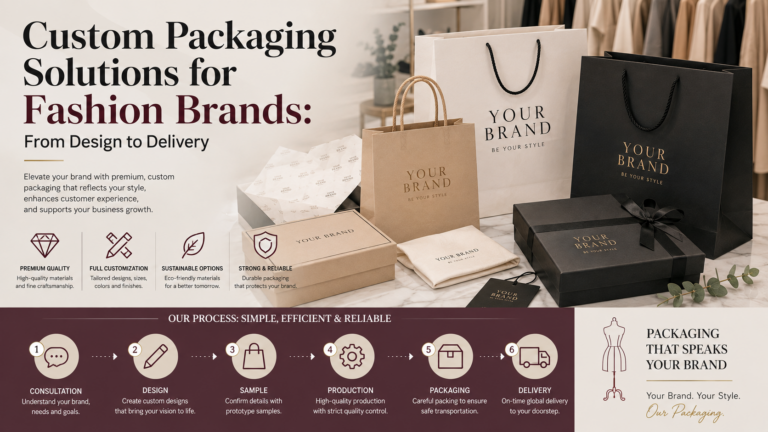

In fashion, packaging is more than a way to carry a purchase home.
A shopping bag, gift box, tissue wrap, or custom package can become part of the customer’s first impression of a brand. For fashion companies, where visual identity and perceived value are closely connected, packaging needs to look good, perform well, and arrive consistently across every store, collection, and campaign.
That is why more fashion brands are treating packaging as a strategic brand asset rather than a simple purchasing item.
From selecting the right paper and bag structure to confirming artwork, production, quality control, and international shipping, a successful custom packaging project requires careful coordination.
This guide explains how fashion brands can build an effective custom packaging solution from design to delivery.
1. Why Packaging Matters So Much for Fashion Brands
Fashion is a highly visual industry.
Customers evaluate a brand through many details:
- Store design
- Product presentation
- Website
- Social media
- Labels
- Hangtags
- Packaging
- Shopping experience
Packaging sits at the intersection of several of these touchpoints.
A well-designed custom shopping bag can reinforce a brand’s identity immediately after purchase.
For example, a fashion brand might use:
- Minimalist white paper bags
- Natural kraft paper
- Premium rope handles
- Embossed logos
- Metallic foil details
- Custom colors
- High-quality printing
Each detail contributes to the overall customer experience.
The bag may only cost a small percentage of the product price, but it can have a disproportionate effect on how the purchase feels.
2. Start With Your Brand Identity
Before selecting a packaging material, fashion brands should define what the packaging needs to communicate.
Ask:
What should the customer feel when they receive the package?
Different brands may want very different answers.
Luxury Fashion
The packaging may emphasize:
- Premium materials
- Clean design
- Precise printing
- Sophisticated finishing
- Strong structure
Contemporary Fashion
The focus may be:
- Minimalism
- Bold typography
- Distinctive colors
- Modern graphics
Sustainable Fashion
The packaging may prioritize:
- Recycled paper
- Natural textures
- Minimal finishing
- Reusable formats
- Responsible material choices
Streetwear
Packaging can be:
- Bold
- Graphic-heavy
- Experimental
- Highly recognizable
The packaging should feel like it belongs to the same brand world as the clothing.
3. Choose the Right Packaging Format
Fashion brands rarely need only one packaging product.
Different products and sales channels may require different formats.
Common fashion packaging solutions include:
Custom Paper Shopping Bags
Ideal for:
- Retail stores
- Clothing
- Shoes
- Accessories
- Gift purchases
Paper bags offer a large printable surface for branding and can be customized in many sizes.
Premium Gift Bags
Useful for:
- Seasonal collections
- VIP customers
- Special purchases
- Gift packaging
Reusable Canvas Bags
Suitable for:
- Premium promotions
- Limited collections
- Brand merchandise
- Loyalty campaigns
PP Non-Woven Bags
Often used for:
- Promotional campaigns
- Large-volume events
- Retail promotions
- Cost-conscious reusable packaging
Packaging Boxes
Useful for:
- Shoes
- Accessories
- E-commerce orders
- Premium products
The goal is not to find one packaging format for everything.
Instead, build a packaging system that covers different customer and product scenarios.
4. Select the Right Paper Material
For custom fashion shopping bags, material selection has a major impact on appearance and performance.
Common paper choices include:
- Kraft paper
- White card paper
- Recycled paper
- Coated paper
- Specialty paper
Each creates a different visual effect.
Kraft Paper
Kraft paper provides a natural, textured appearance.
It works particularly well for brands emphasizing:
- Sustainability
- Natural aesthetics
- Minimalism
- Casual fashion
White Card Paper
White paper provides a clean background for brand colors and detailed artwork.
It can be a strong choice for:
- Fashion retailers
- Cosmetics
- Premium lifestyle brands
Coated Paper
Coated paper has a smoother surface and can provide strong print performance.
It may be suitable for:
- Detailed graphics
- Full-color printing
- Premium visual presentation
Recycled Paper
Recycled paper can support brands with sustainability-focused packaging strategies.
Its natural appearance can also become part of the brand aesthetic.
The right choice depends on the balance between appearance, strength, budget, and sustainability goals.
5. Bag Size Should Be Based on the Product
One of the most common packaging mistakes is choosing bag sizes based only on appearance.
A fashion brand should first consider what the bag actually needs to carry.
For example:
Small bag:
Jewelry, accessories, cosmetics, small garments
Medium bag:
Shirts, sweaters, handbags, smaller retail purchases
Large bag:
Coats, multiple garments, shoes, larger shopping orders
The dimensions should account for:
- Product size
- Product weight
- Folding method
- Number of items
- Handle length
- Storage requirements
An oversized bag may waste material and increase shipping volume.
An undersized bag creates a poor customer experience.
The goal is to find the smallest practical size that comfortably fits the intended products.
6. Strength Matters More Than Appearance Alone
A beautiful shopping bag is not successful if the handles break before the customer reaches the car.
Fashion brands should consider the expected load before confirming the specification.
Important structural factors include:
- Paper GSM
- Bag dimensions
- Gusset size
- Bottom construction
- Handle material
- Handle attachment
- Reinforcement
- Number of products per bag
For heavier products such as shoes, jackets, books, or multiple garments, additional reinforcement may be necessary.
The correct specification should be determined through sample testing, not visual judgment alone.
7. Handle Selection Can Change the Entire Look
Handles are both functional and visual.
Common options include:
- Twisted paper handles
- Flat paper handles
- Cotton rope
- Polyester rope
- Ribbon handles
- Die-cut handles
For premium fashion packaging, rope handles are often selected because they create a more substantial tactile experience.
Paper handles can be a practical option for brands looking for a more straightforward paper-based structure.
Handle color can also be matched to the brand identity.
For example:
Black bag + black rope + white logo
creates a very different impression from:
Natural kraft bag + cotton-colored rope + dark green logo.
Small details can completely change the personality of the package.
8. Printing Is Where the Brand Comes to Life
A shopping bag provides a large canvas for visual branding.
Fashion brands can use:
- Logo printing
- Full-color printing
- Pantone color matching
- Patterns
- Illustrations
- Typography
- Seasonal graphics
For brands with strict identity guidelines, color consistency is especially important.
Artwork should be prepared according to the manufacturer’s requirements before production.
Typical artwork considerations include:
- Correct dimensions
- Bleed
- Resolution
- Color mode
- Logo placement
- Safe areas
- Handle position
A clear artwork approval process can prevent expensive production mistakes.
9. Finishing Can Add Premium Value
Fashion packaging often uses finishing techniques to create a more distinctive appearance.
Popular options include:
Hot Foil Stamping
Metallic foil can highlight logos or selected design elements.
Embossing
Creates a raised logo or graphic.
Debossing
Creates a recessed design.
Matte Finish
Can create a refined, understated appearance.
Gloss Finish
Provides a brighter and more reflective surface.
Spot UV
Can highlight selected areas with contrast and shine.
However, more finishing does not necessarily mean better packaging.
A sophisticated fashion brand may achieve a stronger result with one carefully selected finishing technique than with five competing effects.
10. Sustainable Packaging Is Becoming More Important
Fashion brands face increasing pressure to evaluate packaging waste and material choices.
Many companies are exploring:
- Recycled paper
- FSC-certified paper where appropriate
- Reusable bags
- Reduced packaging weight
- Simplified structures
- Recyclable packaging formats
However, sustainability should be approached systematically.
Instead of asking:
“Which material is the greenest?”
brands should ask:
“Which packaging solution provides the required performance with an appropriate environmental profile?”
For example, reducing unnecessary paper weight or optimizing bag dimensions can reduce material usage and shipping volume.
11. Packaging Should Work Across Retail and E-Commerce
Fashion brands increasingly operate across multiple channels.
A company may sell through:
- Flagship stores
- Shopping malls
- Pop-up stores
- Online stores
- Department stores
- Wholesale partners
- International distributors
Packaging specifications should therefore be consistent enough to support the overall brand identity while remaining practical for each channel.
For e-commerce, packaging may need to focus more heavily on:
- Product protection
- Shipping efficiency
- Carton dimensions
- Storage
- Returns
For physical retail, priorities may include:
- Appearance
- Carrying comfort
- Brand visibility
- Customer experience
A well-designed packaging strategy can account for both.
12. Standardization Is Critical for Fashion Brands With Multiple Stores
A small independent boutique might order a few thousand bags.
A fashion chain with 100 or more stores has a much more complicated requirement.
It may need:
- Multiple bag sizes
- Multiple colors
- Different regional requirements
- Seasonal designs
- Repeated production
- Centralized purchasing
- Consistent quality
In this situation, standardization becomes essential.
A brand should establish a packaging specification that defines:
- Material
- GSM
- Dimensions
- Handle type
- Handle color
- Printing colors
- Logo position
- Finishing
- Carton quantity
This master specification can then be used for future production.
13. Samples Should Be Approved Before Mass Production
One of the most important stages in custom packaging production is sampling.
A physical sample allows the brand to evaluate:
- Size
- Color
- Printing
- Paper texture
- Handle strength
- Construction
- Overall appearance
It is much easier to change a specification at the sample stage than after thousands of bags have been manufactured.
For fashion brands, the approval process can include several steps:
Artwork → Digital proof → Physical sample → Testing → Final approval → Mass production
This creates a clear checkpoint before the larger investment begins.
14. Quality Control Should Be Built Into the Process
Quality control is particularly important for repeat B2B orders.
A supplier should have clear standards for:
Dimensions
Are bag sizes within the approved tolerance?
Printing
Are logos and colors consistent?
Structure
Are the bottom and side folds properly formed?
Handles
Are handles securely attached?
Material
Does the paper match the approved specification?
Finishing
Are foil, embossing, coating, or other effects consistent?
For large fashion brands, even small variations can become noticeable when packaging is displayed across multiple stores.
15. Lead Time Should Be Planned Around Your Launch Date
Packaging needs to arrive before the products do.
This sounds obvious, but packaging delays can become a serious problem during:
- New collection launches
- Holiday campaigns
- Black Friday
- Store openings
- Fashion events
- Promotional campaigns
A typical project may involve several stages:
Design → Sampling → Approval → Material Preparation → Production → Quality Control → Packing → Shipping
Each stage requires time.
B2B buyers should therefore plan packaging orders well before the intended launch date.
Rush production can sometimes be arranged, but it may increase costs or limit material and finishing choices.
16. Shipping Is Part of the Packaging Strategy
Paper bags are relatively lightweight, but they can occupy considerable volume.
This makes packaging efficiency important.
Buyers should consider:
- Flat packing
- Carton dimensions
- Bags per carton
- Pallet utilization
- Shipping method
- Destination
- Consolidation
A poorly packed order can increase transportation costs even if the individual bags are inexpensive.
For international fashion brands, optimizing carton packing and shipment planning can significantly improve the overall landed cost.
17. MOQ and Pricing Should Be Evaluated Together
Custom packaging suppliers typically have minimum order quantities.
The right quantity depends on:
- Number of stores
- Monthly sales
- Campaign length
- Number of bag sizes
- Seasonal demand
- Storage capacity
- Budget
For example, a fashion brand might need:
5,000 small bags
10,000 medium bags
5,000 large bags
rather than ordering one size in a huge quantity.
When comparing suppliers, look beyond the unit price.
Consider the total cost:
Product Cost + Printing + Finishing + Packaging + Shipping + Inventory
This is a much more useful comparison for procurement teams.
18. A Good Supplier Can Simplify the Entire Process
Custom packaging involves many details.
Working with multiple suppliers for:
- Paper
- Printing
- Handles
- Finishing
- Packaging
- Shipping
can make coordination difficult.
A packaging manufacturer capable of handling multiple stages can simplify the workflow.
Ideally, the supplier should support you from:
Artwork confirmation → Material selection → Sampling → Production → Quality Control → Packing → Delivery
This reduces communication gaps and makes responsibility clearer.
19. Build a Packaging System Instead of Ordering Random Bags
For growing fashion brands, packaging should be standardized as a system.
For example:
Core Retail Collection
- Small paper bag
- Medium paper bag
- Large paper bag
Premium Collection
- Premium paper bag
- Gift box
- Tissue paper
Promotional Collection
- Reusable non-woven bag
- Canvas tote
Seasonal Collection
- Limited-edition printed bag
- Holiday packaging
This approach makes it easier to manage brand consistency while still allowing flexibility.
20. A Fashion Packaging Project: From Design to Delivery
A typical B2B custom packaging workflow can look like this:
Step 1: Define Requirements
Determine:
- Product type
- Bag size
- Material
- Quantity
- Budget
- Target market
Step 2: Select Material
Compare kraft, white card, recycled, coated, or specialty paper.
Step 3: Confirm Structure
Choose:
- Handle
- Bottom
- Gusset
- Reinforcement
Step 4: Prepare Artwork
Finalize the logo, colors, dimensions, and graphics.
Step 5: Produce Samples
Check appearance and performance.
Step 6: Approve the Sample
Confirm all specifications before mass production.
Step 7: Begin Production
Manufacture the bags according to the approved specification.
Step 8: Quality Inspection
Check material, dimensions, printing, handles, and finishing.
Step 9: Pack for Shipment
Optimize cartons and pallet loading.
Step 10: Deliver
Ship to the required warehouse, distribution center, or store location.
This structured workflow makes the project easier to manage and scale.
Custom Fashion Packaging Checklist
Before placing an order, fashion brands should confirm:
- Brand positioning
- Packaging format
- Bag dimensions
- Paper material
- GSM
- Handle type
- Handle color
- Reinforcement
- Printing method
- Pantone colors
- Finishing
- Artwork specifications
- Sample approval
- Quantity
- MOQ
- Production lead time
- Quality standards
- Carton packing
- Shipping method
- Delivery deadline
Conclusion
For fashion brands, packaging is no longer simply the final step after a customer makes a purchase.
It is part of the brand experience.
The right custom packaging can reinforce brand identity, improve perceived value, support sustainability goals, create memorable customer experiences, and provide additional brand exposure long after the purchase.
But achieving that result requires more than choosing a beautiful bag.
Brands need to coordinate material, structure, printing, finishing, sampling, production, quality control, packaging, and shipping as one connected process.
The strongest packaging projects start with a clear brand vision and finish with a carefully controlled delivery.
Whether you need premium paper shopping bags for a fashion boutique, standardized bags for a multi-store retail chain, or reusable packaging for a seasonal campaign, a well-planned custom packaging solution can turn an ordinary shopping bag into a recognizable extension of your brand.
Looking for custom packaging solutions for your fashion brand? We provide custom paper bags, reusable non-woven bags, canvas bags, gift boxes, and other packaging solutions with professional design support, custom printing, bulk production, quality control, and global shipping for B2B buyers.