
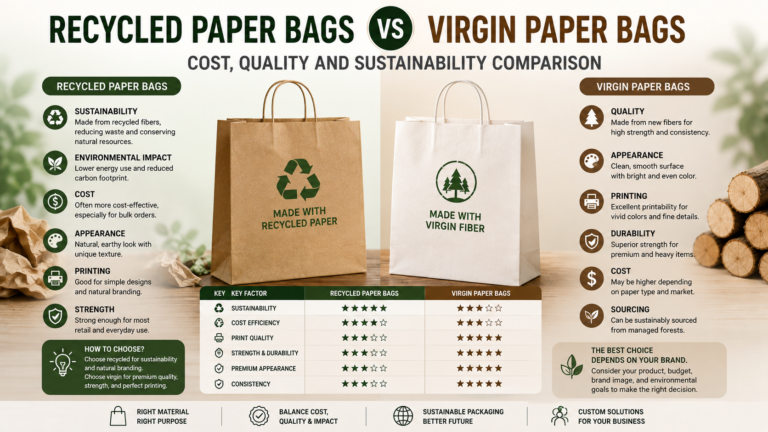

When businesses start planning custom paper bags, one of the first material decisions is often whether to use recycled paper or virgin paper.
At first glance, the choice seems straightforward:
Recycled paper = more sustainable
Virgin paper = better quality
But the real purchasing decision is more nuanced.
Both materials can be suitable for commercial packaging, and the right option depends on the bag’s intended use, required strength, printing quality, brand positioning, budget, and sustainability goals.
For retail chains, fashion brands, cosmetics companies, restaurants, gift businesses, and other B2B buyers, understanding the differences can help avoid choosing a material based on assumptions alone.
This guide compares recycled and virgin paper bags across cost, quality, appearance, durability, sustainability, printing, and practical applications.
What Is the Difference Between Recycled and Virgin Paper?
The most basic difference is the source of the paper fiber.
Virgin Paper
Virgin paper is made primarily from newly sourced wood fiber that has not previously been used in another paper product.
It can offer:
- Consistent fiber quality
- Strong structural performance
- Clean appearance
- Good printability
- Consistent color
Virgin paper is commonly used when brands require a specific appearance or performance level.
Recycled Paper
Recycled paper is produced using recovered paper fibers from previously used paper products.
Depending on the manufacturing process and specification, recycled paper can contain different proportions of recycled content.
It is often selected by brands that want to:
- Increase recycled content
- Reduce reliance on virgin fiber
- Support circular material use
- Communicate sustainability goals
However, recycled paper is not automatically the right choice for every application.
The key question is:
What performance does your packaging actually need?
Recycled vs Virgin Paper Bags at a Glance
| Factor | Recycled Paper Bags | Virgin Paper Bags |
|---|---|---|
| Material source | Recovered paper fibers | Newly sourced fiber |
| Sustainability positioning | Strong | Depends on sourcing |
| Appearance | Natural, slightly varied | Clean and consistent |
| Printability | Good | Excellent |
| Fiber consistency | Can vary | Generally high |
| Strength | Suitable for many applications | Strong and consistent |
| Premium appearance | Possible | Excellent |
| Color consistency | May vary | Generally more consistent |
| Customization | High | High |
| Suitable for retail | Yes | Yes |
| Suitable for premium packaging | Yes, depending on specification | Often preferred |
| Cost | Specification-dependent | Specification-dependent |
There is no universal winner.
The right choice depends on the priorities of the project.
1. Cost: Is Recycled Paper Cheaper?
This is one of the most common questions from B2B buyers.
The answer is:
Not necessarily.
It is tempting to assume that recycled paper must always be cheaper because it uses recovered materials.
In reality, the final price of a custom paper bag depends on many variables.
These include:
- Paper type
- GSM
- Bag size
- Paper availability
- Printing
- Handle type
- Finishing
- Order quantity
- Production process
- Packaging
- Shipping
A recycled paper bag with premium specifications may cost more than a basic virgin-paper bag.
Likewise, a simple recycled kraft bag can be highly cost-effective for large-volume applications.
For this reason, buyers should compare complete specifications, rather than asking only whether recycled paper is cheaper.
2. Material Efficiency Can Matter More Than the Paper Type
When evaluating cost and sustainability, paper weight is extremely important.
A heavier paper uses more material.
For example, a bag produced with 150 GSM paper and another produced with 200 GSM paper may have noticeably different material consumption.
However, higher GSM is not automatically better.
A good packaging specification should provide enough strength for the intended application without unnecessary material.
This means a well-designed recycled paper bag can sometimes achieve a better balance than an unnecessarily heavy virgin paper bag.
The goal should be:
Use the right material at the right weight for the right application.
3. Quality: Which Paper Is Stronger?
The answer depends on the specific paper grade.
Virgin fibers are generally longer and can provide strong paper structures.
This can make virgin paper attractive for applications requiring:
- Higher strength
- Consistent performance
- Heavy products
- Premium construction
- Repeated handling
Recycled fibers have already gone through processing and can have shorter fiber characteristics.
However, modern recycled paper can still provide excellent performance when properly engineered.
Manufacturers can compensate through:
- Appropriate GSM
- Paper structure
- Bag dimensions
- Reinforced bottoms
- Handle reinforcement
- Structural design
Therefore, paper quality cannot be judged solely by whether it is recycled or virgin.
4. Appearance and Color Consistency
Appearance can be particularly important for fashion, cosmetics, luxury retail, and corporate packaging.
Virgin paper generally provides a clean and consistent base.
This can be advantageous when brands require:
- Bright white backgrounds
- Precise brand colors
- Detailed graphics
- High-end photography
- Minimalist designs
- Consistent production across large orders
Recycled paper can have a more natural appearance.
Depending on the grade, it may feature:
- Natural tones
- Slight color variation
- Visible fiber characteristics
- A less processed appearance
For brands that want an authentic or eco-conscious visual identity, this can actually be an advantage.
5. Printing Quality
Both recycled and virgin paper can be printed successfully.
However, the selected paper surface can influence the final appearance.
Virgin white paper can provide a clean background for:
- Full-color printing
- Fine typography
- Detailed graphics
- Brand color matching
Recycled kraft paper often works particularly well with:
- Black logos
- Dark green
- Brown
- Minimalist graphics
- Natural color palettes
For complex artwork, brands should always request a physical sample.
A design that looks perfect on a computer screen can produce a different result on different paper surfaces.
6. Premium Finishing
Custom paper bags can include finishing such as:
- Hot foil stamping
- Embossing
- Debossing
- Matte coating
- Gloss coating
- Spot UV
Virgin paper, particularly smooth white or coated grades, can be a strong choice when a highly polished premium finish is required.
Recycled paper can also be used for premium packaging, but its natural texture may create a different visual effect.
This leads to an important design principle:
Premium does not always mean perfectly smooth.
A luxury brand with an environmentally focused identity may deliberately choose recycled paper with a natural texture rather than a highly coated surface.
7. Sustainability: Why Choose Recycled Paper?
One of the biggest reasons brands choose recycled paper is its role in circular material use.
Using recycled fiber can help reduce dependence on newly sourced fiber and give previously used paper another role in the material cycle.
For brands with sustainability targets, recycled paper can therefore be an attractive option.
It may also support packaging messaging around:
- Recycled content
- Resource efficiency
- Circularity
- Waste reduction
However, brands should avoid making broad environmental claims without supporting documentation.
If your marketing says that a bag contains a certain percentage of recycled content, make sure your supplier can provide appropriate specifications or documentation.
8. Is Virgin Paper Unsustainable?
Not necessarily.
This is an important distinction.
Virgin paper is made from newly sourced fiber, but that does not automatically mean it is environmentally irresponsible.
The sustainability profile of virgin paper can depend on factors such as:
- Fiber sourcing
- Forestry practices
- Manufacturing
- Energy use
- Transportation
- Paper weight
- Product lifespan
- End-of-life management
Responsibly sourced virgin fiber can be an appropriate material for packaging applications where strength, consistency, or appearance are important.
Therefore, the comparison should not be:
“Recycled = good, virgin = bad.”
A better approach is to evaluate the complete material and supply chain.
9. Durability for Heavy Products
For heavy products, structural performance becomes a major consideration.
Examples include:
- Wine bottles
- Spirits
- Shoes
- Books
- Multiple retail products
- Gift sets
In these cases, the paper type is only one part of the equation.
You should also evaluate:
Paper GSM
Does the paper have enough strength?
Bottom Structure
Can the bottom support the product weight?
Handle Attachment
Can the handles withstand repeated lifting?
Reinforcement
Are additional reinforcement materials necessary?
Bag Dimensions
Does the size create excessive stress on the structure?
A well-designed recycled paper bag can perform very well for many applications, while a poorly designed virgin paper bag can still fail.
10. Which Material Is Better for Retail Chains?
Retail chains often have different priorities from small businesses.
If you operate dozens or hundreds of stores, consistency becomes extremely important.
You may need:
- Consistent color
- Consistent dimensions
- Stable paper specifications
- Reliable production
- Repeat-order consistency
- Predictable lead times
Virgin paper can be attractive when strict visual consistency is a major requirement.
However, recycled paper can also work well if the supplier can maintain consistent specifications across production batches.
For large retail networks, the best approach is to approve a master sample and detailed specification before scaling production.
11. Which Material Is Better for Fashion Brands?
Fashion brands often balance sustainability and aesthetics.
Both options can work.
Recycled Paper
Suitable for brands emphasizing:
- Natural aesthetics
- Sustainability
- Minimalism
- Eco-conscious positioning
Virgin Paper
Suitable for brands emphasizing:
- Clean luxury
- Strong color accuracy
- Premium printing
- Smooth surfaces
- High-end finishing
The decision should therefore reflect the brand identity.
A streetwear brand may prefer textured recycled kraft paper.
A luxury cosmetics brand may prefer smooth white paper with precise printing and foil details.
12. Which Material Is Better for Cosmetics and Beauty Brands?
Cosmetics packaging often requires strong visual presentation.
Customers expect:
- Precise branding
- Clean colors
- Premium textures
- High-quality finishing
Virgin white or coated paper can be particularly suitable for these requirements.
However, recycled paper is becoming increasingly relevant for beauty brands with strong sustainability positioning.
A beauty brand might use recycled paper with minimalist graphics to create a natural, contemporary aesthetic.
The key is to make sure the material supports both:
Brand identity + required print quality.
13. Which Material Is Better for Food and Takeaway Packaging?
For restaurants, cafés, bakeries, and takeaway businesses, practicality is often the priority.
Important factors include:
- Bag strength
- Size
- Handle durability
- Product weight
- Oil or moisture considerations
- Printing
- Cost
- Order quantity
Recycled kraft paper can be a practical option for many takeaway applications.
However, the exact material specification should be selected based on the food product and applicable requirements.
Packaging intended for direct food contact may have additional compliance considerations.
14. Recycled Paper Can Strengthen Brand Storytelling
Consumers increasingly encounter sustainability messaging across websites, stores, product labels, and packaging.
A recycled paper bag can become another physical expression of the brand’s positioning.
For example, a brand could communicate:
“Made with recycled paper”
or provide more specific information where appropriate.
But the strongest sustainability communication is usually specific rather than vague.
Instead of simply saying:
“Eco-friendly packaging”
brands can provide meaningful information about the material and its intended disposal pathway.
This makes the packaging story more credible.
15. Virgin Paper Can Deliver Better Consistency for Certain Designs
Some packaging projects depend heavily on precise visual reproduction.
For example:
- Luxury logos
- Fine gradients
- Detailed illustrations
- Corporate brand colors
- Large solid-color backgrounds
In these cases, consistent paper surface and color can make production easier.
Virgin paper may therefore be the safer choice when visual consistency is more important than natural texture.
This can be particularly relevant when the same bag is being manufactured repeatedly across multiple production runs.
16. Recycled vs Virgin: Consider the Entire Lifecycle
Material selection should not stop at the factory.
Consider the full packaging journey:
Raw Material → Production → Printing → Shipping → Customer Use → Reuse → Recycling/Disposal
Each stage can influence the overall environmental profile.
For example, reducing the bag’s size could decrease material usage and shipping volume regardless of whether the paper is recycled or virgin.
Similarly, designing a durable bag that gets reused multiple times can change the value proposition.
This is why a lifecycle perspective is more useful than focusing on a single characteristic.
17. How to Choose the Right Material for Your Business
A simple decision framework can help.
Choose Recycled Paper When:
- Recycled content is an important brand objective
- A natural appearance fits the brand
- The application does not require extreme strength
- Customers value sustainability messaging
- The paper specification meets the required printing quality
- Your supplier can provide consistent quality and documentation
Consider Virgin Paper When:
- High strength is required
- Color consistency is critical
- Premium printing is a major priority
- Smooth surfaces are preferred
- The bag needs a highly polished appearance
- The application requires consistent performance
Consider a Hybrid Approach When:
Your business uses multiple bag types.
For example:
Standard retail bags → Recycled paper
Premium gift bags → Virgin or specialty paper
Heavy product bags → Reinforced specification
This can be more practical than forcing one material across every application.
A Practical Comparison for B2B Buyers
| Requirement | Recycled Paper | Virgin Paper |
|---|---|---|
| Sustainability positioning | ★★★★★ | ★★★ |
| Natural appearance | ★★★★★ | ★★★ |
| Print consistency | ★★★★ | ★★★★★ |
| High-end finish | ★★★★ | ★★★★★ |
| Strength potential | ★★★★ | ★★★★★ |
| Brand color consistency | ★★★★ | ★★★★★ |
| Everyday retail | ★★★★★ | ★★★★★ |
| Premium retail | ★★★★ | ★★★★★ |
| Eco-focused branding | ★★★★★ | ★★★★ |
| Cost efficiency | Depends on specification | Depends on specification |
These ratings are general purchasing considerations, not fixed technical specifications. Actual performance depends on the paper grade and manufacturing process.
Questions to Ask Your Paper Bag Supplier
Before choosing recycled or virgin paper, ask your manufacturer:
- What paper grades are available?
- What GSM do you recommend for my products?
- What percentage of recycled content is available?
- Can you provide material documentation?
- Can you provide samples of both materials?
- How does the printing look on each paper?
- What is the expected load capacity?
- What handle options are available?
- Can the bottom be reinforced?
- What finishing options are compatible?
- What is the MOQ for each material?
- How does pricing change with order quantity?
- Can repeat orders maintain the same specification?
- What packaging and shipping options are available?
Getting physical samples is particularly useful when appearance and strength are important.
How to Reduce Cost Without Sacrificing Sustainability
If your goal is to control costs while improving sustainability, consider these strategies:
Optimize the Bag Size
Avoid oversized bags that consume unnecessary paper.
Choose the Right GSM
Do not automatically select the heaviest paper.
Simplify the Artwork
A simple logo can sometimes be more cost-effective than full-surface printing.
Standardize Sizes
Using a limited number of bag sizes can simplify purchasing and inventory management.
Increase Order Quantity Carefully
Larger quantities may reduce unit costs, but only order what your business can realistically use.
Optimize Carton Packing
Efficient packing can reduce shipping volume and storage requirements.
Test Before Mass Production
A sample can reveal problems before they become expensive production mistakes.
The Best Choice Depends on Your Brand
There is no universal winner in the recycled paper vs virgin paper debate.
The best material depends on what your packaging needs to achieve.
If your priority is:
Natural appearance + recycled content + sustainability positioning
recycled paper may be an excellent choice.
If your priority is:
Strength + print precision + premium appearance + consistency
virgin paper may be more suitable.
And if your business serves multiple markets or product categories, you may benefit from using both materials strategically.
Conclusion
Recycled and virgin paper bags each have their own advantages.
Recycled paper can support sustainability goals, circular material use, and natural brand aesthetics.
Virgin paper can provide strong, consistent performance, excellent printability, and a polished premium appearance.
The smartest B2B purchasing decision is not simply to choose the material with the strongest marketing story.
Instead, evaluate:
Cost + Quality + Function + Brand Image + Sustainability + Compliance + Logistics
When these factors are considered together, brands can select a paper bag specification that fits both their commercial goals and their customers’ expectations.
Looking for custom recycled or virgin paper bags for your business? We can help you compare paper materials, GSM, bag structures, printing, handles, finishing, MOQ, and shipping options to develop a packaging solution that fits your products and budget.